 Add to Chrome
 Add to Firefox
 Add to Edge
Robust In-Hand Manipulation via Priors in Reinforcement Learning and Mechanical Design
Jul 13, 2026
In-hand manipulation without external sensing is challenging due to uncertainties from finger-object contacts and disturbances by gravity. While reinforcement learning has shown promise in learning complex finger gaiting, existing approaches do not prioritize maintaining well-conditioned grasps for sustained manipulation. We introduce two complementary physics priors for robust in-hand rolling: a global grasp-quality prior derived from classical grasp analysis and a local contact-geometry prior based on fingertip curvature. The grasp-quality prior is used as a dense reward-shaping term that encourages well-distributed contacts with improved worst-case wrench resistance. The contact-geometry prior is expressed in the fingertip geometry that mechanically shapes the contact interface toward task-aligned rolling while reducing off-axis drift. We evaluate the effect of these priors on learning in-hand rolling manipulation for a multifingered robotic hand manipulating three different objects at four palm orientations. Results show significant improvement in rotation efficiency, grasp stability, and disturbance rejection, suggesting that physics priors embedded in both learning and fingertip morphology improve task robustness and sim-to-real transfer. An overview video can be found at https://youtu.be/pdd1wHxQnJM?si=dM-U5kiiPTYsk3Pk.

Learning to Feel the Future: DreamTacVLA for Contact-Rich Manipulation
Dec 29, 2025Vision-Language-Action (VLA) models have shown remarkable generalization by mapping web-scale knowledge to robotic control, yet they remain blind to physical contact. Consequently, they struggle with contact-rich manipulation tasks that require reasoning about force, texture, and slip. While some approaches incorporate low-dimensional tactile signals, they fail to capture the high-resolution dynamics essential for such interactions. To address this limitation, we introduce DreamTacVLA, a framework that grounds VLA models in contact physics by learning to feel the future. Our model adopts a hierarchical perception scheme in which high-resolution tactile images serve as micro-vision inputs coupled with wrist-camera local vision and third-person macro vision. To reconcile these multi-scale sensory streams, we first train a unified policy with a Hierarchical Spatial Alignment (HSA) loss that aligns tactile tokens with their spatial counterparts in the wrist and third-person views. To further deepen the model's understanding of fine-grained contact dynamics, we finetune the system with a tactile world model that predicts future tactile signals. To mitigate tactile data scarcity and the wear-prone nature of tactile sensors, we construct a hybrid large-scale dataset sourced from both high-fidelity digital twin and real-world experiments. By anticipating upcoming tactile states, DreamTacVLA acquires a rich model of contact physics and conditions its actions on both real observations and imagined consequences. Across contact-rich manipulation tasks, it outperforms state-of-the-art VLA baselines, achieving up to 95% success, highlighting the importance of understanding physical contact for robust, touch-aware robotic agents.
Active Acoustic Sensing for Robot Manipulation
Aug 03, 2023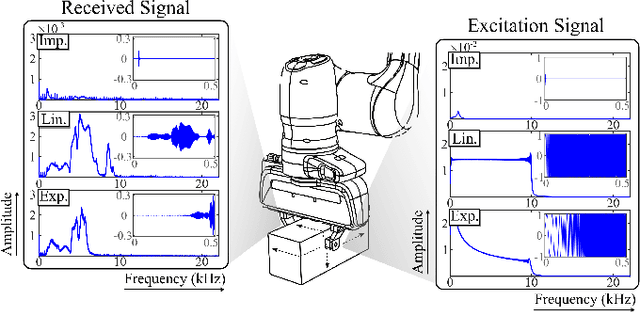
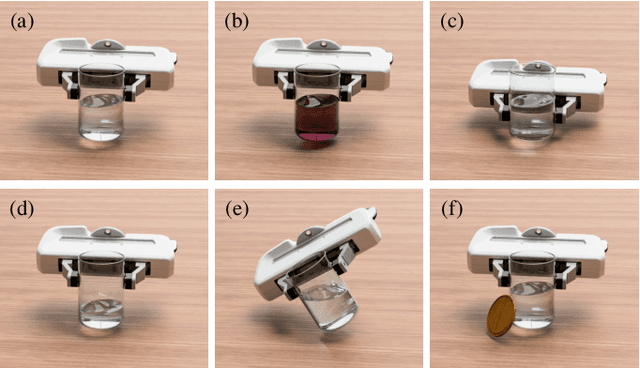
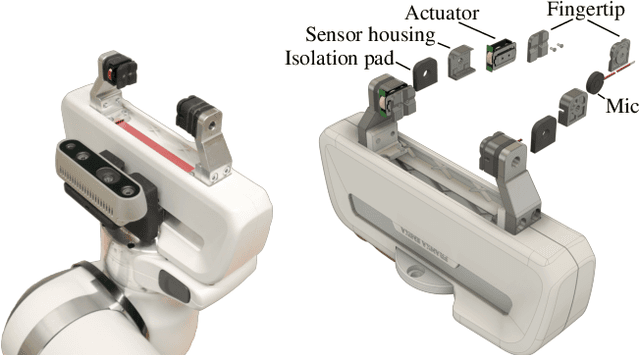
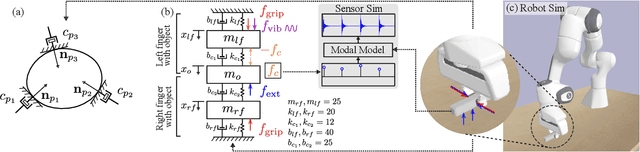
Perception in robot manipulation has been actively explored with the goal of advancing and integrating vision and touch for global and local feature extraction. However, it is difficult to perceive certain object internal states, and the integration of visual and haptic perception is not compact and is easily biased. We propose to address these limitations by developing an active acoustic sensing method for robot manipulation. Active acoustic sensing relies on the resonant properties of the object, which are related to its material, shape, internal structure, and contact interactions with the gripper and environment. The sensor consists of a vibration actuator paired with a piezo-electric microphone. The actuator generates a waveform, and the microphone tracks the waveform's propagation and distortion as it travels through the object. This paper presents the sensing principles, hardware design, simulation development, and evaluation of physical and simulated sensory data under different conditions as a proof-of-concept. This work aims to provide fundamentals on a useful tool for downstream robot manipulation tasks using active acoustic sensing, such as object recognition, grasping point estimation, object pose estimation, and external contact formation detection.