 Add to Chrome
 Add to Firefox
 Add to Edge
Tool-IQA: Augmenting Image Quality Assessment with Simple Tools
Jun 15, 2026
Vision-Language Models (VLMs) have been increasingly adopted for Image Quality Assessment (IQA). However, current methods typically employ a static one-shot scoring paradigm, despite the fact that humans assess image quality through dynamic visual inspection, e.g., selectively adjusting views to verify details and subtle artifacts. Specifically, relying solely on a single-pass observation introduces two primary limitations: first, perceiving the image only at a global scale restricts the assessment of finer local details; second, the original intensity distribution of the image may overwhelm the visibility, leading to insufficient inspection of image quality. To address these issues, we propose Tool-IQA, shifting the assessment mechanism from passive scoring to a tool-augmented workflow. In particular, we equip VLMs with simple yet effective view tools: a Magnifier to inspect local details, and a Gamma Corrector to uncover visibility and hidden artifacts. The assessment follows a structured pipeline that consists of an initial observation with rubric notes, a tool-augmented in-depth inspection, and a final quantification for calibrated quality score. Furthermore, to ensure efficient and purposeful tool callings, we introduce a batch-aware training strategy to reward tool interactions that can yield positive contributions rather than simply encouraging usage. Experiments on a variety of IQA benchmarks demonstrate that, with effective tool calling and calibrated assessment, our proposed Tool-IQA significantly outperforms existing state-of-the-art models, e.g., it achieves a PLCC of 0.854 on the challenging CLIVE dataset.

NTIRE 2026 The 3rd Restore Any Image Model (RAIM) Challenge: Professional Image Quality Assessment (Track 1)
Apr 14, 2026In this paper, we present an overview of the NTIRE 2026 challenge on the 3rd Restore Any Image Model in the Wild, specifically focusing on Track 1: Professional Image Quality Assessment. Conventional Image Quality Assessment (IQA) typically relies on scalar scores. By compressing complex visual characteristics into a single number, these methods fundamentally struggle to distinguish subtle differences among uniformly high-quality images. Furthermore, they fail to articulate why one image is superior, lacking the reasoning capabilities required to provide guidance for vision tasks. To bridge this gap, recent advancements in Multimodal Large Language Models (MLLMs) offer a promising paradigm. Inspired by this potential, our challenge establishes a novel benchmark exploring the ability of MLLMs to mimic human expert cognition in evaluating high-quality image pairs. Participants were tasked with overcoming critical bottlenecks in professional scenarios, centering on two primary objectives: (1) Comparative Quality Selection: reliably identifying the visually superior image within a high-quality pair; and (2) Interpretative Reasoning: generating grounded, expert-level explanations that detail the rationale behind the selection. In total, the challenge attracted nearly 200 registrations and over 2,500 submissions. The top-performing methods significantly advanced the state of the art in professional IQA. The challenge dataset is available at https://github.com/narthchin/RAIM-PIQA, and the official homepage is accessible at https://www.codabench.org/competitions/12789/.
UniSurgSAM: A Unified Promptable Model for Reliable Surgical Video Segmentation
Apr 04, 2026Surgical video segmentation is fundamental to computer-assisted surgery. In practice, surgeons need to dynamically specify targets throughout extended procedures, using heterogeneous cues such as visual selections, textual expressions, or audio instructions. However, existing Promptable Video Object Segmentation (PVOS) methods are typically restricted to a single prompt modality and rely on coupled frameworks that cause optimization interference between target initialization and tracking. Moreover, these methods produce hallucinated predictions when the target is absent and suffer from accumulated mask drift without failure recovery. To address these challenges, we present UniSurgSAM, a unified PVOS model enabling reliable surgical video segmentation through visual, textual, or audio prompts. Specifically, UniSurgSAM employs a decoupled two-stage framework that independently optimizes initialization and tracking to resolve the optimization interference. Within this framework, we introduce three key designs for reliability: presence-aware decoding that models target absence to suppress hallucinations; boundary-aware long-term tracking that prevents mask drift over extended sequences; and adaptive state transition that closes the loop between stages for failure recovery. Furthermore, we establish a multi-modal and multi-granular benchmark from four public surgical datasets with precise instance-level masklets. Extensive experiments demonstrate that UniSurgSAM achieves state-of-the-art performance in real time across all prompt modalities and granularities, providing a practical foundation for computer-assisted surgery. Code and datasets will be available at https://jinlab-imvr.github.io/UniSurgSAM.
Beyond Ground-Truth: Leveraging Image Quality Priors for Real-World Image Restoration
Mar 31, 2026Real-world image restoration aims to restore high-quality (HQ) images from degraded low-quality (LQ) inputs captured under uncontrolled conditions. Existing methods typically depend on ground-truth (GT) supervision, assuming that GT provides perfect reference quality. However, GT can still contain images with inconsistent perceptual fidelity, causing models to converge to the average quality level of the training data rather than achieving the highest perceptual quality attainable. To address these problems, we propose a novel framework, termed IQPIR, that introduces an Image Quality Prior (IQP)-extracted from pre-trained No-Reference Image Quality Assessment (NR-IQA) models-to guide the restoration process toward perceptually optimal outputs explicitly. Our approach synergistically integrates IQP with a learned codebook prior through three key mechanisms: (1) a quality-conditioned Transformer, where NR-IQA-derived scores serve as conditioning signals to steer the predicted representation toward maximal perceptual quality. This design provides a plug-and-play enhancement compatible with existing restoration architectures without structural modification; and (2) a dual-branch codebook structure, which disentangles common and HQ-specific features, ensuring a comprehensive representation of both generic structural information and quality-sensitive attributes; and (3) a discrete representation-based quality optimization strategy, which mitigates over-optimization effects commonly observed in continuous latent spaces. Extensive experiments on real-world image restoration demonstrate that our method not only surpasses cutting-edge methods but also serves as a generalizable quality-guided enhancement strategy for existing methods. The code is available.
QualiTeacher: Quality-Conditioned Pseudo-Labeling for Real-World Image Restoration
Mar 09, 2026Real-world image restoration (RWIR) is a highly challenging task due to the absence of clean ground-truth images. Many recent methods resort to pseudo-label (PL) supervision, often within a Mean-Teacher (MT) framework. However, these methods face a critical paradox: unconditionally trusting the often imperfect, low-quality PLs forces the student model to learn undesirable artifacts, while discarding them severely limits data diversity and impairs model generalization. In this paper, we propose QualiTeacher, a novel framework that transforms pseudo-label quality from a noisy liability into a conditional supervisory signal. Instead of filtering, QualiTeacher explicitly conditions the student model on the quality of the PLs, estimated by an ensemble of complementary non-reference image quality assessment (NR-IQA) models spanning low-level distortion and semantic-level assessment. This strategy teaches the student network to learn a quality-graded restoration manifold, enabling it to understand what constitutes different quality levels. Consequently, it can not only avoid mimicking artifacts from low-quality labels but also extrapolate to generate results of higher quality than the teacher itself. To ensure the robustness and accuracy of this quality-driven learning, we further enhance the process with a multi-augmentation scheme to diversify the PL quality spectrum, a score-based preference optimization strategy inspired by Direct Preference Optimization (DPO) to enforce a monotonically ordered quality separation, and a cropped consistency loss to prevent adversarial over-optimization (reward hacking) of the IQA models. Experiments on standard RWIR benchmarks demonstrate that QualiTeacher can serve as a plug-and-play strategy to improve the quality of the existing pseudo-labeling framework, establishing a new paradigm for learning from imperfect supervision. Code will be released.
SurGo-R1: Benchmarking and Modeling Contextual Reasoning for Operative Zone in Surgical Video
Feb 25, 2026Minimally invasive surgery has dramatically improved patient operative outcomes, yet identifying safe operative zones remains challenging in critical phases, requiring surgeons to integrate visual cues, procedural phase, and anatomical context under high cognitive load. Existing AI systems offer binary safety verification or static detection, ignoring the phase-dependent nature of intraoperative reasoning. We introduce ResGo, a benchmark of laparoscopic frames annotated with Go Zone bounding boxes and clinician-authored rationales covering phase, exposure quality reasoning, next action and risk reminder. We introduce evaluation metrics that treat correct grounding under incorrect phase as failures, revealing that most vision-language models cannot handle such tasks and perform poorly. We then present SurGo-R1, a model optimized via RLHF with a multi-turn phase-then-go architecture where the model first identifies the surgical phase, then generates reasoning and Go Zone coordinates conditioned on that context. On unseen procedures, SurGo-R1 achieves 76.6% phase accuracy, 32.7 mIoU, and 54.8% hardcore accuracy, a 6.6$\times$ improvement over the mainstream generalist VLMs. Code, model and benchmark will be available at https://github.com/jinlab-imvr/SurGo-R1
DR.Experts: Differential Refinement of Distortion-Aware Experts for Blind Image Quality Assessment
Feb 10, 2026Blind Image Quality Assessment, aiming to replicate human perception of visual quality without reference, plays a key role in vision tasks, yet existing models often fail to effectively capture subtle distortion cues, leading to a misalignment with human subjective judgments. We identify that the root cause of this limitation lies in the lack of reliable distortion priors, as methods typically learn shallow relationships between unified image features and quality scores, resulting in their insensitive nature to distortions and thus limiting their performance. To address this, we introduce DR.Experts, a novel prior-driven BIQA framework designed to explicitly incorporate distortion priors, enabling a reliable quality assessment. DR.Experts begins by leveraging a degradation-aware vision-language model to obtain distortion-specific priors, which are further refined and enhanced by the proposed Distortion-Saliency Differential Module through distinguishing them from semantic attentions, thereby ensuring the genuine representations of distortions. The refined priors, along with semantics and bridging representation, are then fused by a proposed mixture-of-experts style module named the Dynamic Distortion Weighting Module. This mechanism weights each distortion-specific feature as per its perceptual impact, ensuring that the final quality prediction aligns with human perception. Extensive experiments conducted on five challenging BIQA benchmarks demonstrate the superiority of DR.Experts over current methods and showcase its excellence in terms of generalization and data efficiency.
ReSurgSAM2: Referring Segment Anything in Surgical Video via Credible Long-term Tracking
May 13, 2025Surgical scene segmentation is critical in computer-assisted surgery and is vital for enhancing surgical quality and patient outcomes. Recently, referring surgical segmentation is emerging, given its advantage of providing surgeons with an interactive experience to segment the target object. However, existing methods are limited by low efficiency and short-term tracking, hindering their applicability in complex real-world surgical scenarios. In this paper, we introduce ReSurgSAM2, a two-stage surgical referring segmentation framework that leverages Segment Anything Model 2 to perform text-referred target detection, followed by tracking with reliable initial frame identification and diversity-driven long-term memory. For the detection stage, we propose a cross-modal spatial-temporal Mamba to generate precise detection and segmentation results. Based on these results, our credible initial frame selection strategy identifies the reliable frame for the subsequent tracking. Upon selecting the initial frame, our method transitions to the tracking stage, where it incorporates a diversity-driven memory mechanism that maintains a credible and diverse memory bank, ensuring consistent long-term tracking. Extensive experiments demonstrate that ReSurgSAM2 achieves substantial improvements in accuracy and efficiency compared to existing methods, operating in real-time at 61.2 FPS. Our code and datasets will be available at https://github.com/jinlab-imvr/ReSurgSAM2.
Gamma: Toward Generic Image Assessment with Mixture of Assessment Experts
Mar 09, 2025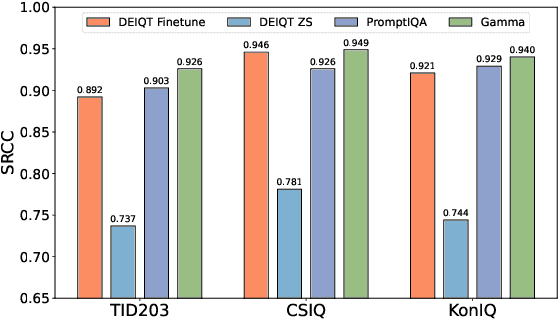
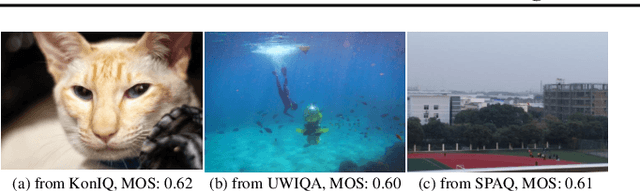
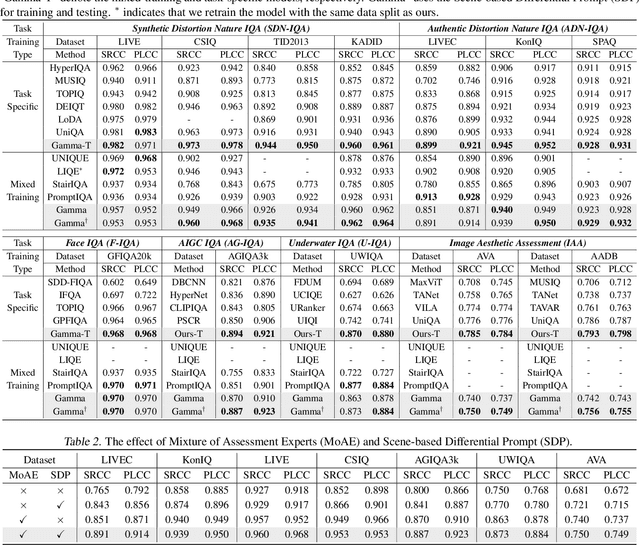
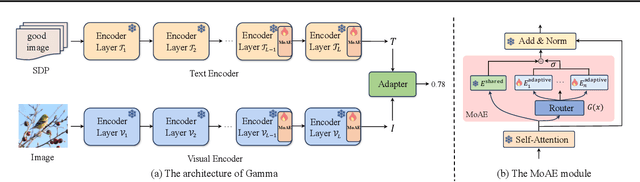
Image assessment aims to evaluate the quality and aesthetics of images and has been applied across various scenarios, such as natural and AIGC scenes. Existing methods mostly address these sub-tasks or scenes individually. While some works attempt to develop unified image assessment models, they have struggled to achieve satisfactory performance or cover a broad spectrum of assessment scenarios. In this paper, we present \textbf{Gamma}, a \textbf{G}eneric im\textbf{A}ge assess\textbf{M}ent model using \textbf{M}ixture of \textbf{A}ssessment Experts, which can effectively assess images from diverse scenes through mixed-dataset training. Achieving unified training in image assessment presents significant challenges due to annotation biases across different datasets. To address this issue, we first propose a Mixture of Assessment Experts (MoAE) module, which employs shared and adaptive experts to dynamically learn common and specific knowledge for different datasets, respectively. In addition, we introduce a Scene-based Differential Prompt (SDP) strategy, which uses scene-specific prompts to provide prior knowledge and guidance during the learning process, further boosting adaptation for various scenes. Our Gamma model is trained and evaluated on 12 datasets spanning 6 image assessment scenarios. Extensive experiments show that our unified Gamma outperforms other state-of-the-art mixed-training methods by significant margins while covering more scenes. Code: https://github.com/zht8506/Gamma.
UniQA: Unified Vision-Language Pre-training for Image Quality and Aesthetic Assessment
Jun 03, 2024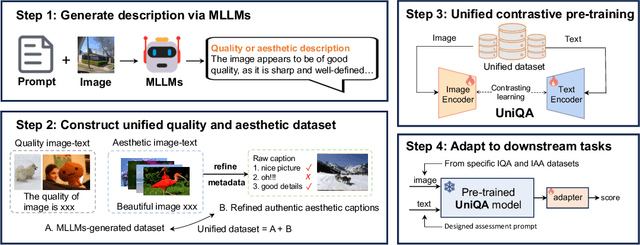
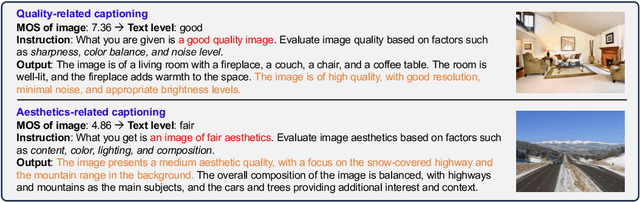
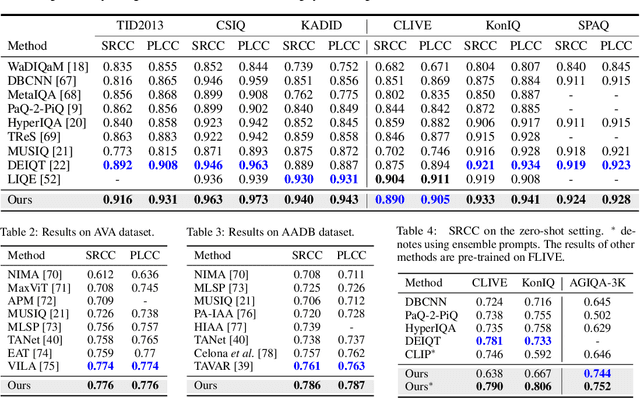
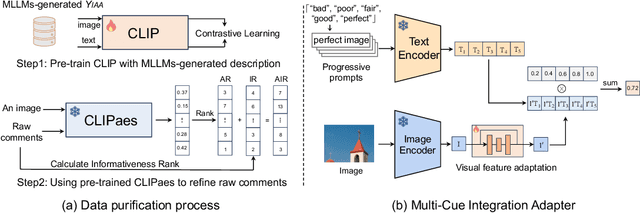
Image Quality Assessment (IQA) and Image Aesthetic Assessment (IAA) aim to simulate human subjective perception of image visual quality and aesthetic appeal. Existing methods typically address these tasks independently due to distinct learning objectives. However, they neglect the underlying interconnectedness of both tasks, which hinders the learning of task-agnostic shared representations for human subjective perception. To confront this challenge, we propose Unified vision-language pre-training of Quality and Aesthetics (UniQA), to learn general perceptions of two tasks, thereby benefiting them simultaneously. Addressing the absence of text in the IQA datasets and the presence of textual noise in the IAA datasets, (1) we utilize multimodal large language models (MLLMs) to generate high-quality text descriptions; (2) the generated text for IAA serves as metadata to purify noisy IAA data. To effectively adapt the pre-trained UniQA to downstream tasks, we further propose a lightweight adapter that utilizes versatile cues to fully exploit the extensive knowledge of the pre-trained model. Extensive experiments demonstrate that our approach attains a new state-of-the-art performance on both IQA and IAA tasks, while concurrently showcasing exceptional zero-shot and few-label image assessment capabilities. The source code will be available at https://github.com/zht8506/UniQA.