 Add to Chrome
 Add to Firefox
 Add to Edge
MoVerse: Real-Time Video World Modeling with Panoramic Gaussian Scaffold
Jun 11, 2026
We present MoVerse, a real-time video world model that creates an interactively navigable scene from a single narrow-field-of-view image. This setting is challenging because the input observes only a small fraction of the environment, while interactive roaming requires a complete surrounding world, persistent geometry, controllable camera motion, and temporally coherent high-fidelity observations. MoVerse addresses this problem by separating world construction from observation rendering. It first expands the input into a gravity-aligned 360$^\circ$ panorama with topology-aware diffusion, closing the missing field of view before 3D reasoning. It then lifts the panorama into a persistent 3D Gaussian scaffold using panoramic geometry-aware residual prediction, yielding a dense and directly renderable spatial memory. Finally, a Gaussian-conditioned video renderer translates scaffold renderings along user-specified camera trajectories into photorealistic video. To make this renderer practical for interaction, we train a bidirectional diffusion teacher for high-quality conditional rendering and distill it into a causal autoregressive student for bounded-latency streaming. This design combines the controllability and long-range consistency of explicit 3D representations with the perceptual quality of generative video models. MoVerse supports real-time scene roaming at 8~FPS on a single NVIDIA RTX~4090 GPU, demonstrating a practical path toward single-image world creation with interactive video output.

MoCam: Unified Novel View Synthesis via Structured Denoising Dynamics
May 13, 2026Generative novel view synthesis faces a fundamental dilemma: geometric priors provide spatial alignment but become sparse and inaccurate under view changes, while appearance priors offer visual fidelity but lack geometric correspondence. Existing methods either propagate geometric errors throughout generation or suffer from signal conflicts when fusing both statically. We introduce MoCam, which employs structured denoising dynamics to orchestrate a coordinated progression from geometry to appearance within the diffusion process. MoCam first leverages geometric priors in early stages to anchor coarse structures and tolerate their incompleteness, then switches to appearance priors in later stages to actively correct geometric errors and refine details. This design naturally unifies static and dynamic view synthesis by temporally decoupling geometric alignment and appearance refinement within the diffusion process. Experiments demonstrate that MoCam significantly outperforms prior methods, particularly when point clouds contain severe holes or distortions, achieving robust geometry-appearance disentanglement.
UniSurgSAM: A Unified Promptable Model for Reliable Surgical Video Segmentation
Apr 04, 2026Surgical video segmentation is fundamental to computer-assisted surgery. In practice, surgeons need to dynamically specify targets throughout extended procedures, using heterogeneous cues such as visual selections, textual expressions, or audio instructions. However, existing Promptable Video Object Segmentation (PVOS) methods are typically restricted to a single prompt modality and rely on coupled frameworks that cause optimization interference between target initialization and tracking. Moreover, these methods produce hallucinated predictions when the target is absent and suffer from accumulated mask drift without failure recovery. To address these challenges, we present UniSurgSAM, a unified PVOS model enabling reliable surgical video segmentation through visual, textual, or audio prompts. Specifically, UniSurgSAM employs a decoupled two-stage framework that independently optimizes initialization and tracking to resolve the optimization interference. Within this framework, we introduce three key designs for reliability: presence-aware decoding that models target absence to suppress hallucinations; boundary-aware long-term tracking that prevents mask drift over extended sequences; and adaptive state transition that closes the loop between stages for failure recovery. Furthermore, we establish a multi-modal and multi-granular benchmark from four public surgical datasets with precise instance-level masklets. Extensive experiments demonstrate that UniSurgSAM achieves state-of-the-art performance in real time across all prompt modalities and granularities, providing a practical foundation for computer-assisted surgery. Code and datasets will be available at https://jinlab-imvr.github.io/UniSurgSAM.
Gimbal360: Differentiable Auto-Leveling for Canonicalized $360^\circ$ Panoramic Image Completion
Mar 24, 2026Diffusion models excel at 2D outpainting, but extending them to $360^\circ$ panoramic completion from unposed perspective images is challenging due to the geometric and topological mismatch between perspective projections and spherical panoramas. We present Gimbal360, a principled framework that explicitly bridges perspective observations and spherical panoramas. We introduce a Canonical Viewing Space that regularizes projective geometry and provides a consistent intermediate representation between the two domains. To anchor in-the-wild inputs to this space, we propose a Differentiable Auto-Leveling module that stabilizes feature orientation without requiring camera parameters at inference. Panoramic generation also introduces a topological challenge. Standard generative architectures assume a bounded Euclidean image plane, while Equirectangular Projection (ERP) panoramas exhibit intrinsic $S^1$ periodicity. Euclidean operations therefore break boundary continuity. We address this mismatch by enforcing topological equivariance in the latent space to preserve seamless periodic structure. To support this formulation, we introduce Horizon360, a curated large-scale dataset of gravity-aligned panoramic environments. Extensive experiments show that explicitly standardizing geometric and topological priors enables Gimbal360 to achieve state-of-the-art performance in structurally consistent $360^\circ$ scene completion.
SurgFed: Language-guided Multi-Task Federated Learning for Surgical Video Understanding
Mar 10, 2026Surgical scene Multi-Task Federated Learning (MTFL) is essential for robot-assisted minimally invasive surgery (RAS) but remains underexplored in surgical video understanding due to two key challenges: (1) Tissue Diversity: Local models struggle to adapt to site-specific tissue features, limiting their effectiveness in heterogeneous clinical environments and leading to poor local predictions. (2) Task Diversity: Server-side aggregation, relying solely on gradient-based clustering, often produces suboptimal or incorrect parameter updates due to inter-site task heterogeneity, resulting in inaccurate localization. In light of these two issues, we propose SurgFed, a multi-task federated learning framework, enabling federated learning for surgical scene segmentation and depth estimation across diverse surgical types. SurgFed is powered by two appealing designs, i.e., Language-guided Channel Selection (LCS) and Language-guided Hyper Aggregation (LHA), to address the challenge of fully exploration on corss-site and cross-task. Technically, the LCS is first designed a lightweight personalized channel selection network that enhances site-specific adaptation using pre-defined text inputs, which optimally the local model learn the specific embeddings. We further introduce the LHA that employs a layer-wise cross-attention mechanism with pre-defined text inputs to model task interactions across sites and guide a hypernetwork for personalized parameter updates. Extensive empirical evidence shows that SurgFed yields improvements over the state-of-the-art methods in five public datasets across four surgical types. The code is available at https://anonymous.4open.science/r/SurgFed-070E/.
SurGo-R1: Benchmarking and Modeling Contextual Reasoning for Operative Zone in Surgical Video
Feb 25, 2026Minimally invasive surgery has dramatically improved patient operative outcomes, yet identifying safe operative zones remains challenging in critical phases, requiring surgeons to integrate visual cues, procedural phase, and anatomical context under high cognitive load. Existing AI systems offer binary safety verification or static detection, ignoring the phase-dependent nature of intraoperative reasoning. We introduce ResGo, a benchmark of laparoscopic frames annotated with Go Zone bounding boxes and clinician-authored rationales covering phase, exposure quality reasoning, next action and risk reminder. We introduce evaluation metrics that treat correct grounding under incorrect phase as failures, revealing that most vision-language models cannot handle such tasks and perform poorly. We then present SurGo-R1, a model optimized via RLHF with a multi-turn phase-then-go architecture where the model first identifies the surgical phase, then generates reasoning and Go Zone coordinates conditioned on that context. On unseen procedures, SurGo-R1 achieves 76.6% phase accuracy, 32.7 mIoU, and 54.8% hardcore accuracy, a 6.6$\times$ improvement over the mainstream generalist VLMs. Code, model and benchmark will be available at https://github.com/jinlab-imvr/SurGo-R1
A Review of Machine Learning for Cavitation Intensity Recognition in Complex Industrial Systems
Nov 19, 2025Cavitation intensity recognition (CIR) is a critical technology for detecting and evaluating cavitation phenomena in hydraulic machinery, with significant implications for operational safety, performance optimization, and maintenance cost reduction in complex industrial systems. Despite substantial research progress, a comprehensive review that systematically traces the development trajectory and provides explicit guidance for future research is still lacking. To bridge this gap, this paper presents a thorough review and analysis of hundreds of publications on intelligent CIR across various types of mechanical equipment from 2002 to 2025, summarizing its technological evolution and offering insights for future development. The early stages are dominated by traditional machine learning approaches that relied on manually engineered features under the guidance of domain expert knowledge. The advent of deep learning has driven the development of end-to-end models capable of automatically extracting features from multi-source signals, thereby significantly improving recognition performance and robustness. Recently, physical informed diagnostic models have been proposed to embed domain knowledge into deep learning models, which can enhance interpretability and cross-condition generalization. In the future, transfer learning, multi-modal fusion, lightweight network architectures, and the deployment of industrial agents are expected to propel CIR technology into a new stage, addressing challenges in multi-source data acquisition, standardized evaluation, and industrial implementation. The paper aims to systematically outline the evolution of CIR technology and highlight the emerging trend of integrating deep learning with physical knowledge. This provides a significant reference for researchers and practitioners in the field of intelligent cavitation diagnosis in complex industrial systems.
ReSurgSAM2: Referring Segment Anything in Surgical Video via Credible Long-term Tracking
May 13, 2025Surgical scene segmentation is critical in computer-assisted surgery and is vital for enhancing surgical quality and patient outcomes. Recently, referring surgical segmentation is emerging, given its advantage of providing surgeons with an interactive experience to segment the target object. However, existing methods are limited by low efficiency and short-term tracking, hindering their applicability in complex real-world surgical scenarios. In this paper, we introduce ReSurgSAM2, a two-stage surgical referring segmentation framework that leverages Segment Anything Model 2 to perform text-referred target detection, followed by tracking with reliable initial frame identification and diversity-driven long-term memory. For the detection stage, we propose a cross-modal spatial-temporal Mamba to generate precise detection and segmentation results. Based on these results, our credible initial frame selection strategy identifies the reliable frame for the subsequent tracking. Upon selecting the initial frame, our method transitions to the tracking stage, where it incorporates a diversity-driven memory mechanism that maintains a credible and diverse memory bank, ensuring consistent long-term tracking. Extensive experiments demonstrate that ReSurgSAM2 achieves substantial improvements in accuracy and efficiency compared to existing methods, operating in real-time at 61.2 FPS. Our code and datasets will be available at https://github.com/jinlab-imvr/ReSurgSAM2.
HC$^3$L-Diff: Hybrid conditional latent diffusion with high frequency enhancement for CBCT-to-CT synthesis
Nov 03, 2024Background: Cone-beam computed tomography (CBCT) plays a crucial role in image-guided radiotherapy, but artifacts and noise make them unsuitable for accurate dose calculation. Artificial intelligence methods have shown promise in enhancing CBCT quality to produce synthetic CT (sCT) images. However, existing methods either produce images of suboptimal quality or incur excessive time costs, failing to satisfy clinical practice standards. Methods and materials: We propose a novel hybrid conditional latent diffusion model for efficient and accurate CBCT-to-CT synthesis, named HC$^3$L-Diff. We employ the Unified Feature Encoder (UFE) to compress images into a low-dimensional latent space, thereby optimizing computational efficiency. Beyond the use of CBCT images, we propose integrating its high-frequency knowledge as a hybrid condition to guide the diffusion model in generating sCT images with preserved structural details. This high-frequency information is captured using our designed High-Frequency Extractor (HFE). During inference, we utilize denoising diffusion implicit model to facilitate rapid sampling. We construct a new in-house prostate dataset with paired CBCT and CT to validate the effectiveness of our method. Result: Extensive experimental results demonstrate that our approach outperforms state-of-the-art methods in terms of sCT quality and generation efficiency. Moreover, our medical physicist conducts the dosimetric evaluations to validate the benefit of our method in practical dose calculation, achieving a remarkable 93.8% gamma passing rate with a 2%/2mm criterion, superior to other methods. Conclusion: The proposed HC$^3$L-Diff can efficiently achieve high-quality CBCT-to-CT synthesis in only over 2 mins per patient. Its promising performance in dose calculation shows great potential for enhancing real-world adaptive radiotherapy.
Performance Analysis of Pair-wise Symbol Detection in Uplink NOMA-ISaC Systems
Aug 30, 2024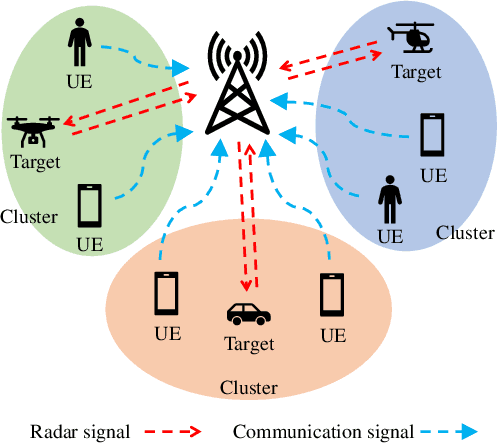

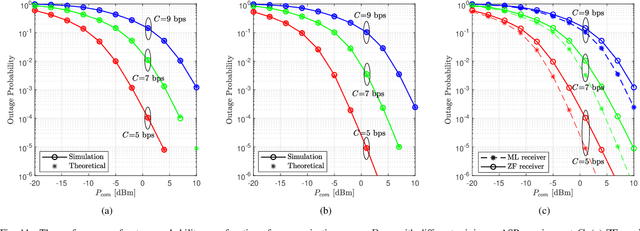
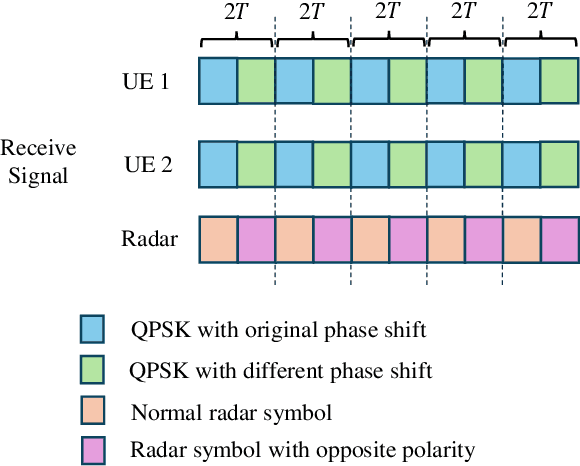
This paper investigates the bit error rate (BER) and outage probability performance of integrated sensing and communication (ISaC) in uplink non-orthogonal multiple access (NOMA) based Internet of Things (IoT) systems. Specifically, we consider an ISaC system where the radar signal is designed to be orthogonal to the communication signal over two symbol periods so that its interference on the communication signal is completely eliminated when detecting the data in pairs of consecutive symbols. This is akin to multi-symbol rate NOMA systems except in this case as the radar bears no data, its waveform is manipulated to be orthogonal to the transmitted communication signal. To eliminate potential decision ambiguity during the pair-wise data detection, a constant phase-offset between adjacent communication symbols is applied at the transmitter. The performance of such a system is analyzed through deriving analytical expressions for the exact BER of zero-forcing (ZF) based receivers. In addition, close-form expressions for the upper BER bound and the outage probability for both ZF and the joint maximum likelihood (JML) receivers are presented. The results show that the derived expressions are perfectly matched with the simulation results. The obtained expressions provide an insight into the performance of this novel ISaC system including demonstrating the impact of various parameters and showing how the ZF receiver provides a useful trade-off between performance and complexity relative to the JML receiver.