 Add to Chrome
 Add to Firefox
 Add to Edge
DR.Experts: Differential Refinement of Distortion-Aware Experts for Blind Image Quality Assessment
Feb 10, 2026
Blind Image Quality Assessment, aiming to replicate human perception of visual quality without reference, plays a key role in vision tasks, yet existing models often fail to effectively capture subtle distortion cues, leading to a misalignment with human subjective judgments. We identify that the root cause of this limitation lies in the lack of reliable distortion priors, as methods typically learn shallow relationships between unified image features and quality scores, resulting in their insensitive nature to distortions and thus limiting their performance. To address this, we introduce DR.Experts, a novel prior-driven BIQA framework designed to explicitly incorporate distortion priors, enabling a reliable quality assessment. DR.Experts begins by leveraging a degradation-aware vision-language model to obtain distortion-specific priors, which are further refined and enhanced by the proposed Distortion-Saliency Differential Module through distinguishing them from semantic attentions, thereby ensuring the genuine representations of distortions. The refined priors, along with semantics and bridging representation, are then fused by a proposed mixture-of-experts style module named the Dynamic Distortion Weighting Module. This mechanism weights each distortion-specific feature as per its perceptual impact, ensuring that the final quality prediction aligns with human perception. Extensive experiments conducted on five challenging BIQA benchmarks demonstrate the superiority of DR.Experts over current methods and showcase its excellence in terms of generalization and data efficiency.

Scale Contrastive Learning with Selective Attentions for Blind Image Quality Assessment
Nov 13, 2024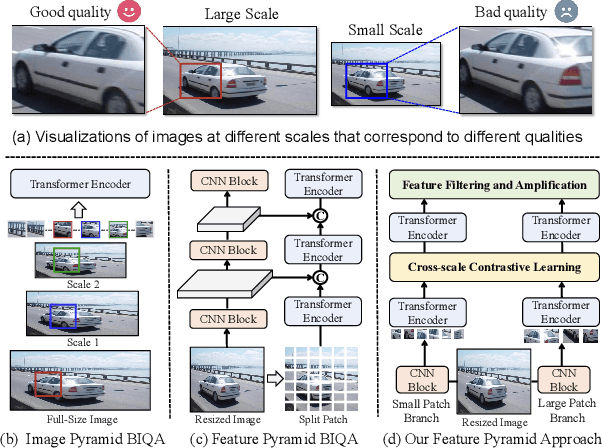
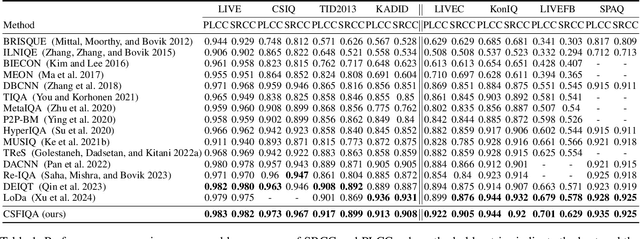
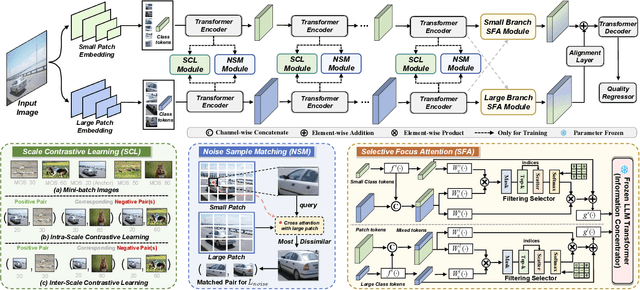
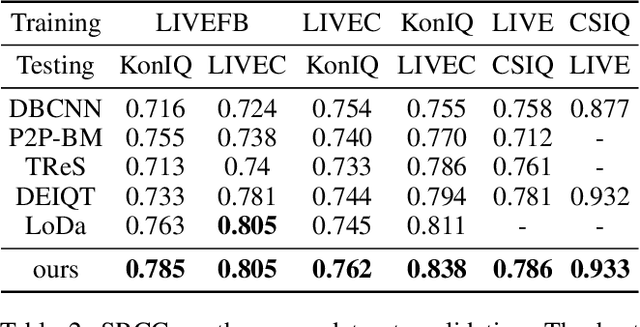
Blind image quality assessment (BIQA) serves as a fundamental task in computer vision, yet it often fails to consistently align with human subjective perception. Recent advances show that multi-scale evaluation strategies are promising due to their ability to replicate the hierarchical structure of human vision. However, the effectiveness of these strategies is limited by a lack of understanding of how different image scales influence perceived quality. This paper addresses two primary challenges: the significant redundancy of information across different scales, and the confusion caused by combining features from these scales, which may vary widely in quality. To this end, a new multi-scale BIQA framework is proposed, namely Contrast-Constrained Scale-Focused IQA Framework (CSFIQA). CSFIQA features a selective focus attention mechanism to minimize information redundancy and highlight critical quality-related information. Additionally, CSFIQA includes a scale-level contrastive learning module equipped with a noise sample matching mechanism to identify quality discrepancies across the same image content at different scales. By exploring the intrinsic relationship between image scales and the perceived quality, the proposed CSFIQA achieves leading performance on eight benchmark datasets, e.g., achieving SRCC values of 0.967 (versus 0.947 in CSIQ) and 0.905 (versus 0.876 in LIVEC).