 Add to Chrome
 Add to Firefox
 Add to Edge
SurfSurg6D: Geometry Consistent Dense Correspondence for Textureless Surgical Instrument Pose Estimation
May 25, 2026
Surgical instrument pose estimation provides crucial information for promising applications, including autonomous robotic surgery, skill assessment, and standardization of surgical workflow. However, this task remains highly challenging due to high precision requirements, frequent occlusions, textureless instruments, scarcity of depth information and very limited annotated data. These constraints often lead to unsatisfactory performance when employing general object pose estimation approaches to surgical scenarios. To address these issues, we first construct a new dataset SynSurg6D, to alleviate the data shortage in this task. We further propose SurfSurg6D, a dense-correspondence framework tailored for surgical instrument pose estimation. Experimental results on the SurgRIPE, EndoVis2018 and SurgPose datasets demonstrate that the introduction of our generated dataset SynSurg6D is able to diversify the pose distributions, thus enhancing the performance of existing approaches. Furthermore, SurfSurg6D outperforms existing methods, providing a robust solution for precise and efficient RGB-only pose estimation.

UniSurgSAM: A Unified Promptable Model for Reliable Surgical Video Segmentation
Apr 04, 2026Surgical video segmentation is fundamental to computer-assisted surgery. In practice, surgeons need to dynamically specify targets throughout extended procedures, using heterogeneous cues such as visual selections, textual expressions, or audio instructions. However, existing Promptable Video Object Segmentation (PVOS) methods are typically restricted to a single prompt modality and rely on coupled frameworks that cause optimization interference between target initialization and tracking. Moreover, these methods produce hallucinated predictions when the target is absent and suffer from accumulated mask drift without failure recovery. To address these challenges, we present UniSurgSAM, a unified PVOS model enabling reliable surgical video segmentation through visual, textual, or audio prompts. Specifically, UniSurgSAM employs a decoupled two-stage framework that independently optimizes initialization and tracking to resolve the optimization interference. Within this framework, we introduce three key designs for reliability: presence-aware decoding that models target absence to suppress hallucinations; boundary-aware long-term tracking that prevents mask drift over extended sequences; and adaptive state transition that closes the loop between stages for failure recovery. Furthermore, we establish a multi-modal and multi-granular benchmark from four public surgical datasets with precise instance-level masklets. Extensive experiments demonstrate that UniSurgSAM achieves state-of-the-art performance in real time across all prompt modalities and granularities, providing a practical foundation for computer-assisted surgery. Code and datasets will be available at https://jinlab-imvr.github.io/UniSurgSAM.
Instrument-Splatting++: Towards Controllable Surgical Instrument Digital Twin Using Gaussian Splatting
Mar 25, 2026High-quality and controllable digital twins of surgical instruments are critical for Real2Sim in robot-assisted surgery, as they enable realistic simulation, synthetic data generation, and perception learning under novel poses. We present Instrument-Splatting++, a monocular 3D Gaussian Splatting (3DGS) framework that reconstructs surgical instruments as a fully controllable Gaussian asset with high fidelity. Our pipeline starts with part-wise geometry pretraining that injects CAD priors into Gaussian primitives and equips the representation with part-aware semantic rendering. Built on the pretrained model, we propose a semantics-aware pose estimation and tracking (SAPET) method to recover per-frame 6-DoF pose and joint angles from unposed endoscopic videos, where a gripper-tip network trained purely from synthetic semantics provides robust supervision and a loose regularization suppresses singular articulations. Finally, we introduce Robust Texture Learning (RTL), which alternates pose refinement and robust appearance optimization, mitigating pose noise during texture learning. The proposed framework can perform pose estimation and learn realistic texture from unposed videos. We validate our method on sequences extracted from EndoVis17/18, SAR-RARP, and an in-house dataset, showing superior photometric quality and improved geometric accuracy over state-of-the-art baselines. We further demonstrate a downstream keypoint detection task where unseen-pose data augmentation from our controllable instrument Gaussian improves performance.
Surg$Σ$: A Spectrum of Large-Scale Multimodal Data and Foundation Models for Surgical Intelligence
Mar 17, 2026Surgical intelligence has the potential to improve the safety and consistency of surgical care, yet most existing surgical AI frameworks remain task-specific and struggle to generalize across procedures and institutions. Although multimodal foundation models, particularly multimodal large language models, have demonstrated strong cross-task capabilities across various medical domains, their advancement in surgery remains constrained by the lack of large-scale, systematically curated multimodal data. To address this challenge, we introduce Surg$Σ$, a spectrum of large-scale multimodal data and foundation models for surgical intelligence. At the core of this framework lies Surg$Σ$-DB, a large-scale multimodal data foundation designed to support diverse surgical tasks. Surg$Σ$-DB consolidates heterogeneous surgical data sources (including open-source datasets, curated in-house clinical collections and web-source data) into a unified schema, aiming to improve label consistency and data standardization across heterogeneous datasets. Surg$Σ$-DB spans 6 clinical specialties and diverse surgical types, providing rich image- and video-level annotations across 18 practical surgical tasks covering understanding, reasoning, planning, and generation, at an unprecedented scale (over 5.98M conversations). Beyond conventional multimodal conversations, Surg$Σ$-DB incorporates hierarchical reasoning annotations, providing richer semantic cues to support deeper contextual understanding in complex surgical scenarios. We further provide empirical evidence through recently developed surgical foundation models built upon Surg$Σ$-DB, illustrating the practical benefits of large-scale multimodal annotations, unified semantic design, and structured reasoning annotations for improving cross-task generalization and interpretability.
SurGo-R1: Benchmarking and Modeling Contextual Reasoning for Operative Zone in Surgical Video
Feb 25, 2026Minimally invasive surgery has dramatically improved patient operative outcomes, yet identifying safe operative zones remains challenging in critical phases, requiring surgeons to integrate visual cues, procedural phase, and anatomical context under high cognitive load. Existing AI systems offer binary safety verification or static detection, ignoring the phase-dependent nature of intraoperative reasoning. We introduce ResGo, a benchmark of laparoscopic frames annotated with Go Zone bounding boxes and clinician-authored rationales covering phase, exposure quality reasoning, next action and risk reminder. We introduce evaluation metrics that treat correct grounding under incorrect phase as failures, revealing that most vision-language models cannot handle such tasks and perform poorly. We then present SurGo-R1, a model optimized via RLHF with a multi-turn phase-then-go architecture where the model first identifies the surgical phase, then generates reasoning and Go Zone coordinates conditioned on that context. On unseen procedures, SurGo-R1 achieves 76.6% phase accuracy, 32.7 mIoU, and 54.8% hardcore accuracy, a 6.6$\times$ improvement over the mainstream generalist VLMs. Code, model and benchmark will be available at https://github.com/jinlab-imvr/SurGo-R1
SurgRAW: Multi-Agent Workflow with Chain-of-Thought Reasoning for Surgical Intelligence
Mar 13, 2025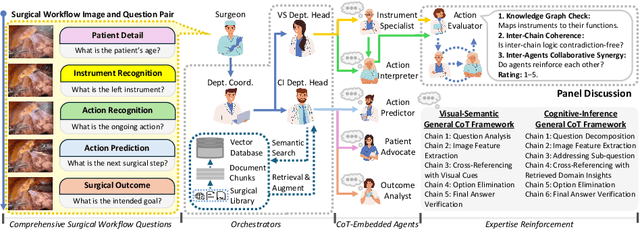
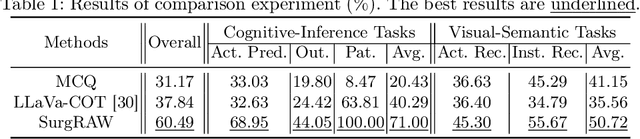
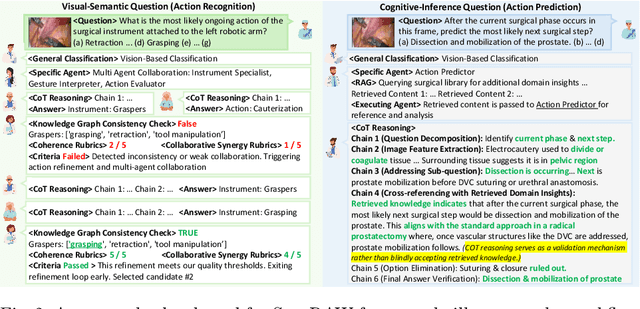
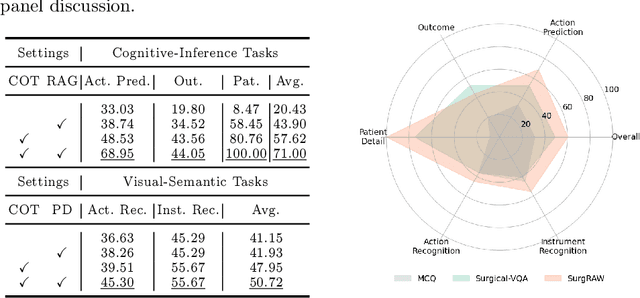
Integration of Vision-Language Models (VLMs) in surgical intelligence is hindered by hallucinations, domain knowledge gaps, and limited understanding of task interdependencies within surgical scenes, undermining clinical reliability. While recent VLMs demonstrate strong general reasoning and thinking capabilities, they still lack the domain expertise and task-awareness required for precise surgical scene interpretation. Although Chain-of-Thought (CoT) can structure reasoning more effectively, current approaches rely on self-generated CoT steps, which often exacerbate inherent domain gaps and hallucinations. To overcome this, we present SurgRAW, a CoT-driven multi-agent framework that delivers transparent, interpretable insights for most tasks in robotic-assisted surgery. By employing specialized CoT prompts across five tasks: instrument recognition, action recognition, action prediction, patient data extraction, and outcome assessment, SurgRAW mitigates hallucinations through structured, domain-aware reasoning. Retrieval-Augmented Generation (RAG) is also integrated to external medical knowledge to bridge domain gaps and improve response reliability. Most importantly, a hierarchical agentic system ensures that CoT-embedded VLM agents collaborate effectively while understanding task interdependencies, with a panel discussion mechanism promotes logical consistency. To evaluate our method, we introduce SurgCoTBench, the first reasoning-based dataset with structured frame-level annotations. With comprehensive experiments, we demonstrate the effectiveness of proposed SurgRAW with 29.32% accuracy improvement over baseline VLMs on 12 robotic procedures, achieving the state-of-the-art performance and advancing explainable, trustworthy, and autonomous surgical assistance.
UnPuzzle: A Unified Framework for Pathology Image Analysis
Mar 05, 2025Pathology image analysis plays a pivotal role in medical diagnosis, with deep learning techniques significantly advancing diagnostic accuracy and research. While numerous studies have been conducted to address specific pathological tasks, the lack of standardization in pre-processing methods and model/database architectures complicates fair comparisons across different approaches. This highlights the need for a unified pipeline and comprehensive benchmarks to enable consistent evaluation and accelerate research progress. In this paper, we present UnPuzzle, a novel and unified framework for pathological AI research that covers a broad range of pathology tasks with benchmark results. From high-level to low-level, upstream to downstream tasks, UnPuzzle offers a modular pipeline that encompasses data pre-processing, model composition,taskconfiguration,andexperimentconduction.Specifically, it facilitates efficient benchmarking for both Whole Slide Images (WSIs) and Region of Interest (ROI) tasks. Moreover, the framework supports variouslearningparadigms,includingself-supervisedlearning,multi-task learning,andmulti-modallearning,enablingcomprehensivedevelopment of pathology AI models. Through extensive benchmarking across multiple datasets, we demonstrate the effectiveness of UnPuzzle in streamlining pathology AI research and promoting reproducibility. We envision UnPuzzle as a cornerstone for future advancements in pathology AI, providing a more accessible, transparent, and standardized approach to model evaluation. The UnPuzzle repository is publicly available at https://github.com/Puzzle-AI/UnPuzzle.