 Add to Chrome
 Add to Firefox
 Add to Edge
EgoTactile: Learning Grasp Pressure for Everyday Objects from Egocentric Video
Jun 08, 2026
Estimating full-hand grasp pressure from egocentric video is critical for immersive VR and robotic manipulation, yet dense tactile sensing often relies on intrusive hardware. Existing vision-based methods predominantly rely on planar surfaces or fingertip contacts, failing to generalize to complex 3D object interactions. Therefore, we introduce EgoTactile, a benchmark pairing egocentric video with full-hand pressure supervision for diverse everyday objects, incorporating a bare-hand transfer subset to enable generalization to natural scenarios. Leveraging this benchmark, we first establish EgoPressureFormer as a discriminative baseline. Beyond this, to explicitly address the uncertainty in partial observations, we propose EgoPressureDiff, a conditional diffusion framework that adapts a large-scale pre-trained video diffusion backbone. By combining rich world knowledge priors with a Physically-Informed Feature Rectification layer to inject semantic constraints, our approach effectively infers plausible contact patterns and resolves visual-physical ambiguities. Extensive experiments demonstrate that our method achieves superior performance on the benchmark and robust transferability to in-the-wild scenarios. Our project page is available at https://egotactile.github.io/.

Master Micro Residual Correction with Adaptive Tactile Fusion and Force-Mixed Control for Contact-Rich Manipulation
Mar 16, 2026Robotic contact-rich and fine-grained manipulation remains a significant challenge due to complex interaction dynamics and the competing requirements of multi-timescale control. While current visual imitation learning methods excel at long-horizon planning, they often fail to perceive critical interaction cues like friction variations or incipient slip, and struggle to balance global task coherence with local reactive feedback. To address these challenges, we propose M2-ResiPolicy, a novel Master-Micro residual control architecture that synergizes high-level action guidance with low-level correction. The framework consists of a Master-Guidance Policy (MGP) operating at 10 Hz, which generates temporally consistent action chunks via a diffusion-based backbone and employs a tactile-intensity-driven adaptive fusion mechanism to dynamically modulate perceptual weights between vision and touch. Simultaneously, a high-frequency (60 Hz) Micro-Residual Corrector (MRC) utilizes a lightweight GRU to provide real-time action compensation based on TCP wrench feedback. This policy is further integrated with a force-mixed PBIC execution layer, effectively regulating contact forces to ensure interaction safety. Experiments across several demanding tasks including fragile object grasping and precision insertion, demonstrate that M2-ResiPolicy significantly outperforms standard Diffusion Policy (DP) and state-of-the-art Reactive Diffusion Policy (RDP), achieving a 93\% damage-free success rate in chip grasping and superior force regulation stability.
CEI: A Unified Interface for Cross-Embodiment Visuomotor Policy Learning in 3D Space
Jan 14, 2026Robotic foundation models trained on large-scale manipulation datasets have shown promise in learning generalist policies, but they often overfit to specific viewpoints, robot arms, and especially parallel-jaw grippers due to dataset biases. To address this limitation, we propose Cross-Embodiment Interface (\CEI), a framework for cross-embodiment learning that enables the transfer of demonstrations across different robot arm and end-effector morphologies. \CEI introduces the concept of \textit{functional similarity}, which is quantified using Directional Chamfer Distance. Then it aligns robot trajectories through gradient-based optimization, followed by synthesizing observations and actions for unseen robot arms and end-effectors. In experiments, \CEI transfers data and policies from a Franka Panda robot to \textbf{16} different embodiments across \textbf{3} tasks in simulation, and supports bidirectional transfer between a UR5+AG95 gripper robot and a UR5+Xhand robot across \textbf{6} real-world tasks, achieving an average transfer ratio of 82.4\%. Finally, we demonstrate that \CEI can also be extended with spatial generalization and multimodal motion generation capabilities using our proposed techniques. Project website: https://cross-embodiment-interface.github.io/
UMIGen: A Unified Framework for Egocentric Point Cloud Generation and Cross-Embodiment Robotic Imitation Learning
Nov 12, 2025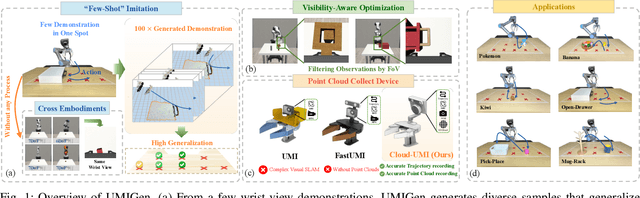
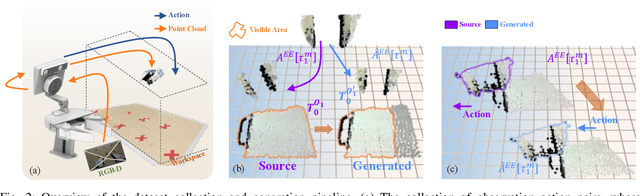
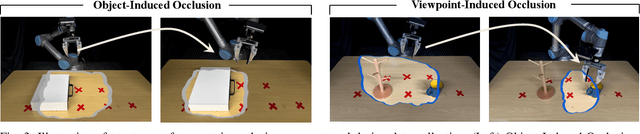

Data-driven robotic learning faces an obvious dilemma: robust policies demand large-scale, high-quality demonstration data, yet collecting such data remains a major challenge owing to high operational costs, dependence on specialized hardware, and the limited spatial generalization capability of current methods. The Universal Manipulation Interface (UMI) relaxes the strict hardware requirements for data collection, but it is restricted to capturing only RGB images of a scene and omits the 3D geometric information on which many tasks rely. Inspired by DemoGen, we propose UMIGen, a unified framework that consists of two key components: (1) Cloud-UMI, a handheld data collection device that requires no visual SLAM and simultaneously records point cloud observation-action pairs; and (2) a visibility-aware optimization mechanism that extends the DemoGen pipeline to egocentric 3D observations by generating only points within the camera's field of view. These two components enable efficient data generation that aligns with real egocentric observations and can be directly transferred across different robot embodiments without any post-processing. Experiments in both simulated and real-world settings demonstrate that UMIGen supports strong cross-embodiment generalization and accelerates data collection in diverse manipulation tasks.
Universal Visuo-Tactile Video Understanding for Embodied Interaction
May 28, 2025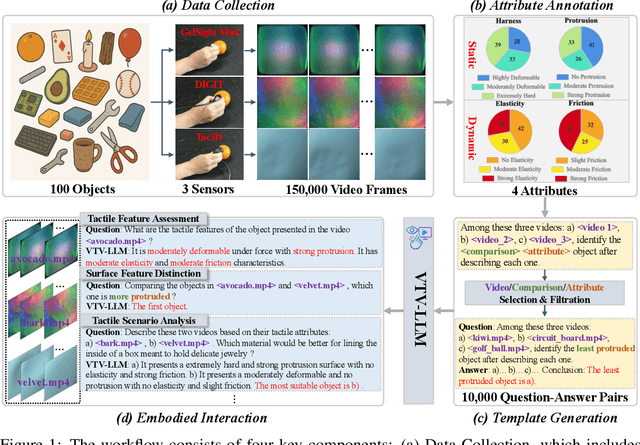
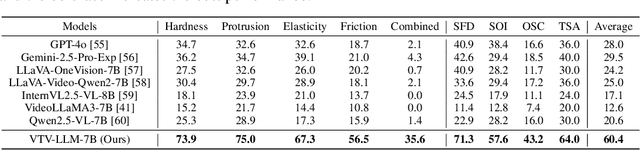
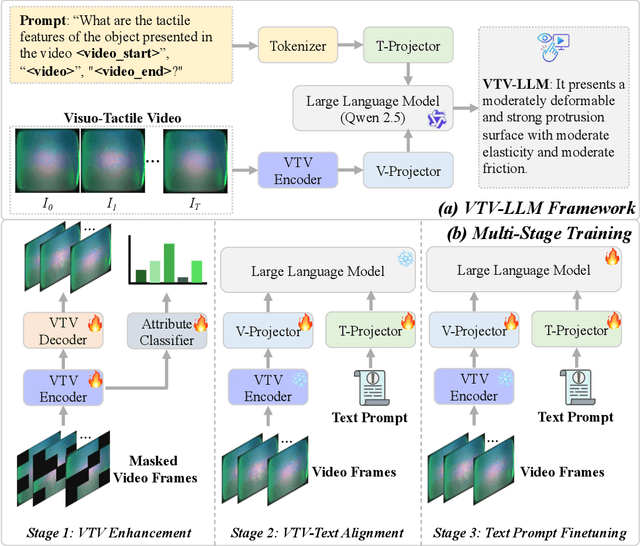

Tactile perception is essential for embodied agents to understand physical attributes of objects that cannot be determined through visual inspection alone. While existing approaches have made progress in visual and language modalities for physical understanding, they fail to effectively incorporate tactile information that provides crucial haptic feedback for real-world interaction. In this paper, we present VTV-LLM, the first multi-modal large language model for universal Visuo-Tactile Video (VTV) understanding that bridges the gap between tactile perception and natural language. To address the challenges of cross-sensor and cross-modal integration, we contribute VTV150K, a comprehensive dataset comprising 150,000 video frames from 100 diverse objects captured across three different tactile sensors (GelSight Mini, DIGIT, and Tac3D), annotated with four fundamental tactile attributes (hardness, protrusion, elasticity, and friction). We develop a novel three-stage training paradigm that includes VTV enhancement for robust visuo-tactile representation, VTV-text alignment for cross-modal correspondence, and text prompt finetuning for natural language generation. Our framework enables sophisticated tactile reasoning capabilities including feature assessment, comparative analysis, scenario-based decision making and so on. Experimental evaluations demonstrate that VTV-LLM achieves superior performance in tactile video understanding tasks, establishing a foundation for more intuitive human-machine interaction in tactile domains.