 Add to Chrome
 Add to Firefox
 Add to Edge
From Craft to Kernel: A Governance-First Execution Architecture and Semantic ISA for Agentic Computers
Apr 20, 2026
The transition of agentic AI from brittle prototypes to production systems is stalled by a pervasive crisis of craft. We suggest that the prevailing orchestration paradigm-delegating the system control loop to large language models and merely patching with heuristic guardrails-is the root cause of this fragility. Instead, we propose Arbiter-K, a Governance-First execution architecture that reconceptualizes the underlying model as a Probabilistic Processing Unit encapsulated by a deterministic, neuro-symbolic kernel. Arbiter-K implements a Semantic Instruction Set Architecture (ISA) to reify probabilistic messages into discrete instructions. This allows the kernel to maintain a Security Context Registry and construct an Instruction Dependency Graph at runtime, enabling active taint propagation based on the data-flow pedigree of each reasoning node. By leveraging this mechanism, Arbiter-K precisely interdicts unsafe trajectories at deterministic sinks (e.g., high-risk tool calls or unauthorized network egress) and enables autonomous execution correction and architectural rollback when security policies are triggered. Evaluations on OpenClaw and NanoBot demonstrate that Arbiter-K enforces security as a microarchitectural property, achieving 76% to 95% unsafe interception for a 92.79% absolute gain over native policies. The code is publicly available at https://github.com/cure-lab/ArbiterOS.

QUARK: Quantization-Enabled Circuit Sharing for Transformer Acceleration by Exploiting Common Patterns in Nonlinear Operations
Nov 10, 2025Transformer-based models have revolutionized computer vision (CV) and natural language processing (NLP) by achieving state-of-the-art performance across a range of benchmarks. However, nonlinear operations in models significantly contribute to inference latency, presenting unique challenges for efficient hardware acceleration. To this end, we propose QUARK, a quantization-enabled FPGA acceleration framework that leverages common patterns in nonlinear operations to enable efficient circuit sharing, thereby reducing hardware resource requirements. QUARK targets all nonlinear operations within Transformer-based models, achieving high-performance approximation through a novel circuit-sharing design tailored to accelerate these operations. Our evaluation demonstrates that QUARK significantly reduces the computational overhead of nonlinear operators in mainstream Transformer architectures, achieving up to a 1.96 times end-to-end speedup over GPU implementations. Moreover, QUARK lowers the hardware overhead of nonlinear modules by more than 50% compared to prior approaches, all while maintaining high model accuracy -- and even substantially boosting accuracy under ultra-low-bit quantization.
VBridge: Connecting the Dots Between Features, Explanations, and Data for Healthcare Models
Aug 04, 2021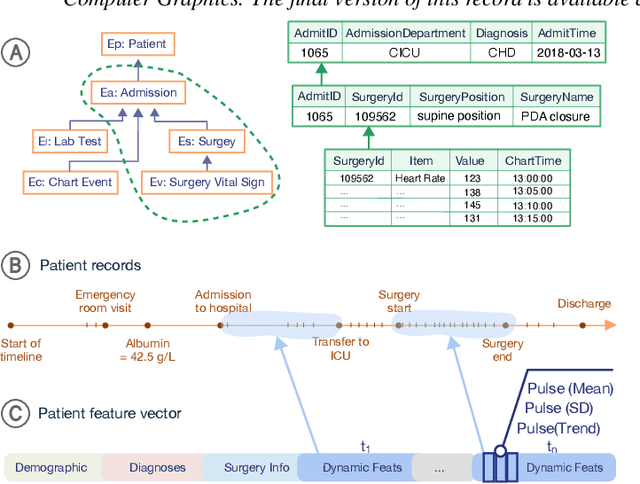
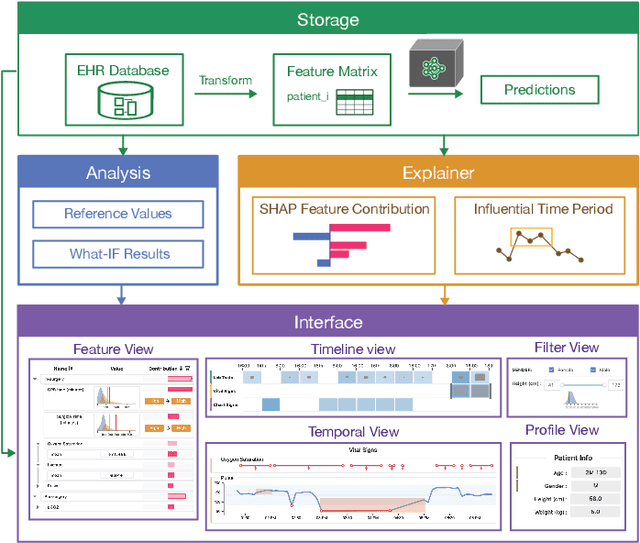
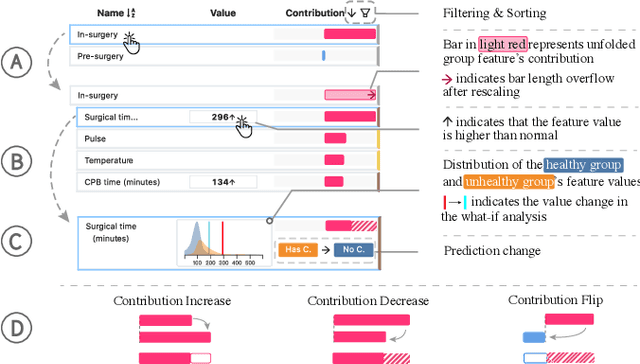
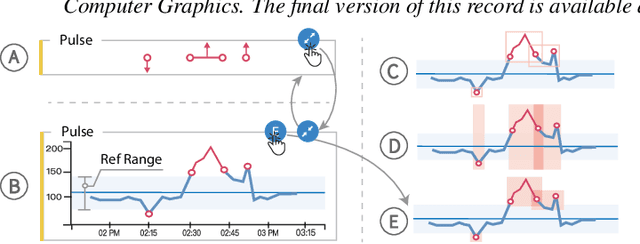
Machine learning (ML) is increasingly applied to Electronic Health Records (EHRs) to solve clinical prediction tasks. Although many ML models perform promisingly, issues with model transparency and interpretability limit their adoption in clinical practice. Directly using existing explainable ML techniques in clinical settings can be challenging. Through literature surveys and collaborations with six clinicians with an average of 17 years of clinical experience, we identified three key challenges, including clinicians' unfamiliarity with ML features, lack of contextual information, and the need for cohort-level evidence. Following an iterative design process, we further designed and developed VBridge, a visual analytics tool that seamlessly incorporates ML explanations into clinicians' decision-making workflow. The system includes a novel hierarchical display of contribution-based feature explanations and enriched interactions that connect the dots between ML features, explanations, and data. We demonstrated the effectiveness of VBridge through two case studies and expert interviews with four clinicians, showing that visually associating model explanations with patients' situational records can help clinicians better interpret and use model predictions when making clinician decisions. We further derived a list of design implications for developing future explainable ML tools to support clinical decision-making.