 Add to Chrome
 Add to Firefox
 Add to Edge
DeGS: A Scalable 3DGS Architecture via Decoupled Workload Parsing and Reorganization
Aug 03, 2026
3D Gaussian Splatting (3DGS) has emerged as a leading technique for real-time novel view synthesis, yet existing 3DGS accelerators suffer from poor architectural scalability: increasing the number of PEs leads to marginal performance improvement during rendering. We identify that the root cause is the tightly coupled ``checking-while-blending'' dataflow, which exacerbates PE underutilization caused by spatial redundancy from irregular Gaussian coverage and temporal redundancy from asynchronous pixel-wise termination under parallel execution. To address this issue, we propose DeGS, a scalable architecture for efficient 3DGS inference. To systematically eliminate the redundancies inherent in rendering, DeGS exploits a decoupled dataflow, restructuring the coupled $α$-checking, transmittance checking, and $α$-blending of the standard rendering process into consecutive workload parsing, reorganization, and blending stages. This allows the fragmented, length-variable, and temporal-dependent workloads to be reorganized into compact, conflict-free, and dense workloads prior to blending, thereby significantly improving PE utilization during parallel blending. Implemented in 28 nm technology, DeGS achieves 2.36$\times$--7.25$\times$ throughput, 1.82$\times$--6.02$\times$ end-to-end speedup, and 1.59$\times$--4.42$\times$ energy efficiency over state-of-the-art 3DGS accelerators (GSCore, GBU, GCC) across diverse scenes and resolutions (720p to 8K). Moreover, scaling from 16 to 1024 PEs, DeGS maintains over 80\% PE utilization at high resolutions, significantly outperforming existing accelerators.

$π$-StepNFT: Wider Space Needs Finer Steps in Online RL for Flow-based VLAs
Mar 02, 2026Flow-based vision-language-action (VLA) models excel in embodied control but suffer from intractable likelihoods during multi-step sampling, hindering online reinforcement learning. We propose \textbf{\textit{$\boldsymbolπ$-StepNFT}} (Step-wise Negative-aware Fine-Tuning), a critic-and-likelihood-free framework that requires only a single forward pass per optimization step and eliminates auxiliary value networks. We identify that wider exploration spaces necessitate finer-grained, step-wise guidance for alignment. Empirically, $π$-StepNFT unlocks latent potential on LIBERO with competitive few-shot robustness. Moreover, it achieves superior generalization on ManiSkill, outperforming value-based baselines in OOD scenarios by preventing overfitting to multimodal features. This property offers a scalable solution promising for complex real-world applications.
SpatialViz-Bench: Automatically Generated Spatial Visualization Reasoning Tasks for MLLMs
Jul 10, 2025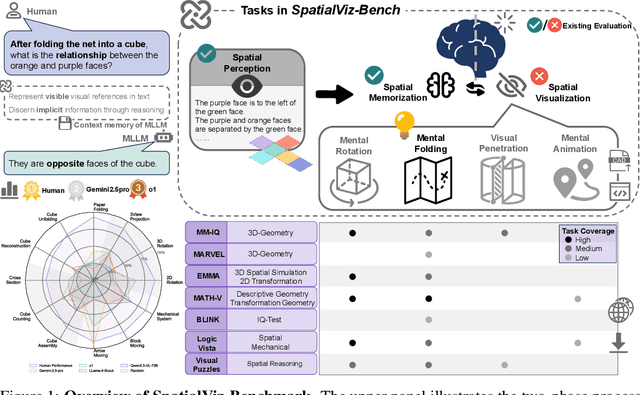
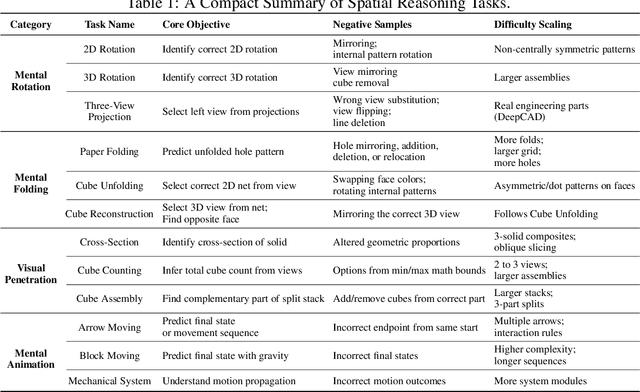
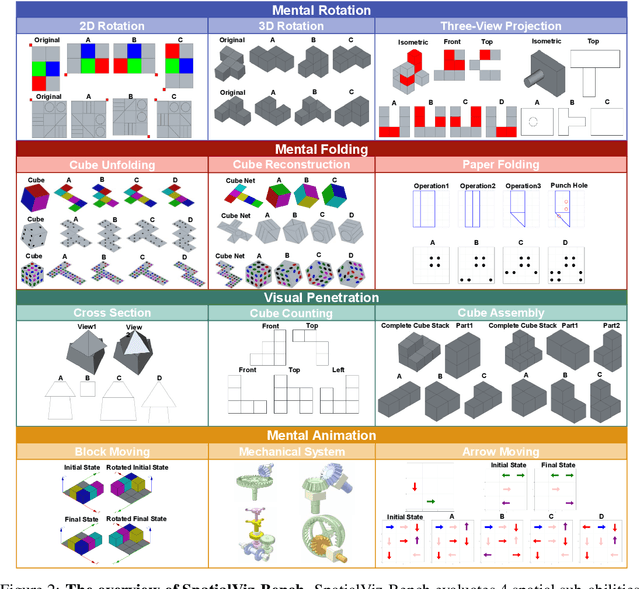
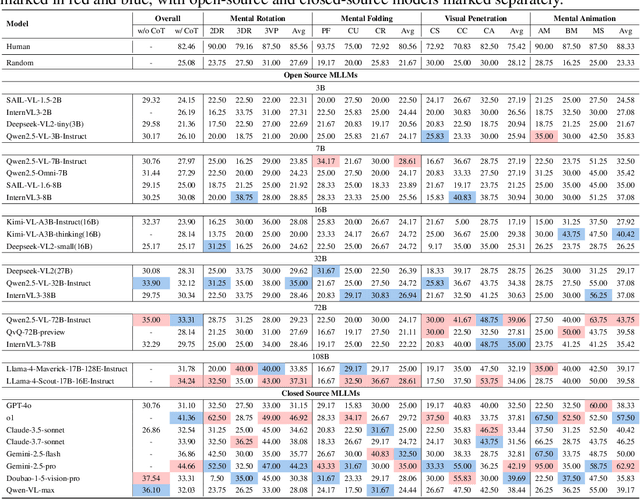
Humans can directly imagine and manipulate visual images in their minds, a capability known as spatial visualization. While multi-modal Large Language Models (MLLMs) support imagination-based reasoning, spatial visualization remains insufficiently evaluated, typically embedded within broader mathematical and logical assessments. Existing evaluations often rely on IQ tests or math competitions that may overlap with training data, compromising assessment reliability. To this end, we introduce SpatialViz-Bench, a comprehensive multi-modal benchmark for spatial visualization with 12 tasks across 4 sub-abilities, comprising 1,180 automatically generated problems. Our evaluation of 33 state-of-the-art MLLMs not only reveals wide performance variations and demonstrates the benchmark's strong discriminative power, but also uncovers counter-intuitive findings: models exhibit unexpected behaviors by showing difficulty perception that misaligns with human intuition, displaying dramatic 2D-to-3D performance cliffs, and defaulting to formula derivation despite spatial tasks requiring visualization alone. SpatialVizBench empirically demonstrates that state-of-the-art MLLMs continue to exhibit deficiencies in spatial visualization tasks, thereby addressing a significant lacuna in the field. The benchmark is publicly available.