 Add to Chrome
 Add to Firefox
 Add to Edge
TaPR: Test-Aware Policy Refinement for Feedback-Conditioned Code Generation
Aug 01, 2026
Multi-turn code agents rely on execution feedback to repair incorrect programs, yet standard reinforcement learning paradigms optimize and evaluate policy performance primarily using single-shot outcome rewards. This misalignment conflates initial code generation with feedback-driven refinement, discards granular execution signals across intermediate turns, and fails to evaluate whether the policy actually acquires self-repair capabilities. We propose Test-aware Policy Refinement (TaPR), a framework that transforms execution feedback into a dense per-turn test-pass-ratio reward under a consistent multi-turn interaction protocol. Across six models on 219 code-generation problems from LiveCodeBench, TaPR improves the pooled three-turn success rate (Pass@3) by 2.44 percentage points. In the predefined 7B/8B high-headroom slice, pooled accuracy increases from 30.25% to 33.56% (+3.31 pp), with 42 improvements and 13 regressions in paired trials. On a matched Qwen3-8B ablation, the dense reward supplies nonzero feedback in all of the first ten steps and reaches a higher Hard-subset peak than outcome-only GRPO within the tested budget, although GRPO nearly matches pooled Pass@3 by step 300. Our primary contribution is a reward-decomposition framework and a turn-aware evaluation protocol that decouple first-shot generation quality from multi-turn repair competence.

CURE: Local Uncertainty Repair for Block-Parallel Speculative Decoding
Aug 01, 2026Speculative decoding mitigates the latency of sequential generation in autoregressive Large Language Models (LLMs) by interleaving draft generation with target verification. However, existing parallel drafting backends often suffer from rapid accuracy degradation over long horizons, leading to high rejection rates during verification and suboptimal wall-clock speedups. We observe that drafting errors are not uniformly distributed but typically stem from localized high-uncertainty tokens that destabilize downstream generation trajectories. Motivated by this token error pattern, we propose CURE, a budget-aware dynamic repair tree designed to repair errors at uncertainty focal points without incurring prohibitive tree-verification overheads. Specifically, our method uses predictive confidence margins to dynamically locate candidate error tokens within a block-parallel draft, expands bounded repair paths only at these fragile nodes, and employs a novel repair resynchronization mechanism to realign draft states post-verification. Evaluations on code-generation benchmarks (HumanEval, MBPP, and LiveCodeBench-lite) and mathematical reasoning benchmark (GSM8K) demonstrate that CURE increases the average accepted length by 4.2-7.5% over parallel baselines without repair, translating to an end-to-end speedup of $2.66-3.49\times$ over target-only decoding. Furthermore, we provide a plug-and-play repair module compatible with standard parallel drafting frameworks. We also characterize the trade-off between draft compute and verification efficiency.
Seq-Masks: Bridging the gap between appearance and gait modeling for video-based person re-identification
Dec 10, 2021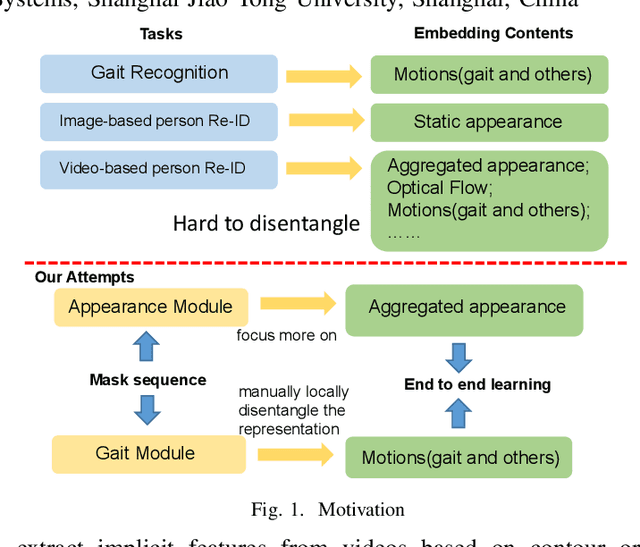
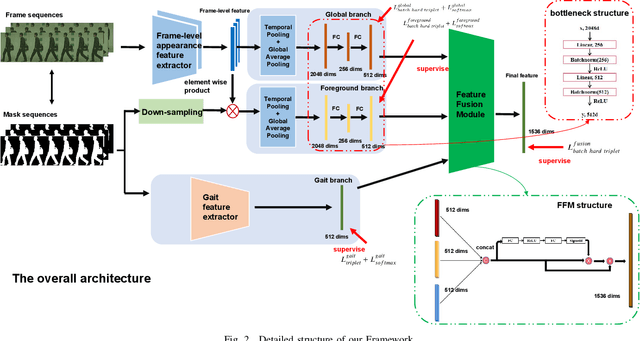
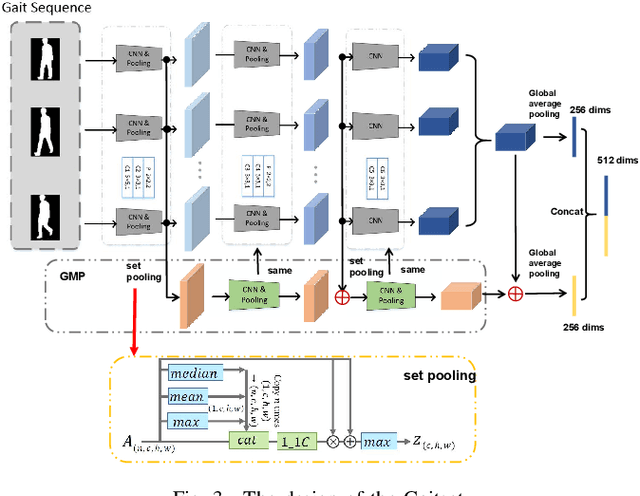
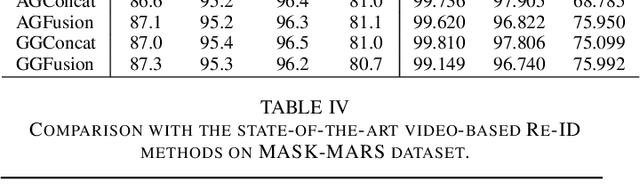
ideo-based person re-identification (Re-ID) aims to match person images in video sequences captured by disjoint surveillance cameras. Traditional video-based person Re-ID methods focus on exploring appearance information, thus, vulnerable against illumination changes, scene noises, camera parameters, and especially clothes/carrying variations. Gait recognition provides an implicit biometric solution to alleviate the above headache. Nonetheless, it experiences severe performance degeneration as camera view varies. In an attempt to address these problems, in this paper, we propose a framework that utilizes the sequence masks (SeqMasks) in the video to integrate appearance information and gait modeling in a close fashion. Specifically, to sufficiently validate the effectiveness of our method, we build a novel dataset named MaskMARS based on MARS. Comprehensive experiments on our proposed large wild video Re-ID dataset MaskMARS evidenced our extraordinary performance and generalization capability. Validations on the gait recognition metric CASIA-B dataset further demonstrated the capability of our hybrid model.
DVHN: A Deep Hashing Framework for Large-scale Vehicle Re-identification
Dec 09, 2021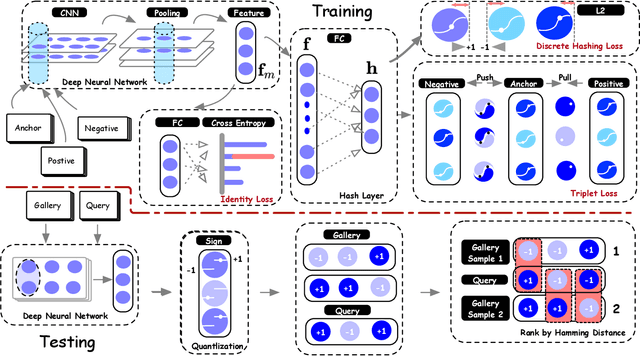
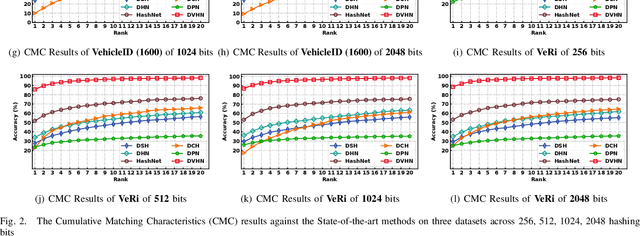
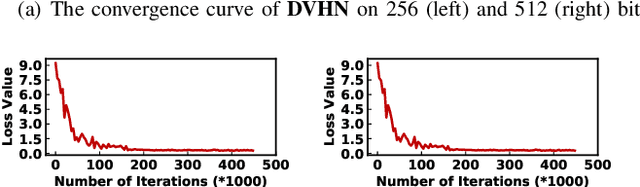
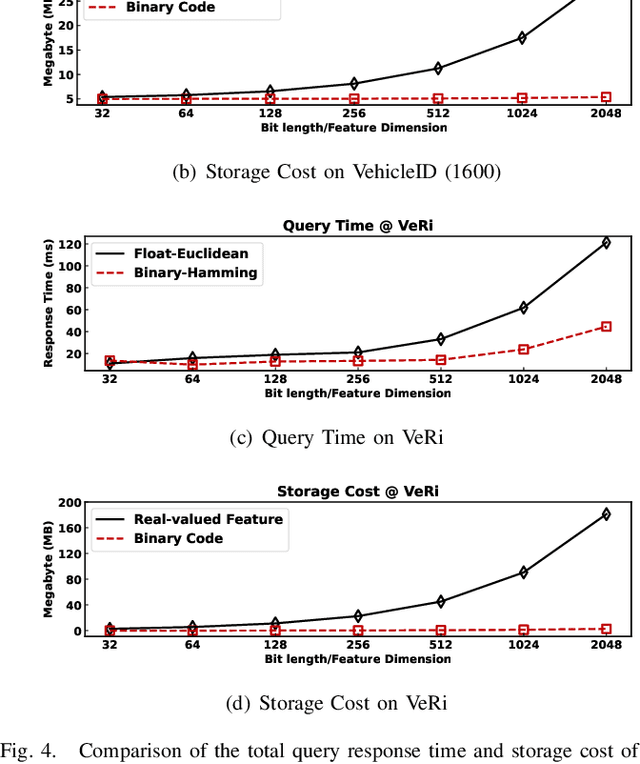
In this paper, we make the very first attempt to investigate the integration of deep hash learning with vehicle re-identification. We propose a deep hash-based vehicle re-identification framework, dubbed DVHN, which substantially reduces memory usage and promotes retrieval efficiency while reserving nearest neighbor search accuracy. Concretely,~DVHN directly learns discrete compact binary hash codes for each image by jointly optimizing the feature learning network and the hash code generating module. Specifically, we directly constrain the output from the convolutional neural network to be discrete binary codes and ensure the learned binary codes are optimal for classification. To optimize the deep discrete hashing framework, we further propose an alternating minimization method for learning binary similarity-preserved hashing codes. Extensive experiments on two widely-studied vehicle re-identification datasets- \textbf{VehicleID} and \textbf{VeRi}-~have demonstrated the superiority of our method against the state-of-the-art deep hash methods. \textbf{DVHN} of $2048$ bits can achieve 13.94\% and 10.21\% accuracy improvement in terms of \textbf{mAP} and \textbf{Rank@1} for \textbf{VehicleID (800)} dataset. For \textbf{VeRi}, we achieve 35.45\% and 32.72\% performance gains for \textbf{Rank@1} and \textbf{mAP}, respectively.
TransHash: Transformer-based Hamming Hashing for Efficient Image Retrieval
May 05, 2021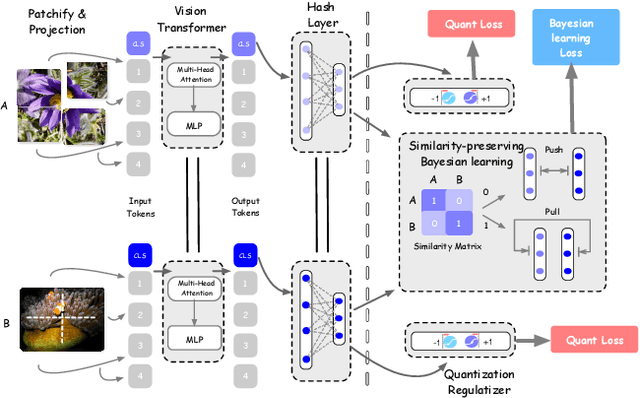
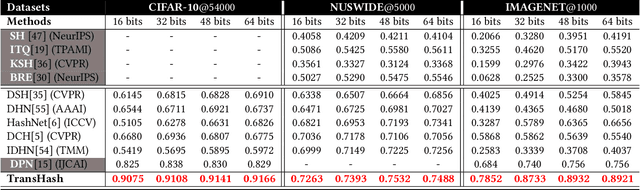
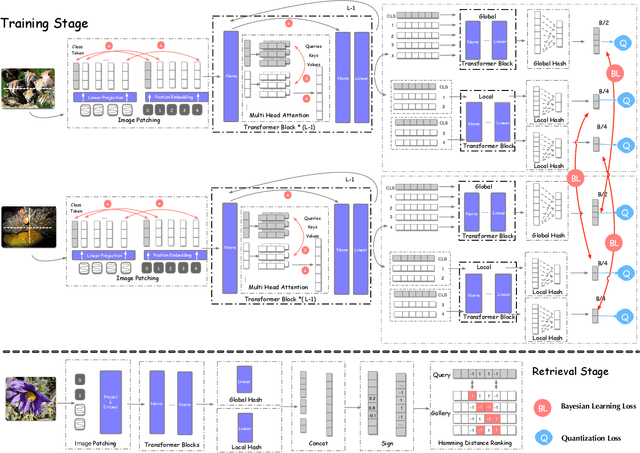

Deep hamming hashing has gained growing popularity in approximate nearest neighbour search for large-scale image retrieval. Until now, the deep hashing for the image retrieval community has been dominated by convolutional neural network architectures, e.g. \texttt{Resnet}\cite{he2016deep}. In this paper, inspired by the recent advancements of vision transformers, we present \textbf{Transhash}, a pure transformer-based framework for deep hashing learning. Concretely, our framework is composed of two major modules: (1) Based on \textit{Vision Transformer} (ViT), we design a siamese vision transformer backbone for image feature extraction. To learn fine-grained features, we innovate a dual-stream feature learning on top of the transformer to learn discriminative global and local features. (2) Besides, we adopt a Bayesian learning scheme with a dynamically constructed similarity matrix to learn compact binary hash codes. The entire framework is jointly trained in an end-to-end manner.~To the best of our knowledge, this is the first work to tackle deep hashing learning problems without convolutional neural networks (\textit{CNNs}). We perform comprehensive experiments on three widely-studied datasets: \textbf{CIFAR-10}, \textbf{NUSWIDE} and \textbf{IMAGENET}. The experiments have evidenced our superiority against the existing state-of-the-art deep hashing methods. Specifically, we achieve 8.2\%, 2.6\%, 12.7\% performance gains in terms of average \textit{mAP} for different hash bit lengths on three public datasets, respectively.