 Add to Chrome
 Add to Firefox
 Add to Edge
Are All Tokens Necessary for Visual Place Recognition? An Empirical Study of Token Reduction for Efficient Inference
Jul 17, 2026
Recent visual place recognition (VPR) methods based on vision transformers, particularly foundation models, have achieved remarkable recognition performance. However, these models process all visual tokens throughout the entire network, resulting in substantial computational overhead, which hinders their deployment in real-time and resource-constrained scenarios. A natural question thus arises: are all visual tokens necessary for VPR? To answer this question, we present the first systematic benchmark of token reduction for efficient visual place recognition. Our benchmark comprehensively evaluates representative token pruning, token merging, and hybrid pruning-merging methods across multiple state-of-the-art VPR models and diverse benchmark datasets covering urban, suburban, and natural environments. We further investigate token reduction from multiple perspectives, including recognition performance under different reduction configurations, computational complexity, inference speed, qualitative visualization, and deployment efficiency on edge devices. Through extensive experiments and in-depth analysis, our benchmark reveals multiple important characteristics of token reduction in VPR and provides several practical insights into the trade-offs between accuracy and inference efficiency. For example, token reduction can reduce computational cost by up to 29\% and improve throughput by up to 44\%, while incurring less than 1\% degradation in recognition accuracy. Overall, this work establishes a comprehensive foundation for future research on token-efficient VPR and efficient visual retrieval systems. Our codes and models will be available at https://github.com/Tong-Jin01/TokenReduction4VPR

SCGNN: Semantic Consistency enhanced Graph Neural Network Guided by Granular-ball Computing
May 05, 2026Capturing semantic consistency among nodes is crucial for effective graph representation learning. Existing approaches typically rely on $k$-nearest neighbors ($k$NN) or other node-level full search algorithms (FSA) to mine semantic relationships via exhaustive pairwise similarity computation, which suffer from high computational complexity and rigid neighbor selection, limiting scalability and introducing noisy connections. In this paper, we propose the Semantic Consistency enhanced Graph Neural Network (SCGNN), a novel plug-and-play framework that leverages granular-ball computing (GBC) to efficiently capture semantic consistency in a scalable manner. Unlike node-level FSA methods, SCGNN models group-level semantic structure by adaptively partitioning nodes into granular balls, significantly reducing computational cost while improving robustness to noise. To effectively utilize the discovered group-level semantic consistency, we design a dual enhancement strategy. Specifically, (1) a structure enhancement module constructs an anchor-based graph structure, where each anchor is a virtual node representing the group-level semantic carried by a granular ball, then injecting group-level semantic information into the graph structure; and (2) a supervision enhancement module performs label consistency checking (LCC) by combining GBC predictions with model-generated pseudo-labels, thereby producing more reliable supervision signals. SCGNN is compatible with various GNN backbones. During the forward propagation of SCGNN, the vanilla graph and the augment graph are jointly encoded, and their predictions are fused; during the backpropagation, the supervision enhancement module provides enhanced supervision signals to guide parameter updates.
Layer Embedding Deep Fusion Graph Neural Network
Apr 25, 2026Graph Neural Networks (GNNs) have demonstrated impressive performance in learning representations from graph-structured data. However, their message-passing mechanism inherently relies on the assumption of label consistency among connected nodes, limiting their applicability to low-homophily settings. Moreover, since message passing operates as a hierarchical diffusion process, GNNs face challenges in capturing long-range dependencies. As network depth increases, the structural noise along heterophilic edges tends to be amplified, resulting in over-smoothing. This issue becomes especially prominent in highly heterophilic graphs, where the propagation of inconsistent semantics across the topology continually exacerbates misaggregation. To address this issue, we propose a novel framework named Layer Embedding Deep Fusion Graph Neural Network (LEDF-GNN). Specifically, we design a Layer Embedding Deep Fusion (LEDF) operator that nonlinearly fuses multi-layer embeddings to capture inter-layer dependencies and effectively alleviate deep propagation degradation. Meanwhile, to mitigate structural heterophily, LEDF-GNN employs a Dual-Topology Parallel Strategy (DTPS) that simultaneously leverages the original and reconstructed topologies, allowing for adaptive structure-semantics co-optimization under diverse homophily conditions. Extensive semi-supervised classification experiments on the citation and image benchmarks demonstrate that, under both homophilic and heterophilic settings, LEDF-GNN consistently outperforms state-of-the-art baselines, validating its effectiveness and generalization capability across diverse graph types.
HyperOffload: Graph-Driven Hierarchical Memory Management for Large Language Models on SuperNode Architectures
Feb 03, 2026The rapid evolution of Large Language Models (LLMs) towards long-context reasoning and sparse architectures has pushed memory requirements far beyond the capacity of individual device HBM. While emerging supernode architectures offer terabyte-scale shared memory pools via high-bandwidth interconnects, existing software stacks fail to exploit this hardware effectively. Current runtime-based offloading and swapping techniques operate with a local view, leading to reactive scheduling and exposed communication latency that stall the computation pipeline. In this paper, we propose the SuperNode Memory Management Framework (\textbf{HyperOffload}). It employs a compiler-assisted approach that leverages graph-driven memory management to treat remote memory access as explicit operations in the computation graph, specifically designed for hierarchical SuperNode architectures. Unlike reactive runtime systems, SuperNode represents data movement using cache operators within the compiler's Intermediate Representation (IR). This design enables a global, compile-time analysis of tensor lifetimes and execution dependencies. Leveraging this visibility, we develop a global execution-order refinement algorithm that statically schedules data transfers to hide remote memory latency behind compute-intensive regions. We implement SuperNode within the production deep learning framework MindSpore, adding a remote memory backend and specialized compiler passes. Evaluation on representative LLM workloads shows that SuperNode reduces peak device memory usage by up to 26\% for inference while maintaining end-to-end performance. Our work demonstrates that integrating memory-augmented hardware into the compiler's optimization framework is essential for scaling next-generation AI workloads.
Matrix Completion Via Reweighted Logarithmic Norm Minimization
Dec 24, 2025Low-rank matrix completion (LRMC) has demonstrated remarkable success in a wide range of applications. To address the NP-hard nature of the rank minimization problem, the nuclear norm is commonly used as a convex and computationally tractable surrogate for the rank function. However, this approach often yields suboptimal solutions due to the excessive shrinkage of singular values. In this letter, we propose a novel reweighted logarithmic norm as a more effective nonconvex surrogate, which provides a closer approximation than many existing alternatives. We efficiently solve the resulting optimization problem by employing the alternating direction method of multipliers (ADMM). Experimental results on image inpainting demonstrate that the proposed method achieves superior performance compared to state-of-the-art LRMC approaches, both in terms of visual quality and quantitative metrics.
AutoMat: Enabling Automated Crystal Structure Reconstruction from Microscopy via Agentic Tool Use
May 19, 2025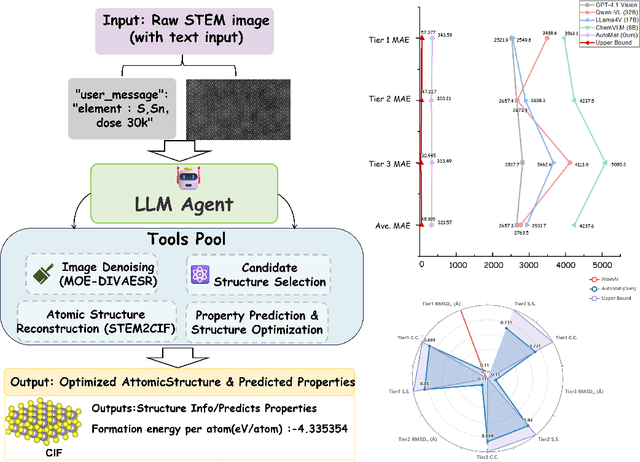
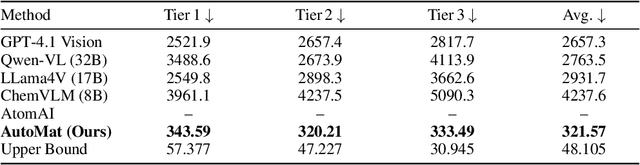
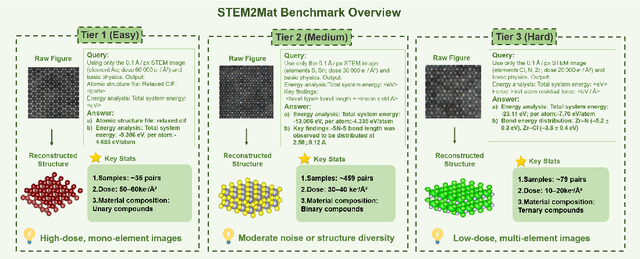
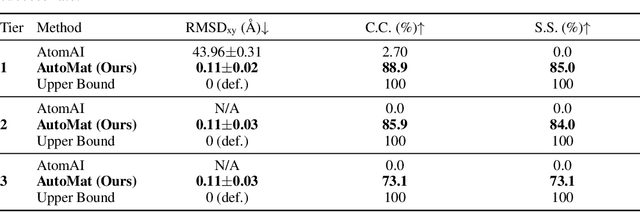
Machine learning-based interatomic potentials and force fields depend critically on accurate atomic structures, yet such data are scarce due to the limited availability of experimentally resolved crystals. Although atomic-resolution electron microscopy offers a potential source of structural data, converting these images into simulation-ready formats remains labor-intensive and error-prone, creating a bottleneck for model training and validation. We introduce AutoMat, an end-to-end, agent-assisted pipeline that automatically transforms scanning transmission electron microscopy (STEM) images into atomic crystal structures and predicts their physical properties. AutoMat combines pattern-adaptive denoising, physics-guided template retrieval, symmetry-aware atomic reconstruction, fast relaxation and property prediction via MatterSim, and coordinated orchestration across all stages. We propose the first dedicated STEM2Mat-Bench for this task and evaluate performance using lattice RMSD, formation energy MAE, and structure-matching success rate. By orchestrating external tool calls, AutoMat enables a text-only LLM to outperform vision-language models in this domain, achieving closed-loop reasoning throughout the pipeline. In large-scale experiments over 450 structure samples, AutoMat substantially outperforms existing multimodal large language models and tools. These results validate both AutoMat and STEM2Mat-Bench, marking a key step toward bridging microscopy and atomistic simulation in materials science.The code and dataset are publicly available at https://github.com/yyt-2378/AutoMat and https://huggingface.co/datasets/yaotianvector/STEM2Mat.
Source-free domain adaptation based on label reliability for cross-domain bearing fault diagnosis
Mar 11, 2025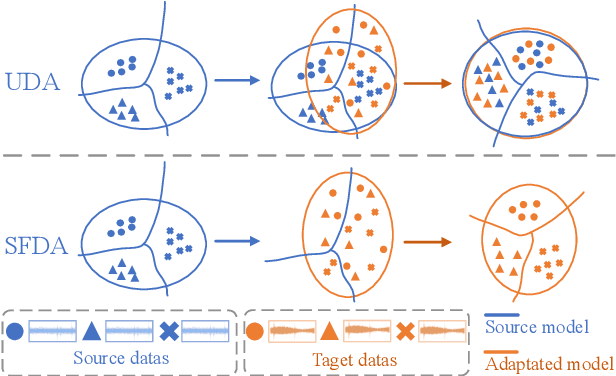
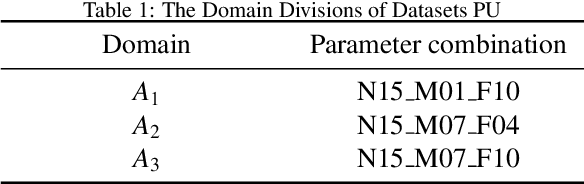
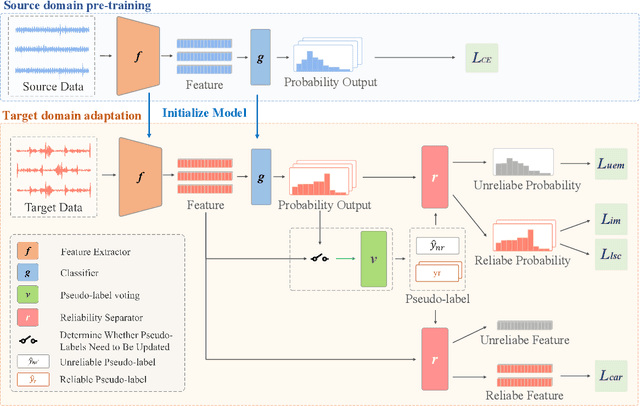
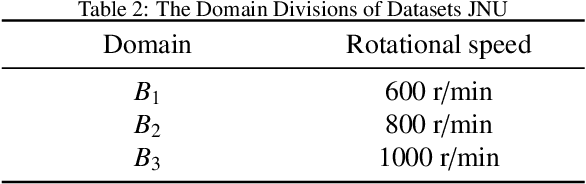
Source-free domain adaptation (SFDA) has been exploited for cross-domain bearing fault diagnosis without access to source data. Current methods select partial target samples with reliable pseudo-labels for model adaptation, which is sub-optimal due to the ignored target samples. We argue that every target sample can contribute to model adaptation, and accordingly propose in this paper a novel SFDA-based approach for bearing fault diagnosis that exploits both reliable and unreliable pseudo-labels. We develop a data-augmentation-based label voting strategy to divide the target samples into reliable and unreliable ones. We propose to explore the underlying relation between feature space and label space by using the reliable pseudo-labels as ground-truth labels, meanwhile, alleviating negative transfer by maximizing the entropy of the unreliable pseudo-labels. The proposed method achieves well-balance between discriminability and diversity by taking advantage of reliable and unreliable pseudo-labels. Extensive experiments are conducted on two bearing fault benchmarks, demonstrating that our approach achieves significant performance improvements against existing SFDA-based bearing fault diagnosis methods. Our code is available at https://github.com/BdLab405/SDALR.
Sequential three-way group decision-making for double hierarchy hesitant fuzzy linguistic term set
Jun 27, 2024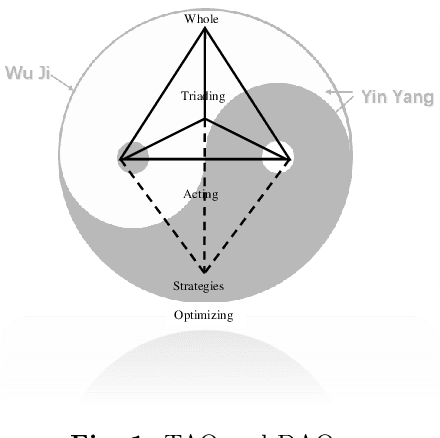


Group decision-making (GDM) characterized by complexity and uncertainty is an essential part of various life scenarios. Most existing researches lack tools to fuse information quickly and interpret decision results for partially formed decisions. This limitation is particularly noticeable when there is a need to improve the efficiency of GDM. To address this issue, a novel multi-level sequential three-way decision for group decision-making (S3W-GDM) method is constructed from the perspective of granular computing. This method simultaneously considers the vagueness, hesitation, and variation of GDM problems under double hierarchy hesitant fuzzy linguistic term sets (DHHFLTS) environment. First, for fusing information efficiently, a novel multi-level expert information fusion method is proposed, and the concepts of expert decision table and the extraction/aggregation of decision-leveled information based on the multi-level granularity are defined. Second, the neighborhood theory, outranking relation and regret theory (RT) are utilized to redesign the calculations of conditional probability and relative loss function. Then, the granular structure of DHHFLTS based on the sequential three-way decision (S3WD) is defined to improve the decision-making efficiency, and the decision-making strategy and interpretation of each decision-level are proposed. Furthermore, the algorithm of S3W-GDM is given. Finally, an illustrative example of diagnosis is presented, and the comparative and sensitivity analysis with other methods are performed to verify the efficiency and rationality of the proposed method.
Utilizing Autoregressive Networks for Full Lifecycle Data Generation of Rolling Bearings for RUL Prediction
Jan 02, 2024The prediction of rolling bearing lifespan is of significant importance in industrial production. However, the scarcity of high-quality, full lifecycle data has been a major constraint in achieving precise predictions. To address this challenge, this paper introduces the CVGAN model, a novel framework capable of generating one-dimensional vibration signals in both horizontal and vertical directions, conditioned on historical vibration data and remaining useful life. In addition, we propose an autoregressive generation method that can iteratively utilize previously generated vibration information to guide the generation of current signals. The effectiveness of the CVGAN model is validated through experiments conducted on the PHM 2012 dataset. Our findings demonstrate that the CVGAN model, in terms of both MMD and FID metrics, outperforms many advanced methods in both autoregressive and non-autoregressive generation modes. Notably, training using the full lifecycle data generated by the CVGAN model significantly improves the performance of the predictive model. This result highlights the effectiveness of the data generated by CVGans in enhancing the predictive power of these models.
Utilizing Multiple Inputs Autoregressive Models for Bearing Remaining Useful Life Prediction
Nov 26, 2023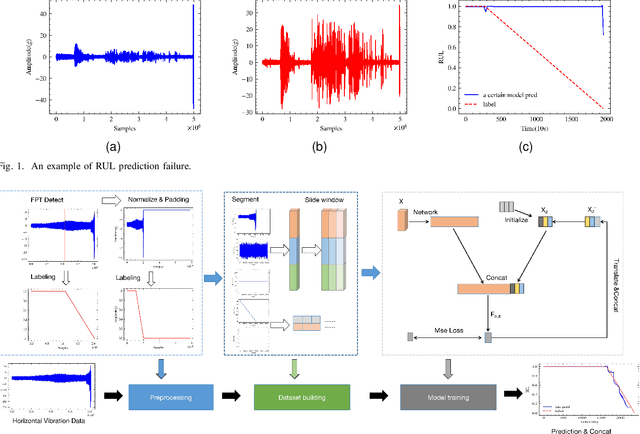
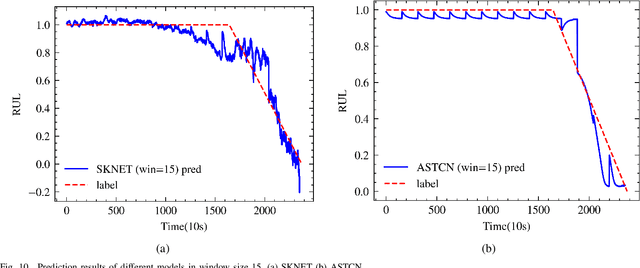
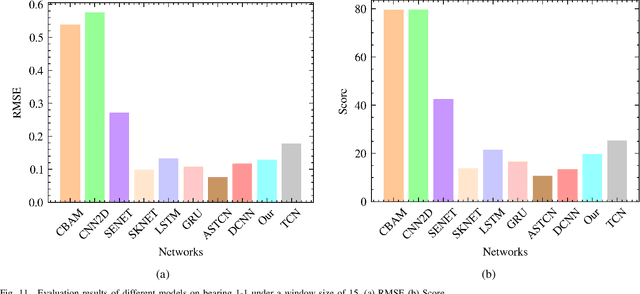
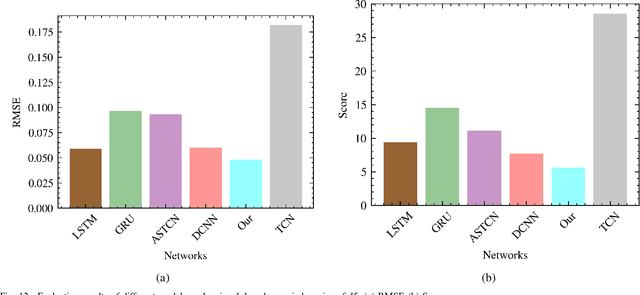
Accurate prediction of the Remaining Useful Life (RUL) of rolling bearings is crucial in industrial production, yet existing models often struggle with limited generalization capabilities due to their inability to fully process all vibration signal patterns. We introduce a novel multi-input autoregressive model to address this challenge in RUL prediction for bearings. Our approach uniquely integrates vibration signals with previously predicted Health Indicator (HI) values, employing feature fusion to output current window HI values. Through autoregressive iterations, the model attains a global receptive field, effectively overcoming the limitations in generalization. Furthermore, we innovatively incorporate a segmentation method and multiple training iterations to mitigate error accumulation in autoregressive models. Empirical evaluation on the PMH2012 dataset demonstrates that our model, compared to other backbone networks using similar autoregressive approaches, achieves significantly lower Root Mean Square Error (RMSE) and Score. Notably, it outperforms traditional autoregressive models that use label values as inputs and non-autoregressive networks, showing superior generalization abilities with a marked lead in RMSE and Score metrics.