 Add to Chrome
 Add to Firefox
 Add to Edge
A Gravity-informed Spatiotemporal Transformer for Human Activity Intensity Prediction
Jun 16, 2025
Human activity intensity prediction is a crucial to many location-based services. Although tremendous progress has been made to model dynamic spatiotemporal patterns of human activity, most existing methods, including spatiotemporal graph neural networks (ST-GNNs), overlook physical constraints of spatial interactions and the over-smoothing phenomenon in spatial correlation modeling. To address these limitations, this work proposes a physics-informed deep learning framework, namely Gravity-informed Spatiotemporal Transformer (Gravityformer) by refining transformer attention to integrate the universal law of gravitation and explicitly incorporating constraints from spatial interactions. Specifically, it (1) estimates two spatially explicit mass parameters based on inflow and outflow, (2) models the likelihood of cross-unit interaction using closed-form solutions of spatial interactions to constrain spatial modeling randomness, and (3) utilizes the learned spatial interaction to guide and mitigate the over-smoothing phenomenon in transformer attention matrices. The underlying law of human activity can be explicitly modeled by the proposed adaptive gravity model. Moreover, a parallel spatiotemporal graph convolution transformer structure is proposed for achieving a balance between coupled spatial and temporal learning. Systematic experiments on six real-world large-scale activity datasets demonstrate the quantitative and qualitative superiority of our approach over state-of-the-art benchmarks. Additionally, the learned gravity attention matrix can be disentangled and interpreted based on geographical laws. This work provides a novel insight into integrating physical laws with deep learning for spatiotemporal predictive learning.

EnerBridge-DPO: Energy-Guided Protein Inverse Folding with Markov Bridges and Direct Preference Optimization
Jun 11, 2025Designing protein sequences with optimal energetic stability is a key challenge in protein inverse folding, as current deep learning methods are primarily trained by maximizing sequence recovery rates, often neglecting the energy of the generated sequences. This work aims to overcome this limitation by developing a model that directly generates low-energy, stable protein sequences. We propose EnerBridge-DPO, a novel inverse folding framework focused on generating low-energy, high-stability protein sequences. Our core innovation lies in: First, integrating Markov Bridges with Direct Preference Optimization (DPO), where energy-based preferences are used to fine-tune the Markov Bridge model. The Markov Bridge initiates optimization from an information-rich prior sequence, providing DPO with a pool of structurally plausible sequence candidates. Second, an explicit energy constraint loss is introduced, which enhances the energy-driven nature of DPO based on prior sequences, enabling the model to effectively learn energy representations from a wealth of prior knowledge and directly predict sequence energy values, thereby capturing quantitative features of the energy landscape. Our evaluations demonstrate that EnerBridge-DPO can design protein complex sequences with lower energy while maintaining sequence recovery rates comparable to state-of-the-art models, and accurately predicts $\Delta \Delta G$ values between various sequences.
DEKC: Data-Enable Control for Tethered Space Robot Deployment in the Presence of Uncertainty via Koopman Operator Theory
Jun 10, 2025This work focuses the deployment of tethered space robot in the presence of unknown uncertainty. A data-enable framework called DEKC which contains offline training part and online execution part is proposed to deploy tethered space robot in the presence of uncertainty. The main idea of this work is modeling the unknown uncertainty as a dynamical system, which enables high accuracy and convergence of capturing uncertainty. The core part of proposed framework is a proxy model of uncertainty, which is derived from data-driven Koopman theory and is separated with controller design. In the offline stage, the lifting functions associated with Koopman operator are parameterized with deep neural networks. Then by solving an optimization problem, the lifting functions are learned from sampling data. In the online execution stage, the proxy model cooperates the learned lifting functions obtained in the offline phase to capture the unknown uncertainty. Then the output of proxy model is compensated to the baseline controller such that the effect of uncertainty can be attenuated or even eliminated. Furthermore, considering some scenarios in which the performance of proxy model may weaken, a receding-horizon scheme is proposed to update the proxy model online. Finally, the extensive numerical simulations demonstrate the effectiveness of our proposed framework. The implementation of proposed DEKC framework is publicly available at https://github.com/NPU-RCIR/DEKC.git.
A Constructed Response: Designing and Choreographing Robot Arm Movements in Collaborative Dance Improvisation
May 29, 2025Dancers often prototype movements themselves or with each other during improvisation and choreography. How are these interactions altered when physically manipulable technologies are introduced into the creative process? To understand how dancers design and improvise movements while working with instruments capable of non-humanoid movements, we engaged dancers in workshops to co-create movements with a robot arm in one-human-to-one-robot and three-human-to-one-robot settings. We found that dancers produced more fluid movements in one-to-one scenarios, experiencing a stronger sense of connection and presence with the robot as a co-dancer. In three-to-one scenarios, the dancers divided their attention between the human dancers and the robot, resulting in increased perceived use of space and more stop-and-go movements, perceiving the robot as part of the stage background. This work highlights how technologies can drive creativity in movement artists adapting to new ways of working with physical instruments, contributing design insights supporting artistic collaborations with non-humanoid agents.
PreGenie: An Agentic Framework for High-quality Visual Presentation Generation
May 27, 2025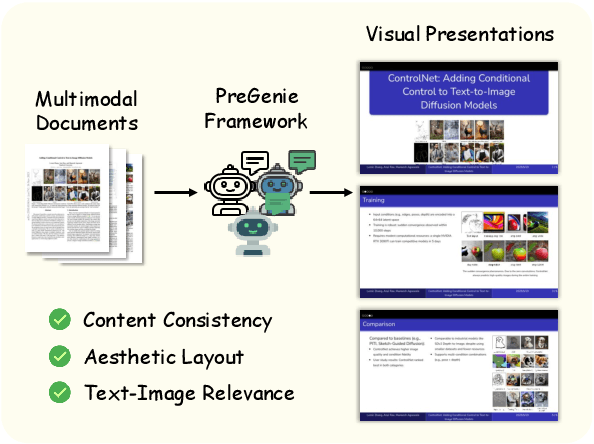
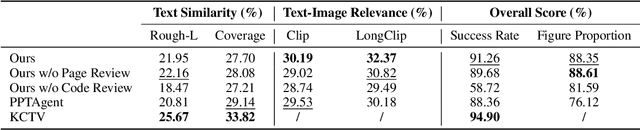
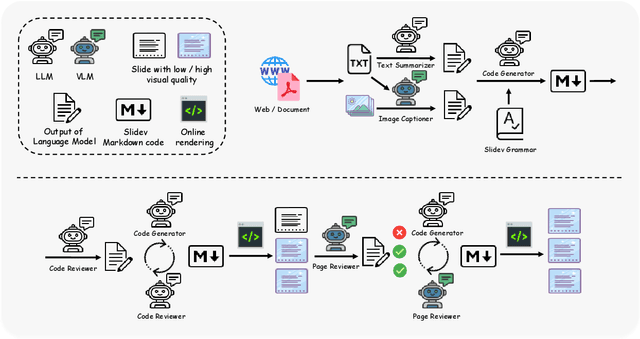
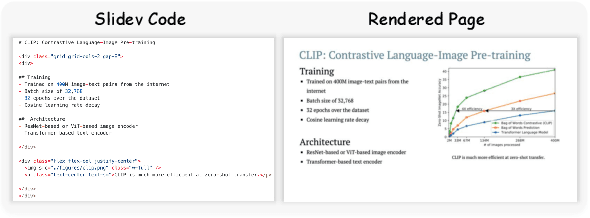
Visual presentations are vital for effective communication. Early attempts to automate their creation using deep learning often faced issues such as poorly organized layouts, inaccurate text summarization, and a lack of image understanding, leading to mismatched visuals and text. These limitations restrict their application in formal contexts like business and scientific research. To address these challenges, we propose PreGenie, an agentic and modular framework powered by multimodal large language models (MLLMs) for generating high-quality visual presentations. PreGenie is built on the Slidev presentation framework, where slides are rendered from Markdown code. It operates in two stages: (1) Analysis and Initial Generation, which summarizes multimodal input and generates initial code, and (2) Review and Re-generation, which iteratively reviews intermediate code and rendered slides to produce final, high-quality presentations. Each stage leverages multiple MLLMs that collaborate and share information. Comprehensive experiments demonstrate that PreGenie excels in multimodal understanding, outperforming existing models in both aesthetics and content consistency, while aligning more closely with human design preferences.
DeepMultiConnectome: Deep Multi-Task Prediction of Structural Connectomes Directly from Diffusion MRI Tractography
May 27, 2025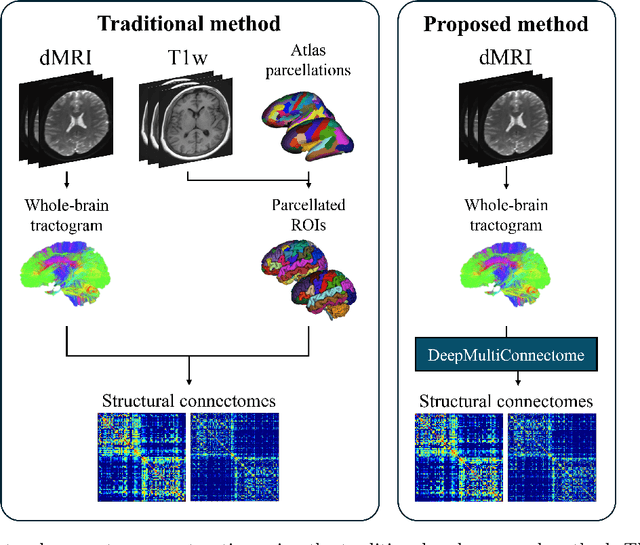
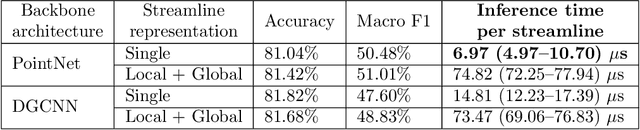
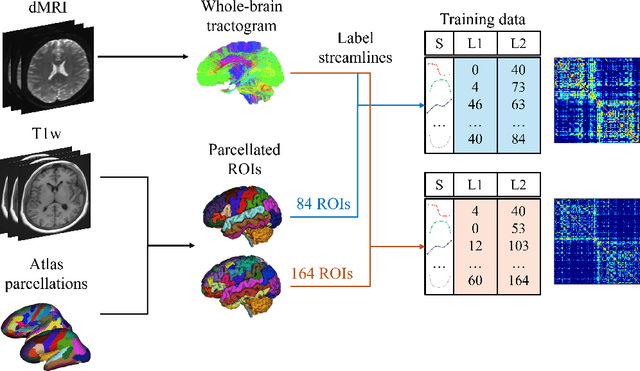

Diffusion MRI (dMRI) tractography enables in vivo mapping of brain structural connections, but traditional connectome generation is time-consuming and requires gray matter parcellation, posing challenges for large-scale studies. We introduce DeepMultiConnectome, a deep-learning model that predicts structural connectomes directly from tractography, bypassing the need for gray matter parcellation while supporting multiple parcellation schemes. Using a point-cloud-based neural network with multi-task learning, the model classifies streamlines according to their connected regions across two parcellation schemes, sharing a learned representation. We train and validate DeepMultiConnectome on tractography from the Human Connectome Project Young Adult dataset ($n = 1000$), labeled with an 84 and 164 region gray matter parcellation scheme. DeepMultiConnectome predicts multiple structural connectomes from a whole-brain tractogram containing 3 million streamlines in approximately 40 seconds. DeepMultiConnectome is evaluated by comparing predicted connectomes with traditional connectomes generated using the conventional method of labeling streamlines using a gray matter parcellation. The predicted connectomes are highly correlated with traditionally generated connectomes ($r = 0.992$ for an 84-region scheme; $r = 0.986$ for a 164-region scheme) and largely preserve network properties. A test-retest analysis of DeepMultiConnectome demonstrates reproducibility comparable to traditionally generated connectomes. The predicted connectomes perform similarly to traditionally generated connectomes in predicting age and cognitive function. Overall, DeepMultiConnectome provides a scalable, fast model for generating subject-specific connectomes across multiple parcellation schemes.
Instance Data Condensation for Image Super-Resolution
May 27, 2025
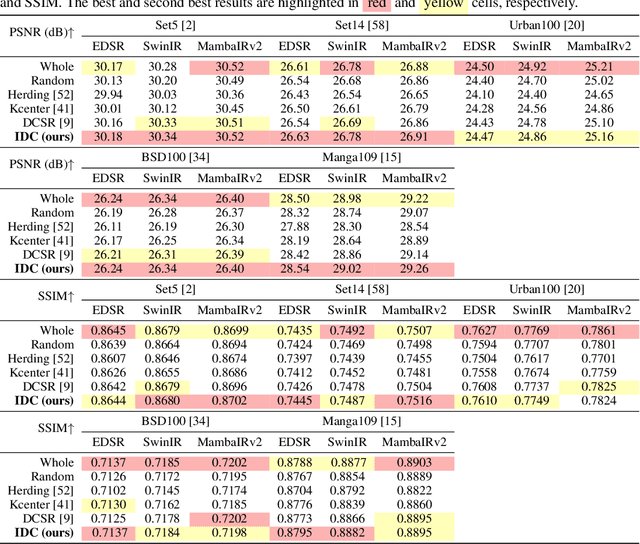
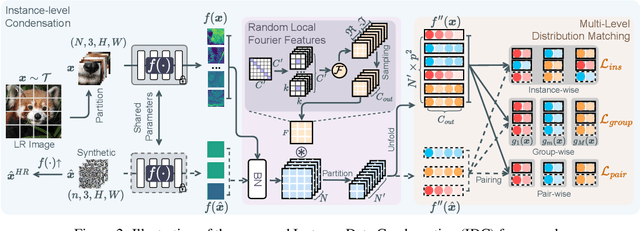
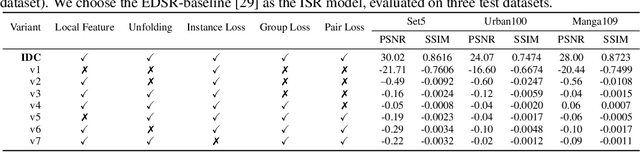
Deep learning based image Super-Resolution (ISR) relies on large training datasets to optimize model generalization; this requires substantial computational and storage resources during training. While dataset condensation has shown potential in improving data efficiency and privacy for high-level computer vision tasks, it has not yet been fully exploited for ISR. In this paper, we propose a novel Instance Data Condensation (IDC) framework specifically for ISR, which achieves instance-level data condensation through Random Local Fourier Feature Extraction and Multi-level Feature Distribution Matching. This aims to optimize feature distributions at both global and local levels and obtain high-quality synthesized training content with fine detail. This framework has been utilized to condense the most commonly used training dataset for ISR, DIV2K, with a 10% condensation rate. The resulting synthetic dataset offers comparable or (in certain cases) even better performance compared to the original full dataset and excellent training stability when used to train various popular ISR models. To the best of our knowledge, this is the first time that a condensed/synthetic dataset (with a 10% data volume) has demonstrated such performance. The source code and the synthetic dataset have been made available at https://github.com/.
One Model to Rank Them All: Unifying Online Advertising with End-to-End Learning
May 26, 2025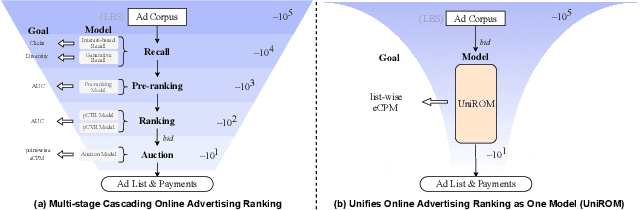
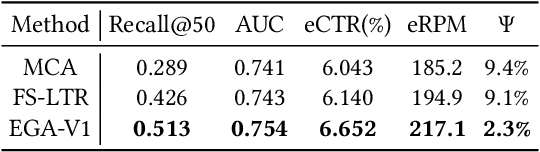
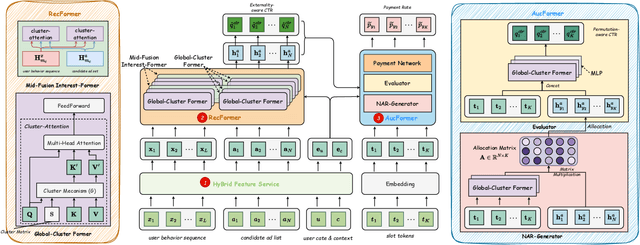
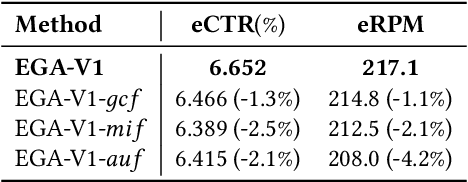
Modern industrial advertising systems commonly employ Multi-stage Cascading Architectures (MCA) to balance computational efficiency with ranking accuracy. However, this approach presents two fundamental challenges: (1) performance inconsistencies arising from divergent optimization targets and capability differences between stages, and (2) failure to account for advertisement externalities - the complex interactions between candidate ads during ranking. These limitations ultimately compromise system effectiveness and reduce platform profitability. In this paper, we present UniROM, an end-to-end generative architecture that Unifies online advertising Ranking as One Model. UniROM replaces cascaded stages with a single model to directly generate optimal ad sequences from the full candidate ad corpus in location-based services (LBS). The primary challenges associated with this approach stem from high costs of feature processing and computational bottlenecks in modeling externalities of large-scale candidate pools. To address these challenges, UniROM introduces an algorithm and engine co-designed hybrid feature service to decouple user and ad feature processing, reducing latency while preserving expressiveness. To efficiently extract intra- and cross-sequence mutual information, we propose RecFormer with an innovative cluster-attention mechanism as its core architectural component. Furthermore, we propose a bi-stage training strategy that integrates pre-training with reinforcement learning-based post-training to meet sophisticated platform and advertising objectives. Extensive offline evaluations on public benchmarks and large-scale online A/B testing on industrial advertising platform have demonstrated the superior performance of UniROM over state-of-the-art MCAs.
Advanced long-term earth system forecasting by learning the small-scale nature
May 26, 2025Reliable long-term forecast of Earth system dynamics is heavily hampered by instabilities in current AI models during extended autoregressive simulations. These failures often originate from inherent spectral bias, leading to inadequate representation of critical high-frequency, small-scale processes and subsequent uncontrolled error amplification. We present Triton, an AI framework designed to address this fundamental challenge. Inspired by increasing grids to explicitly resolve small scales in numerical models, Triton employs a hierarchical architecture processing information across multiple resolutions to mitigate spectral bias and explicitly model cross-scale dynamics. We demonstrate Triton's superior performance on challenging forecast tasks, achieving stable year-long global temperature forecasts, skillful Kuroshio eddy predictions till 120 days, and high-fidelity turbulence simulations preserving fine-scale structures all without external forcing, with significantly surpassing baseline AI models in long-term stability and accuracy. By effectively suppressing high-frequency error accumulation, Triton offers a promising pathway towards trustworthy AI-driven simulation for climate and earth system science.
Image-based Visibility Analysis Replacing Line-of-Sight Simulation: An Urban Landmark Perspective
May 17, 2025Visibility analysis is one of the fundamental analytics methods in urban planning and landscape research, traditionally conducted through computational simulations based on the Line-of-Sight (LoS) principle. However, when assessing the visibility of named urban objects such as landmarks, geometric intersection alone fails to capture the contextual and perceptual dimensions of visibility as experienced in the real world. The study challenges the traditional LoS-based approaches by introducing a new, image-based visibility analysis method. Specifically, a Vision Language Model (VLM) is applied to detect the target object within a direction-zoomed Street View Image (SVI). Successful detection represents the object's visibility at the corresponding SVI location. Further, a heterogeneous visibility graph is constructed to address the complex interaction between observers and target objects. In the first case study, the method proves its reliability in detecting the visibility of six tall landmark constructions in global cities, with an overall accuracy of 87%. Furthermore, it reveals broader contextual differences when the landmarks are perceived and experienced. In the second case, the proposed visibility graph uncovers the form and strength of connections for multiple landmarks along the River Thames in London, as well as the places where these connections occur. Notably, bridges on the River Thames account for approximately 30% of total connections. Our method complements and enhances traditional LoS-based visibility analysis, and showcases the possibility of revealing the prevalent connection of any visual objects in the urban environment. It opens up new research perspectives for urban planning, heritage conservation, and computational social science.