 Add to Chrome
 Add to Firefox
 Add to Edge
TimeMark: A Trustworthy Time Watermarking Framework for Exact Generation-Time Recovery from AIGC
Apr 14, 2026
The widespread use of Large Language Models (LLMs) in text generation has raised increasing concerns about intellectual property disputes. Watermarking techniques, which embed meta information into AI-generated content (AIGC), have the potential to serve as judicial evidence. However, existing methods rely on statistical signals in token distributions, leading to inherently probabilistic detection and reduced reliability, especially in multi-bit encoding (e.g., timestamps). Moreover, such methods introduce detectable statistical patterns, making them vulnerable to forgery attacks and enabling model providers to fabricate arbitrary watermarks. To address these issues, we propose the concept of trustworthy watermark, which achieves reliable recovery with 100% identification accuracy while resisting both user-side statistical attacks and provider-side forgery. We focus on trustworthy time watermarking for use as judicial evidence. Our framework integrates cryptographic techniques and encodes time information into time-dependent secret keys under regulatory supervision, preventing arbitrary timestamp fabrication. The watermark payload is decoupled from time and generated as a random, non-stored bit sequence for each instance, eliminating statistical patterns. To ensure verifiability, we design a two-stage encoding mechanism, which, combined with error-correcting codes, enables reliable recovery of generation time with theoretically perfect accuracy. Both theoretical analysis and experiments demonstrate that our framework satisfies the reliability requirements for judicial evidence and offers a practical solution for future AIGC-related intellectual property disputes.

GIANTS: Generative Insight Anticipation from Scientific Literature
Apr 10, 2026Scientific breakthroughs often emerge from synthesizing prior ideas into novel contributions. While language models (LMs) show promise in scientific discovery, their ability to perform this targeted, literature-grounded synthesis remains underexplored. We introduce insight anticipation, a generation task in which a model predicts a downstream paper's core insight from its foundational parent papers. To evaluate this capability, we develop GiantsBench, a benchmark of 17k examples across eight scientific domains, where each example consists of a set of parent papers paired with the core insight of a downstream paper. We evaluate models using an LM judge that scores similarity between generated and ground-truth insights, and show that these similarity scores correlate with expert human ratings. Finally, we present GIANTS-4B, an LM trained via reinforcement learning (RL) to optimize insight anticipation using these similarity scores as a proxy reward. Despite its smaller open-source architecture, GIANTS-4B outperforms proprietary baselines and generalizes to unseen domains, achieving a 34% relative improvement in similarity score over gemini-3-pro. Human evaluations further show that GIANTS-4B produces insights that are more conceptually clear than those of the base model. In addition, SciJudge-30B, a third-party model trained to compare research abstracts by likely citation impact, predicts that insights generated by GIANTS-4B are more likely to lead to higher citations, preferring them over the base model in 68% of pairwise comparisons. We release our code, benchmark, and model to support future research in automated scientific discovery.
Micro-expression Recognition Based on Dual-branch Feature Extraction and Fusion
Feb 27, 2026Micro-expressions, characterized by transience and subtlety, pose challenges to existing optical flow-based recognition methods. To address this, this paper proposes a dual-branch micro-expression feature extraction network integrated with parallel attention. Key contributions include: 1) a residual network designed to alleviate gradient anishing and network degradation; 2) an Inception network constructed to enhance model representation and suppress interference from irrelevant regions; 3) an adaptive feature fusion module developed to integrate dual-branch features. Experiments on the CASME II dataset demonstrate that the proposed method achieves 74.67% accuracy, outperforming LBP-TOP (by 11.26%), MSMMT (by 3.36%), and other comparative methods.
SAM3-LiteText: An Anatomical Study of the SAM3 Text Encoder for Efficient Vision-Language Segmentation
Feb 12, 2026Vision-language segmentation models such as SAM3 enable flexible, prompt-driven visual grounding, but inherit large, general-purpose text encoders originally designed for open-ended language understanding. In practice, segmentation prompts are short, structured, and semantically constrained, leading to substantial over-provisioning in text encoder capacity and persistent computational and memory overhead. In this paper, we perform a large-scale anatomical analysis of text prompting in vision-language segmentation, covering 404,796 real prompts across multiple benchmarks. Our analysis reveals severe redundancy: most context windows are underutilized, vocabulary usage is highly sparse, and text embeddings lie on low-dimensional manifold despite high-dimensional representations. Motivated by these findings, we propose SAM3-LiteText, a lightweight text encoding framework that replaces the original SAM3 text encoder with a compact MobileCLIP student that is optimized by knowledge distillation. Extensive experiments on image and video segmentation benchmarks show that SAM3-LiteText reduces text encoder parameters by up to 88%, substantially reducing static memory footprint, while maintaining segmentation performance comparable to the original model. Code: https://github.com/SimonZeng7108/efficientsam3/tree/sam3_litetext.
FactNet: A Billion-Scale Knowledge Graph for Multilingual Factual Grounding
Feb 03, 2026While LLMs exhibit remarkable fluency, their utility is often compromised by factual hallucinations and a lack of traceable provenance. Existing resources for grounding mitigate this but typically enforce a dichotomy: they offer either structured knowledge without textual context (e.g., knowledge bases) or grounded text with limited scale and linguistic coverage. To bridge this gap, we introduce FactNet, a massive, open-source resource designed to unify 1.7 billion atomic assertions with 3.01 billion auditable evidence pointers derived exclusively from 316 Wikipedia editions. Unlike recent synthetic approaches, FactNet employs a strictly deterministic construction pipeline, ensuring that every evidence unit is recoverable with byte-level precision. Extensive auditing confirms a high grounding precision of 92.1%, even in long-tail languages. Furthermore, we establish FactNet-Bench, a comprehensive evaluation suite for Knowledge Graph Completion, Question Answering, and Fact Checking. FactNet provides the community with a foundational, reproducible resource for training and evaluating trustworthy, verifiable multilingual systems.
LPS-Bench: Benchmarking Safety Awareness of Computer-Use Agents in Long-Horizon Planning under Benign and Adversarial Scenarios
Feb 03, 2026Computer-use agents (CUAs) that interact with real computer systems can perform automated tasks but face critical safety risks. Ambiguous instructions may trigger harmful actions, and adversarial users can manipulate tool execution to achieve malicious goals. Existing benchmarks mostly focus on short-horizon or GUI-based tasks, evaluating on execution-time errors but overlooking the ability to anticipate planning-time risks. To fill this gap, we present LPS-Bench, a benchmark that evaluates the planning-time safety awareness of MCP-based CUAs under long-horizon tasks, covering both benign and adversarial interactions across 65 scenarios of 7 task domains and 9 risk types. We introduce a multi-agent automated pipeline for scalable data generation and adopt an LLM-as-a-judge evaluation protocol to assess safety awareness through the planning trajectory. Experiments reveal substantial deficiencies in existing CUAs' ability to maintain safe behavior. We further analyze the risks and propose mitigation strategies to improve long-horizon planning safety in MCP-based CUA systems. We open-source our code at https://github.com/tychenn/LPS-Bench.
Zero-Shot Stance Detection in the Wild: Dynamic Target Generation and Multi-Target Adaptation
Jan 28, 2026Current stance detection research typically relies on predicting stance based on given targets and text. However, in real-world social media scenarios, targets are neither predefined nor static but rather complex and dynamic. To address this challenge, we propose a novel task: zero-shot stance detection in the wild with Dynamic Target Generation and Multi-Target Adaptation (DGTA), which aims to automatically identify multiple target-stance pairs from text without prior target knowledge. We construct a Chinese social media stance detection dataset and design multi-dimensional evaluation metrics. We explore both integrated and two-stage fine-tuning strategies for large language models (LLMs) and evaluate various baseline models. Experimental results demonstrate that fine-tuned LLMs achieve superior performance on this task: the two-stage fine-tuned Qwen2.5-7B attains the highest comprehensive target recognition score of 66.99%, while the integrated fine-tuned DeepSeek-R1-Distill-Qwen-7B achieves a stance detection F1 score of 79.26%.
Principled Fine-tuning of LLMs from User-Edits: A Medley of Preference, Supervision, and Reward
Jan 27, 2026We study how to fine-tune LLMs using user-edit deployment data consisting of a set of context, an agent's response, and user edits. This deployment data is naturally generated by users in applications such as LLMs-based writing assistants and coding agents. The _natural_ origin of user edits makes it a desired source for adapting and personalizing LLMs. In this setup, there emerges a unification of various feedback types namely preferences, supervised labels, and cost that are typically studied separately in the literature. In this paper, we initiate the theoretical investigation of learning from user edits. We first derive bounds for learning algorithms that learn from each of these feedback types. We prove that these algorithms have different trade-offs depending upon the user, data distribution, and model class. We then propose a simple ensembling procedure to jointly learn from these feedback types. On two domains adapted from Gao et al. 2024, we show our ensembling procedure outperforms these methods that learn from individual feedback. Further, we show that our proposed procedure can robustly adapt to different user-edit distributions at test time.
GFix: Perceptually Enhanced Gaussian Splatting Video Compression
Nov 10, 2025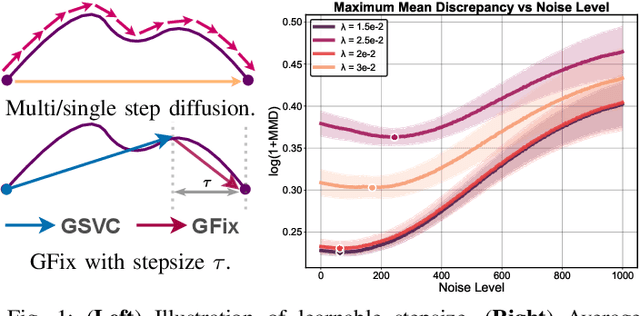
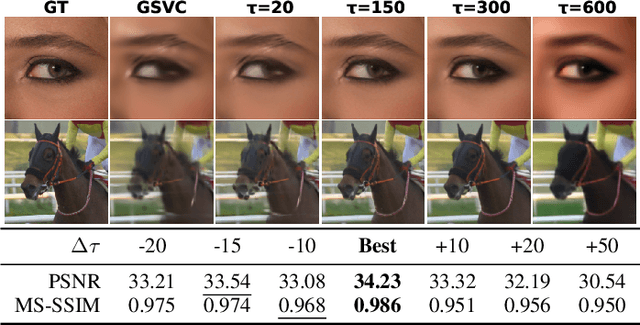
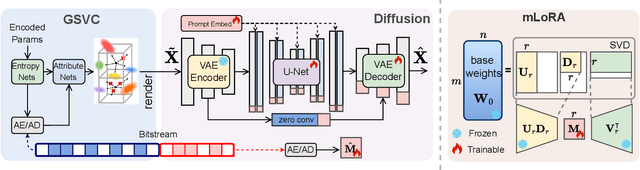
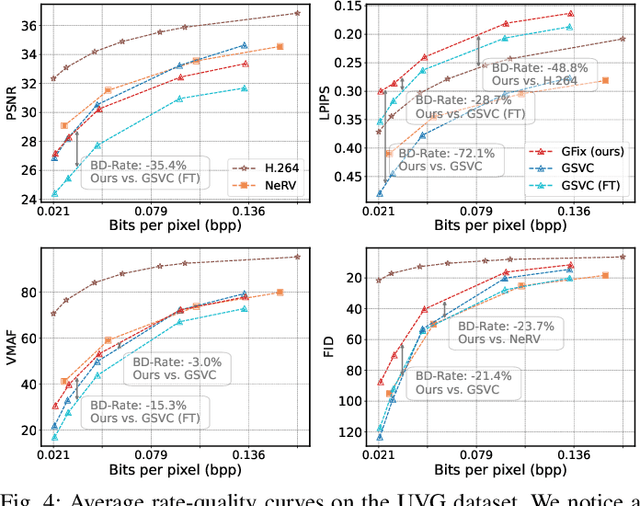
3D Gaussian Splatting (3DGS) enhances 3D scene reconstruction through explicit representation and fast rendering, demonstrating potential benefits for various low-level vision tasks, including video compression. However, existing 3DGS-based video codecs generally exhibit more noticeable visual artifacts and relatively low compression ratios. In this paper, we specifically target the perceptual enhancement of 3DGS-based video compression, based on the assumption that artifacts from 3DGS rendering and quantization resemble noisy latents sampled during diffusion training. Building on this premise, we propose a content-adaptive framework, GFix, comprising a streamlined, single-step diffusion model that serves as an off-the-shelf neural enhancer. Moreover, to increase compression efficiency, We propose a modulated LoRA scheme that freezes the low-rank decompositions and modulates the intermediate hidden states, thereby achieving efficient adaptation of the diffusion backbone with highly compressible updates. Experimental results show that GFix delivers strong perceptual quality enhancement, outperforming GSVC with up to 72.1% BD-rate savings in LPIPS and 21.4% in FID.
Vision Transformer for Robust Occluded Person Reidentification in Complex Surveillance Scenes
Oct 31, 2025Person re-identification (ReID) in surveillance is challenged by occlusion, viewpoint distortion, and poor image quality. Most existing methods rely on complex modules or perform well only on clear frontal images. We propose Sh-ViT (Shuffling Vision Transformer), a lightweight and robust model for occluded person ReID. Built on ViT-Base, Sh-ViT introduces three components: First, a Shuffle module in the final Transformer layer to break spatial correlations and enhance robustness to occlusion and blur; Second, scenario-adapted augmentation (geometric transforms, erasing, blur, and color adjustment) to simulate surveillance conditions; Third, DeiT-based knowledge distillation to improve learning with limited labels.To support real-world evaluation, we construct the MyTT dataset, containing over 10,000 pedestrians and 30,000+ images from base station inspections, with frequent equipment occlusion and camera variations. Experiments show that Sh-ViT achieves 83.2% Rank-1 and 80.1% mAP on MyTT, outperforming CNN and ViT baselines, and 94.6% Rank-1 and 87.5% mAP on Market1501, surpassing state-of-the-art methods.In summary, Sh-ViT improves robustness to occlusion and blur without external modules, offering a practical solution for surveillance-based personnel monitoring.