 Add to Chrome
 Add to Firefox
 Add to Edge
PixIE: Prompted Pixel-Space Low-Light Image Enhancement
May 27, 2026
Low-light images suffer from severe noise, contrast loss, and semantic ambiguity, making enhancement a joint problem of denoising and detail recovery. We propose PixIE, a feed-forward pixel-space LLIE framework semantically prompted by a vision foundation model. PixIE first performs cross-scale denoising to suppress noise and preserve structure, then refines details using DINO-Prompted Pixel Blocks (DPPBs), which inject intermediate DINOv3 features through patch-conditioned, spatially continuous per-pixel modulation. To make pixel-space attention efficient across scales, we introduce Spatial-Channel Compaction (SCC), which jointly reduces the spatial token grid and channel dimension. We further propose Multi-Receptive-Field Pixel Embedding (MRPE) to provide neighborhood-aware pixel representations before semantic prompting, improving robustness to signal-dependent noise beyond point-wise embeddings. Experiments on LLIE benchmarks show that PixIE improves average PSNR by 1.9-15.0% over recent state-of-the-art methods and reduces LPIPS by 8.5-44.4%. Qualitative comparisons further show sharper details and more stable textures, improving both reconstruction fidelity and perceptual quality.

FGSVQA: Frequency-Guided Short-form Video Quality Assessment
May 19, 2026Short-form video poses new challenges to the quality assessment of user-generated content (UGC) due to its complex generation pipeline, rapid content variation, and mixed distortions. To address this challenge, we propose an end-to-end video quality assessment (VQA) framework that employs a dense visual encoder based on CLIP, and incorporates compression priors derived from the frequency domain to generate artifact- and structure-aware weight maps for feature aggregation. By explicitly decomposing artifact, structure, and original visual feature branches and adaptively fusing them over time through a learned gating module, the proposed method achieves accurate and efficient quality prediction. Experimental results show that our method achieves strong performance on short-form video datasets in terms of average rank and linear correlation (SRCC: 0.736, PLCC: 0.787), while maintaining efficient inference runtime. The code and additional results are available at: https://github.com/xinyiW915/FGSVQA.
The Fourth Challenge on Image Super-Resolution ($\times$4) at NTIRE 2026: Benchmark Results and Method Overview
Apr 16, 2026This paper presents the NTIRE 2026 image super-resolution ($\times$4) challenge, one of the associated competitions of the NTIRE 2026 Workshop at CVPR 2026. The challenge aims to reconstruct high-resolution (HR) images from low-resolution (LR) inputs generated through bicubic downsampling with a $\times$4 scaling factor. The objective is to develop effective super-resolution solutions and analyze recent advances in the field. To reflect the evolving objectives of image super-resolution, the challenge includes two tracks: (1) a restoration track, which emphasizes pixel-wise fidelity and ranks submissions based on PSNR; and (2) a perceptual track, which focuses on visual realism and evaluates results using a perceptual score. A total of 194 participants registered for the challenge, with 31 teams submitting valid entries. This report summarizes the challenge design, datasets, evaluation protocol, main results, and methods of participating teams. The challenge provides a unified benchmark and offers insights into current progress and future directions in image super-resolution.
NTIRE 2026 Challenge on Short-form UGC Video Restoration in the Wild with Generative Models: Datasets, Methods and Results
Apr 12, 2026This paper presents an overview of the NTIRE 2026 Challenge on Short-form UGC Video Restoration in the Wild with Generative Models. This challenge utilizes a new short-form UGC (S-UGC) video restoration benchmark, termed KwaiVIR, which is contributed by USTC and Kuaishou Technology. It contains both synthetically distorted videos and real-world short-form UGC videos in the wild. For this edition, the released data include 200 synthetic training videos, 48 wild training videos, 11 validation videos, and 20 testing videos. The primary goal of this challenge is to establish a strong and practical benchmark for restoring short-form UGC videos under complex real-world degradations, especially in the emerging paradigm of generative-model-based S-UGC video restoration. This challenge has two tracks: (i) the primary track is a subjective track, where the evaluation is based on a user study; (ii) the second track is an objective track. These two tracks enable a comprehensive assessment of restoration quality. In total, 95 teams have registered for this competition. And 12 teams submitted valid final solutions and fact sheets for the testing phase. The submitted methods achieved strong performance on the KwaiVIR benchmark, demonstrating encouraging progress in short-form UGC video restoration in the wild.
A Mamba-based Perceptual Loss Function for Learning-based UGC Transcoding
Mar 26, 2026In user-generated content (UGC) transcoding, source videos typically suffer various degradations due to prior compression, editing, or suboptimal capture conditions. Consequently, existing video compression paradigms that solely optimize for fidelity relative to the reference become suboptimal, as they force the codec to replicate the inherent artifacts of the non-pristine source. To address this, we propose a novel perceptually inspired loss function for learning-based UGC video transcoding that redefines the role of the reference video, shifting it from a ground-truth pixel anchor to an informative contextual guide. Specifically, we train a lightweight neural quality model based on a Selective Structured State-Space Model (Mamba) optimized using a weakly-supervised Siamese ranking strategy. The proposed model is then integrated into the rate-distortion optimization (RDO) process of two neural video codecs (DCVC and HiNeRV) as a loss function, aiming to generate reconstructed content with improved perceptual quality. Our experiments demonstrate that this framework achieves substantial coding gains over both autoencoder and implicit neural representation-based baselines, with 8.46% and 12.89% BD-rate savings, respectively.
Q-Tacit: Image Quality Assessment via Latent Visual Reasoning
Mar 23, 2026Vision-Language Model (VLM)-based image quality assessment (IQA) has been significantly advanced by incorporating Chain-of-Thought (CoT) reasoning. Recent work has refined image quality reasoning by applying reinforcement learning (RL) and leveraging active visual tools. However, such strategies are typically language-centric, with visual information being treated as static preconditions. Quality-related visual cues often cannot be abstracted into text in extenso due to the gap between discrete textual tokens and quality perception space, which in turn restricts the reasoning effectiveness for visually intensive IQA tasks. In this paper, we revisit this by asking the question, "Is natural language the ideal space for quality reasoning?" and, as a consequence, we propose Q-Tacit, a new paradigm that elicits VLMs to reason beyond natural language in the latent quality space. Our approach follows a synergistic two-stage process: (i) injecting structural visual quality priors into the latent space, and (ii) calibrating latent reasoning trajectories to improve quality assessment ability. Extensive experiments demonstrate that Q-Tacit can effectively perform quality reasoning with significantly fewer tokens than previous reasoning-based methods, while achieving strong overall performance. This paper validates the proposition that language is not the only compact representation suitable for visual quality, opening possibilities for further exploration of effective latent reasoning paradigms for IQA. Source code will be released to support future research.
Prune Wisely, Reconstruct Sharply: Compact 3D Gaussian Splatting via Adaptive Pruning and Difference-of-Gaussian Primitives
Feb 27, 2026Recent significant advances in 3D scene representation have been driven by 3D Gaussian Splatting (3DGS), which has enabled real-time rendering with photorealistic quality. 3DGS often requires a large number of primitives to achieve high fidelity, leading to redundant representations and high resource consumption, thereby limiting its scalability for complex or large-scale scenes. Consequently, effective pruning strategies and more expressive primitives that can reduce redundancy while preserving visual quality are crucial for practical deployment. We propose an efficient, integrated reconstruction-aware pruning strategy that adaptively determines pruning timing and refining intervals based on reconstruction quality, thus reducing model size while enhancing rendering quality. Moreover, we introduce a 3D Difference-of-Gaussians primitive that jointly models both positive and negative densities in a single primitive, improving the expressiveness of Gaussians under compact configurations. Our method significantly improves model compactness, achieving up to 90\% reduction in Gaussian-count while delivering visual quality that is similar to, or in some cases better than, that produced by state-of-the-art methods. Code will be made publicly available.
SAM3-LiteText: An Anatomical Study of the SAM3 Text Encoder for Efficient Vision-Language Segmentation
Feb 12, 2026Vision-language segmentation models such as SAM3 enable flexible, prompt-driven visual grounding, but inherit large, general-purpose text encoders originally designed for open-ended language understanding. In practice, segmentation prompts are short, structured, and semantically constrained, leading to substantial over-provisioning in text encoder capacity and persistent computational and memory overhead. In this paper, we perform a large-scale anatomical analysis of text prompting in vision-language segmentation, covering 404,796 real prompts across multiple benchmarks. Our analysis reveals severe redundancy: most context windows are underutilized, vocabulary usage is highly sparse, and text embeddings lie on low-dimensional manifold despite high-dimensional representations. Motivated by these findings, we propose SAM3-LiteText, a lightweight text encoding framework that replaces the original SAM3 text encoder with a compact MobileCLIP student that is optimized by knowledge distillation. Extensive experiments on image and video segmentation benchmarks show that SAM3-LiteText reduces text encoder parameters by up to 88%, substantially reducing static memory footprint, while maintaining segmentation performance comparable to the original model. Code: https://github.com/SimonZeng7108/efficientsam3/tree/sam3_litetext.
GFix: Perceptually Enhanced Gaussian Splatting Video Compression
Nov 10, 2025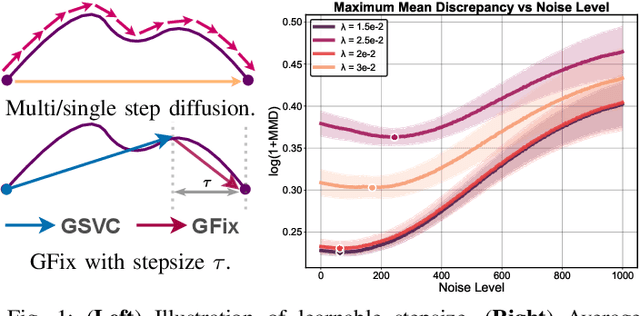
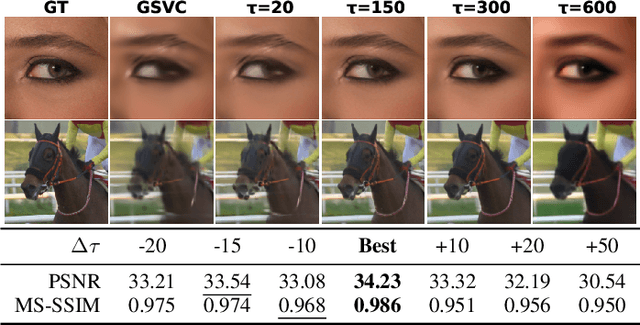
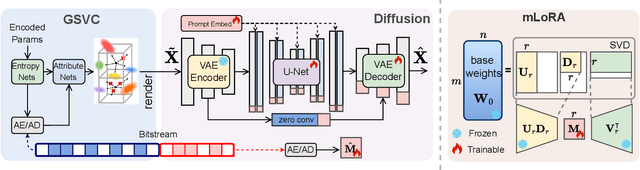
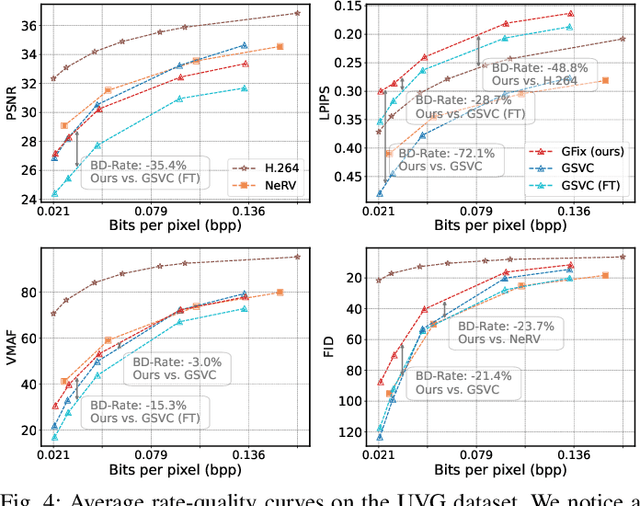
3D Gaussian Splatting (3DGS) enhances 3D scene reconstruction through explicit representation and fast rendering, demonstrating potential benefits for various low-level vision tasks, including video compression. However, existing 3DGS-based video codecs generally exhibit more noticeable visual artifacts and relatively low compression ratios. In this paper, we specifically target the perceptual enhancement of 3DGS-based video compression, based on the assumption that artifacts from 3DGS rendering and quantization resemble noisy latents sampled during diffusion training. Building on this premise, we propose a content-adaptive framework, GFix, comprising a streamlined, single-step diffusion model that serves as an off-the-shelf neural enhancer. Moreover, to increase compression efficiency, We propose a modulated LoRA scheme that freezes the low-rank decompositions and modulates the intermediate hidden states, thereby achieving efficient adaptation of the diffusion backbone with highly compressible updates. Experimental results show that GFix delivers strong perceptual quality enhancement, outperforming GSVC with up to 72.1% BD-rate savings in LPIPS and 21.4% in FID.
CAMP-VQA: Caption-Embedded Multimodal Perception for No-Reference Quality Assessment of Compressed Video
Nov 10, 2025The prevalence of user-generated content (UGC) on platforms such as YouTube and TikTok has rendered no-reference (NR) perceptual video quality assessment (VQA) vital for optimizing video delivery. Nonetheless, the characteristics of non-professional acquisition and the subsequent transcoding of UGC video on sharing platforms present significant challenges for NR-VQA. Although NR-VQA models attempt to infer mean opinion scores (MOS), their modeling of subjective scores for compressed content remains limited due to the absence of fine-grained perceptual annotations of artifact types. To address these challenges, we propose CAMP-VQA, a novel NR-VQA framework that exploits the semantic understanding capabilities of large vision-language models. Our approach introduces a quality-aware prompting mechanism that integrates video metadata (e.g., resolution, frame rate, bitrate) with key fragments extracted from inter-frame variations to guide the BLIP-2 pretraining approach in generating fine-grained quality captions. A unified architecture has been designed to model perceptual quality across three dimensions: semantic alignment, temporal characteristics, and spatial characteristics. These multimodal features are extracted and fused, then regressed to video quality scores. Extensive experiments on a wide variety of UGC datasets demonstrate that our model consistently outperforms existing NR-VQA methods, achieving improved accuracy without the need for costly manual fine-grained annotations. Our method achieves the best performance in terms of average rank and linear correlation (SRCC: 0.928, PLCC: 0.938) compared to state-of-the-art methods. The source code and trained models, along with a user-friendly demo, are available at: https://github.com/xinyiW915/CAMP-VQA.