 Add to Chrome
 Add to Firefox
 Add to Edge
The Power of Graph Signal Processing for Chip Placement Acceleration
Feb 24, 2025


Placement is a critical task with high computation complexity in VLSI physical design. Modern analytical placers formulate the placement objective as a nonlinear optimization task, which suffers a long iteration time. To accelerate and enhance the placement process, recent studies have turned to deep learning-based approaches, particularly leveraging graph convolution networks (GCNs). However, learning-based placers require time- and data-consuming model training due to the complexity of circuit placement that involves large-scale cells and design-specific graph statistics. This paper proposes GiFt, a parameter-free technique for accelerating placement, rooted in graph signal processing. GiFt excels at capturing multi-resolution smooth signals of circuit graphs to generate optimized placement solutions without the need for time-consuming model training, and meanwhile significantly reduces the number of iterations required by analytical placers. Experimental results show that GiFt significantly improving placement efficiency, while achieving competitive or superior performance compared to state-of-the-art placers. In particular, compared to DREAMPlace, the recently proposed GPU-accelerated analytical placer, GF-Placer improves total runtime over 45%.

AttentionEngine: A Versatile Framework for Efficient Attention Mechanisms on Diverse Hardware Platforms
Feb 21, 2025Transformers and large language models (LLMs) have revolutionized machine learning, with attention mechanisms at the core of their success. As the landscape of attention variants expands, so too do the challenges of optimizing their performance, particularly across different hardware platforms. Current optimization strategies are often narrowly focused, requiring extensive manual intervention to accommodate changes in model configurations or hardware environments. In this paper, we introduce AttentionEngine, a comprehensive framework designed to streamline the optimization of attention mechanisms across heterogeneous hardware backends. By decomposing attention computation into modular operations with customizable components, AttentionEngine enables flexible adaptation to diverse algorithmic requirements. The framework further automates kernel optimization through a combination of programmable templates and a robust cross-platform scheduling strategy. Empirical results reveal performance gains of up to 10x on configurations beyond the reach of existing methods. AttentionEngine offers a scalable, efficient foundation for developing and deploying attention mechanisms with minimal manual tuning. Our code has been open-sourced and is available at https://github.com/microsoft/AttentionEngine.
Proving Olympiad Inequalities by Synergizing LLMs and Symbolic Reasoning
Feb 19, 2025
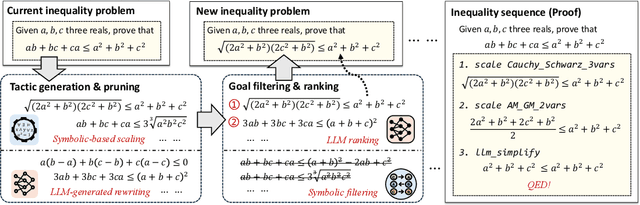


Large language models (LLMs) can prove mathematical theorems formally by generating proof steps (\textit{a.k.a.} tactics) within a proof system. However, the space of possible tactics is vast and complex, while the available training data for formal proofs is limited, posing a significant challenge to LLM-based tactic generation. To address this, we introduce a neuro-symbolic tactic generator that synergizes the mathematical intuition learned by LLMs with domain-specific insights encoded by symbolic methods. The key aspect of this integration is identifying which parts of mathematical reasoning are best suited to LLMs and which to symbolic methods. While the high-level idea of neuro-symbolic integration is broadly applicable to various mathematical problems, in this paper, we focus specifically on Olympiad inequalities (Figure~1). We analyze how humans solve these problems and distill the techniques into two types of tactics: (1) scaling, handled by symbolic methods, and (2) rewriting, handled by LLMs. In addition, we combine symbolic tools with LLMs to prune and rank the proof goals for efficient proof search. We evaluate our framework on 161 challenging inequalities from multiple mathematics competitions, achieving state-of-the-art performance and significantly outperforming existing LLM and symbolic approaches without requiring additional training data.
MM-Verify: Enhancing Multimodal Reasoning with Chain-of-Thought Verification
Feb 19, 2025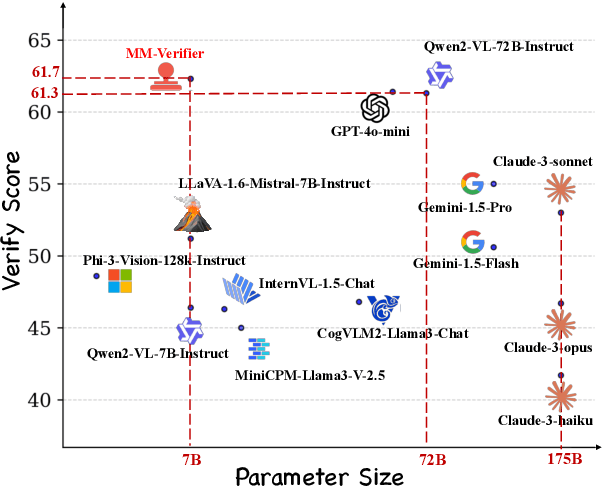
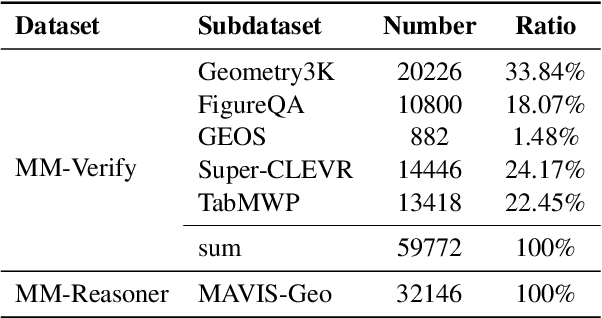
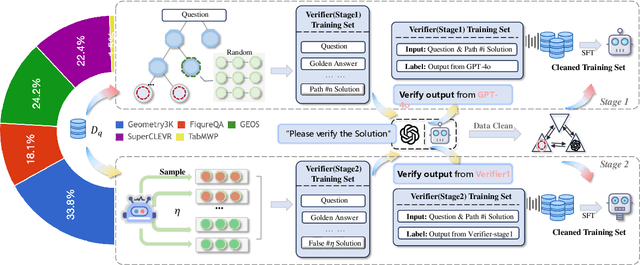
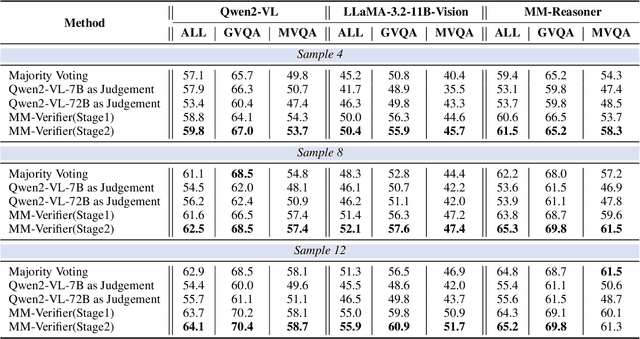
According to the Test-Time Scaling, the integration of External Slow-Thinking with the Verify mechanism has been demonstrated to enhance multi-round reasoning in large language models (LLMs). However, in the multimodal (MM) domain, there is still a lack of a strong MM-Verifier. In this paper, we introduce MM-Verifier and MM-Reasoner to enhance multimodal reasoning through longer inference and more robust verification. First, we propose a two-step MM verification data synthesis method, which combines a simulation-based tree search with verification and uses rejection sampling to generate high-quality Chain-of-Thought (COT) data. This data is then used to fine-tune the verification model, MM-Verifier. Additionally, we present a more efficient method for synthesizing MMCOT data, bridging the gap between text-based and multimodal reasoning. The synthesized data is used to fine-tune MM-Reasoner. Our MM-Verifier outperforms all larger models on the MathCheck, MathVista, and MathVerse benchmarks. Moreover, MM-Reasoner demonstrates strong effectiveness and scalability, with performance improving as data size increases. Finally, our approach achieves strong performance when combining MM-Reasoner and MM-Verifier, reaching an accuracy of 65.3 on MathVista, surpassing GPT-4o (63.8) with 12 rollouts.
MagicArticulate: Make Your 3D Models Articulation-Ready
Feb 18, 2025

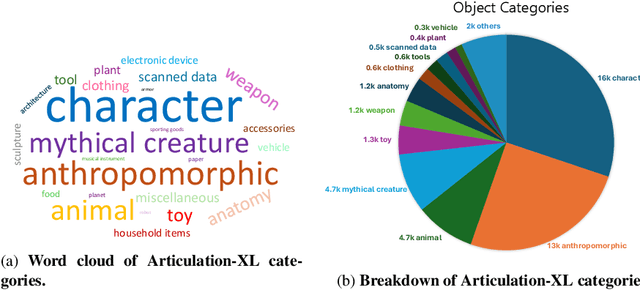
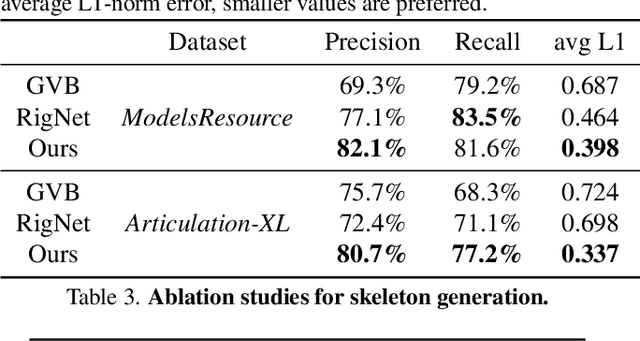
With the explosive growth of 3D content creation, there is an increasing demand for automatically converting static 3D models into articulation-ready versions that support realistic animation. Traditional approaches rely heavily on manual annotation, which is both time-consuming and labor-intensive. Moreover, the lack of large-scale benchmarks has hindered the development of learning-based solutions. In this work, we present MagicArticulate, an effective framework that automatically transforms static 3D models into articulation-ready assets. Our key contributions are threefold. First, we introduce Articulation-XL, a large-scale benchmark containing over 33k 3D models with high-quality articulation annotations, carefully curated from Objaverse-XL. Second, we propose a novel skeleton generation method that formulates the task as a sequence modeling problem, leveraging an auto-regressive transformer to naturally handle varying numbers of bones or joints within skeletons and their inherent dependencies across different 3D models. Third, we predict skinning weights using a functional diffusion process that incorporates volumetric geodesic distance priors between vertices and joints. Extensive experiments demonstrate that MagicArticulate significantly outperforms existing methods across diverse object categories, achieving high-quality articulation that enables realistic animation. Project page: https://chaoyuesong.github.io/MagicArticulate.
iMOVE: Instance-Motion-Aware Video Understanding
Feb 18, 2025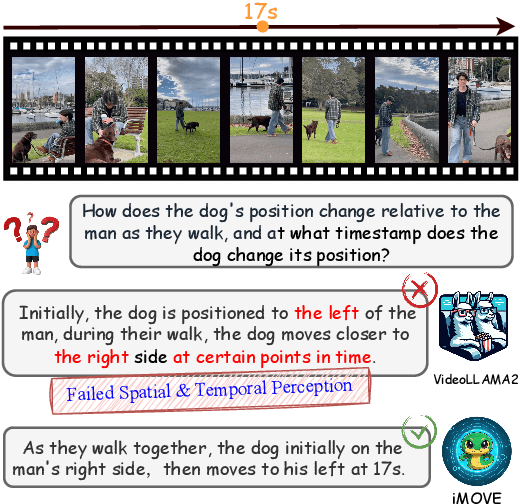
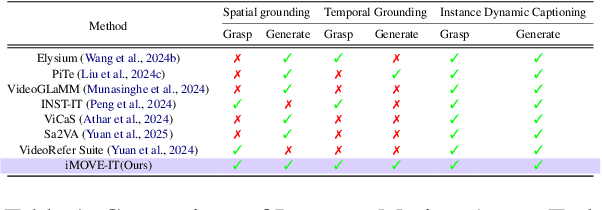
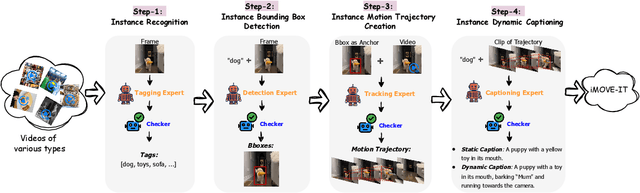
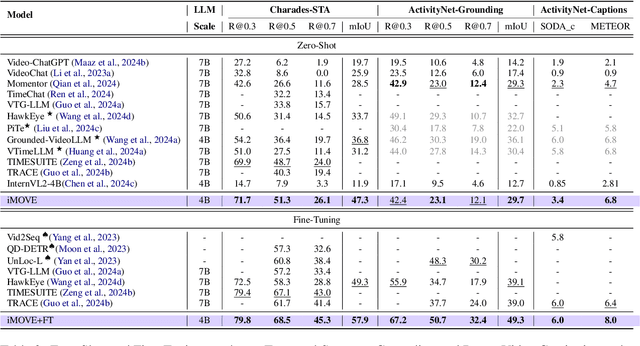
Enhancing the fine-grained instance spatiotemporal motion perception capabilities of Video Large Language Models is crucial for improving their temporal and general video understanding. However, current models struggle to perceive detailed and complex instance motions. To address these challenges, we have made improvements from both data and model perspectives. In terms of data, we have meticulously curated iMOVE-IT, the first large-scale instance-motion-aware video instruction-tuning dataset. This dataset is enriched with comprehensive instance motion annotations and spatiotemporal mutual-supervision tasks, providing extensive training for the model's instance-motion-awareness. Building on this foundation, we introduce iMOVE, an instance-motion-aware video foundation model that utilizes Event-aware Spatiotemporal Efficient Modeling to retain informative instance spatiotemporal motion details while maintaining computational efficiency. It also incorporates Relative Spatiotemporal Position Tokens to ensure awareness of instance spatiotemporal positions. Evaluations indicate that iMOVE excels not only in video temporal understanding and general video understanding but also demonstrates significant advantages in long-term video understanding.
Baichuan-M1: Pushing the Medical Capability of Large Language Models
Feb 18, 2025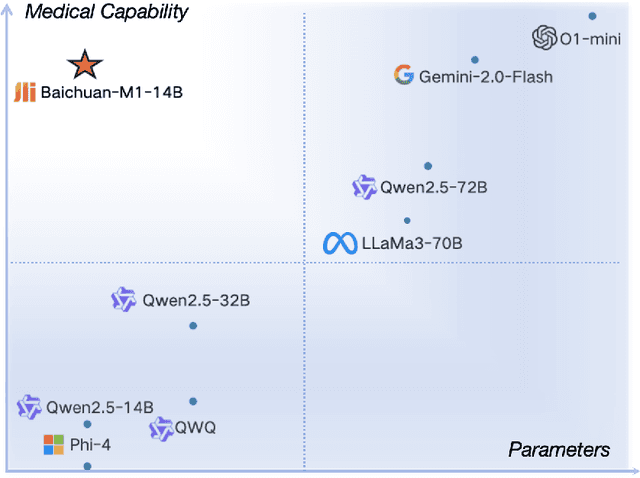

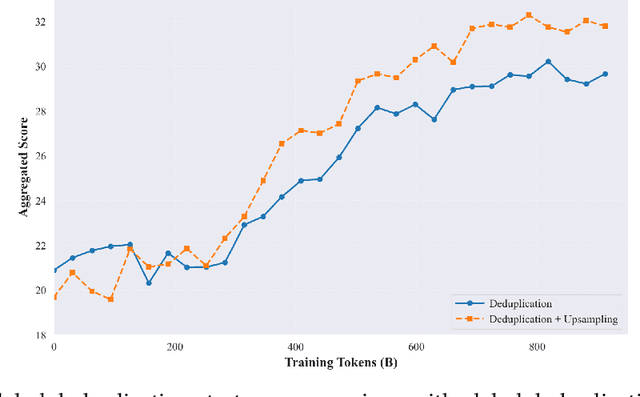
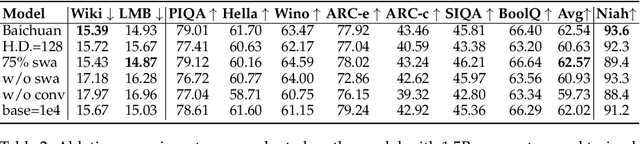
The current generation of large language models (LLMs) is typically designed for broad, general-purpose applications, while domain-specific LLMs, especially in vertical fields like medicine, remain relatively scarce. In particular, the development of highly efficient and practical LLMs for the medical domain is challenging due to the complexity of medical knowledge and the limited availability of high-quality data. To bridge this gap, we introduce Baichuan-M1, a series of large language models specifically optimized for medical applications. Unlike traditional approaches that simply continue pretraining on existing models or apply post-training to a general base model, Baichuan-M1 is trained from scratch with a dedicated focus on enhancing medical capabilities. Our model is trained on 20 trillion tokens and incorporates a range of effective training methods that strike a balance between general capabilities and medical expertise. As a result, Baichuan-M1 not only performs strongly across general domains such as mathematics and coding but also excels in specialized medical fields. We have open-sourced Baichuan-M1-14B, a mini version of our model, which can be accessed through the following links.
Detection and Geographic Localization of Natural Objects in the Wild: A Case Study on Palms
Feb 18, 2025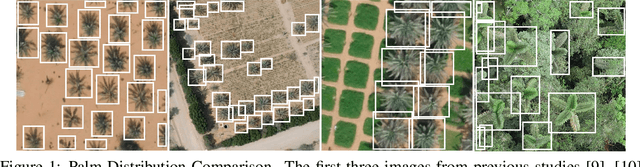

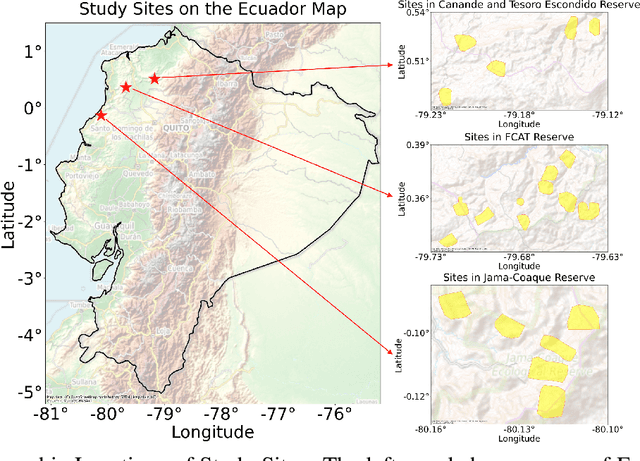
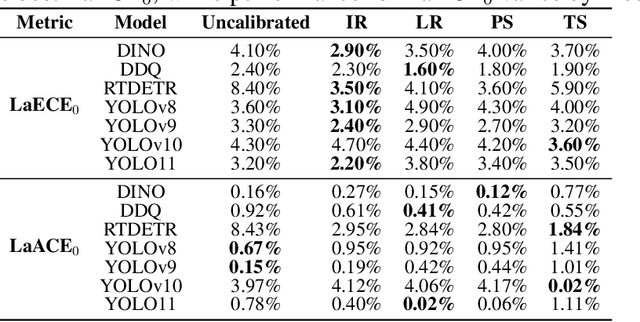
Palms are ecologically and economically indicators of tropical forest health, biodiversity, and human impact that support local economies and global forest product supply chains. While palm detection in plantations is well-studied, efforts to map naturally occurring palms in dense forests remain limited by overlapping crowns, uneven shading, and heterogeneous landscapes. We develop PRISM (Processing, Inference, Segmentation, and Mapping), a flexible pipeline for detecting and localizing palms in dense tropical forests using large orthomosaic images. Orthomosaics are created from thousands of aerial images and spanning several to hundreds of gigabytes. Our contributions are threefold. First, we construct a large UAV-derived orthomosaic dataset collected across 21 ecologically diverse sites in western Ecuador, annotated with 8,830 bounding boxes and 5,026 palm center points. Second, we evaluate multiple state-of-the-art object detectors based on efficiency and performance, integrating zero-shot SAM 2 as the segmentation backbone, and refining the results for precise geographic mapping. Third, we apply calibration methods to align confidence scores with IoU and explore saliency maps for feature explainability. Though optimized for palms, PRISM is adaptable for identifying other natural objects, such as eastern white pines. Future work will explore transfer learning for lower-resolution datasets (0.5 to 1m).
SAIF: A Sparse Autoencoder Framework for Interpreting and Steering Instruction Following of Language Models
Feb 17, 2025The ability of large language models (LLMs) to follow instructions is crucial for their practical applications, yet the underlying mechanisms remain poorly understood. This paper presents a novel framework that leverages sparse autoencoders (SAE) to interpret how instruction following works in these models. We demonstrate how the features we identify can effectively steer model outputs to align with given instructions. Through analysis of SAE latent activations, we identify specific latents responsible for instruction following behavior. Our findings reveal that instruction following capabilities are encoded by a distinct set of instruction-relevant SAE latents. These latents both show semantic proximity to relevant instructions and demonstrate causal effects on model behavior. Our research highlights several crucial factors for achieving effective steering performance: precise feature identification, the role of final layer, and optimal instruction positioning. Additionally, we demonstrate that our methodology scales effectively across SAEs and LLMs of varying sizes.
WaferLLM: A Wafer-Scale LLM Inference System
Feb 06, 2025Emerging AI accelerators increasingly adopt wafer-scale manufacturing technologies, integrating hundreds of thousands of AI cores in a mesh-based architecture with large distributed on-chip memory (tens of GB in total) and ultra-high on-chip memory bandwidth (tens of PB/s). However, current LLM inference systems, optimized for shared memory architectures like GPUs, fail to fully exploit these accelerators. We introduce WaferLLM, the first wafer-scale LLM inference system. WaferLLM is guided by a novel PLMR device model that captures the unique hardware characteristics of wafer-scale architectures. Leveraging this model, WaferLLM pioneers wafer-scale LLM parallelism, optimizing the utilization of hundreds of thousands of on-chip cores. It also introduces MeshGEMM and MeshGEMV, the first GEMM and GEMV implementations designed to scale effectively on wafer-scale accelerators. Evaluations show that WaferLLM achieves 200$\times$ better wafer-scale accelerator utilization than state-of-the-art systems. On a commodity wafer-scale accelerator, WaferLLM delivers 606$\times$ faster and 22$\times$ more energy-efficient GEMV compared to an advanced GPU. For LLMs, WaferLLM enables 39$\times$ faster decoding with 1.7$\times$ better energy efficiency. We anticipate these numbers will grow significantly as wafer-scale AI models, software, and hardware continue to mature.