 Add to Chrome
 Add to Firefox
 Add to Edge
Exploring Post-Training Alignment of Small Language Models for Biomedical Data-to-Text Generation: A Case Study of Medication Leaflet
Jul 15, 2026
Translating complex biomedical data into patient-friendly narratives is central to modern biomedical informatics. This study presents a comparative analysis of training small language models (SLMs) in specialized biomedical datato-text generation tasks. We explore widely adopted post-training methods including supervised fine-tuning (SFT), direct preference optimization (DPO), odds ratio preference optimization (ORPO), and group relative policy optimization (GRPO) with Qwen-based SLMs on a medicine package leaflets dataset. To assess cross-dataset generalizability, we also curated drug label data from openFDA. We evaluate models using both standard lexical overlap metrics like ROUGE as well as semantic similarity measures. Across our experiments, the results show that (1) the aligned SLMs outperform proprietary models like GPT-5; (2) ORPO outperforms the SFTbaselines; (3) GRPO yields the most robust cross-dataset performance among the alignment methods tested as well as GPT-5.

Confidence-feedback-weighted graph matching network: online-offline laser-induced damage site matching under complex interference
Jun 28, 2026Online inspection images of final optics in high-power laser facilities contain pseudo-damage sites that closely resemble true damage sites. Determining the authenticity of online-detected sites is therefore difficult and requires accurate matching to offline ground-truth sites. However, this matching remains highly challenging due to limited match-discriminative features, local geometric distortions, and numerous distractor sites. Existing matching models mainly suppress distractors implicitly through loss-function supervision. We propose a confidence-feedback-weighted graph matching network that requires only damage-site centroid coordinates as input. It estimates node matchability confidence from each round of matching scores and feeds it back as a reliability weight to guide subsequent edge-feature aggregation, thereby suppressing distractor propagation and enhancing cross-graph discriminability. Within this framework, a geometric consistency constraint calibrates spurious high-confidence matchability estimates, while a hard-example mining loss improves discrimination between structurally similar sites. Experiments on our Complex-Scene dataset show that the proposed method achieves a matching F1-score of 96.36$\%$ with robust and efficient performance.
ATRS: Adaptive Trajectory Re-splitting via a Shared Neural Policy for Parallel Optimization
Apr 24, 2026Parallel trajectory optimization via the Alternating Direction Method of Multipliers (ADMM) has emerged as a scalable approach to long-horizon motion planning. However, existing frameworks typically decompose the problem into parallel subproblems based on a predefined fixed structure. Such structural rigidity often causes optimization stagnation in highly constrained regions, where a few lagging subproblems delay global convergence. A natural remedy is to adaptively re-split these stagnating segments online. Yet, deciding when, where, and how to split exceeds the capability of rule-based heuristics. To this end, we propose ATRS, a novel framework that embeds a shared Deep Reinforcement Learning policy into the parallel ADMM loop. We formulate this adaptive adjustment as a Multi-Agent Shared-Policy Markov Decision Process, where all trajectory segments act as homogeneous agents and share a unified neural policy network. This parameter-sharing architecture endows the system with size invariance, enabling it to handle dynamically changing segment counts during re-splitting and generalize to arbitrary trajectory lengths. Furthermore, our formulation inherently supports zero-shot generalization to unseen environments, as our network relies solely on the internal states of the numerical solver rather than on the geometric features of the environment. To ensure solver stability, a Confidence-Based Election mechanism selects only the most stagnating segment for re-splitting at each step. Extensive simulations demonstrate that ATRS accelerates convergence, reducing the number of iterations by up to 26.0% and the computation time by up to 19.1%. Real-world experiments further confirm its applicability to both large-scale offline global planning and real-time onboard replanning within 35 ms per cycle, with no sim-to-real degradation.
When Can We Trust Deep Neural Networks? Towards Reliable Industrial Deployment with an Interpretability Guide
Apr 21, 2026The deployment of AI systems in safety-critical domains, such as industrial defect inspection, autonomous driving, and medical diagnosis, is severely hampered by their lack of reliability. A single undetected erroneous prediction can lead to catastrophic outcomes. Unfortunately, there is often no alternative but to place trust in the outputs of a trained AI system, which operates without an internal safeguard to flag unreliable predictions, even in cases of high accuracy. We propose a post-hoc explanation-based indicator to detect false negatives in binary defect detection networks. To our knowledge, this is the first method to proactively identify potentially erroneous network outputs. Our core idea leverages the difference between class-specific discriminative heatmaps and class-agnostic ones. We compute the difference in their intersection over union (IoU) as a reliability score. An adversarial enhancement method is further introduced to amplify this disparity. Evaluations on two industrial defect detection benchmarks show our method effectively identifies false negatives. With adversarial enhancement, it achieves 100\% recall, albeit with a trade-off for true negatives. Our work thus advocates for a new and trustworthy deployment paradigm: data-model-explanation-output, moving beyond conventional end-to-end systems to provide critical support for reliable AI in real-world applications.
R-GenIMA: Integrating Neuroimaging and Genetics with Interpretable Multimodal AI for Alzheimer's Disease Progression
Dec 22, 2025Early detection of Alzheimer's disease (AD) requires models capable of integrating macro-scale neuroanatomical alterations with micro-scale genetic susceptibility, yet existing multimodal approaches struggle to align these heterogeneous signals. We introduce R-GenIMA, an interpretable multimodal large language model that couples a novel ROI-wise vision transformer with genetic prompting to jointly model structural MRI and single nucleotide polymorphisms (SNPs) variations. By representing each anatomically parcellated brain region as a visual token and encoding SNP profiles as structured text, the framework enables cross-modal attention that links regional atrophy patterns to underlying genetic factors. Applied to the ADNI cohort, R-GenIMA achieves state-of-the-art performance in four-way classification across normal cognition (NC), subjective memory concerns (SMC), mild cognitive impairment (MCI), and AD. Beyond predictive accuracy, the model yields biologically meaningful explanations by identifying stage-specific brain regions and gene signatures, as well as coherent ROI-Gene association patterns across the disease continuum. Attention-based attribution revealed genes consistently enriched for established GWAS-supported AD risk loci, including APOE, BIN1, CLU, and RBFOX1. Stage-resolved neuroanatomical signatures identified shared vulnerability hubs across disease stages alongside stage-specific patterns: striatal involvement in subjective decline, frontotemporal engagement during prodromal impairment, and consolidated multimodal network disruption in AD. These results demonstrate that interpretable multimodal AI can synthesize imaging and genetics to reveal mechanistic insights, providing a foundation for clinically deployable tools that enable earlier risk stratification and inform precision therapeutic strategies in Alzheimer's disease.
Step-GUI Technical Report
Dec 19, 2025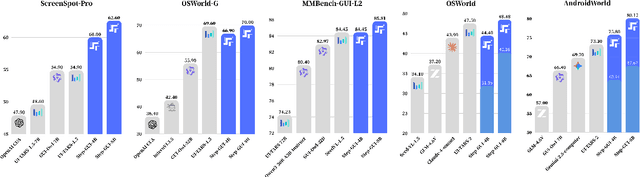
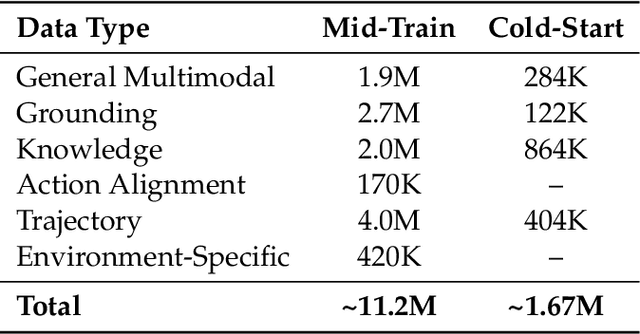
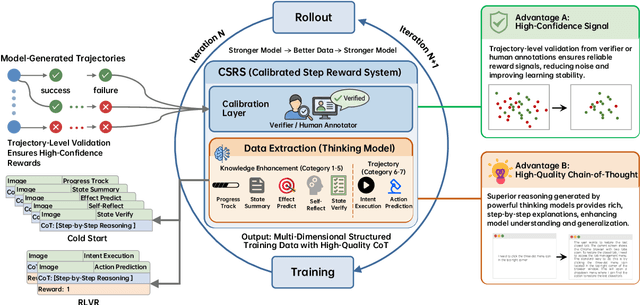
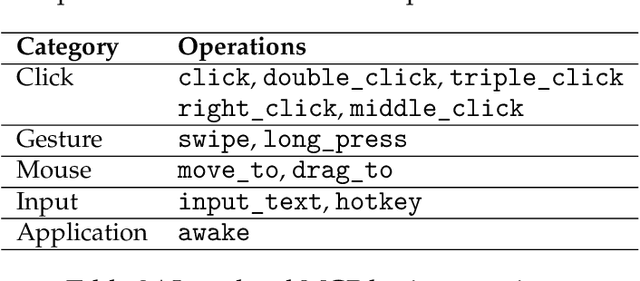
Recent advances in multimodal large language models unlock unprecedented opportunities for GUI automation. However, a fundamental challenge remains: how to efficiently acquire high-quality training data while maintaining annotation reliability? We introduce a self-evolving training pipeline powered by the Calibrated Step Reward System, which converts model-generated trajectories into reliable training signals through trajectory-level calibration, achieving >90% annotation accuracy with 10-100x lower cost. Leveraging this pipeline, we introduce Step-GUI, a family of models (4B/8B) that achieves state-of-the-art GUI performance (8B: 80.2% AndroidWorld, 48.5% OSWorld, 62.6% ScreenShot-Pro) while maintaining robust general capabilities. As GUI agent capabilities improve, practical deployment demands standardized interfaces across heterogeneous devices while protecting user privacy. To this end, we propose GUI-MCP, the first Model Context Protocol for GUI automation with hierarchical architecture that combines low-level atomic operations and high-level task delegation to local specialist models, enabling high-privacy execution where sensitive data stays on-device. Finally, to assess whether agents can handle authentic everyday usage, we introduce AndroidDaily, a benchmark grounded in real-world mobile usage patterns with 3146 static actions and 235 end-to-end tasks across high-frequency daily scenarios (8B: static 89.91%, end-to-end 52.50%). Our work advances the development of practical GUI agents and demonstrates strong potential for real-world deployment in everyday digital interactions.
Zeus: Zero-shot LLM Instruction for Union Segmentation in Multimodal Medical Imaging
Apr 09, 2025Medical image segmentation has achieved remarkable success through the continuous advancement of UNet-based and Transformer-based foundation backbones. However, clinical diagnosis in the real world often requires integrating domain knowledge, especially textual information. Conducting multimodal learning involves visual and text modalities shown as a solution, but collecting paired vision-language datasets is expensive and time-consuming, posing significant challenges. Inspired by the superior ability in numerous cross-modal tasks for Large Language Models (LLMs), we proposed a novel Vision-LLM union framework to address the issues. Specifically, we introduce frozen LLMs for zero-shot instruction generation based on corresponding medical images, imitating the radiology scanning and report generation process. {To better approximate real-world diagnostic processes}, we generate more precise text instruction from multimodal radiology images (e.g., T1-w or T2-w MRI and CT). Based on the impressive ability of semantic understanding and rich knowledge of LLMs. This process emphasizes extracting special features from different modalities and reunion the information for the ultimate clinical diagnostic. With generated text instruction, our proposed union segmentation framework can handle multimodal segmentation without prior collected vision-language datasets. To evaluate our proposed method, we conduct comprehensive experiments with influential baselines, the statistical results and the visualized case study demonstrate the superiority of our novel method.}
A Self-guided Multimodal Approach to Enhancing Graph Representation Learning for Alzheimer's Diseases
Dec 09, 2024


Graph neural networks (GNNs) are powerful machine learning models designed to handle irregularly structured data. However, their generic design often proves inadequate for analyzing brain connectomes in Alzheimer's Disease (AD), highlighting the need to incorporate domain knowledge for optimal performance. Infusing AD-related knowledge into GNNs is a complicated task. Existing methods typically rely on collaboration between computer scientists and domain experts, which can be both time-intensive and resource-demanding. To address these limitations, this paper presents a novel self-guided, knowledge-infused multimodal GNN that autonomously incorporates domain knowledge into the model development process. Our approach conceptualizes domain knowledge as natural language and introduces a specialized multimodal GNN capable of leveraging this uncurated knowledge to guide the learning process of the GNN, such that it can improve the model performance and strengthen the interpretability of the predictions. To evaluate our framework, we curated a comprehensive dataset of recent peer-reviewed papers on AD and integrated it with multiple real-world AD datasets. Experimental results demonstrate the ability of our method to extract relevant domain knowledge, provide graph-based explanations for AD diagnosis, and improve the overall performance of the GNN. This approach provides a more scalable and efficient alternative to inject domain knowledge for AD compared with the manual design from the domain expert, advancing both prediction accuracy and interpretability in AD diagnosis.
Contrastive Disentangling: Fine-grained representation learning through multi-level contrastive learning without class priors
Sep 07, 2024Recent advancements in unsupervised representation learning often leverage class information to enhance feature extraction and clustering performance. However, this reliance on class priors limits the applicability of such methods in real-world scenarios where class information is unavailable or ambiguous. In this paper, we propose Contrastive Disentangling (CD), a simple and effective framework that learns representations without any reliance on class priors. Our framework employs a multi-level contrastive learning strategy that combines instance-level and feature-level losses with a normalized entropy loss to learn semantically rich and fine-grained representations. Specifically, (1) the instance-level contrastive loss encourages the separation of feature representations for different samples, (2) the feature-level contrastive loss promotes independence among the feature head predictions, and (3) the normalized entropy loss encourages the feature heads to capture meaningful and prevalent attributes from the data. These components work together to enable CD to significantly outperform existing methods, as demonstrated by extensive experiments on benchmark datasets including CIFAR-10, CIFAR-100, STL-10, and ImageNet-10, particularly in scenarios where class priors are absent. The code is available at https://github.com/Hoper-J/Contrastive-Disentangling.
Interpretable Spatio-Temporal Embedding for Brain Structural-Effective Network with Ordinary Differential Equation
May 21, 2024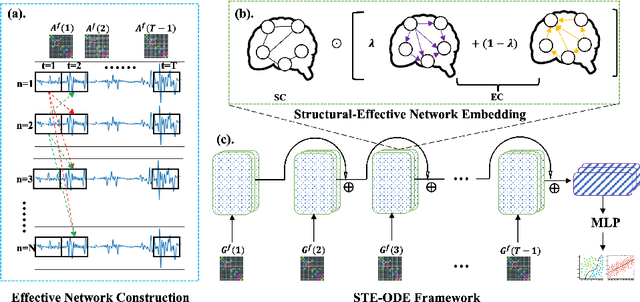

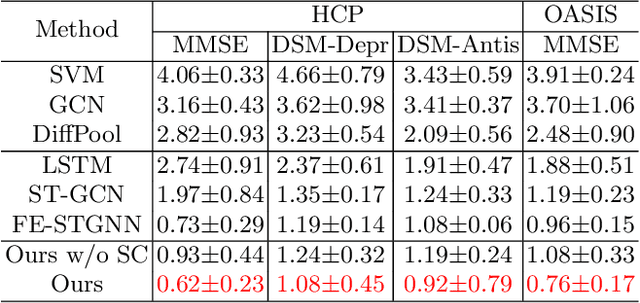

The MRI-derived brain network serves as a pivotal instrument in elucidating both the structural and functional aspects of the brain, encompassing the ramifications of diseases and developmental processes. However, prevailing methodologies, often focusing on synchronous BOLD signals from functional MRI (fMRI), may not capture directional influences among brain regions and rarely tackle temporal functional dynamics. In this study, we first construct the brain-effective network via the dynamic causal model. Subsequently, we introduce an interpretable graph learning framework termed Spatio-Temporal Embedding ODE (STE-ODE). This framework incorporates specifically designed directed node embedding layers, aiming at capturing the dynamic interplay between structural and effective networks via an ordinary differential equation (ODE) model, which characterizes spatial-temporal brain dynamics. Our framework is validated on several clinical phenotype prediction tasks using two independent publicly available datasets (HCP and OASIS). The experimental results clearly demonstrate the advantages of our model compared to several state-of-the-art methods.