 Add to Chrome
 Add to Firefox
 Add to Edge
Temporal-Causal Unity as an Operational Framework for Collective Dynamics: Causal-Progress Clocks, Synchronization, and Polarization
Jul 21, 2026
This paper develops temporal-causal unity (TCU), a framework connecting a process-philosophical thesis -- time is the ordered unfolding of causal change -- to an operational model of cognitive and social dynamics. The framework deliberately separates three claims: an interpretive thesis about becoming, a measurable causal-progress coordinate, and a stochastic network model. Causal progress is defined by $τ(t)=\int_0^tλ(s\mid\mathcal H_s)\,{\rm d}s$, where the nonnegative event intensity $λ$ must be specified independently of the outcome. Agents carry an orientation phase and an activation amplitude; weighted interaction, heterogeneous drift, external input, anchoring, and diffusion govern their evolution in $τ$. First- and second-harmonic order parameters separate consensus from bipolar polarization. For the all-to-all noisy Kuramoto special case with Lorentzian drift width $Δ$, synchronization begins at the conditional threshold $K_c = 2(Δ+ D)$, not at a universal constant. Reproducible numerical illustrations illustrate (not empirically demonstrate) this threshold, causal-clock curve collapse, and the consensus-polarization distinction. Six historical episodes are treated as scope probes rather than validation data. The paper derives falsifiable hypotheses and an out-of-sample protocol for comparing causal-progress and chronological-time models. TCU is therefore offered as a disciplined bridge between process ontology and complex-systems modeling, not as a replacement for spacetime physics or as an empirically established identity between time and causation.

From Fragments to Paths: Task-Level Context Recovery for Large Industrial Codebases
Jun 22, 2026Large language models have shown strong performance on software engineering (SE) tasks, yet understanding large industrial repositories remains challenging. Existing methods often retrieve only local fragments and fail to recover the broader task-relevant context needed for complex repository-level tasks. We present DeepDiscovery, a task-level repository-understanding method for large industrial codebases. DeepDiscovery uses a two-stage \textit{Location--Inference} framework to localize high-confidence task anchors and recover broader task-relevant context over multi-relational repository structure under budget constraints. Across controlled method-level evaluation, organization-internal industrial repository-understanding scenarios, and end-to-end evaluation on SWE-bench Verified, DeepDiscovery consistently improves task-relevant file recovery and downstream SE performance. On 27 medium-scale tasks, DeepDiscovery achieves the best file recovery quality among five representative baselines without offline preprocessing. On organization-internal industrial tasks from a production-scale integrated codebase ecosystem, including 27 medium-scale tasks and 40 large-scale tasks, DeepDiscovery improves Full Recall Rate across multiple AI coding systems, with absolute gains ranging from 1.6 to 9.2 percentage points on large subprojects and from 2.5 to 7.4 percentage points on medium-scale subprojects. In a controlled end-to-end evaluation on SWE-bench Verified, a system equipped with DeepDiscovery achieves a 78.6\% Solve Rate, outperforming the corresponding baseline by 8.2 percentage points. These results suggest that stronger task-level repository understanding can improve coding-agent performance on complex SE tasks.
SSDAU: Structured Semantic Data Augmentation for Joint Entity and Relation Extraction
May 28, 2026Joint Entity and Relation Extraction (JERE) is highly sensitive to training data quality, making data augmentation a natural way to improve generalization. However, existing augmentation methods often weaken entity relevance and disrupt semantic structure, limiting their effectiveness for JERE. In this paper, we propose \textbf{Structured Semantic Data Augmentation (SSDAU)}, a method designed to preserve triple-aware semantic structure during augmentation. SSDAU segments text by entity labels, captures semantic features through context-aware encoding, and restructures entity semantics to generate augmented data. To distinguish semantically similar entities, SSDAU combines contextualized embeddings with traditional similarity scores. To reduce topic inconsistency, we apply BERTopic-based filtering to remove irrelevant augmentations. We evaluate SSDAU on datasets with different annotation types and compare its performance on five representative JERE models against seven popular augmentation baselines. Experiments show that SSDAU generates semantically consistent data, is more robust to ambiguity than non-LLM methods (8.95\% vs. 23.58\% average relative F1 decrease), and significantly outperforms strong alternatives in most settings.
ERNIE 5.0 Technical Report
Feb 04, 2026In this report, we introduce ERNIE 5.0, a natively autoregressive foundation model desinged for unified multimodal understanding and generation across text, image, video, and audio. All modalities are trained from scratch under a unified next-group-of-tokens prediction objective, based on an ultra-sparse mixture-of-experts (MoE) architecture with modality-agnostic expert routing. To address practical challenges in large-scale deployment under diverse resource constraints, ERNIE 5.0 adopts a novel elastic training paradigm. Within a single pre-training run, the model learns a family of sub-models with varying depths, expert capacities, and routing sparsity, enabling flexible trade-offs among performance, model size, and inference latency in memory- or time-constrained scenarios. Moreover, we systematically address the challenges of scaling reinforcement learning to unified foundation models, thereby guaranteeing efficient and stable post-training under ultra-sparse MoE architectures and diverse multimodal settings. Extensive experiments demonstrate that ERNIE 5.0 achieves strong and balanced performance across multiple modalities. To the best of our knowledge, among publicly disclosed models, ERNIE 5.0 represents the first production-scale realization of a trillion-parameter unified autoregressive model that supports both multimodal understanding and generation. To facilitate further research, we present detailed visualizations of modality-agnostic expert routing in the unified model, alongside comprehensive empirical analysis of elastic training, aiming to offer profound insights to the community.
Robustness of Mixtures of Experts to Feature Noise
Jan 21, 2026Despite their practical success, it remains unclear why Mixture of Experts (MoE) models can outperform dense networks beyond sheer parameter scaling. We study an iso-parameter regime where inputs exhibit latent modular structure but are corrupted by feature noise, a proxy for noisy internal activations. We show that sparse expert activation acts as a noise filter: compared to a dense estimator, MoEs achieve lower generalization error under feature noise, improved robustness to perturbations, and faster convergence speed. Empirical results on synthetic data and real-world language tasks corroborate the theoretical insights, demonstrating consistent robustness and efficiency gains from sparse modular computation.
Contextual Embedding Learning to Enhance 2D Networks for Volumetric Image Segmentation
Apr 02, 2024The segmentation of organs in volumetric medical images plays an important role in computer-aided diagnosis and treatment/surgery planning. Conventional 2D convolutional neural networks (CNNs) can hardly exploit the spatial correlation of volumetric data. Current 3D CNNs have the advantage to extract more powerful volumetric representations but they usually suffer from occupying excessive memory and computation nevertheless. In this study we aim to enhance the 2D networks with contextual information for better volumetric image segmentation. Accordingly, we propose a contextual embedding learning approach to facilitate 2D CNNs capturing spatial information properly. Our approach leverages the learned embedding and the slice-wisely neighboring matching as a soft cue to guide the network. In such a way, the contextual information can be transferred slice-by-slice thus boosting the volumetric representation of the network. Experiments on challenging prostate MRI dataset (PROMISE12) and abdominal CT dataset (CHAOS) show that our contextual embedding learning can effectively leverage the inter-slice context and improve segmentation performance. The proposed approach is a plug-and-play, and memory-efficient solution to enhance the 2D networks for volumetric segmentation. The code will be publicly available.
STOPNet: Multiview-based 6-DoF Suction Detection for Transparent Objects on Production Lines
Oct 09, 2023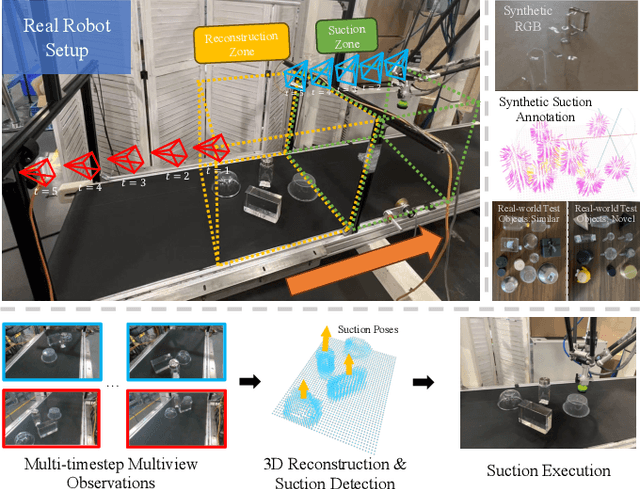
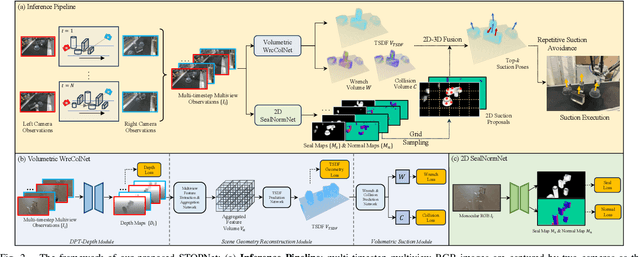
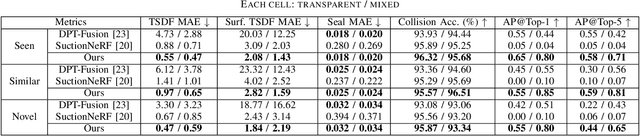
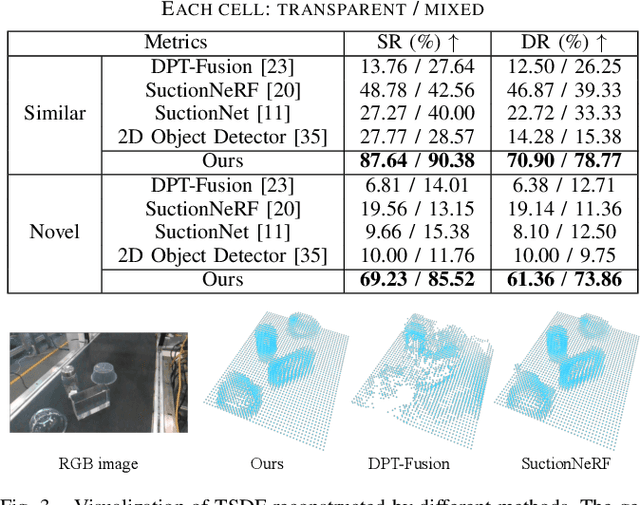
In this work, we present STOPNet, a framework for 6-DoF object suction detection on production lines, with a focus on but not limited to transparent objects, which is an important and challenging problem in robotic systems and modern industry. Current methods requiring depth input fail on transparent objects due to depth cameras' deficiency in sensing their geometry, while we proposed a novel framework to reconstruct the scene on the production line depending only on RGB input, based on multiview stereo. Compared to existing works, our method not only reconstructs the whole 3D scene in order to obtain high-quality 6-DoF suction poses in real time but also generalizes to novel environments, novel arrangements and novel objects, including challenging transparent objects, both in simulation and the real world. Extensive experiments in simulation and the real world show that our method significantly surpasses the baselines and has better generalizability, which caters to practical industrial needs.
Autonomous Intelligent Navigation for Flexible Endoscopy Using Monocular Depth Guidance and 3-D Shape Planning
Feb 26, 2023


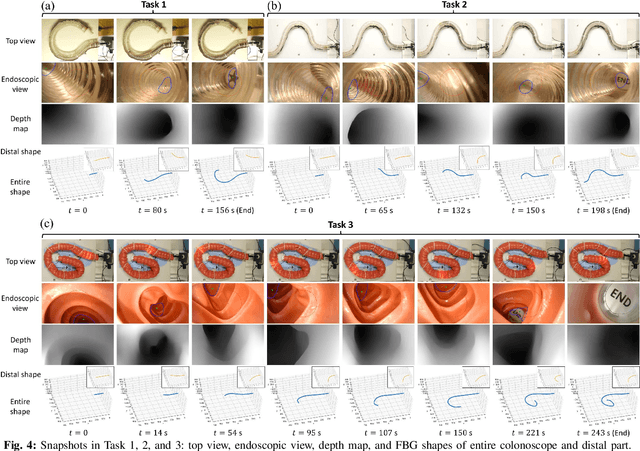
Recent advancements toward perception and decision-making of flexible endoscopes have shown great potential in computer-aided surgical interventions. However, owing to modeling uncertainty and inter-patient anatomical variation in flexible endoscopy, the challenge remains for efficient and safe navigation in patient-specific scenarios. This paper presents a novel data-driven framework with self-contained visual-shape fusion for autonomous intelligent navigation of flexible endoscopes requiring no priori knowledge of system models and global environments. A learning-based adaptive visual servoing controller is proposed to online update the eye-in-hand vision-motor configuration and steer the endoscope, which is guided by monocular depth estimation via a vision transformer (ViT). To prevent unnecessary and excessive interactions with surrounding anatomy, an energy-motivated shape planning algorithm is introduced through entire endoscope 3-D proprioception from embedded fiber Bragg grating (FBG) sensors. Furthermore, a model predictive control (MPC) strategy is developed to minimize the elastic potential energy flow and simultaneously optimize the steering policy. Dedicated navigation experiments on a robotic-assisted flexible endoscope with an FBG fiber in several phantom environments demonstrate the effectiveness and adaptability of the proposed framework.
Dual-View Selective Instance Segmentation Network for Unstained Live Adherent Cells in Differential Interference Contrast Images
Jan 27, 2023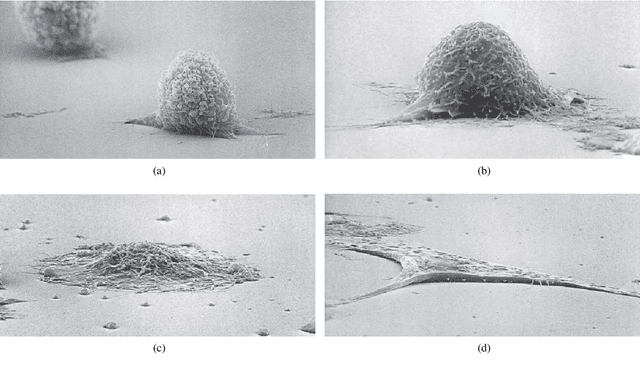
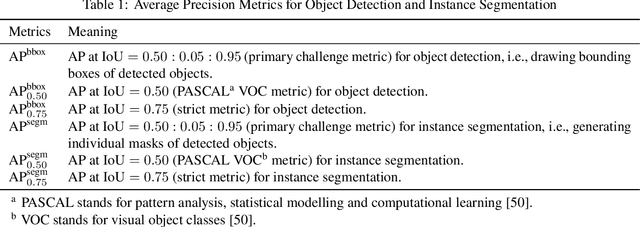
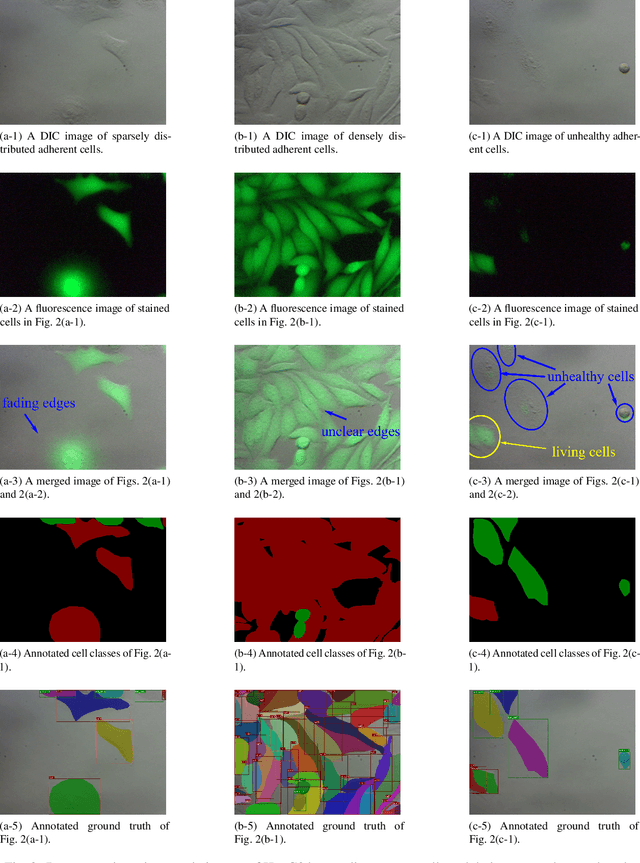
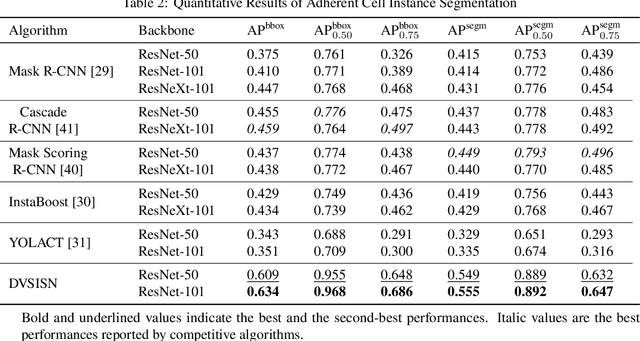
Despite recent advances in data-independent and deep-learning algorithms, unstained live adherent cell instance segmentation remains a long-standing challenge in cell image processing. Adherent cells' inherent visual characteristics, such as low contrast structures, fading edges, and irregular morphology, have made it difficult to distinguish from one another, even by human experts, let alone computational methods. In this study, we developed a novel deep-learning algorithm called dual-view selective instance segmentation network (DVSISN) for segmenting unstained adherent cells in differential interference contrast (DIC) images. First, we used a dual-view segmentation (DVS) method with pairs of original and rotated images to predict the bounding box and its corresponding mask for each cell instance. Second, we used a mask selection (MS) method to filter the cell instances predicted by the DVS to keep masks closest to the ground truth only. The developed algorithm was trained and validated on our dataset containing 520 images and 12198 cells. Experimental results demonstrate that our algorithm achieves an AP_segm of 0.555, which remarkably overtakes a benchmark by a margin of 23.6%. This study's success opens up a new possibility of using rotated images as input for better prediction in cell images.
Distilled Visual and Robot Kinematics Embeddings for Metric Depth Estimation in Monocular Scene Reconstruction
Nov 27, 2022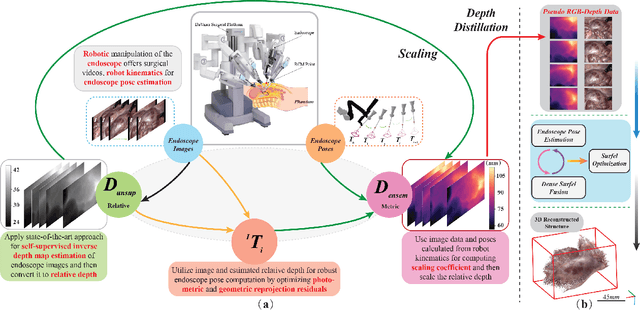
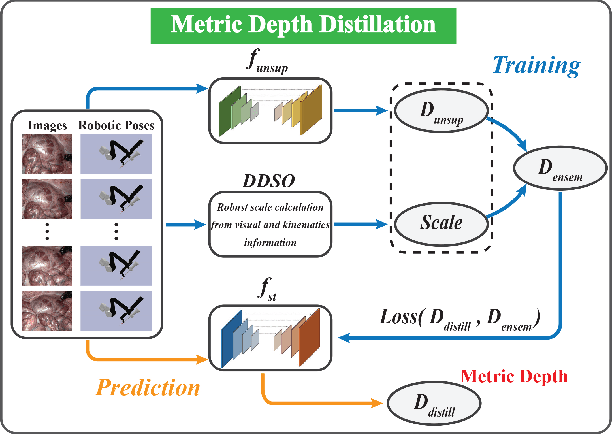
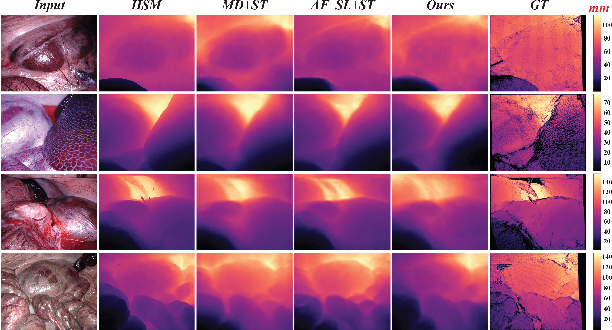

Estimating precise metric depth and scene reconstruction from monocular endoscopy is a fundamental task for surgical navigation in robotic surgery. However, traditional stereo matching adopts binocular images to perceive the depth information, which is difficult to transfer to the soft robotics-based surgical systems due to the use of monocular endoscopy. In this paper, we present a novel framework that combines robot kinematics and monocular endoscope images with deep unsupervised learning into a single network for metric depth estimation and then achieve 3D reconstruction of complex anatomy. Specifically, we first obtain the relative depth maps of surgical scenes by leveraging a brightness-aware monocular depth estimation method. Then, the corresponding endoscope poses are computed based on non-linear optimization of geometric and photometric reprojection residuals. Afterwards, we develop a Depth-driven Sliding Optimization (DDSO) algorithm to extract the scaling coefficient from kinematics and calculated poses offline. By coupling the metric scale and relative depth data, we form a robust ensemble that represents the metric and consistent depth. Next, we treat the ensemble as supervisory labels to train a metric depth estimation network for surgeries (i.e., MetricDepthS-Net) that distills the embeddings from the robot kinematics, endoscopic videos, and poses. With accurate metric depth estimation, we utilize a dense visual reconstruction method to recover the 3D structure of the whole surgical site. We have extensively evaluated the proposed framework on public SCARED and achieved comparable performance with stereo-based depth estimation methods. Our results demonstrate the feasibility of the proposed approach to recover the metric depth and 3D structure with monocular inputs.