 Add to Chrome
 Add to Firefox
 Add to Edge
GeoWorldAD: Geometry World Action Model for Autonomous Driving
Jul 20, 2026
Autonomous driving requires both safe and efficient planning decisions in dynamic 3D environments. Although recent Vision/Video-Action models learn policies directly from visual observations and scale well with advances in vision transformers and large-scale training data, they often lack explicit geometric grounding and future-aware spatial guidance, limiting their ability to balance collision avoidance and driving progress. In this work, we propose GeoWorldAD, a geometry world action model that grounds trajectory planning in ego-aligned 3D space and anticipates short-horizon scene evolution with latent future geometry tokens. Present geometry provides essential spatial constraints for safe planning, while future geometry reveals how surrounding agents and ego-centric free space may evolve, reducing overly conservative decisions without sacrificing safety. To efficiently exploit these geometric cues, GeoWorldAD progressively aggregates multi-scale present geometry and latent future geometry through iterative trajectory refinement. Experiments on NAVSIM v1 and v2 demonstrate state-of-the-art performance, highlighting the effectiveness of explicit 3D geometry grounding and future geometry world modeling for safe and efficient autonomous driving.

OneVL: One-Step Latent Reasoning and Planning with Vision-Language Explanation
Apr 20, 2026Chain-of-Thought (CoT) reasoning has become a powerful driver of trajectory prediction in VLA-based autonomous driving, yet its autoregressive nature imposes a latency cost that is prohibitive for real-time deployment. Latent CoT methods attempt to close this gap by compressing reasoning into continuous hidden states, but consistently fall short of their explicit counterparts. We suggest that this is due to purely linguistic latent representations compressing a symbolic abstraction of the world, rather than the causal dynamics that actually govern driving. Thus, we present OneVL (One-step latent reasoning and planning with Vision-Language explanations), a unified VLA and World Model framework that routes reasoning through compact latent tokens supervised by dual auxiliary decoders. Alongside a language decoder that reconstructs text CoT, we introduce a visual world model decoder that predicts future-frame tokens, forcing the latent space to internalize the causal dynamics of road geometry, agent motion, and environmental change. A three-stage training pipeline progressively aligns these latents with trajectory, language, and visual objectives, ensuring stable joint optimization. At inference, the auxiliary decoders are discarded and all latent tokens are prefilled in a single parallel pass, matching the speed of answer-only prediction. Across four benchmarks, OneVL becomes the first latent CoT method to surpass explicit CoT, delivering state-of-the-art accuracy at answer-only latency, and providing direct evidence that tighter compression, when guided in both language and world-model supervision, produces more generalizable representations than verbose token-by-token reasoning. Project Page: https://xiaomi-embodied-intelligence.github.io/OneVL
OpenGo: An OpenClaw-Based Robotic Dog with Real-Time Skill Switching
Apr 02, 2026Adaptation to complex tasks and multiple scenarios remains a significant challenge for a single robot agent. The ability to acquire organize, and switch between a wide range of skills in real time, particularly in dynamic environments, has become a fundamental requirement for embodied intelligence. We introduce OpenGo, an OpenClaw-powered embodied robotic dog capable of switching skills in real time according to the scene and task instructions. Specifically, the agent is equipped with (1) a customizable skill library with easy skill import and autonomous skill validation, (2) a dispatcher that selects and invokes different skills according to task prompts or language instructions, and (3) a self-learning framework that fine-tunes skills based on task completion and human feedback. We deploy the agent in Unitree's Go2 robotic dog and validate its capabilities in self-checking and switching of skills autonomously. In addition, by integrating Feishu-platform communication, we enable natural-language guidance and human feedback, allowing inexperienced users to control the robotic dog through simple instructions.
DVGT-2: Vision-Geometry-Action Model for Autonomous Driving at Scale
Apr 01, 2026End-to-end autonomous driving has evolved from the conventional paradigm based on sparse perception into vision-language-action (VLA) models, which focus on learning language descriptions as an auxiliary task to facilitate planning. In this paper, we propose an alternative Vision-Geometry-Action (VGA) paradigm that advocates dense 3D geometry as the critical cue for autonomous driving. As vehicles operate in a 3D world, we think dense 3D geometry provides the most comprehensive information for decision-making. However, most existing geometry reconstruction methods (e.g., DVGT) rely on computationally expensive batch processing of multi-frame inputs and cannot be applied to online planning. To address this, we introduce a streaming Driving Visual Geometry Transformer (DVGT-2), which processes inputs in an online manner and jointly outputs dense geometry and trajectory planning for the current frame. We employ temporal causal attention and cache historical features to support on-the-fly inference. To further enhance efficiency, we propose a sliding-window streaming strategy and use historical caches within a certain interval to avoid repetitive computations. Despite the faster speed, DVGT-2 achieves superior geometry reconstruction performance on various datasets. The same trained DVGT-2 can be directly applied to planning across diverse camera configurations without fine-tuning, including closed-loop NAVSIM and open-loop nuScenes benchmarks.
VILTA: A VLM-in-the-Loop Adversary for Enhancing Driving Policy Robustness
Jan 19, 2026The safe deployment of autonomous driving (AD) systems is fundamentally hindered by the long-tail problem, where rare yet critical driving scenarios are severely underrepresented in real-world data. Existing solutions including safety-critical scenario generation and closed-loop learning often rely on rule-based heuristics, resampling methods and generative models learned from offline datasets, limiting their ability to produce diverse and novel challenges. While recent works leverage Vision Language Models (VLMs) to produce scene descriptions that guide a separate, downstream model in generating hazardous trajectories for agents, such two-stage framework constrains the generative potential of VLMs, as the diversity of the final trajectories is ultimately limited by the generalization ceiling of the downstream algorithm. To overcome these limitations, we introduce VILTA (VLM-In-the-Loop Trajectory Adversary), a novel framework that integrates a VLM into the closed-loop training of AD agents. Unlike prior works, VILTA actively participates in the training loop by comprehending the dynamic driving environment and strategically generating challenging scenarios through direct, fine-grained editing of surrounding agents' future trajectories. This direct-editing approach fully leverages the VLM's powerful generalization capabilities to create a diverse curriculum of plausible yet challenging scenarios that extend beyond the scope of traditional methods. We demonstrate that our approach substantially enhances the safety and robustness of the resulting AD policy, particularly in its ability to navigate critical long-tail events.
NEUSIS: A Compositional Neuro-Symbolic Framework for Autonomous Perception, Reasoning, and Planning in Complex UAV Search Missions
Sep 16, 2024


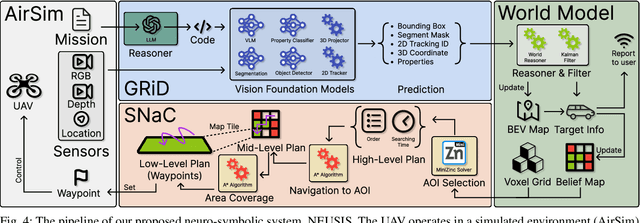
This paper addresses the problem of autonomous UAV search missions, where a UAV must locate specific Entities of Interest (EOIs) within a time limit, based on brief descriptions in large, hazard-prone environments with keep-out zones. The UAV must perceive, reason, and make decisions with limited and uncertain information. We propose NEUSIS, a compositional neuro-symbolic system designed for interpretable UAV search and navigation in realistic scenarios. NEUSIS integrates neuro-symbolic visual perception, reasoning, and grounding (GRiD) to process raw sensory inputs, maintains a probabilistic world model for environment representation, and uses a hierarchical planning component (SNaC) for efficient path planning. Experimental results from simulated urban search missions using AirSim and Unreal Engine show that NEUSIS outperforms a state-of-the-art (SOTA) vision-language model and a SOTA search planning model in success rate, search efficiency, and 3D localization. These results demonstrate the effectiveness of our compositional neuro-symbolic approach in handling complex, real-world scenarios, making it a promising solution for autonomous UAV systems in search missions.