 Add to Chrome
 Add to Firefox
 Add to Edge
PerceptDrive: Perception Prior World-Action Modeling with Adaptive Expert Routing for End-to-End Autonomous Driving
Jul 22, 2026
Frozen perception foundation models encode rich geometric, semantic, and dynamic knowledge. Yet narrow conditioning interfaces may attenuate task-relevant cues, while static fusion cannot adjust expert contributions to each scene. We cast this challenge as the prior-to-plan transfer problem and introduce PerceptDrive, a perception prior world-action modeling framework with adaptive expert routing. PerceptDrive feeds teacher-distilled priors from a frozen, driving-adapted provider and dense observation latents from a frozen self-supervised video encoder into a trainable expert-routed world-action model. Expert-specific query branches process these signals, while a prior-retention objective anchors each branch to its prior. A router predicts soft gates from a shared scene representation and combines the expert conditions before trajectory generation. During training, privileged rule-based sub-metric estimates for branch-specific trajectory drafts provide soft-gate distillation targets. The predicted action-free future latent conditions a flow-matching actor. At inference, privileged components are absent; with one front-facing camera, PerceptDrive generates one trajectory per planning step without test-time scoring, reranking, or search. Experiments show that PerceptDrive achieves state-of-the-art performance with 90.4 PDMS on NAVSIM v1 and 90.2 EPDMS on NAVSIM v2, outperforming existing methods. Ablations confirm complementary gains from prior retention and scene-conditioned routing, alongside differential reliance on the three priors. These results demonstrate that preserving and adaptively routing perception priors improves direct planning without test-time candidate selection.

ForgeDrive: Bidirectional Cross-Conditioning for Unified Visual-Action Generation in Autonomous Driving
Jun 30, 2026World-model-based autonomous driving endows the model with the ability to understand scene evolution. Yet this promise is undermined by the prevailing imagine-then-act paradigm, which allows errors from the more challenging visual generation stage to cascade into action planning. We introduce ForgeDrive, a unified autoregressive diffusion framework with visual-action cross-conditioning that closes this gap through act-then-imagine paradigm. ForgeDrive factorizes the future as a sequence of per-timestep frame-action pairs, intertwining each action with its corresponding visual observation. During training, we decouple the diffusion timesteps of the two modalities and introduce a UniDiffuser-style noise scheduler to get the ability to infer either modality from its counterpart and deepen understanding of relationships between images and actions. At inference, we propose a novel act-then-imagine inference paradigm, and find that at each step, action generation is a capability internalized during training, requiring no clean future frame as a prerequisite at inference time; instead, the generated action can improve the accuracy of future frame generation, which in turn enhances the quality of the next action. Additionally, we augment each step with future ego-status prediction, further sharpening planning ability. Extensive experiments on NAVSIM demonstrate that ForgeDrive not only unifies driving simulation, planning, and visual odometry into a single model, but also outperforms existing strong planners without any post-training strategy.
CHILLGuard: Towards Fine-Grained Chinese LLM Safety Guardrail with Scalable Data Construction and Model-aware Preference Alignment
Jun 13, 2026Malicious content generated from large language models (LLMs) could pose severe safety risks and ethical concerns. While existing LLM safety guardrails excel in English or multilingual settings, they lack adaptation to Chinese-specific regulatory policies, cultural context and linguistic nuances, failing to support fine-grained risk classification for diverse deployment needs. In this paper, we introduce a 5-macro, 31-micro category fine-grained risk taxonomy for Chinese scenarios, and build CHILLGuard: a dedicated Chinese LLM content safety guardrail. To address the critical scarcity of high-quality annotated Chinese safety data, we propose a scalable multi-stage data construction pipeline: we expand multi-source corpus via retrieval-augmented generation, generate implicit harmful samples through prompt engineering rewriting, and refine high-quality data via multi-model voting-based label calibration. Based on this, we build CHILLGuardTrain, a large-scale training set with 405,007 samples, and CHILLGuardTest, a rigorously curated annotated test set with 51,745 samples. We then train CHILLGuard on CHILLGuardTrain under a generator-classifier collaborative framework via Model-aware Direct Preference Optimization. Extensive experiments under multiple settings demonstrate the state-of-the-art performance of CHILLGuard, e.g., a 15.92% improvement of F1 score over Qwen3Guard-8B-Strict on our benchmark. We will release our resources at https://github.com/cswbyu/CHILLGuard.
SurroundSDF: Implicit 3D Scene Understanding Based on Signed Distance Field
Mar 21, 2024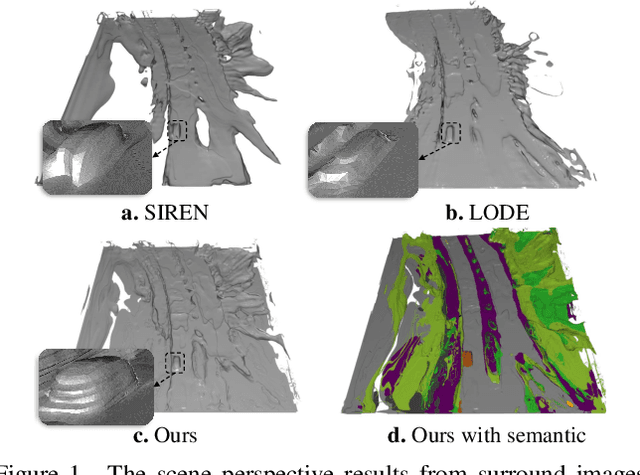
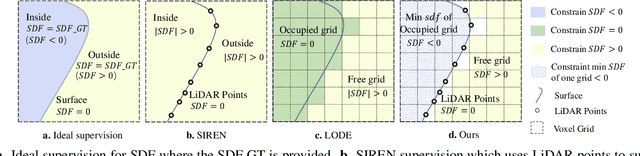
Vision-centric 3D environment understanding is both vital and challenging for autonomous driving systems. Recently, object-free methods have attracted considerable attention. Such methods perceive the world by predicting the semantics of discrete voxel grids but fail to construct continuous and accurate obstacle surfaces. To this end, in this paper, we propose SurroundSDF to implicitly predict the signed distance field (SDF) and semantic field for the continuous perception from surround images. Specifically, we introduce a query-based approach and utilize SDF constrained by the Eikonal formulation to accurately describe the surfaces of obstacles. Furthermore, considering the absence of precise SDF ground truth, we propose a novel weakly supervised paradigm for SDF, referred to as the Sandwich Eikonal formulation, which emphasizes applying correct and dense constraints on both sides of the surface, thereby enhancing the perceptual accuracy of the surface. Experiments suggest that our method achieves SOTA for both occupancy prediction and 3D scene reconstruction tasks on the nuScenes dataset.