 Add to Chrome
 Add to Firefox
 Add to Edge
RAIL: Reachability-Aided Imitation Learning for Safe Policy Execution
Sep 28, 2024
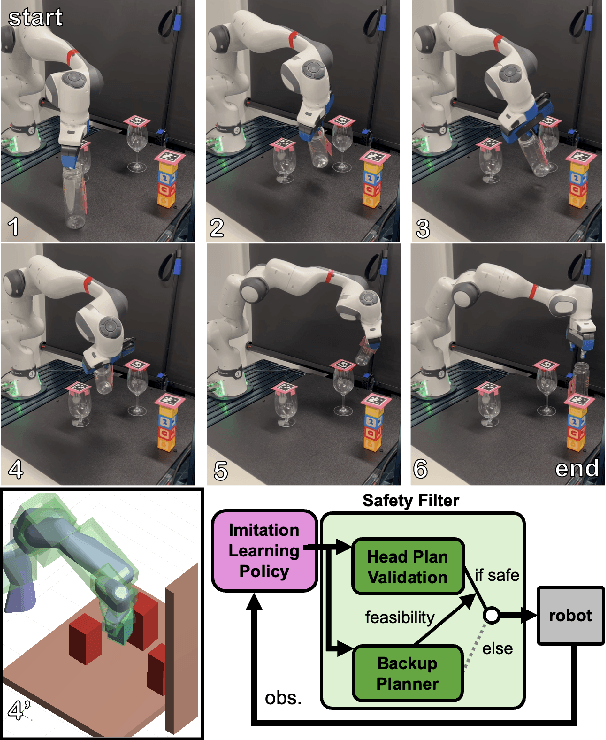
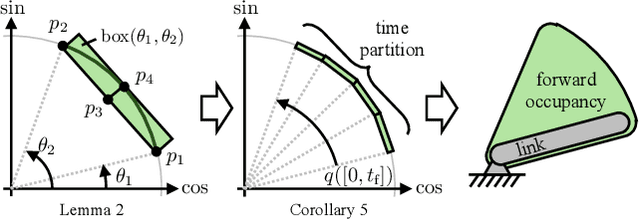
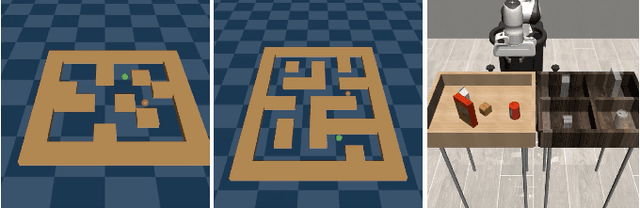

Imitation learning (IL) has shown great success in learning complex robot manipulation tasks. However, there remains a need for practical safety methods to justify widespread deployment. In particular, it is important to certify that a system obeys hard constraints on unsafe behavior in settings when it is unacceptable to design a tradeoff between performance and safety via tuning the policy (i.e. soft constraints). This leads to the question, how does enforcing hard constraints impact the performance (meaning safely completing tasks) of an IL policy? To answer this question, this paper builds a reachability-based safety filter to enforce hard constraints on IL, which we call Reachability-Aided Imitation Learning (RAIL). Through evaluations with state-of-the-art IL policies in mobile robots and manipulation tasks, we make two key findings. First, the highest-performing policies are sometimes only so because they frequently violate constraints, and significantly lose performance under hard constraints. Second, surprisingly, hard constraints on the lower-performing policies can occasionally increase their ability to perform tasks safely. Finally, hardware evaluation confirms the method can operate in real time.

Generative Factor Chaining: Coordinated Manipulation with Diffusion-based Factor Graph
Sep 24, 2024Learning to plan for multi-step, multi-manipulator tasks is notoriously difficult because of the large search space and the complex constraint satisfaction problems. We present Generative Factor Chaining~(GFC), a composable generative model for planning. GFC represents a planning problem as a spatial-temporal factor graph, where nodes represent objects and robots in the scene, spatial factors capture the distributions of valid relationships among nodes, and temporal factors represent the distributions of skill transitions. Each factor is implemented as a modular diffusion model, which are composed during inference to generate feasible long-horizon plans through bi-directional message passing. We show that GFC can solve complex bimanual manipulation tasks and exhibits strong generalization to unseen planning tasks with novel combinations of objects and constraints. More details can be found at: https://generative-fc.github.io/
Deep Generative Models in Robotics: A Survey on Learning from Multimodal Demonstrations
Aug 08, 2024


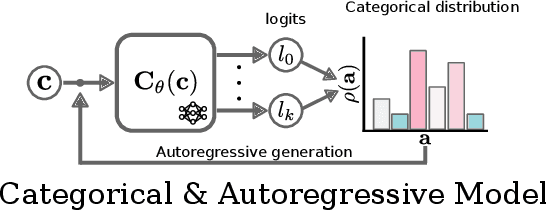
Learning from Demonstrations, the field that proposes to learn robot behavior models from data, is gaining popularity with the emergence of deep generative models. Although the problem has been studied for years under names such as Imitation Learning, Behavioral Cloning, or Inverse Reinforcement Learning, classical methods have relied on models that don't capture complex data distributions well or don't scale well to large numbers of demonstrations. In recent years, the robot learning community has shown increasing interest in using deep generative models to capture the complexity of large datasets. In this survey, we aim to provide a unified and comprehensive review of the last year's progress in the use of deep generative models in robotics. We present the different types of models that the community has explored, such as energy-based models, diffusion models, action value maps, or generative adversarial networks. We also present the different types of applications in which deep generative models have been used, from grasp generation to trajectory generation or cost learning. One of the most important elements of generative models is the generalization out of distributions. In our survey, we review the different decisions the community has made to improve the generalization of the learned models. Finally, we highlight the research challenges and propose a number of future directions for learning deep generative models in robotics.
Neural Visibility Field for Uncertainty-Driven Active Mapping
Jun 11, 2024This paper presents Neural Visibility Field (NVF), a novel uncertainty quantification method for Neural Radiance Fields (NeRF) applied to active mapping. Our key insight is that regions not visible in the training views lead to inherently unreliable color predictions by NeRF at this region, resulting in increased uncertainty in the synthesized views. To address this, we propose to use Bayesian Networks to composite position-based field uncertainty into ray-based uncertainty in camera observations. Consequently, NVF naturally assigns higher uncertainty to unobserved regions, aiding robots to select the most informative next viewpoints. Extensive evaluations show that NVF excels not only in uncertainty quantification but also in scene reconstruction for active mapping, outperforming existing methods.
A Survey of Optimization-based Task and Motion Planning: From Classical To Learning Approaches
Apr 05, 2024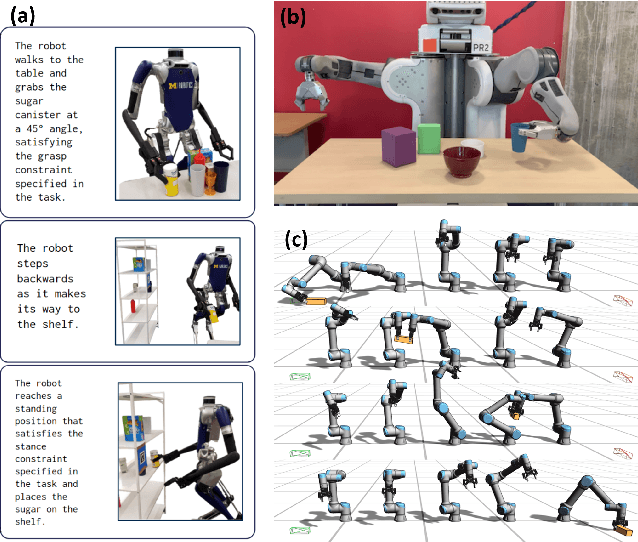
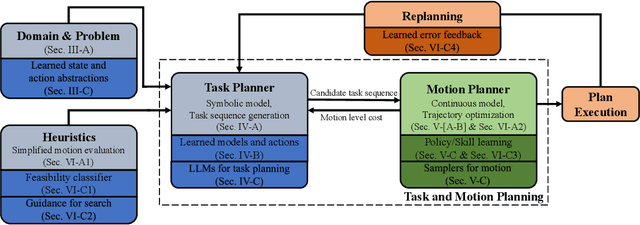

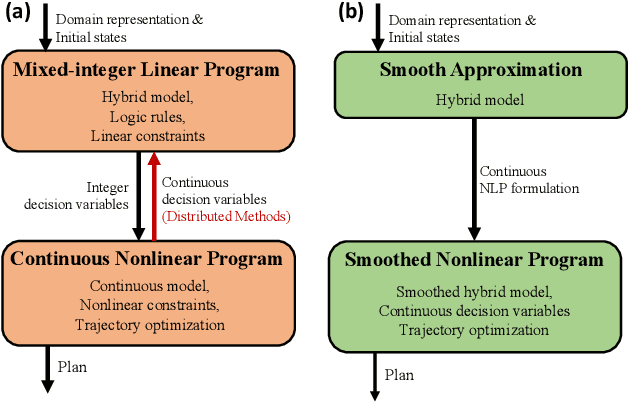
Task and Motion Planning (TAMP) integrates high-level task planning and low-level motion planning to equip robots with the autonomy to effectively reason over long-horizon, dynamic tasks. Optimization-based TAMP focuses on hybrid optimization approaches that define goal conditions via objective functions and are capable of handling open-ended goals, robotic dynamics, and physical interaction between the robot and the environment. Therefore, optimization-based TAMP is particularly suited to solve highly complex, contact-rich locomotion and manipulation problems. This survey provides a comprehensive review on optimization-based TAMP, covering (i) planning domain representations, including action description languages and temporal logic, (ii) individual solution strategies for components of TAMP, including AI planning and trajectory optimization (TO), and (iii) the dynamic interplay between logic-based task planning and model-based TO. A particular focus of this survey is to highlight the algorithm structures to efficiently solve TAMP, especially hierarchical and distributed approaches. Additionally, the survey emphasizes the synergy between the classical methods and contemporary learning-based innovations such as large language models. Furthermore, the future research directions for TAMP is discussed in this survey, highlighting both algorithmic and application-specific challenges.
InstantSplat: Unbounded Sparse-view Pose-free Gaussian Splatting in 40 Seconds
Mar 29, 2024While novel view synthesis (NVS) has made substantial progress in 3D computer vision, it typically requires an initial estimation of camera intrinsics and extrinsics from dense viewpoints. This pre-processing is usually conducted via a Structure-from-Motion (SfM) pipeline, a procedure that can be slow and unreliable, particularly in sparse-view scenarios with insufficient matched features for accurate reconstruction. In this work, we integrate the strengths of point-based representations (e.g., 3D Gaussian Splatting, 3D-GS) with end-to-end dense stereo models (DUSt3R) to tackle the complex yet unresolved issues in NVS under unconstrained settings, which encompasses pose-free and sparse view challenges. Our framework, InstantSplat, unifies dense stereo priors with 3D-GS to build 3D Gaussians of large-scale scenes from sparseview & pose-free images in less than 1 minute. Specifically, InstantSplat comprises a Coarse Geometric Initialization (CGI) module that swiftly establishes a preliminary scene structure and camera parameters across all training views, utilizing globally-aligned 3D point maps derived from a pre-trained dense stereo pipeline. This is followed by the Fast 3D-Gaussian Optimization (F-3DGO) module, which jointly optimizes the 3D Gaussian attributes and the initialized poses with pose regularization. Experiments conducted on the large-scale outdoor Tanks & Temples datasets demonstrate that InstantSplat significantly improves SSIM (by 32%) while concurrently reducing Absolute Trajectory Error (ATE) by 80%. These establish InstantSplat as a viable solution for scenarios involving posefree and sparse-view conditions. Project page: instantsplat.github.io.
EmerNeRF: Emergent Spatial-Temporal Scene Decomposition via Self-Supervision
Nov 03, 2023We present EmerNeRF, a simple yet powerful approach for learning spatial-temporal representations of dynamic driving scenes. Grounded in neural fields, EmerNeRF simultaneously captures scene geometry, appearance, motion, and semantics via self-bootstrapping. EmerNeRF hinges upon two core components: First, it stratifies scenes into static and dynamic fields. This decomposition emerges purely from self-supervision, enabling our model to learn from general, in-the-wild data sources. Second, EmerNeRF parameterizes an induced flow field from the dynamic field and uses this flow field to further aggregate multi-frame features, amplifying the rendering precision of dynamic objects. Coupling these three fields (static, dynamic, and flow) enables EmerNeRF to represent highly-dynamic scenes self-sufficiently, without relying on ground truth object annotations or pre-trained models for dynamic object segmentation or optical flow estimation. Our method achieves state-of-the-art performance in sensor simulation, significantly outperforming previous methods when reconstructing static (+2.93 PSNR) and dynamic (+3.70 PSNR) scenes. In addition, to bolster EmerNeRF's semantic generalization, we lift 2D visual foundation model features into 4D space-time and address a general positional bias in modern Transformers, significantly boosting 3D perception performance (e.g., 37.50% relative improvement in occupancy prediction accuracy on average). Finally, we construct a diverse and challenging 120-sequence dataset to benchmark neural fields under extreme and highly-dynamic settings.
Constrained-Context Conditional Diffusion Models for Imitation Learning
Nov 02, 2023Offline Imitation Learning (IL) is a powerful paradigm to learn visuomotor skills, especially for high-precision manipulation tasks. However, IL methods are prone to spurious correlation - expressive models may focus on distractors that are irrelevant to action prediction - and are thus fragile in real-world deployment. Prior methods have addressed this challenge by exploring different model architectures and action representations. However, none were able to balance between sample efficiency, robustness against distractors, and solving high-precision manipulation tasks with complex action space. To this end, we present $\textbf{C}$onstrained-$\textbf{C}$ontext $\textbf{C}$onditional $\textbf{D}$iffusion $\textbf{M}$odel (C3DM), a diffusion model policy for solving 6-DoF robotic manipulation tasks with high precision and ability to ignore distractions. A key component of C3DM is a fixation step that helps the action denoiser to focus on task-relevant regions around the predicted action while ignoring distractors in the context. We empirically show that C3DM is able to consistently achieve high success rate on a wide array of tasks, ranging from table top manipulation to industrial kitting, that require varying levels of precision and robustness to distractors. For details, please visit this https://sites.google.com/view/c3dm-imitation-learning
NOD-TAMP: Multi-Step Manipulation Planning with Neural Object Descriptors
Nov 02, 2023
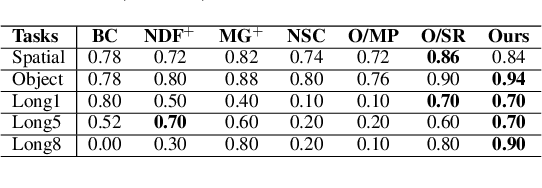
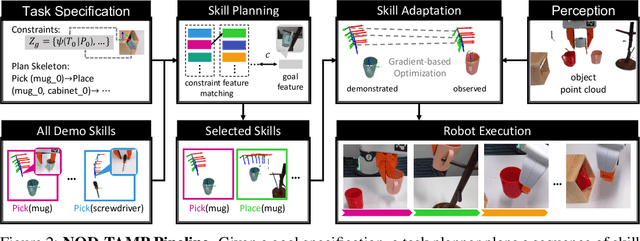
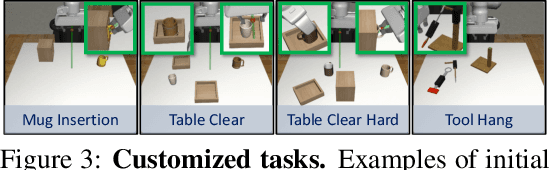
Developing intelligent robots for complex manipulation tasks in household and factory settings remains challenging due to long-horizon tasks, contact-rich manipulation, and the need to generalize across a wide variety of object shapes and scene layouts. While Task and Motion Planning (TAMP) offers a promising solution, its assumptions such as kinodynamic models limit applicability in novel contexts. Neural object descriptors (NODs) have shown promise in object and scene generalization but face limitations in addressing broader tasks. Our proposed TAMP-based framework, NOD-TAMP, extracts short manipulation trajectories from a handful of human demonstrations, adapts these trajectories using NOD features, and composes them to solve broad long-horizon tasks. Validated in a simulation environment, NOD-TAMP effectively tackles varied challenges and outperforms existing methods, establishing a cohesive framework for manipulation planning. For videos and other supplemental material, see the project website: https://sites.google.com/view/nod-tamp/.
Neural Field Dynamics Model for Granular Object Piles Manipulation
Nov 01, 2023We present a learning-based dynamics model for granular material manipulation. Inspired by the Eulerian approach commonly used in fluid dynamics, our method adopts a fully convolutional neural network that operates on a density field-based representation of object piles and pushers, allowing it to exploit the spatial locality of inter-object interactions as well as the translation equivariance through convolution operations. Furthermore, our differentiable action rendering module makes the model fully differentiable and can be directly integrated with a gradient-based trajectory optimization algorithm. We evaluate our model with a wide array of piles manipulation tasks both in simulation and real-world experiments and demonstrate that it significantly exceeds existing latent or particle-based methods in both accuracy and computation efficiency, and exhibits zero-shot generalization capabilities across various environments and tasks.