 Add to Chrome
 Add to Firefox
 Add to Edge
ScaRF-SLAM: Scale-Consistent Reconstruction with Feed-Forward Models and Classical Visual SLAM
May 29, 2026
Recent works have explored unifying SLAM with geometric foundation models (GFMs). However, directly using GFM predictions for tracking is highly sensitive to model capability and uncertainty, as geometric inaccuracies in the predictions can adversely affect pose estimation. To address this limitation, we present a decoupled framework that integrates classical feature-based SLAM with GFMs, which achieves higher quality and more consistent dense reconstruction. In brief, we use classical visual SLAM for robust low-latency tracking and use GFMs exclusively for mapping. By anchoring mapping to poses produced by the SLAM module and optimizing across depth scales, the proposed design avoids propagating inaccuracies from GFM predictions into pose estimation while imposing geometric constraints on the reconstruction. The system builds submaps from multiple posed keyframes and enforces scale consistency via lightweight frame and submap scale optimization. It also performs projection-based point cloud fusion within each submap, and updates submaps online to reflect trajectory updates from the feature-based SLAM. To evaluate tracking and reconstruction of our method, we introduce a loop-rich, building-scale indoor dataset with accurate sensor trajectories and LiDAR ground-truth. Experiments show that our approach achieves superior trajectory accuracy while improving reconstruction precision by 10%-20% over existing methods, with about 2 cm reconstruction error per 10 m chunk on building-scale dataset. On large-scale outdoor datasets, it attains 10 cm error per 30 m chunk (w.r.t LiDAR ground-truth models).

Exploiting Chordal Sparsity for Globally Optimal Estimation with Factor Graphs
May 28, 2026Robust and efficient state estimation is crucial for perception, navigation, and control in robotics. State estimation problems are conveniently modeled using the factor-graph framework as enabled by modern software packages such as GTSAM or g2o. However, the standard solvers included in such frameworks are local and may converge to poor local minima, posing significant safety concerns. Conversely, techniques based on convex relaxations have been shown to provide a means of globally solving or certifying many state estimation problems. However, these relaxations 1) often require substantial effort to formulate, and 2) may incur significantly higher cost compared to efficient local solvers, as they require solving a large semidefinite program (SDP). In this work, we address both shortcomings by 1) creating a new procedure within the GTSAM framework for automatically constructing convex SDP relaxations for any factor graphs with common factor and variable types, and by 2) exploiting the Bayes tree constructions native to GTSAM to decompose the SDP problem, leading to significant speedup in solver time for chordally sparse problems. We demonstrate the favorable scaling of this structure-exploiting global estimator compared to standard local solvers for two case studies: A 3D pose-graph SLAM problem with a ring factor graph and a 2D localization problem with a chain factor graph. The software framework is available at https://github.com/borglab/gtsam.
Uncertainty-driven 3D Gaussian Splatting Active Mapping via Anisotropic Visibility Field
May 28, 2026We present Gaussian Splatting Anisotropic Visibility Field (GAVIS), a novel framework for uncertainty quantification and active mapping in 3DGS. Our key insight is that regions unseen from the training views yield unreliable predictions from the 3DGS. To address this, we introduce a principled and efficient method for quantifying the visibility field in 3DGS, defined as the anisotropic visibility of each particle with respect to the training views, and represented using spherical harmonics. The resulting visibility field is integrated into a Bayesian Network-based uncertainty-aware 3DGS rasterizer, enabling real-time (200 FPS) uncertainty quantification for synthesized views. Active mapping is further performed within a maximum information gain framework building on this formulation. Extensive experiments across diverse environments demonstrate that GAVIS consistently and significantly outperforms prior approaches in both accuracy and efficiency. Moreover, beyond standalone use, our method can be applied post-hoc to improve the performance of existing approaches.
Four Simple Proprioceptive Estimators for Legged Robots
May 21, 2026Legged robots carry an IMU, but the inertial solution drifts because consumer-grade IMUs are noisy. However, the feet create intermittent contacts with the environment that can be used to mitigate that drift. This report develops a sequence of increasingly expressive legged robot state estimators that leverage this. In all cases, the floating-base state comprises attitude, position, velocity, and IMU biases. To model foot contacts, we start from the contact-aided invariant EKF of Hartley et al., albeit at a reduced contact update rate. This is then augmented by replacing the measurement update by a small factor graph. Finally, we turn the same factors into a fixed-lag smoother with contact-episode footholds, with and without an evolving IMU bias. To facilitate reproducibility and further research in proprioceptive legged odometry, all four variants are available in GTSAM (Dellaert et. al), and we additionally provide a ROS2-compatible implementation.
CMC-Opt: Constraint Manifold with Corners for Inequality-Constrained Optimization
May 20, 2026We introduce a manifold-based framework for addressing optimization problems with equality and inequality constraints found in robotics. Our approach transforms the original problem into an unconstrained optimization problem directly on the constrained state space. To achieve this, we introduce ``constraint manifolds with corners" to represent the state space satisfying mixed nonlinear equality and inequality constraints. We further extend manifold optimization algorithms to operate on this new topological structure. We demonstrate the power and robustness of our framework in the context of a large-scale kinodynamic planning problem, successfully generating dynamically feasible trajectories where standard methods fail.
Variable Elimination in Hybrid Factor Graphs for Discrete-Continuous Inference & Estimation
Jan 02, 2026Many hybrid problems in robotics involve both continuous and discrete components, and modeling them together for estimation tasks has been a long standing and difficult problem. Hybrid Factor Graphs give us a mathematical framework to model these types of problems, however existing approaches for solving them are based on approximations. In this work, we propose an efficient Hybrid Factor Graph framework alongwith a variable elimination algorithm to produce a hybrid Bayes network, which can then be used for exact Maximum A Posteriori estimation and marginalization over both sets of variables. Our approach first develops a novel hybrid Gaussian factor which can connect to both discrete and continuous variables, and a hybrid conditional which can represent multiple continuous hypotheses conditioned on the discrete variables. Using these representations, we derive the process of hybrid variable elimination under the Conditional Linear Gaussian scheme, giving us exact posteriors as hybrid Bayes network. To bound the number of discrete hypotheses, we use a tree-structured representation of the factors coupled with a simple pruning and probabilistic assignment scheme, which allows for tractable inference. We demonstrate the applicability of our framework on a SLAM dataset with ambiguous measurements, where discrete choices for the most likely measurement have to be made. Our demonstrated results showcase the accuracy, generality, and simplicity of our hybrid factor graph framework.
SALVe: Semantic Alignment Verification for Floorplan Reconstruction from Sparse Panoramas
Jun 27, 2024We propose a new system for automatic 2D floorplan reconstruction that is enabled by SALVe, our novel pairwise learned alignment verifier. The inputs to our system are sparsely located 360$^\circ$ panoramas, whose semantic features (windows, doors, and openings) are inferred and used to hypothesize pairwise room adjacency or overlap. SALVe initializes a pose graph, which is subsequently optimized using GTSAM. Once the room poses are computed, room layouts are inferred using HorizonNet, and the floorplan is constructed by stitching the most confident layout boundaries. We validate our system qualitatively and quantitatively as well as through ablation studies, showing that it outperforms state-of-the-art SfM systems in completeness by over 200%, without sacrificing accuracy. Our results point to the significance of our work: poses of 81% of panoramas are localized in the first 2 connected components (CCs), and 89% in the first 3 CCs. Code and models are publicly available at https://github.com/zillow/salve.
Neural Visibility Field for Uncertainty-Driven Active Mapping
Jun 11, 2024This paper presents Neural Visibility Field (NVF), a novel uncertainty quantification method for Neural Radiance Fields (NeRF) applied to active mapping. Our key insight is that regions not visible in the training views lead to inherently unreliable color predictions by NeRF at this region, resulting in increased uncertainty in the synthesized views. To address this, we propose to use Bayesian Networks to composite position-based field uncertainty into ray-based uncertainty in camera observations. Consequently, NVF naturally assigns higher uncertainty to unobserved regions, aiding robots to select the most informative next viewpoints. Extensive evaluations show that NVF excels not only in uncertainty quantification but also in scene reconstruction for active mapping, outperforming existing methods.
Architectural-Scale Artistic Brush Painting with a Hybrid Cable Robot
Mar 18, 2024
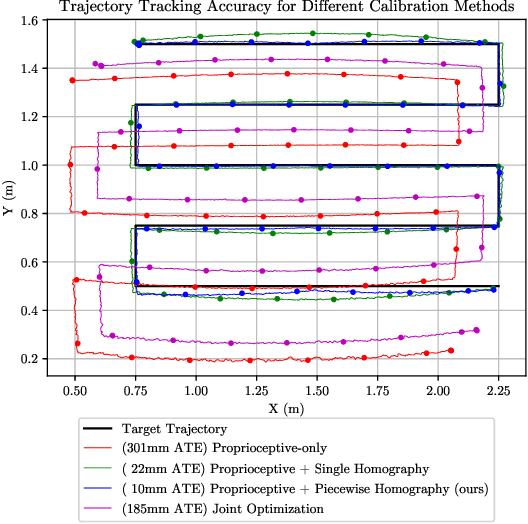

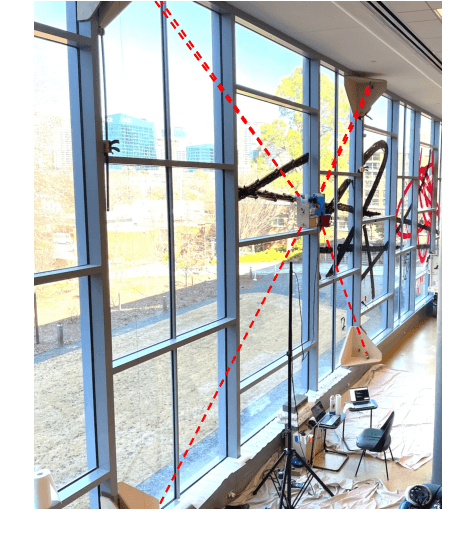
Robot art presents an opportunity to both showcase and advance state-of-the-art robotics through the challenging task of creating art. Creating large-scale artworks in particular engages the public in a way that small-scale works cannot, and the distinct qualities of brush strokes contribute to an organic and human-like quality. Combining the large scale of murals with the strokes of the brush medium presents an especially impactful result, but also introduces unique challenges in maintaining precise, dextrous motion control of the brush across such a large workspace. In this work, we present the first robot to our knowledge that can paint architectural-scale murals with a brush. We create a hybrid robot consisting of a cable-driven parallel robot and 4 degree of freedom (DoF) serial manipulator to paint a 27m by 3.7m mural on windows spanning 2-stories of a building. We discuss our approach to achieving both the scale and accuracy required for brush-painting a mural through a combination of novel mechanical design elements, coordinated planning and control, and on-site calibration algorithms with experimental validations.
A Group Theoretic Metric for Robot State Estimation Leveraging Chebyshev Interpolation
Jan 30, 2024


We propose a new metric for robot state estimation based on the recently introduced $\text{SE}_2(3)$ Lie group definition. Our metric is related to prior metrics for SLAM but explicitly takes into account the linear velocity of the state estimate, improving over current pose-based trajectory analysis. This has the benefit of providing a single, quantitative metric to evaluate state estimation algorithms against, while being compatible with existing tools and libraries. Since ground truth data generally consists of pose data from motion capture systems, we also propose an approach to compute the ground truth linear velocity based on polynomial interpolation. Using Chebyshev interpolation and a pseudospectral parameterization, we can accurately estimate the ground truth linear velocity of the trajectory in an optimal fashion with best approximation error. We demonstrate how this approach performs on multiple robotic platforms where accurate state estimation is vital, and compare it to alternative approaches such as finite differences. The pseudospectral parameterization also provides a means of trajectory data compression as an additional benefit. Experimental results show our method provides a valid and accurate means of comparing state estimation systems, which is also easy to interpret and report.