 Add to Chrome
 Add to Firefox
 Add to Edge
MosaicMem: Hybrid Spatial Memory for Controllable Video World Models
Mar 17, 2026
Video diffusion models are moving beyond short, plausible clips toward world simulators that must remain consistent under camera motion, revisits, and intervention. Yet spatial memory remains a key bottleneck: explicit 3D structures can improve reprojection-based consistency but struggle to depict moving objects, while implicit memory often produces inaccurate camera motion even with correct poses. We propose Mosaic Memory (MosaicMem), a hybrid spatial memory that lifts patches into 3D for reliable localization and targeted retrieval, while exploiting the model's native conditioning to preserve prompt-following generation. MosaicMem composes spatially aligned patches in the queried view via a patch-and-compose interface, preserving what should persist while allowing the model to inpaint what should evolve. With PRoPE camera conditioning and two new memory alignment methods, experiments show improved pose adherence compared to implicit memory and stronger dynamic modeling than explicit baselines. MosaicMem further enables minute-level navigation, memory-based scene editing, and autoregressive rollout.

RAIL: Reachability-Aided Imitation Learning for Safe Policy Execution
Sep 28, 2024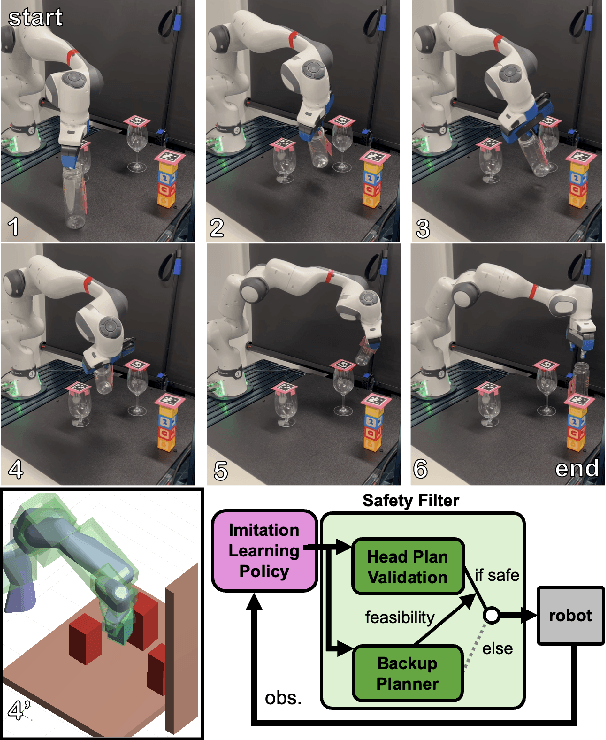
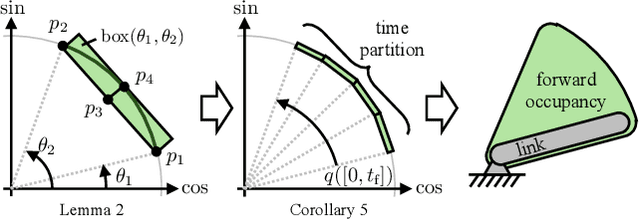
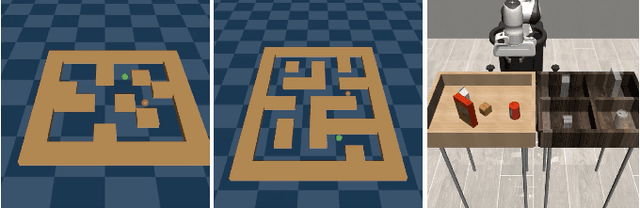

Imitation learning (IL) has shown great success in learning complex robot manipulation tasks. However, there remains a need for practical safety methods to justify widespread deployment. In particular, it is important to certify that a system obeys hard constraints on unsafe behavior in settings when it is unacceptable to design a tradeoff between performance and safety via tuning the policy (i.e. soft constraints). This leads to the question, how does enforcing hard constraints impact the performance (meaning safely completing tasks) of an IL policy? To answer this question, this paper builds a reachability-based safety filter to enforce hard constraints on IL, which we call Reachability-Aided Imitation Learning (RAIL). Through evaluations with state-of-the-art IL policies in mobile robots and manipulation tasks, we make two key findings. First, the highest-performing policies are sometimes only so because they frequently violate constraints, and significantly lose performance under hard constraints. Second, surprisingly, hard constraints on the lower-performing policies can occasionally increase their ability to perform tasks safely. Finally, hardware evaluation confirms the method can operate in real time.