 Add to Chrome
 Add to Firefox
 Add to Edge
Seedance 2.0: Advancing Video Generation for World Complexity
Apr 15, 2026
Seedance 2.0 is a new native multi-modal audio-video generation model, officially released in China in early February 2026. Compared with its predecessors, Seedance 1.0 and 1.5 Pro, Seedance 2.0 adopts a unified, highly efficient, and large-scale architecture for multi-modal audio-video joint generation. This allows it to support four input modalities: text, image, audio, and video, by integrating one of the most comprehensive suites of multi-modal content reference and editing capabilities available in the industry to date. It delivers substantial, well-rounded improvements across all key sub-dimensions of video and audio generation. In both expert evaluations and public user tests, the model has demonstrated performance on par with the leading levels in the field. Seedance 2.0 supports direct generation of audio-video content with durations ranging from 4 to 15 seconds, with native output resolutions of 480p and 720p. For multi-modal inputs as reference, its current open platform supports up to 3 video clips, 9 images, and 3 audio clips. In addition, we provide Seedance 2.0 Fast version, an accelerated variant of Seedance 2.0 designed to boost generation speed for low-latency scenarios. Seedance 2.0 has delivered significant improvements to its foundational generation capabilities and multi-modal generation performance, bringing an enhanced creative experience for end users.

Research on World Models Is Not Merely Injecting World Knowledge into Specific Tasks
Feb 02, 2026World models have emerged as a critical frontier in AI research, aiming to enhance large models by infusing them with physical dynamics and world knowledge. The core objective is to enable agents to understand, predict, and interact with complex environments. However, current research landscape remains fragmented, with approaches predominantly focused on injecting world knowledge into isolated tasks, such as visual prediction, 3D estimation, or symbol grounding, rather than establishing a unified definition or framework. While these task-specific integrations yield performance gains, they often lack the systematic coherence required for holistic world understanding. In this paper, we analyze the limitations of such fragmented approaches and propose a unified design specification for world models. We suggest that a robust world model should not be a loose collection of capabilities but a normative framework that integrally incorporates interaction, perception, symbolic reasoning, and spatial representation. This work aims to provide a structured perspective to guide future research toward more general, robust, and principled models of the world.
Seedance 1.5 pro: A Native Audio-Visual Joint Generation Foundation Model
Dec 23, 2025Recent strides in video generation have paved the way for unified audio-visual generation. In this work, we present Seedance 1.5 pro, a foundational model engineered specifically for native, joint audio-video generation. Leveraging a dual-branch Diffusion Transformer architecture, the model integrates a cross-modal joint module with a specialized multi-stage data pipeline, achieving exceptional audio-visual synchronization and superior generation quality. To ensure practical utility, we implement meticulous post-training optimizations, including Supervised Fine-Tuning (SFT) on high-quality datasets and Reinforcement Learning from Human Feedback (RLHF) with multi-dimensional reward models. Furthermore, we introduce an acceleration framework that boosts inference speed by over 10X. Seedance 1.5 pro distinguishes itself through precise multilingual and dialect lip-syncing, dynamic cinematic camera control, and enhanced narrative coherence, positioning it as a robust engine for professional-grade content creation. Seedance 1.5 pro is now accessible on Volcano Engine at https://console.volcengine.com/ark/region:ark+cn-beijing/experience/vision?type=GenVideo.
Semantic Score Distillation Sampling for Compositional Text-to-3D Generation
Oct 11, 2024


Generating high-quality 3D assets from textual descriptions remains a pivotal challenge in computer graphics and vision research. Due to the scarcity of 3D data, state-of-the-art approaches utilize pre-trained 2D diffusion priors, optimized through Score Distillation Sampling (SDS). Despite progress, crafting complex 3D scenes featuring multiple objects or intricate interactions is still difficult. To tackle this, recent methods have incorporated box or layout guidance. However, these layout-guided compositional methods often struggle to provide fine-grained control, as they are generally coarse and lack expressiveness. To overcome these challenges, we introduce a novel SDS approach, Semantic Score Distillation Sampling (SemanticSDS), designed to effectively improve the expressiveness and accuracy of compositional text-to-3D generation. Our approach integrates new semantic embeddings that maintain consistency across different rendering views and clearly differentiate between various objects and parts. These embeddings are transformed into a semantic map, which directs a region-specific SDS process, enabling precise optimization and compositional generation. By leveraging explicit semantic guidance, our method unlocks the compositional capabilities of existing pre-trained diffusion models, thereby achieving superior quality in 3D content generation, particularly for complex objects and scenes. Experimental results demonstrate that our SemanticSDS framework is highly effective for generating state-of-the-art complex 3D content. Code: https://github.com/YangLing0818/SemanticSDS-3D
Trans4D: Realistic Geometry-Aware Transition for Compositional Text-to-4D Synthesis
Oct 09, 2024Recent advances in diffusion models have demonstrated exceptional capabilities in image and video generation, further improving the effectiveness of 4D synthesis. Existing 4D generation methods can generate high-quality 4D objects or scenes based on user-friendly conditions, benefiting the gaming and video industries. However, these methods struggle to synthesize significant object deformation of complex 4D transitions and interactions within scenes. To address this challenge, we propose Trans4D, a novel text-to-4D synthesis framework that enables realistic complex scene transitions. Specifically, we first use multi-modal large language models (MLLMs) to produce a physic-aware scene description for 4D scene initialization and effective transition timing planning. Then we propose a geometry-aware 4D transition network to realize a complex scene-level 4D transition based on the plan, which involves expressive geometrical object deformation. Extensive experiments demonstrate that Trans4D consistently outperforms existing state-of-the-art methods in generating 4D scenes with accurate and high-quality transitions, validating its effectiveness. Code: https://github.com/YangLing0818/Trans4D
Consistency Flow Matching: Defining Straight Flows with Velocity Consistency
Jul 02, 2024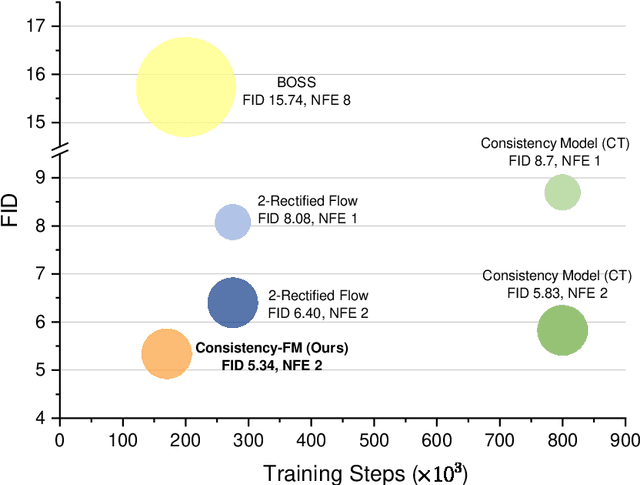

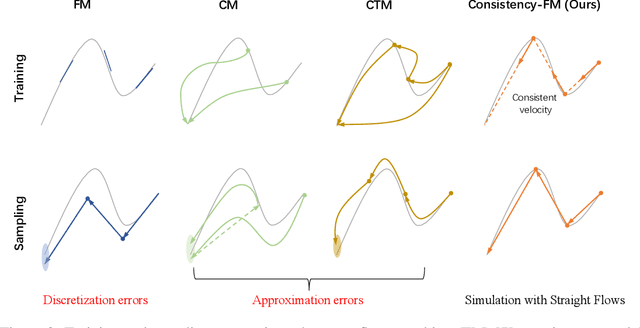
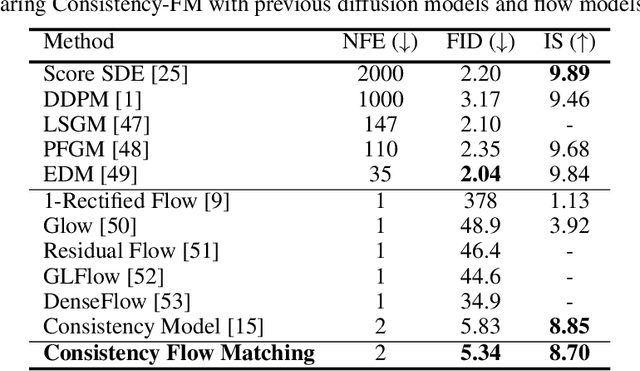
Flow matching (FM) is a general framework for defining probability paths via Ordinary Differential Equations (ODEs) to transform between noise and data samples. Recent approaches attempt to straighten these flow trajectories to generate high-quality samples with fewer function evaluations, typically through iterative rectification methods or optimal transport solutions. In this paper, we introduce Consistency Flow Matching (Consistency-FM), a novel FM method that explicitly enforces self-consistency in the velocity field. Consistency-FM directly defines straight flows starting from different times to the same endpoint, imposing constraints on their velocity values. Additionally, we propose a multi-segment training approach for Consistency-FM to enhance expressiveness, achieving a better trade-off between sampling quality and speed. Preliminary experiments demonstrate that our Consistency-FM significantly improves training efficiency by converging 4.4x faster than consistency models and 1.7x faster than rectified flow models while achieving better generation quality. Our code is available at: https://github.com/YangLing0818/consistency_flow_matching