 Add to Chrome
 Add to Firefox
 Add to Edge
BigMac: Breaking the Pareto Frontier of Compute and Memory in Multimodal LLM Training
May 25, 2026
Training multimodal large language models (MLLMs) is challenged by both model and data heterogeneity. Existing systems redesign the training pipeline to address these challenges, but remain bound by a Pareto frontier between compute and memory efficiency, improving one only at the expense of the other. We present BigMac, a new training pipeline for multimodal LLMs. The core idea of BigMac is to elegantly nest the encoder and generator computation into the original LLM pipeline, forming a dependency-safe nested pipeline structure. With this design, BigMac reduces the activation memory complexity of the encoder and generator to O(1) while keeping the activation memory complexity of the LLM unchanged. At the same time, it achieves the same computational efficiency as the idealized setting with unlimited memory. As a result, BigMac breaks the Pareto frontier between computational efficiency and memory usage, enabling simultaneous optimization of both computation and memory in MLLM training. We evaluate BigMac on multiple MLLMs and training workloads. Experimental results show that BigMac achieves a 1.08$\times$-1.9$\times$ training speedup over baseline systems while maintaining stable memory usage as batch size increases.

CoF-T2I: Video Models as Pure Visual Reasoners for Text-to-Image Generation
Jan 15, 2026Recent video generation models have revealed the emergence of Chain-of-Frame (CoF) reasoning, enabling frame-by-frame visual inference. With this capability, video models have been successfully applied to various visual tasks (e.g., maze solving, visual puzzles). However, their potential to enhance text-to-image (T2I) generation remains largely unexplored due to the absence of a clearly defined visual reasoning starting point and interpretable intermediate states in the T2I generation process. To bridge this gap, we propose CoF-T2I, a model that integrates CoF reasoning into T2I generation via progressive visual refinement, where intermediate frames act as explicit reasoning steps and the final frame is taken as output. To establish such an explicit generation process, we curate CoF-Evol-Instruct, a dataset of CoF trajectories that model the generation process from semantics to aesthetics. To further improve quality and avoid motion artifacts, we enable independent encoding operation for each frame. Experiments show that CoF-T2I significantly outperforms the base video model and achieves competitive performance on challenging benchmarks, reaching 0.86 on GenEval and 7.468 on Imagine-Bench. These results indicate the substantial promise of video models for advancing high-quality text-to-image generation.
Kling-Omni Technical Report
Dec 18, 2025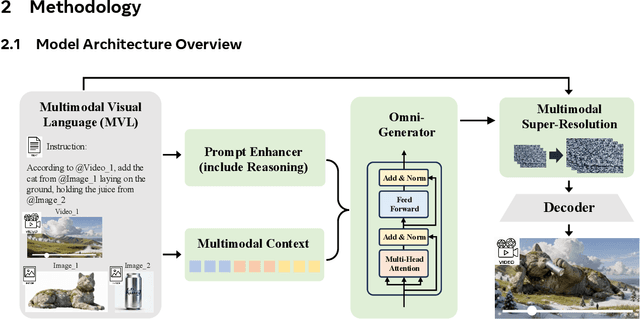
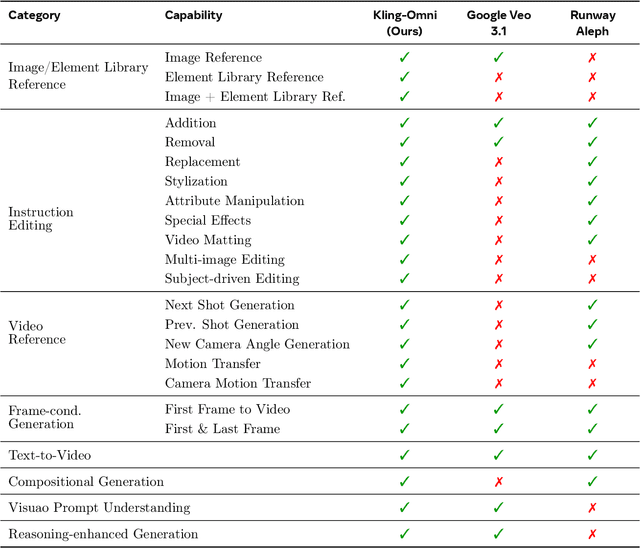
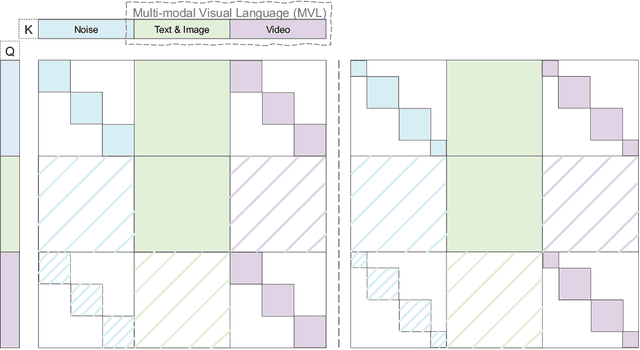
We present Kling-Omni, a generalist generative framework designed to synthesize high-fidelity videos directly from multimodal visual language inputs. Adopting an end-to-end perspective, Kling-Omni bridges the functional separation among diverse video generation, editing, and intelligent reasoning tasks, integrating them into a holistic system. Unlike disjointed pipeline approaches, Kling-Omni supports a diverse range of user inputs, including text instructions, reference images, and video contexts, processing them into a unified multimodal representation to deliver cinematic-quality and highly-intelligent video content creation. To support these capabilities, we constructed a comprehensive data system that serves as the foundation for multimodal video creation. The framework is further empowered by efficient large-scale pre-training strategies and infrastructure optimizations for inference. Comprehensive evaluations reveal that Kling-Omni demonstrates exceptional capabilities in in-context generation, reasoning-based editing, and multimodal instruction following. Moving beyond a content creation tool, we believe Kling-Omni is a pivotal advancement toward multimodal world simulators capable of perceiving, reasoning, generating and interacting with the dynamic and complex worlds.
Adversarial Multi-task Learning for End-to-end Metaphor Detection
May 26, 2023Metaphor detection (MD) suffers from limited training data. In this paper, we started with a linguistic rule called Metaphor Identification Procedure and then proposed a novel multi-task learning framework to transfer knowledge in basic sense discrimination (BSD) to MD. BSD is constructed from word sense disambiguation (WSD), which has copious amounts of data. We leverage adversarial training to align the data distributions of MD and BSD in the same feature space, so task-invariant representations can be learned. To capture fine-grained alignment patterns, we utilize the multi-mode structures of MD and BSD. Our method is totally end-to-end and can mitigate the data scarcity problem in MD. Competitive results are reported on four public datasets. Our code and datasets are available.