 Add to Chrome
 Add to Firefox
 Add to Edge
Kwai Keye-VL-2.0 Technical Report
Jun 09, 2026
We introduce Kwai Keye-VL-2.0-30B-A3B, an open-source Mixture-of-Experts (MoE) multimodal foundation model designed to advance long-video understanding and agentic intelligence. To address the challenges of ultra-long contexts, information redundancy, and prohibitive computational costs inherent in hour-level videos, Keye-VL-2.0 is the first to adapt DeepSeek Sparse Attention (DSA) to GQA-based multimodal architectures, enabling lossless 256K context processing while capturing critical frames and long-range temporal dependencies. This architecture is underpinned by a highly optimized training and inference infrastructure, including scalable video I/O, heterogeneous ViT-LM parallelism, and custom DSA kernels that significantly maximize throughput and minimize computational overhead. Furthermore, to overcome the algorithmic dilemma of catastrophic forgetting during multi-task alignment, we introduce Cross-Modal Multi-Teacher On-Policy Distillation (MOPD) paired with Context-RL and Video-RL. By distilling dense token-level teacher feedback from on-policy rollouts back into the MoE backbone, which activates only 3B parameters, Keye-VL-2.0 natively empowers advanced agent collaboration across Code, Tool, and Search scenarios with multimodal self-correction. Extensive evaluations across video understanding, temporal grounding, reasoning, STEM, and agent benchmarks demonstrate that Keye-VL-2.0-30B-A3B achieves state-of-the-art performance among models of similar scale, particularly excelling in fine-grained temporal localization on TimeLens and long-video comprehension on Video-MME-v2 and LongVideoBench. We release our model checkpoints to accelerate community progress toward scalable and robust multimodal agentic applications.

OneReason Technical Report
Jun 04, 2026Generative recommendation models in the OneRec family have been widely deployed in many real-world services, such as short-video, live-streaming, advertising, and e-commerce. However, these generative models can only benefit from the scaling advantage, while their reasoning ability is hard to activate, since we cannot construct meaningful Chain-of-Thought (CoT) sequences consisting of itemic tokens only. Inspired by the success of the reasoning-style ``think before answer'' paradigm in the LLM field, we conduct preliminary studies (i.e., OneRec-Think, OpenOneRec) to explore reasoning capability in generative recommendation. Nevertheless, we notice an unexpected phenomenon: the thinking mode does not show advantages over the non-thinking mode. Drawing insights from recent findings on CoT robustness in multi-modal language models, we argue that effective reasoning in recommendation rests on two factors: perception, the ability to ground itemic tokens in their underlying language semantics, and cognition, the ability to reorganize a user's behavior sequence into coherent latent interest points. We therefore propose OneReason, which includes: (1) strong itemic token perception in pre-training, (2) a three-level cognition-enhanced CoT format for recommendation tasks in SFT, and (3) a specialize-then-unify training recipe in RL to enhance the thinking ability.
Kwai Summary Attention Technical Report
Apr 27, 2026Long-context ability, has become one of the most important iteration direction of next-generation Large Language Models, particularly in semantic understanding/reasoning, code agentic intelligence and recommendation system. However, the standard softmax attention exhibits quadratic time complexity with respect to sequence length. As the sequence length increases, this incurs substantial overhead in long-context settings, leading the training and inference costs of extremely long sequences deteriorate rapidly. Existing solutions mitigate this issue through two technique routings: i) Reducing the KV cache per layer, such as from the head-level compression GQA, and the embedding dimension-level compression MLA, but the KV cache remains linearly dependent on the sequence length at a 1:1 ratio. ii) Interleaving with KV Cache friendly architecture, such as local attention SWA, linear kernel GDN, but often involve trade-offs among KV Cache and long-context modeling effectiveness. Besides the two technique routings, we argue that there exists an intermediate path not well explored: {Maintaining a linear relationship between the KV cache and sequence length, but performing semantic-level compression through a specific ratio $k$}. This $O(n/k)$ path does not pursue a ``minimum KV cache'', but rather trades acceptable memory costs for complete, referential, and interpretable retention of long distant dependency. Motivated by this, we propose Kwai Summary Attention (KSA), a novel attention mechanism that reduces sequence modeling cost by compressing historical contexts into learnable summary tokens.
$R_\text{dm}$: Re-conceptualizing Distribution Matching as a Reward for Diffusion Distillation
Mar 31, 2026Diffusion models achieve state-of-the-art generative performance but are fundamentally bottlenecked by their slow, iterative sampling process. While diffusion distillation techniques enable high-fidelity, few-step generation, traditional objectives often restrict the student's performance by anchoring it solely to the teacher. Recent approaches have attempted to break this ceiling by integrating Reinforcement Learning (RL), typically through a simple summation of distillation and RL objectives. In this work, we propose a novel paradigm by re-conceptualizing distribution matching as a reward, denoted as $R_\text{dm}$. This unified perspective bridges the algorithmic gap between Diffusion Matching Distillation (DMD) and RL, providing several primary benefits. (1) Enhanced Optimization Stability: We introduce Group Normalized Distribution Matching (GNDM), which adapts standard RL group normalization to stabilize $R_\text{dm}$ estimation. By leveraging group-mean statistics, GNDM establishes a more robust and effective optimization direction. (2) Seamless Reward Integration: Our reward-centric formulation inherently supports adaptive weighting mechanisms, allowing for the fluid combination of DMD with external reward models. (3) Improved Sampling Efficiency: By aligning with RL principles, the framework readily incorporates Importance Sampling (IS), leading to a significant boost in sampling efficiency. Extensive experiments demonstrate that GNDM outperforms vanilla DMD, reducing the FID by 1.87. Furthermore, our multi-reward variant, GNDMR, surpasses existing baselines by striking an optimal balance between aesthetic quality and fidelity, achieving a peak HPS of 30.37 and a low FID-SD of 12.21. Ultimately, $R_\text{dm}$ provides a flexible, stable, and efficient framework for real-time, high-fidelity synthesis. Codes are coming soon.
Kelix Technical Report
Feb 12, 2026Autoregressive large language models (LLMs) scale well by expressing diverse tasks as sequences of discrete natural-language tokens and training with next-token prediction, which unifies comprehension and generation under self-supervision. Extending this paradigm to multimodal data requires a shared, discrete representation across modalities. However, most vision-language models (VLMs) still rely on a hybrid interface: discrete text tokens paired with continuous Vision Transformer (ViT) features. Because supervision is largely text-driven, these models are often biased toward understanding and cannot fully leverage large-scale self-supervised learning on non-text data. Recent work has explored discrete visual tokenization to enable fully autoregressive multimodal modeling, showing promising progress toward unified understanding and generation. Yet existing discrete vision tokens frequently lose information due to limited code capacity, resulting in noticeably weaker understanding than continuous-feature VLMs. We present Kelix, a fully discrete autoregressive unified model that closes the understanding gap between discrete and continuous visual representations.
OpenOneRec Technical Report
Dec 31, 2025While the OneRec series has successfully unified the fragmented recommendation pipeline into an end-to-end generative framework, a significant gap remains between recommendation systems and general intelligence. Constrained by isolated data, they operate as domain specialists-proficient in pattern matching but lacking world knowledge, reasoning capabilities, and instruction following. This limitation is further compounded by the lack of a holistic benchmark to evaluate such integrated capabilities. To address this, our contributions are: 1) RecIF Bench & Open Data: We propose RecIF-Bench, a holistic benchmark covering 8 diverse tasks that thoroughly evaluate capabilities from fundamental prediction to complex reasoning. Concurrently, we release a massive training dataset comprising 96 million interactions from 160,000 users to facilitate reproducible research. 2) Framework & Scaling: To ensure full reproducibility, we open-source our comprehensive training pipeline, encompassing data processing, co-pretraining, and post-training. Leveraging this framework, we demonstrate that recommendation capabilities can scale predictably while mitigating catastrophic forgetting of general knowledge. 3) OneRec-Foundation: We release OneRec Foundation (1.7B and 8B), a family of models establishing new state-of-the-art (SOTA) results across all tasks in RecIF-Bench. Furthermore, when transferred to the Amazon benchmark, our models surpass the strongest baselines with an average 26.8% improvement in Recall@10 across 10 diverse datasets (Figure 1). This work marks a step towards building truly intelligent recommender systems. Nonetheless, realizing this vision presents significant technical and theoretical challenges, highlighting the need for broader research engagement in this promising direction.
OneRec-V2 Technical Report
Aug 28, 2025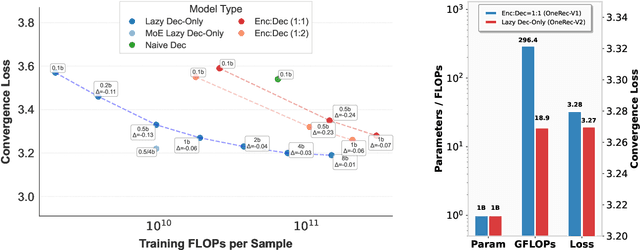
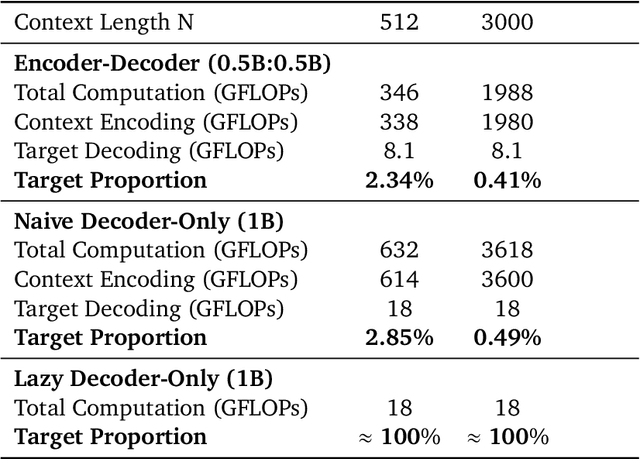

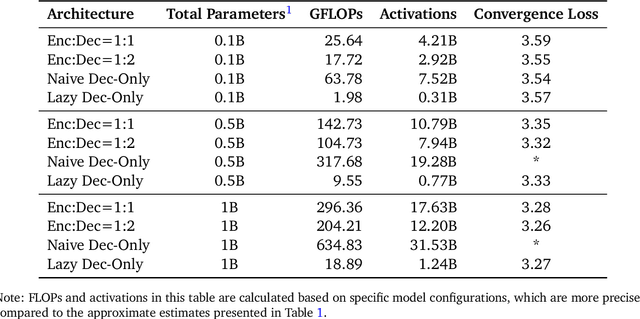
Recent breakthroughs in generative AI have transformed recommender systems through end-to-end generation. OneRec reformulates recommendation as an autoregressive generation task, achieving high Model FLOPs Utilization. While OneRec-V1 has shown significant empirical success in real-world deployment, two critical challenges hinder its scalability and performance: (1) inefficient computational allocation where 97.66% of resources are consumed by sequence encoding rather than generation, and (2) limitations in reinforcement learning relying solely on reward models. To address these challenges, we propose OneRec-V2, featuring: (1) Lazy Decoder-Only Architecture: Eliminates encoder bottlenecks, reducing total computation by 94% and training resources by 90%, enabling successful scaling to 8B parameters. (2) Preference Alignment with Real-World User Interactions: Incorporates Duration-Aware Reward Shaping and Adaptive Ratio Clipping to better align with user preferences using real-world feedback. Extensive A/B tests on Kuaishou demonstrate OneRec-V2's effectiveness, improving App Stay Time by 0.467%/0.741% while balancing multi-objective recommendations. This work advances generative recommendation scalability and alignment with real-world feedback, representing a step forward in the development of end-to-end recommender systems.
Kwai Keye-VL Technical Report
Jul 02, 2025While Multimodal Large Language Models (MLLMs) demonstrate remarkable capabilities on static images, they often fall short in comprehending dynamic, information-dense short-form videos, a dominant medium in today's digital landscape. To bridge this gap, we introduce \textbf{Kwai Keye-VL}, an 8-billion-parameter multimodal foundation model engineered for leading-edge performance in short-video understanding while maintaining robust general-purpose vision-language abilities. The development of Keye-VL rests on two core pillars: a massive, high-quality dataset exceeding 600 billion tokens with a strong emphasis on video, and an innovative training recipe. This recipe features a four-stage pre-training process for solid vision-language alignment, followed by a meticulous two-phase post-training process. The first post-training stage enhances foundational capabilities like instruction following, while the second phase focuses on stimulating advanced reasoning. In this second phase, a key innovation is our five-mode ``cold-start'' data mixture, which includes ``thinking'', ``non-thinking'', ``auto-think'', ``think with image'', and high-quality video data. This mixture teaches the model to decide when and how to reason. Subsequent reinforcement learning (RL) and alignment steps further enhance these reasoning capabilities and correct abnormal model behaviors, such as repetitive outputs. To validate our approach, we conduct extensive evaluations, showing that Keye-VL achieves state-of-the-art results on public video benchmarks and remains highly competitive on general image-based tasks (Figure 1). Furthermore, we develop and release the \textbf{KC-MMBench}, a new benchmark tailored for real-world short-video scenarios, where Keye-VL shows a significant advantage.
OneRec Technical Report
Jun 16, 2025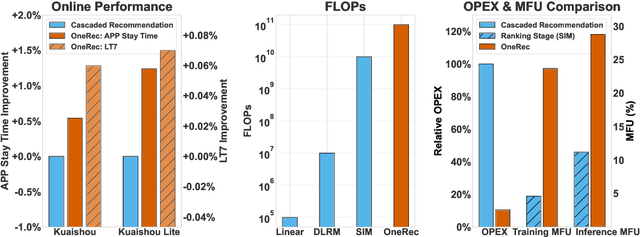

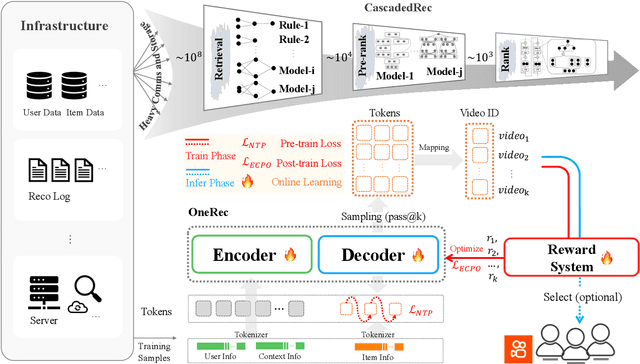
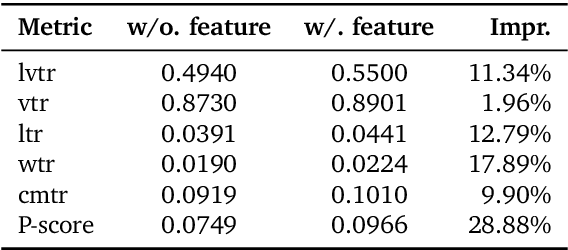
Recommender systems have been widely used in various large-scale user-oriented platforms for many years. However, compared to the rapid developments in the AI community, recommendation systems have not achieved a breakthrough in recent years. For instance, they still rely on a multi-stage cascaded architecture rather than an end-to-end approach, leading to computational fragmentation and optimization inconsistencies, and hindering the effective application of key breakthrough technologies from the AI community in recommendation scenarios. To address these issues, we propose OneRec, which reshapes the recommendation system through an end-to-end generative approach and achieves promising results. Firstly, we have enhanced the computational FLOPs of the current recommendation model by 10 $\times$ and have identified the scaling laws for recommendations within certain boundaries. Secondly, reinforcement learning techniques, previously difficult to apply for optimizing recommendations, show significant potential in this framework. Lastly, through infrastructure optimizations, we have achieved 23.7% and 28.8% Model FLOPs Utilization (MFU) on flagship GPUs during training and inference, respectively, aligning closely with the LLM community. This architecture significantly reduces communication and storage overhead, resulting in operating expense that is only 10.6% of traditional recommendation pipelines. Deployed in Kuaishou/Kuaishou Lite APP, it handles 25% of total queries per second, enhancing overall App Stay Time by 0.54% and 1.24%, respectively. Additionally, we have observed significant increases in metrics such as 7-day Lifetime, which is a crucial indicator of recommendation experience. We also provide practical lessons and insights derived from developing, optimizing, and maintaining a production-scale recommendation system with significant real-world impact.
SlimPipe: Memory-Thrifty and Efficient Pipeline Parallelism for Long-Context LLM Training
Apr 20, 2025Pipeline Parallelism (PP) serves as a crucial technique for training Large Language Models (LLMs), owing to its capability to alleviate memory pressure from model states with relatively low communication overhead. However, in long-context scenarios, existing pipeline parallelism methods fail to address the substantial activation memory pressure, primarily due to the peak memory consumption resulting from the accumulation of activations across multiple microbatches. Moreover, these approaches inevitably introduce considerable pipeline bubbles, further hindering efficiency. To tackle these challenges, we propose SlimPipe, a novel approach to fine-grained pipeline parallelism that employs uniform sequence slicing coupled with one-forward-one-backward (1F1B) schedule. It reduces the accumulated activations from several microbatches to just one, which is split into several slices. Although the slices are evenly partitioned, the computation cost is not equal across slices due to causal attention. We develop a sophisticated workload redistribution technique to address this load imbalance. SlimPipe achieves (1) near-zero memory overhead and (2) minimal pipeline bubbles simultaneously. The effectiveness of SlimPipe has been proven by thorough testing with diverse model architectures, context window sizes, and SlimPipe-specific configurations. For example, on the Llama 70B model, compared to state-of-the-art methods, SlimPipe significantly boosts the Model FLOPs Utilization (MFU) to up to $1.57\times$ for a context length of 512K. More notably, for a context length of 2048K, it maintains over 45% utilization on 256 NVIDIA Hopper 80GB GPUs, while other approaches either suffer significant performance drops or fail entirely due to memory constraints.