 Add to Chrome
 Add to Firefox
 Add to Edge
AIBench: Evaluating Visual-Logical Consistency in Academic Illustration Generation
Mar 31, 2026
Although image generation has boosted various applications via its rapid evolution, whether the state-of-the-art models are able to produce ready-to-use academic illustrations for papers is still largely unexplored. Directly comparing or evaluating the illustration with VLM is native but requires oracle multi-modal understanding ability, which is unreliable for long and complex texts and illustrations. To address this, we propose AIBench, the first benchmark using VQA for evaluating logic correctness of the academic illustrations and VLMs for assessing aesthetics. In detail, we designed four levels of questions proposed from a logic diagram summarized from the method part of the paper, which query whether the generated illustration aligns with the paper on different scales. Our VQA-based approach raises more accurate and detailed evaluations on visual-logical consistency while relying less on the ability of the judger VLM. With our high-quality AIBench, we conduct extensive experiments and conclude that the performance gap between models on this task is significantly larger than general ones, reflecting their various complex reasoning and high-density generation ability. Further, the logic and aesthetics are hard to optimize simultaneously as in handcrafted illustrations. Additional experiments further state that test-time scaling on both abilities significantly boosts the performance on this task.

Benchmarking Large Vision-Language Models on Fine-Grained Image Tasks: A Comprehensive Evaluation
Apr 21, 2025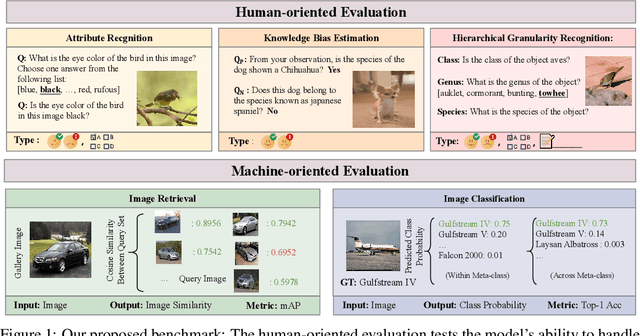
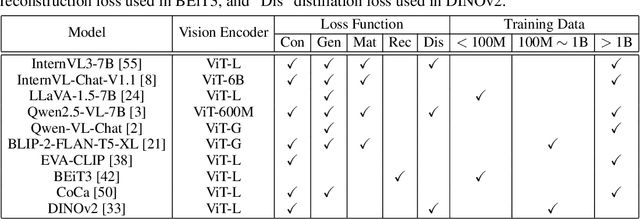
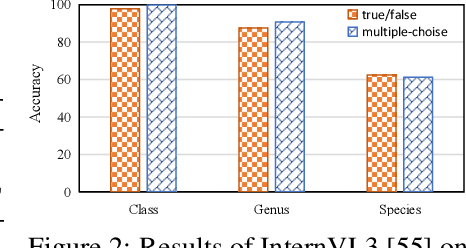
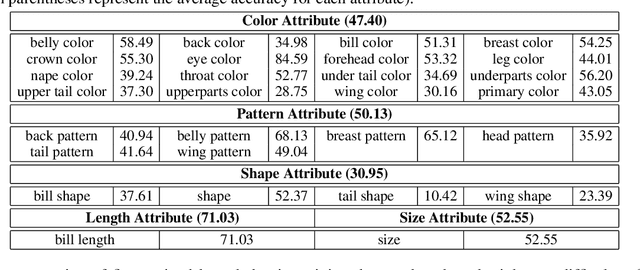
Recent advancements in Large Vision-Language Models (LVLMs) have demonstrated remarkable multimodal perception capabilities, garnering significant attention. While numerous evaluation studies have emerged, assessing LVLMs both holistically and on specialized tasks, fine-grained image tasks-fundamental to computer vision-remain largely unexplored. To fill this gap, we introduce a comprehensive fine-grained evaluation benchmark, i.e., FG-BMK, comprising 3.49 million questions and 3.32 million images. Our evaluation systematically examines LVLMs from both human-oriented and machine-oriented perspectives, focusing on their semantic recognition and fine-grained feature representation capabilities. Through extensive experiments on eight representative LVLMs/VLMs, we uncover key findings regarding the influence of training paradigms, modality alignment, perturbation susceptibility, and fine-grained category reasoning on task performance. This work provides critical insights into the limitations of current LVLMs and offers guidance for future data construction and model design in the development of more advanced LVLMs. Our code is open-source and available at https://github.com/SEU-VIPGroup/FG-BMK.