 Add to Chrome
 Add to Firefox
 Add to Edge
GNeSF: Generalizable Neural Semantic Fields
Oct 26, 2023


3D scene segmentation based on neural implicit representation has emerged recently with the advantage of training only on 2D supervision. However, existing approaches still requires expensive per-scene optimization that prohibits generalization to novel scenes during inference. To circumvent this problem, we introduce a generalizable 3D segmentation framework based on implicit representation. Specifically, our framework takes in multi-view image features and semantic maps as the inputs instead of only spatial information to avoid overfitting to scene-specific geometric and semantic information. We propose a novel soft voting mechanism to aggregate the 2D semantic information from different views for each 3D point. In addition to the image features, view difference information is also encoded in our framework to predict the voting scores. Intuitively, this allows the semantic information from nearby views to contribute more compared to distant ones. Furthermore, a visibility module is also designed to detect and filter out detrimental information from occluded views. Due to the generalizability of our proposed method, we can synthesize semantic maps or conduct 3D semantic segmentation for novel scenes with solely 2D semantic supervision. Experimental results show that our approach achieves comparable performance with scene-specific approaches. More importantly, our approach can even outperform existing strong supervision-based approaches with only 2D annotations. Our source code is available at: https://github.com/HLinChen/GNeSF.

Improving Seq2Seq Grammatical Error Correction via Decoding Interventions
Oct 23, 2023The sequence-to-sequence (Seq2Seq) approach has recently been widely used in grammatical error correction (GEC) and shows promising performance. However, the Seq2Seq GEC approach still suffers from two issues. First, a Seq2Seq GEC model can only be trained on parallel data, which, in GEC task, is often noisy and limited in quantity. Second, the decoder of a Seq2Seq GEC model lacks an explicit awareness of the correctness of the token being generated. In this paper, we propose a unified decoding intervention framework that employs an external critic to assess the appropriateness of the token to be generated incrementally, and then dynamically influence the choice of the next token. We discover and investigate two types of critics: a pre-trained left-to-right language model critic and an incremental target-side grammatical error detector critic. Through extensive experiments on English and Chinese datasets, our framework consistently outperforms strong baselines and achieves results competitive with state-of-the-art methods.
Making LLaMA SEE and Draw with SEED Tokenizer
Oct 02, 2023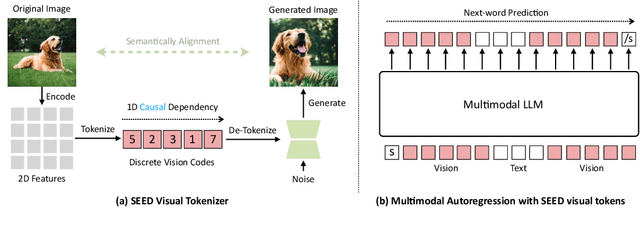
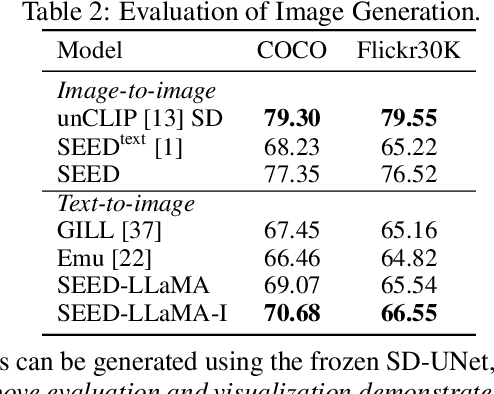
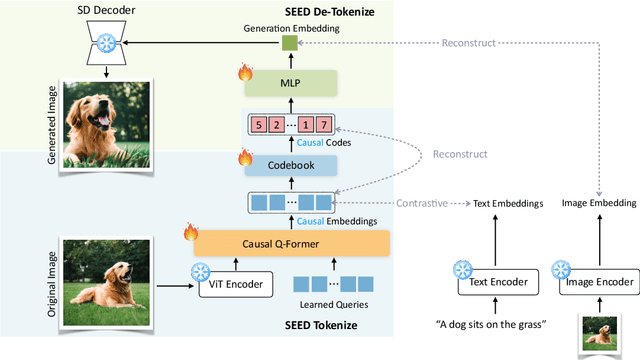
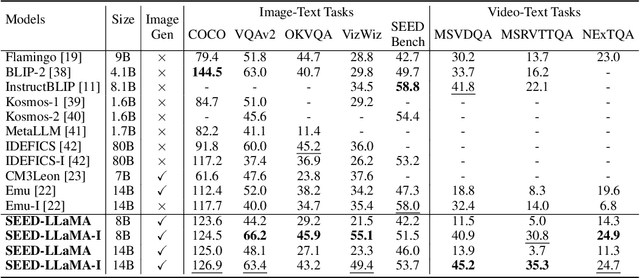
The great success of Large Language Models (LLMs) has expanded the potential of multimodality, contributing to the gradual evolution of General Artificial Intelligence (AGI). A true AGI agent should not only possess the capability to perform predefined multi-tasks but also exhibit emergent abilities in an open-world context. However, despite the considerable advancements made by recent multimodal LLMs, they still fall short in effectively unifying comprehension and generation tasks, let alone open-world emergent abilities. We contend that the key to overcoming the present impasse lies in enabling text and images to be represented and processed interchangeably within a unified autoregressive Transformer. To this end, we introduce SEED, an elaborate image tokenizer that empowers LLMs with the ability to SEE and Draw at the same time. We identify two crucial design principles: (1) Image tokens should be independent of 2D physical patch positions and instead be produced with a 1D causal dependency, exhibiting intrinsic interdependence that aligns with the left-to-right autoregressive prediction mechanism in LLMs. (2) Image tokens should capture high-level semantics consistent with the degree of semantic abstraction in words, and be optimized for both discriminativeness and reconstruction during the tokenizer training phase. With SEED tokens, LLM is able to perform scalable multimodal autoregression under its original training recipe, i.e., next-word prediction. SEED-LLaMA is therefore produced by large-scale pretraining and instruction tuning on the interleaved textual and visual data, demonstrating impressive performance on a broad range of multimodal comprehension and generation tasks. More importantly, SEED-LLaMA has exhibited compositional emergent abilities such as multi-turn in-context multimodal generation, acting like your AI assistant.
One For All: Video Conversation is Feasible Without Video Instruction Tuning
Sep 27, 2023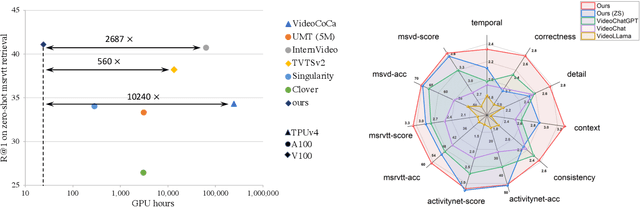
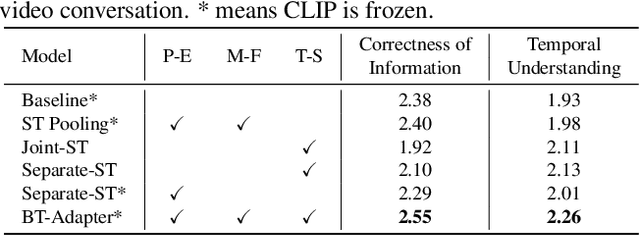
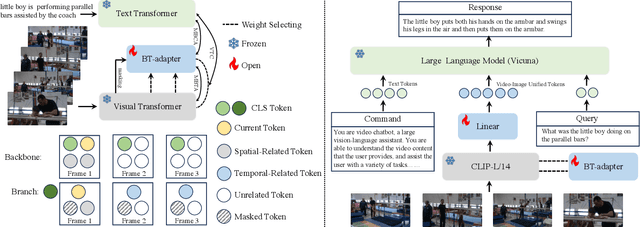
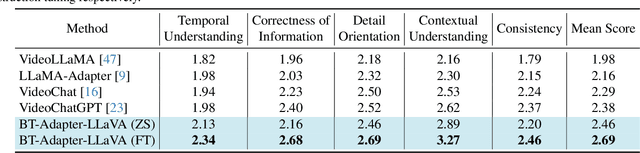
The recent progress in Large Language Models (LLM) has spurred various advancements in image-language conversation agents, while how to build a proficient video-based dialogue system is still under exploration. Considering the extensive scale of LLM and visual backbone, minimal GPU memory is left for facilitating effective temporal modeling, which is crucial for comprehending and providing feedback on videos. To this end, we propose Branching Temporal Adapter (BT-Adapter), a novel method for extending image-language pretrained models into the video domain. Specifically, BT-Adapter serves as a plug-and-use temporal modeling branch alongside the pretrained visual encoder, which is tuned while keeping the backbone frozen. Just pretrained once, BT-Adapter can be seamlessly integrated into all image conversation models using this version of CLIP, enabling video conversations without the need for video instructions. Besides, we develop a unique asymmetric token masking strategy inside the branch with tailor-made training tasks for BT-Adapter, facilitating faster convergence and better results. Thanks to BT-Adapter, we are able to empower existing multimodal dialogue models with strong video understanding capabilities without incurring excessive GPU costs. Without bells and whistles, BT-Adapter achieves (1) state-of-the-art zero-shot results on various video tasks using thousands of fewer GPU hours. (2) better performance than current video chatbots without any video instruction tuning. (3) state-of-the-art results of video chatting using video instruction tuning, outperforming previous SOTAs by a large margin.
InstructDiffusion: A Generalist Modeling Interface for Vision Tasks
Sep 07, 2023We present InstructDiffusion, a unifying and generic framework for aligning computer vision tasks with human instructions. Unlike existing approaches that integrate prior knowledge and pre-define the output space (e.g., categories and coordinates) for each vision task, we cast diverse vision tasks into a human-intuitive image-manipulating process whose output space is a flexible and interactive pixel space. Concretely, the model is built upon the diffusion process and is trained to predict pixels according to user instructions, such as encircling the man's left shoulder in red or applying a blue mask to the left car. InstructDiffusion could handle a variety of vision tasks, including understanding tasks (such as segmentation and keypoint detection) and generative tasks (such as editing and enhancement). It even exhibits the ability to handle unseen tasks and outperforms prior methods on novel datasets. This represents a significant step towards a generalist modeling interface for vision tasks, advancing artificial general intelligence in the field of computer vision.
GHuNeRF: Generalizable Human NeRF from a Monocular Video
Sep 03, 2023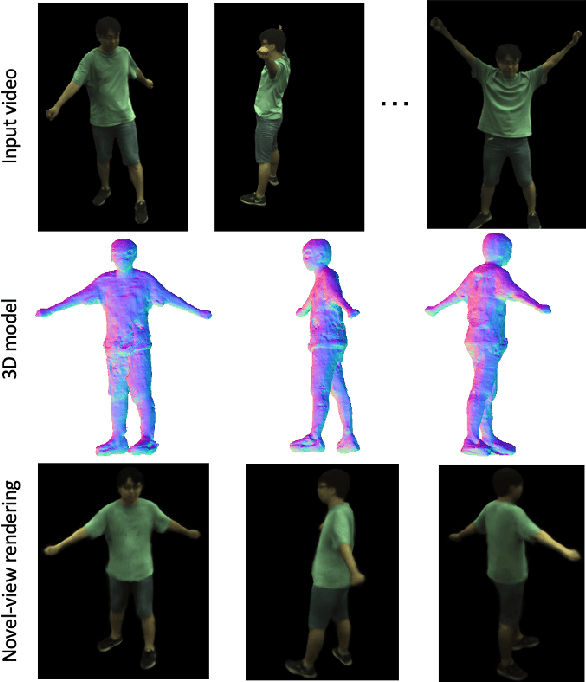
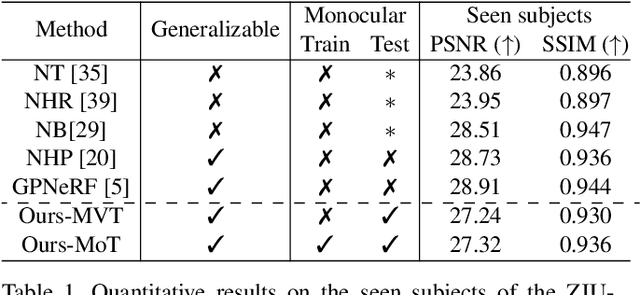
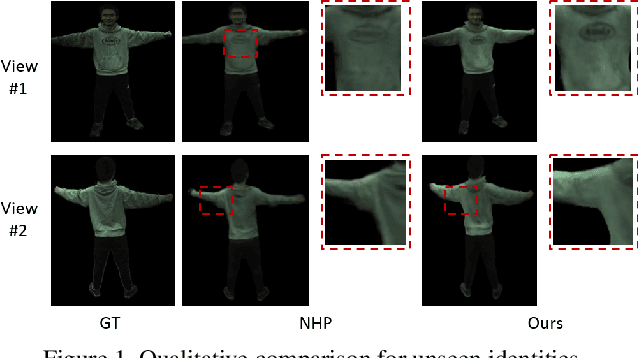
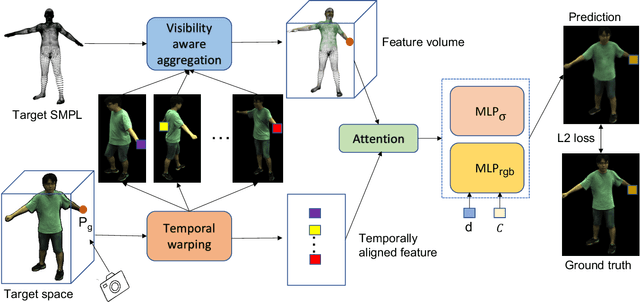
In this paper, we tackle the challenging task of learning a generalizable human NeRF model from a monocular video. Although existing generalizable human NeRFs have achieved impressive results, they require muti-view images or videos which might not be always available. On the other hand, some works on free-viewpoint rendering of human from monocular videos cannot be generalized to unseen identities. In view of these limitations, we propose GHuNeRF to learn a generalizable human NeRF model from a monocular video of the human performer. We first introduce a visibility-aware aggregation scheme to compute vertex-wise features, which is used to construct a 3D feature volume. The feature volume can only represent the overall geometry of the human performer with insufficient accuracy due to the limited resolution. To solve this, we further enhance the volume feature with temporally aligned point-wise features using an attention mechanism. Finally, the enhanced feature is used for predicting density and color for each sampled point. A surface-guided sampling strategy is also introduced to improve the efficiency for both training and inference. We validate our approach on the widely-used ZJU-MoCap dataset, where we achieve comparable performance with existing multi-view video based approaches. We also test on the monocular People-Snapshot dataset and achieve better performance than existing works when only monocular video is used.
A Visual Interpretation-Based Self-Improved Classification System Using Virtual Adversarial Training
Sep 03, 2023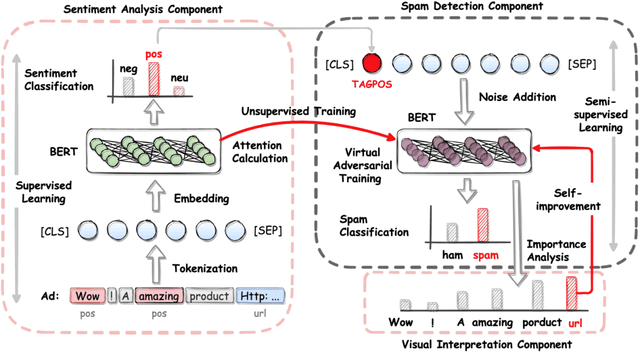
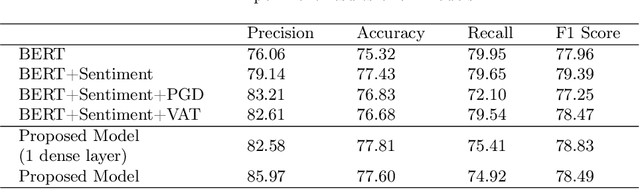
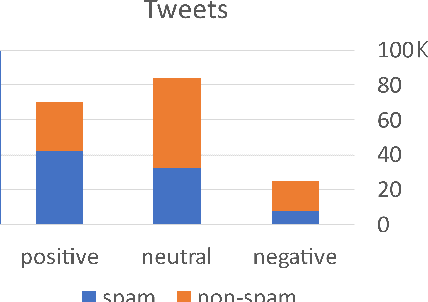

The successful application of large pre-trained models such as BERT in natural language processing has attracted more attention from researchers. Since the BERT typically acts as an end-to-end black box, classification systems based on it usually have difficulty in interpretation and low robustness. This paper proposes a visual interpretation-based self-improving classification model with a combination of virtual adversarial training (VAT) and BERT models to address the above problems. Specifically, a fine-tuned BERT model is used as a classifier to classify the sentiment of the text. Then, the predicted sentiment classification labels are used as part of the input of another BERT for spam classification via a semi-supervised training manner using VAT. Additionally, visualization techniques, including visualizing the importance of words and normalizing the attention head matrix, are employed to analyze the relevance of each component to classification accuracy. Moreover, brand-new features will be found in the visual analysis, and classification performance will be improved. Experimental results on Twitter's tweet dataset demonstrate the effectiveness of the proposed model on the classification task. Furthermore, the ablation study results illustrate the effect of different components of the proposed model on the classification results.
ECPC-IDS:A benchmark endometrail cancer PET/CT image dataset for evaluation of semantic segmentation and detection of hypermetabolic regions
Sep 02, 2023
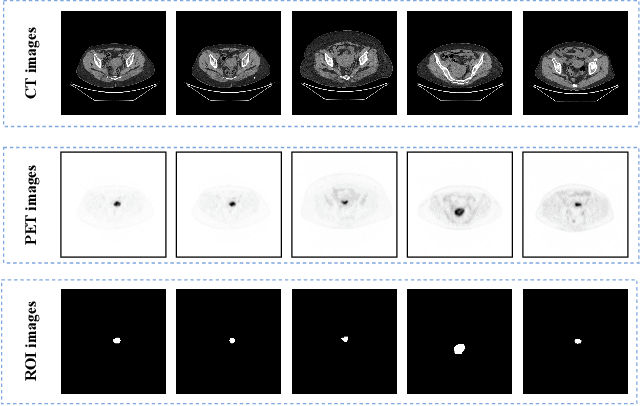
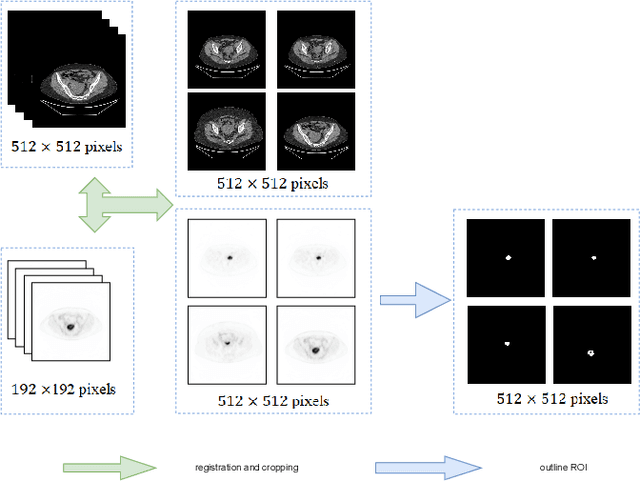

Endometrial cancer is one of the most common tumors in the female reproductive system and is the third most common gynecological malignancy that causes death after ovarian and cervical cancer. Early diagnosis can significantly improve the 5-year survival rate of patients. With the development of artificial intelligence, computer-assisted diagnosis plays an increasingly important role in improving the accuracy and objectivity of diagnosis, as well as reducing the workload of doctors. However, the absence of publicly available endometrial cancer image datasets restricts the application of computer-assisted diagnostic techniques.In this paper, a publicly available Endometrial Cancer PET/CT Image Dataset for Evaluation of Semantic Segmentation and Detection of Hypermetabolic Regions (ECPC-IDS) are published. Specifically, the segmentation section includes PET and CT images, with a total of 7159 images in multiple formats. In order to prove the effectiveness of segmentation methods on ECPC-IDS, five classical deep learning semantic segmentation methods are selected to test the image segmentation task. The object detection section also includes PET and CT images, with a total of 3579 images and XML files with annotation information. Six deep learning methods are selected for experiments on the detection task.This study conduct extensive experiments using deep learning-based semantic segmentation and object detection methods to demonstrate the differences between various methods on ECPC-IDS. As far as we know, this is the first publicly available dataset of endometrial cancer with a large number of multiple images, including a large amount of information required for image and target detection. ECPC-IDS can aid researchers in exploring new algorithms to enhance computer-assisted technology, benefiting both clinical doctors and patients greatly.
PHE-SICH-CT-IDS: A Benchmark CT Image Dataset for Evaluation Semantic Segmentation, Object Detection and Radiomic Feature Extraction of Perihematomal Edema in Spontaneous Intracerebral Hemorrhage
Aug 21, 2023Intracerebral hemorrhage is one of the diseases with the highest mortality and poorest prognosis worldwide. Spontaneous intracerebral hemorrhage (SICH) typically presents acutely, prompt and expedited radiological examination is crucial for diagnosis, localization, and quantification of the hemorrhage. Early detection and accurate segmentation of perihematomal edema (PHE) play a critical role in guiding appropriate clinical intervention and enhancing patient prognosis. However, the progress and assessment of computer-aided diagnostic methods for PHE segmentation and detection face challenges due to the scarcity of publicly accessible brain CT image datasets. This study establishes a publicly available CT dataset named PHE-SICH-CT-IDS for perihematomal edema in spontaneous intracerebral hemorrhage. The dataset comprises 120 brain CT scans and 7,022 CT images, along with corresponding medical information of the patients. To demonstrate its effectiveness, classical algorithms for semantic segmentation, object detection, and radiomic feature extraction are evaluated. The experimental results confirm the suitability of PHE-SICH-CT-IDS for assessing the performance of segmentation, detection and radiomic feature extraction methods. To the best of our knowledge, this is the first publicly available dataset for PHE in SICH, comprising various data formats suitable for applications across diverse medical scenarios. We believe that PHE-SICH-CT-IDS will allure researchers to explore novel algorithms, providing valuable support for clinicians and patients in the clinical setting. PHE-SICH-CT-IDS is freely published for non-commercial purpose at: https://figshare.com/articles/dataset/PHE-SICH-CT-IDS/23957937.
Calibrating Uncertainty for Semi-Supervised Crowd Counting
Aug 19, 2023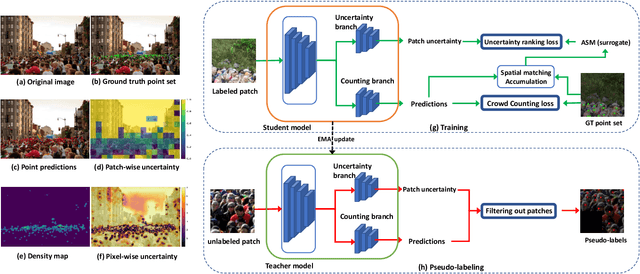
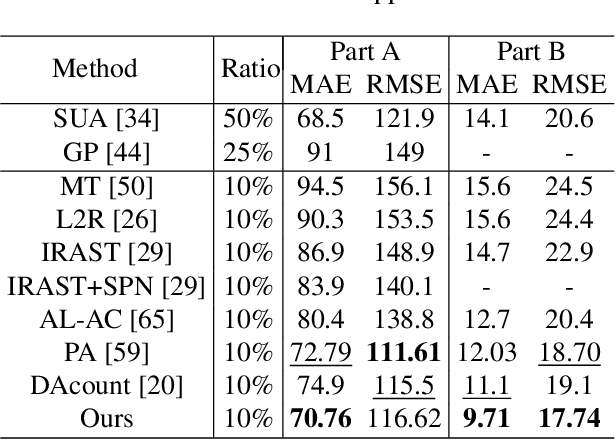
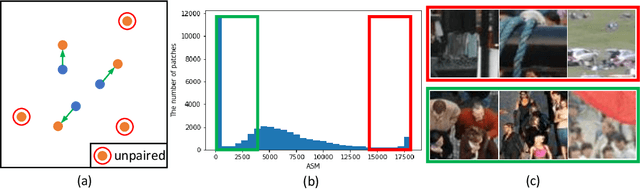
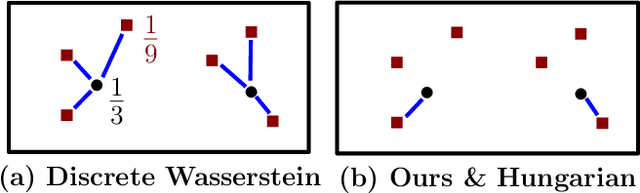
Semi-supervised crowd counting is an important yet challenging task. A popular approach is to iteratively generate pseudo-labels for unlabeled data and add them to the training set. The key is to use uncertainty to select reliable pseudo-labels. In this paper, we propose a novel method to calibrate model uncertainty for crowd counting. Our method takes a supervised uncertainty estimation strategy to train the model through a surrogate function. This ensures the uncertainty is well controlled throughout the training. We propose a matching-based patch-wise surrogate function to better approximate uncertainty for crowd counting tasks. The proposed method pays a sufficient amount of attention to details, while maintaining a proper granularity. Altogether our method is able to generate reliable uncertainty estimation, high quality pseudolabels, and achieve state-of-the-art performance in semisupervised crowd counting.