 Add to Chrome
 Add to Firefox
 Add to Edge
Meta-CoT: Enhancing Granularity and Generalization in Image Editing
Apr 27, 2026
Unified multi-modal understanding/generative models have shown improved image editing performance by incorporating fine-grained understanding into their Chain-of-Thought (CoT) process. However, a critical question remains underexplored: what forms of CoT and training strategy can jointly enhance both the understanding granularity and generalization? To address this, we propose Meta-CoT, a paradigm that performs a two-level decomposition of any single-image editing operation with two key properties: (1) Decomposability. We observe that any editing intention can be represented as a triplet - (task, target, required understanding ability). Inspired by this, Meta-CoT decomposes both the editing task and the target, generating task-specific CoT and traversing editing operations on all targets. This decomposition enhances the model's understanding granularity of editing operations and guides it to learn each element of the triplet during training, substantially improving the editing capability. (2) Generalizability. In the second decomposition level, we further break down editing tasks into five fundamental meta-tasks. We find that training on these five meta-tasks, together with the other two elements of the triplet, is sufficient to achieve strong generalization across diverse, unseen editing tasks. To further align the model's editing behavior with its CoT reasoning, we introduce the CoT-Editing Consistency Reward, which encourages more accurate and effective utilization of CoT information during editing. Experiments demonstrate that our method achieves an overall 15.8% improvement across 21 editing tasks, and generalizes effectively to unseen editing tasks when trained on only a small set of meta-tasks. Our code, benchmark, and model are released at https://shiyi-zh0408.github.io/projectpages/Meta-CoT/

Hierarchical SVG Tokenization: Learning Compact Visual Programs for Scalable Vector Graphics Modeling
Apr 06, 2026Recent large language models have shifted SVG generation from differentiable rendering optimization to autoregressive program synthesis. However, existing approaches still rely on generic byte-level tokenization inherited from natural language processing, which poorly reflects the geometric structure of vector graphics. Numerical coordinates are fragmented into discrete symbols, destroying spatial relationships and introducing severe token redundancy, often leading to coordinate hallucination and inefficient long-sequence generation. To address these challenges, we propose HiVG, a hierarchical SVG tokenization framework tailored for autoregressive vector graphics generation. HiVG decomposes raw SVG strings into structured \textit{atomic tokens} and further compresses executable command--parameter groups into geometry-constrained \textit{segment tokens}, substantially improving sequence efficiency while preserving syntactic validity. To further mitigate spatial mismatch, we introduce a Hierarchical Mean--Noise (HMN) initialization strategy that injects numerical ordering signals and semantic priors into new token embeddings. Combined with a curriculum training paradigm that progressively increases program complexity, HiVG enables more stable learning of executable SVG programs. Extensive experiments on both text-to-SVG and image-to-SVG tasks demonstrate improved generation fidelity, spatial consistency, and sequence efficiency compared with conventional tokenization schemes.
HiAR: Efficient Autoregressive Long Video Generation via Hierarchical Denoising
Mar 09, 2026Autoregressive (AR) diffusion offers a promising framework for generating videos of theoretically infinite length. However, a major challenge is maintaining temporal continuity while preventing the progressive quality degradation caused by error accumulation. To ensure continuity, existing methods typically condition on highly denoised contexts; yet, this practice propagates prediction errors with high certainty, thereby exacerbating degradation. In this paper, we argue that a highly clean context is unnecessary. Drawing inspiration from bidirectional diffusion models, which denoise frames at a shared noise level while maintaining coherence, we propose that conditioning on context at the same noise level as the current block provides sufficient signal for temporal consistency while effectively mitigating error propagation. Building on this insight, we propose HiAR, a hierarchical denoising framework that reverses the conventional generation order: instead of completing each block sequentially, it performs causal generation across all blocks at every denoising step, so that each block is always conditioned on context at the same noise level. This hierarchy naturally admits pipelined parallel inference, yielding a 1.8 wall-clock speedup in our 4-step setting. We further observe that self-rollout distillation under this paradigm amplifies a low-motion shortcut inherent to the mode-seeking reverse-KL objective. To counteract this, we introduce a forward-KL regulariser in bidirectional-attention mode, which preserves motion diversity for causal inference without interfering with the distillation loss. On VBench (20s generation), HiAR achieves the best overall score and the lowest temporal drift among all compared methods.
Generative Visual Chain-of-Thought for Image Editing
Mar 02, 2026Existing image editing methods struggle to perceive where to edit, especially under complex scenes and nuanced spatial instructions. To address this issue, we propose Generative Visual Chain-of-Thought (GVCoT), a unified framework that performs native visual reasoning by first generating spatial cues to localize the target region and then executing the edit. Unlike prior text-only CoT or tool-dependent visual CoT paradigms, GVCoT jointly optimizes visual tokens generated during the reasoning and editing phases in an end-to-end manner. This way fosters the emergence of innate spatial reasoning ability and enables more effective utilization of visual-domain cues. The main challenge of training GCVoT lies in the scarcity of large-scale editing data with precise edit region annotations; to this end, we construct GVCoT-Edit-Instruct, a dataset of 1.8M high-quality samples spanning 19 tasks. We adopt a progressive training strategy: supervised fine-tuning to build foundational localization ability in reasoning trace before final editing, followed by reinforcement learning to further improve reasoning and editing quality. Finally, we introduce SREdit-Bench, a new benchmark designed to comprehensively stress-test models under sophisticated scenes and fine-grained referring expressions. Experiments demonstrate that GVCoT consistently outperforms state-of-the-art models on SREdit-Bench and ImgEdit. We hope our GVCoT will inspire future research toward interpretable and precise image editing.
TAG-MoE: Task-Aware Gating for Unified Generative Mixture-of-Experts
Jan 12, 2026Unified image generation and editing models suffer from severe task interference in dense diffusion transformers architectures, where a shared parameter space must compromise between conflicting objectives (e.g., local editing v.s. subject-driven generation). While the sparse Mixture-of-Experts (MoE) paradigm is a promising solution, its gating networks remain task-agnostic, operating based on local features, unaware of global task intent. This task-agnostic nature prevents meaningful specialization and fails to resolve the underlying task interference. In this paper, we propose a novel framework to inject semantic intent into MoE routing. We introduce a Hierarchical Task Semantic Annotation scheme to create structured task descriptors (e.g., scope, type, preservation). We then design Predictive Alignment Regularization to align internal routing decisions with the task's high-level semantics. This regularization evolves the gating network from a task-agnostic executor to a dispatch center. Our model effectively mitigates task interference, outperforming dense baselines in fidelity and quality, and our analysis shows that experts naturally develop clear and semantically correlated specializations.
Re-Align: Structured Reasoning-guided Alignment for In-Context Image Generation and Editing
Jan 08, 2026In-context image generation and editing (ICGE) enables users to specify visual concepts through interleaved image-text prompts, demanding precise understanding and faithful execution of user intent. Although recent unified multimodal models exhibit promising understanding capabilities, these strengths often fail to transfer effectively to image generation. We introduce Re-Align, a unified framework that bridges the gap between understanding and generation through structured reasoning-guided alignment. At its core lies the In-Context Chain-of-Thought (IC-CoT), a structured reasoning paradigm that decouples semantic guidance and reference association, providing clear textual target and mitigating confusion among reference images. Furthermore, Re-Align introduces an effective RL training scheme that leverages a surrogate reward to measure the alignment between structured reasoning text and the generated image, thereby improving the model's overall performance on ICGE tasks. Extensive experiments verify that Re-Align outperforms competitive methods of comparable model scale and resources on both in-context image generation and editing tasks.
Incorporating Pre-trained Diffusion Models in Solving the Schrödinger Bridge Problem
Aug 25, 2025
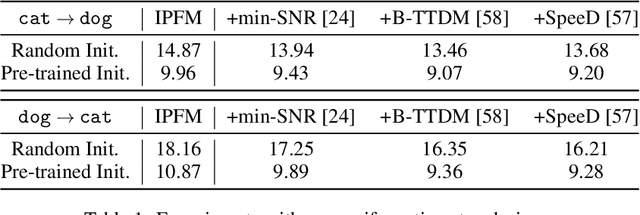
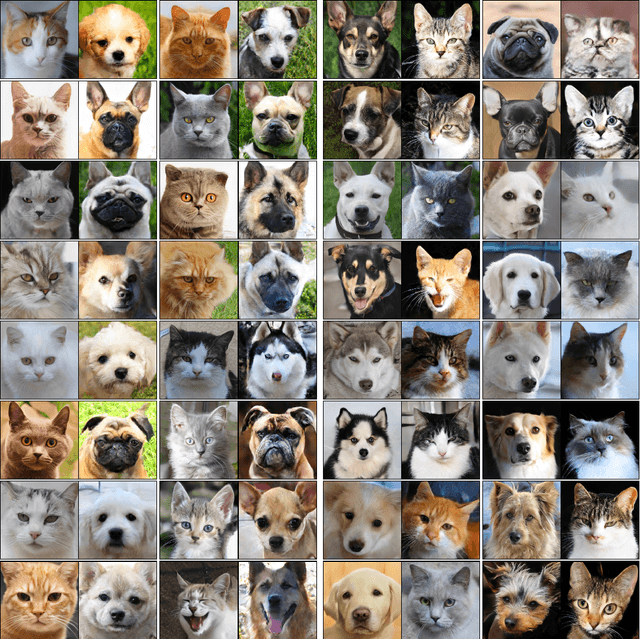
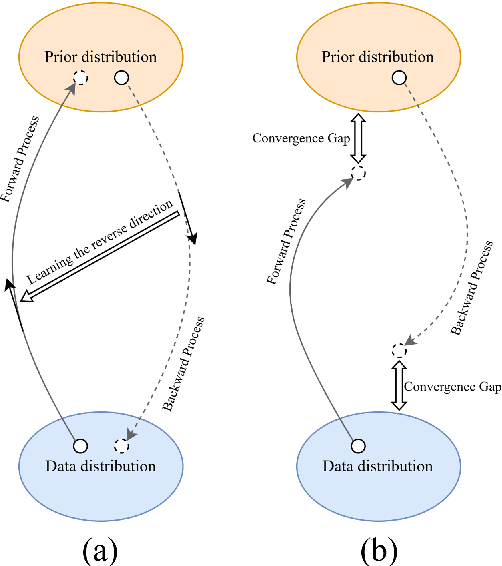
This paper aims to unify Score-based Generative Models (SGMs), also known as Diffusion models, and the Schr\"odinger Bridge (SB) problem through three reparameterization techniques: Iterative Proportional Mean-Matching (IPMM), Iterative Proportional Terminus-Matching (IPTM), and Iterative Proportional Flow-Matching (IPFM). These techniques significantly accelerate and stabilize the training of SB-based models. Furthermore, the paper introduces novel initialization strategies that use pre-trained SGMs to effectively train SB-based models. By using SGMs as initialization, we leverage the advantages of both SB-based models and SGMs, ensuring efficient training of SB-based models and further improving the performance of SGMs. Extensive experiments demonstrate the significant effectiveness and improvements of the proposed methods. We believe this work contributes to and paves the way for future research on generative models.
Fast Autoregressive Models for Continuous Latent Generation
Apr 24, 2025Autoregressive models have demonstrated remarkable success in sequential data generation, particularly in NLP, but their extension to continuous-domain image generation presents significant challenges. Recent work, the masked autoregressive model (MAR), bypasses quantization by modeling per-token distributions in continuous spaces using a diffusion head but suffers from slow inference due to the high computational cost of the iterative denoising process. To address this, we propose the Fast AutoRegressive model (FAR), a novel framework that replaces MAR's diffusion head with a lightweight shortcut head, enabling efficient few-step sampling while preserving autoregressive principles. Additionally, FAR seamlessly integrates with causal Transformers, extending them from discrete to continuous token generation without requiring architectural modifications. Experiments demonstrate that FAR achieves $2.3\times$ faster inference than MAR while maintaining competitive FID and IS scores. This work establishes the first efficient autoregressive paradigm for high-fidelity continuous-space image generation, bridging the critical gap between quality and scalability in visual autoregressive modeling.
Improved Noise Schedule for Diffusion Training
Jul 03, 2024Diffusion models have emerged as the de facto choice for generating visual signals. However, training a single model to predict noise across various levels poses significant challenges, necessitating numerous iterations and incurring significant computational costs. Various approaches, such as loss weighting strategy design and architectural refinements, have been introduced to expedite convergence. In this study, we propose a novel approach to design the noise schedule for enhancing the training of diffusion models. Our key insight is that the importance sampling of the logarithm of the Signal-to-Noise ratio (logSNR), theoretically equivalent to a modified noise schedule, is particularly beneficial for training efficiency when increasing the sample frequency around $\log \text{SNR}=0$. We empirically demonstrate the superiority of our noise schedule over the standard cosine schedule. Furthermore, we highlight the advantages of our noise schedule design on the ImageNet benchmark, showing that the designed schedule consistently benefits different prediction targets.
Step-aware Preference Optimization: Aligning Preference with Denoising Performance at Each Step
Jun 06, 2024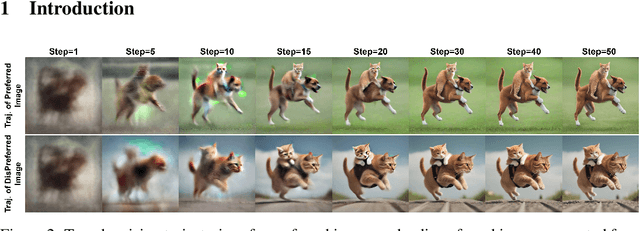
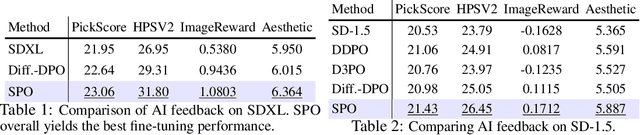
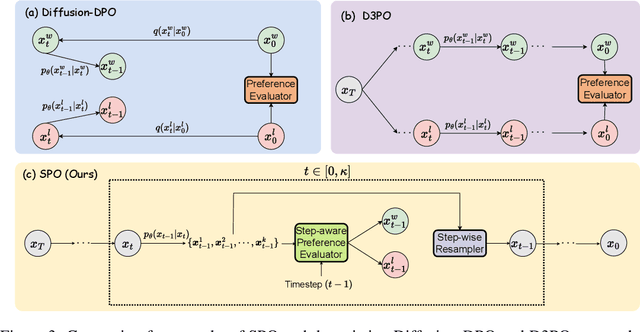

Recently, Direct Preference Optimization (DPO) has extended its success from aligning large language models (LLMs) to aligning text-to-image diffusion models with human preferences. Unlike most existing DPO methods that assume all diffusion steps share a consistent preference order with the final generated images, we argue that this assumption neglects step-specific denoising performance and that preference labels should be tailored to each step's contribution. To address this limitation, we propose Step-aware Preference Optimization (SPO), a novel post-training approach that independently evaluates and adjusts the denoising performance at each step, using a step-aware preference model and a step-wise resampler to ensure accurate step-aware supervision. Specifically, at each denoising step, we sample a pool of images, find a suitable win-lose pair, and, most importantly, randomly select a single image from the pool to initialize the next denoising step. This step-wise resampler process ensures the next win-lose image pair comes from the same image, making the win-lose comparison independent of the previous step. To assess the preferences at each step, we train a separate step-aware preference model that can be applied to both noisy and clean images. Our experiments with Stable Diffusion v1.5 and SDXL demonstrate that SPO significantly outperforms the latest Diffusion-DPO in aligning generated images with complex, detailed prompts and enhancing aesthetics, while also achieving more than 20x times faster in training efficiency. Code and model: https://rockeycoss.github.io/spo.github.io/