 Add to Chrome
 Add to Firefox
 Add to Edge
CMMR-VLN: Vision-and-Language Navigation via Continual Multimodal Memory Retrieval
Mar 09, 2026
Although large language models (LLMs) are introduced into vision-and-language navigation (VLN) to improve instruction comprehension and generalization, existing LLM- based VLN lacks the ability to selectively recall and use relevant priori experiences to help navigation tasks, limiting their performance in long-horizon and unfamiliar scenarios. In this work, we propose CMMR-VLN (Continual Multimodal Memory Retrieval based VLN), a VLN framework that endows LLM agents with structured memory and reflection capabilities. Specifically, the CMMR-VLN constructs a multimodal experi- ence memory indexed by panoramic visual images and salient landmarks to retrieve relevant experiences during navigation, introduces a retrieved-augmented generation pipeline to mimick how experienced human navigators leverage priori knowledge, and incorporates a reflection-based memory update strategy that selectively stores complete successful paths and the key initial mistake in failure cases. Comprehensive tests illustrate average success rate improvements of 52.9%, 20.9% and 20.9%, and 200%, 50% and 50% over the NavGPT, the MapGPT, and the DiscussNav in simulation and real tests, respectively eluci- dating the great potential of the CMMR-VLN as a backbone VLN framework.

ECPC-IDS:A benchmark endometrail cancer PET/CT image dataset for evaluation of semantic segmentation and detection of hypermetabolic regions
Sep 02, 2023
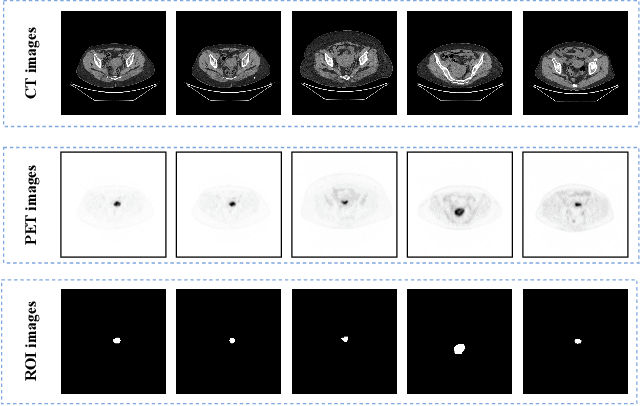
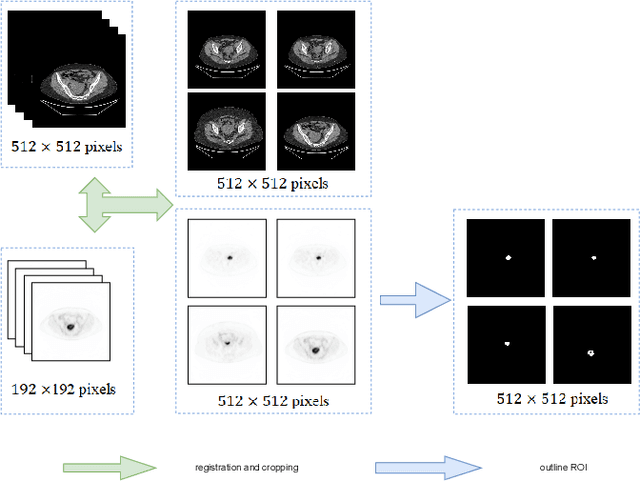

Endometrial cancer is one of the most common tumors in the female reproductive system and is the third most common gynecological malignancy that causes death after ovarian and cervical cancer. Early diagnosis can significantly improve the 5-year survival rate of patients. With the development of artificial intelligence, computer-assisted diagnosis plays an increasingly important role in improving the accuracy and objectivity of diagnosis, as well as reducing the workload of doctors. However, the absence of publicly available endometrial cancer image datasets restricts the application of computer-assisted diagnostic techniques.In this paper, a publicly available Endometrial Cancer PET/CT Image Dataset for Evaluation of Semantic Segmentation and Detection of Hypermetabolic Regions (ECPC-IDS) are published. Specifically, the segmentation section includes PET and CT images, with a total of 7159 images in multiple formats. In order to prove the effectiveness of segmentation methods on ECPC-IDS, five classical deep learning semantic segmentation methods are selected to test the image segmentation task. The object detection section also includes PET and CT images, with a total of 3579 images and XML files with annotation information. Six deep learning methods are selected for experiments on the detection task.This study conduct extensive experiments using deep learning-based semantic segmentation and object detection methods to demonstrate the differences between various methods on ECPC-IDS. As far as we know, this is the first publicly available dataset of endometrial cancer with a large number of multiple images, including a large amount of information required for image and target detection. ECPC-IDS can aid researchers in exploring new algorithms to enhance computer-assisted technology, benefiting both clinical doctors and patients greatly.