 Add to Chrome
 Add to Firefox
 Add to Edge
Spatial 3D-LLM: Exploring Spatial Awareness in 3D Vision-Language Models
Jul 22, 2025
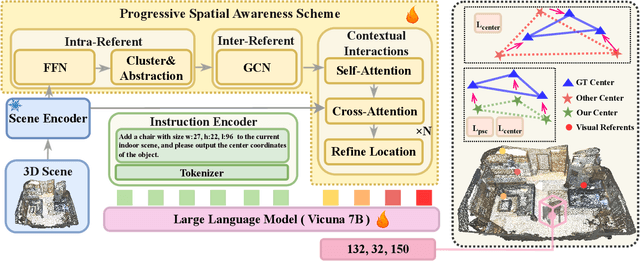
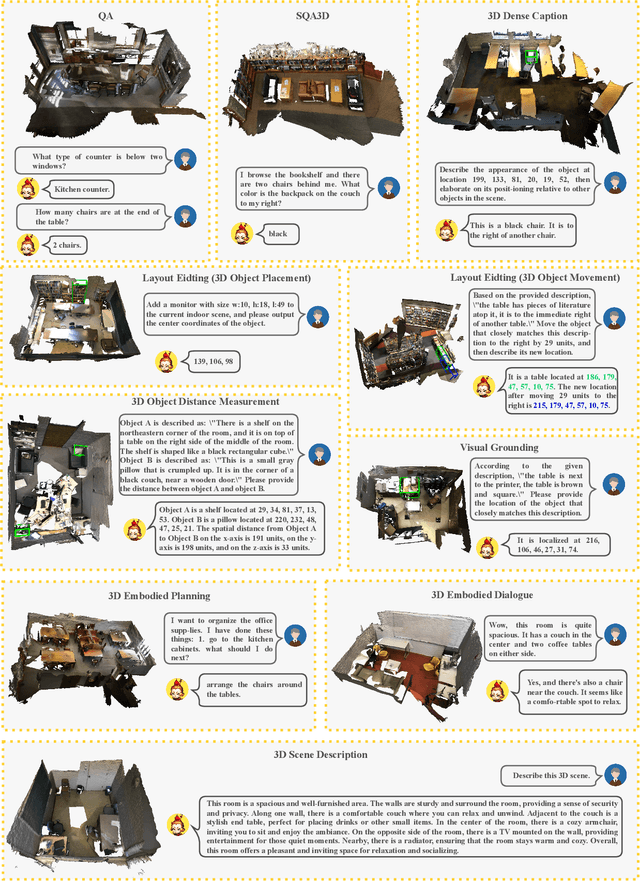
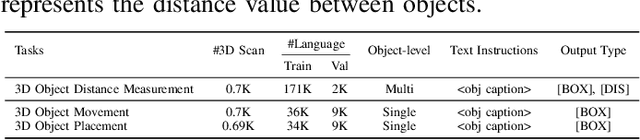
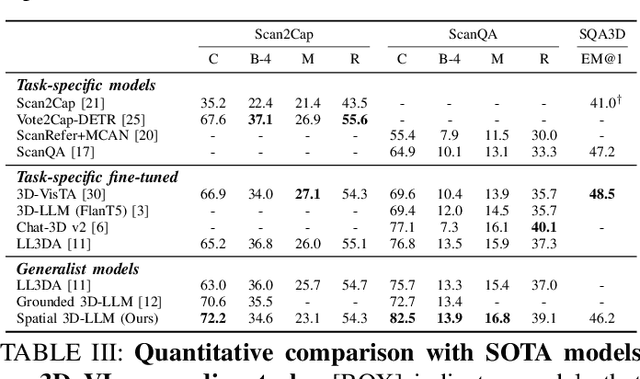
New era has unlocked exciting possibilities for extending Large Language Models (LLMs) to tackle 3D vision-language tasks. However, most existing 3D multimodal LLMs (MLLMs) rely on compressing holistic 3D scene information or segmenting independent objects to perform these tasks, which limits their spatial awareness due to insufficient representation of the richness inherent in 3D scenes. To overcome these limitations, we propose Spatial 3D-LLM, a 3D MLLM specifically designed to enhance spatial awareness for 3D vision-language tasks by enriching the spatial embeddings of 3D scenes. Spatial 3D-LLM integrates an LLM backbone with a progressive spatial awareness scheme that progressively captures spatial information as the perception field expands, generating location-enriched 3D scene embeddings to serve as visual prompts. Furthermore, we introduce two novel tasks: 3D object distance measurement and 3D layout editing, and construct a 3D instruction dataset, MODEL, to evaluate the model's spatial awareness capabilities. Experimental results demonstrate that Spatial 3D-LLM achieves state-of-the-art performance across a wide range of 3D vision-language tasks, revealing the improvements stemmed from our progressive spatial awareness scheme of mining more profound spatial information. Our code is available at https://github.com/bjshuyuan/Spatial-3D-LLM.

Label-Consistent Dataset Distillation with Detector-Guided Refinement
Jul 17, 2025Dataset distillation (DD) aims to generate a compact yet informative dataset that achieves performance comparable to the original dataset, thereby reducing demands on storage and computational resources. Although diffusion models have made significant progress in dataset distillation, the generated surrogate datasets often contain samples with label inconsistencies or insufficient structural detail, leading to suboptimal downstream performance. To address these issues, we propose a detector-guided dataset distillation framework that explicitly leverages a pre-trained detector to identify and refine anomalous synthetic samples, thereby ensuring label consistency and improving image quality. Specifically, a detector model trained on the original dataset is employed to identify anomalous images exhibiting label mismatches or low classification confidence. For each defective image, multiple candidates are generated using a pre-trained diffusion model conditioned on the corresponding image prototype and label. The optimal candidate is then selected by jointly considering the detector's confidence score and dissimilarity to existing qualified synthetic samples, thereby ensuring both label accuracy and intra-class diversity. Experimental results demonstrate that our method can synthesize high-quality representative images with richer details, achieving state-of-the-art performance on the validation set.
3DKeyAD: High-Resolution 3D Point Cloud Anomaly Detection via Keypoint-Guided Point Clustering
Jul 17, 2025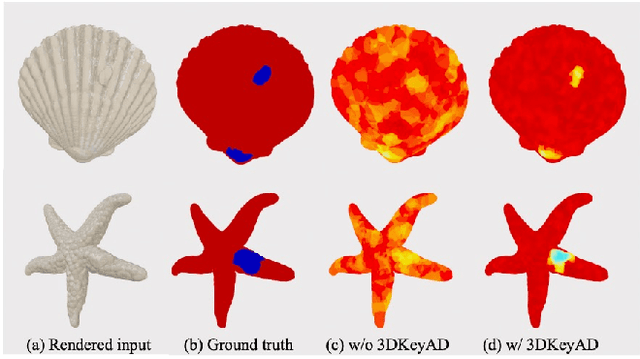
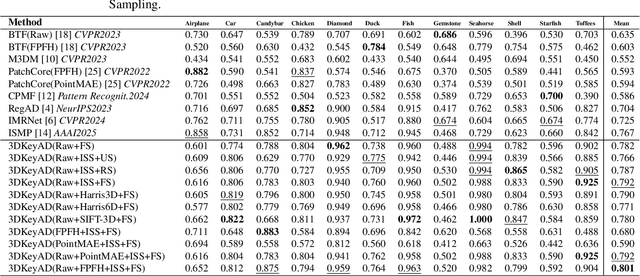
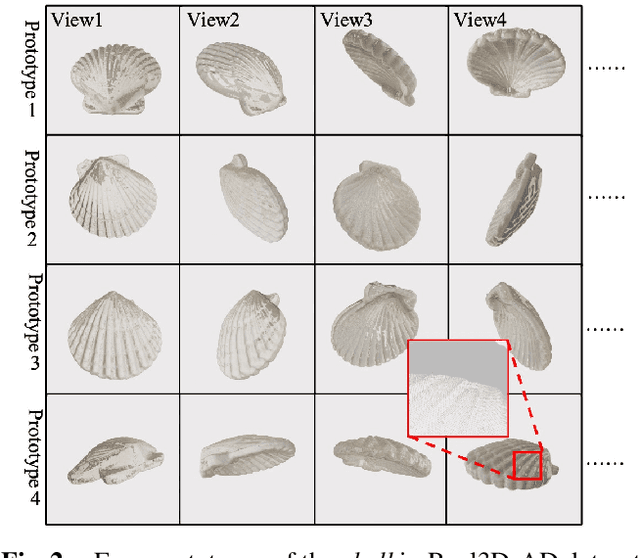
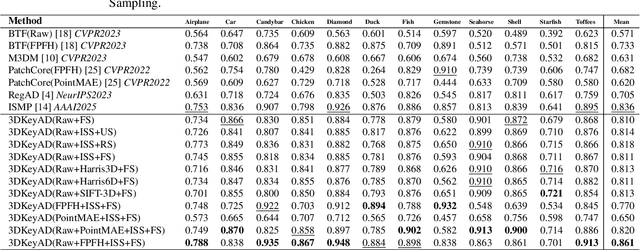
High-resolution 3D point clouds are highly effective for detecting subtle structural anomalies in industrial inspection. However, their dense and irregular nature imposes significant challenges, including high computational cost, sensitivity to spatial misalignment, and difficulty in capturing localized structural differences. This paper introduces a registration-based anomaly detection framework that combines multi-prototype alignment with cluster-wise discrepancy analysis to enable precise 3D anomaly localization. Specifically, each test sample is first registered to multiple normal prototypes to enable direct structural comparison. To evaluate anomalies at a local level, clustering is performed over the point cloud, and similarity is computed between features from the test sample and the prototypes within each cluster. Rather than selecting cluster centroids randomly, a keypoint-guided strategy is employed, where geometrically informative points are chosen as centroids. This ensures that clusters are centered on feature-rich regions, enabling more meaningful and stable distance-based comparisons. Extensive experiments on the Real3D-AD benchmark demonstrate that the proposed method achieves state-of-the-art performance in both object-level and point-level anomaly detection, even using only raw features.
Xiangqi-R1: Enhancing Spatial Strategic Reasoning in LLMs for Chinese Chess via Reinforcement Learning
Jul 16, 2025Game playing has long served as a fundamental benchmark for evaluating Artificial General Intelligence (AGI). While Large Language Models (LLMs) have demonstrated impressive capabilities in general reasoning, their effectiveness in spatial strategic reasoning, which is critical for complex and fully observable board games, remains insufficiently explored. In this work, we adopt Chinese Chess (Xiangqi) as a challenging and rich testbed due to its intricate rules and spatial complexity. To advance LLMs' strategic competence in such environments, we propose a training framework tailored to Xiangqi, built upon a large-scale dataset of five million board-move pairs enhanced with expert annotations and engine evaluations. Building on this foundation, we introduce Xiangqi-R1, a 7B-parameter model trained in multi-stage manner: (1) fine-tuning for legal move prediction to capture basic spatial rules, (2) incorporating strategic annotations to improve decision-making, and (3) applying reinforcement learning via Group Relative Policy Optimization (GRPO) with multi-dimensional reward signals to enhance reasoning stability. Our Experimental results indicate that, despite their size and power, general-purpose LLMs struggle to achieve satisfactory performance in these tasks. Compared to general-purpose LLMs, Xiangqi-R1 greatly advances with an 18% rise in move legality and a 22% boost in analysis accuracy. Our results point to a promising path for creating general strategic intelligence in spatially complex areas.
MoSE: Skill-by-Skill Mixture-of-Expert Learning for Autonomous Driving
Jul 10, 2025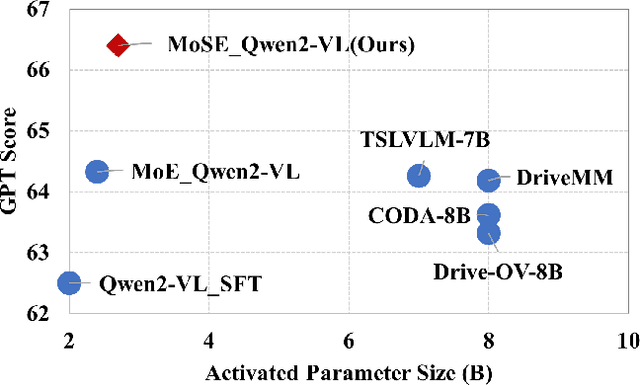
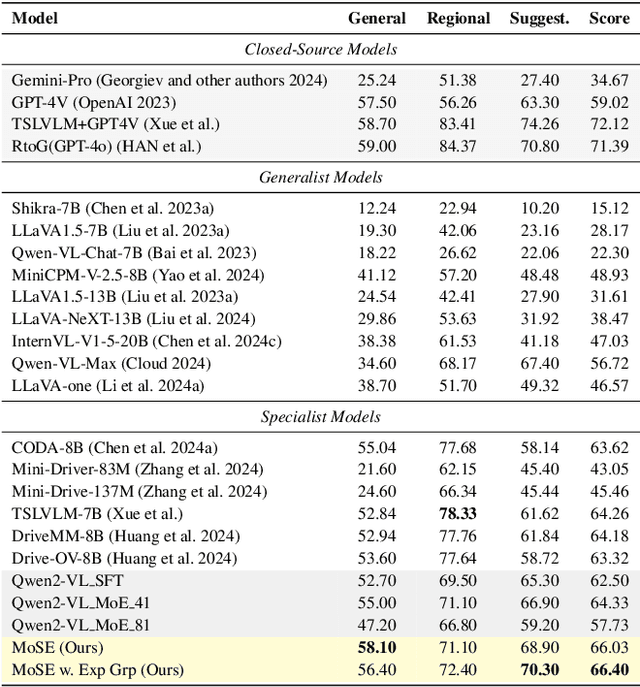
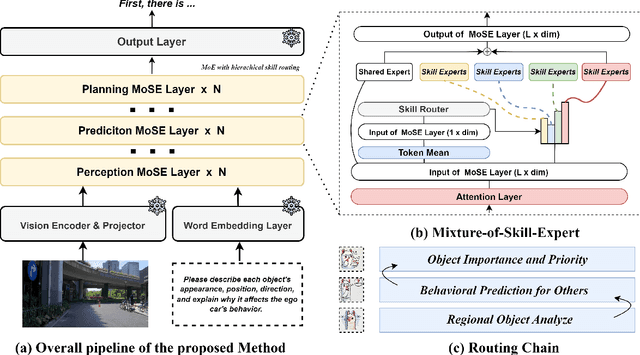
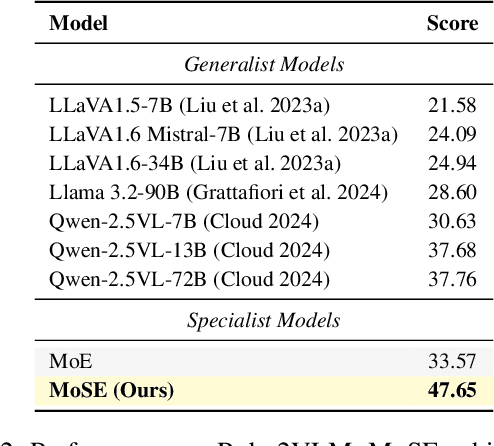
Recent studies show large language models (LLMs) and vision language models (VLMs) trained using web-scale data can empower end-to-end autonomous driving systems for a better generalization and interpretation. Specifically, by dynamically routing inputs to specialized subsets of parameters, the Mixture-of-Experts (MoE) technique enables general LLMs or VLMs to achieve substantial performance improvements while maintaining computational efficiency. However, general MoE models usually demands extensive training data and complex optimization. In this work, inspired by the learning process of human drivers, we propose a skill-oriented MoE, called MoSE, which mimics human drivers' learning process and reasoning process, skill-by-skill and step-by-step. We propose a skill-oriented routing mechanism that begins with defining and annotating specific skills, enabling experts to identify the necessary driving competencies for various scenarios and reasoning tasks, thereby facilitating skill-by-skill learning. Further align the driving process to multi-step planning in human reasoning and end-to-end driving models, we build a hierarchical skill dataset and pretrain the router to encourage the model to think step-by-step. Unlike multi-round dialogs, MoSE integrates valuable auxiliary tasks (e.g.\ description, reasoning, planning) in one single forward process without introducing any extra computational cost. With less than 3B sparsely activated parameters, our model outperforms several 8B+ parameters on CODA AD corner case reasoning task. Compared to existing methods based on open-source models and data, our approach achieves state-of-the-art performance with significantly reduced activated model size (at least by $62.5\%$) with a single-turn conversation.
Fast Gaussian Processes under Monotonicity Constraints
Jul 09, 2025Gaussian processes (GPs) are widely used as surrogate models for complicated functions in scientific and engineering applications. In many cases, prior knowledge about the function to be approximated, such as monotonicity, is available and can be leveraged to improve model fidelity. Incorporating such constraints into GP models enhances predictive accuracy and reduces uncertainty, but remains a computationally challenging task for high-dimensional problems. In this work, we present a novel virtual point-based framework for building constrained GP models under monotonicity constraints, based on regularized linear randomize-then-optimize (RLRTO), which enables efficient sampling from a constrained posterior distribution by means of solving randomized optimization problems. We also enhance two existing virtual point-based approaches by replacing Gibbs sampling with the No U-Turn Sampler (NUTS) for improved efficiency. A Python implementation of these methods is provided and can be easily applied to a wide range of problems. This implementation is then used to validate the approaches on approximating a range of synthetic functions, demonstrating comparable predictive performance between all considered methods and significant improvements in computational efficiency with the two NUTS methods and especially with the RLRTO method. The framework is further applied to construct surrogate models for systems of differential equations.
video-SALMONN 2: Captioning-Enhanced Audio-Visual Large Language Models
Jun 18, 2025Videos contain a wealth of information, and generating detailed and accurate descriptions in natural language is a key aspect of video understanding. In this paper, we present video-SALMONN 2, an advanced audio-visual large language model (LLM) with low-rank adaptation (LoRA) designed for enhanced video (with paired audio) captioning through directed preference optimisation (DPO). We propose new metrics to evaluate the completeness and accuracy of video descriptions, which are optimised using DPO. To further improve training, we propose a novel multi-round DPO (MrDPO) approach, which involves periodically updating the DPO reference model, merging and re-initialising the LoRA module as a proxy for parameter updates after each training round (1,000 steps), and incorporating guidance from ground-truth video captions to stabilise the process. Experimental results show that MrDPO significantly enhances video-SALMONN 2's captioning accuracy, reducing the captioning error rates by 28\%. The final video-SALMONN 2 model, with just 7 billion parameters, surpasses leading models such as GPT-4o and Gemini-1.5-Pro in video captioning tasks, while maintaining highly competitive performance to the state-of-the-art on widely used video question-answering benchmarks among models of similar size. Codes are available at \href{https://github.com/bytedance/video-SALMONN-2}{https://github.com/bytedance/video-SALMONN-2}.
Hunyuan3D 2.1: From Images to High-Fidelity 3D Assets with Production-Ready PBR Material
Jun 18, 20253D AI-generated content (AIGC) is a passionate field that has significantly accelerated the creation of 3D models in gaming, film, and design. Despite the development of several groundbreaking models that have revolutionized 3D generation, the field remains largely accessible only to researchers, developers, and designers due to the complexities involved in collecting, processing, and training 3D models. To address these challenges, we introduce Hunyuan3D 2.1 as a case study in this tutorial. This tutorial offers a comprehensive, step-by-step guide on processing 3D data, training a 3D generative model, and evaluating its performance using Hunyuan3D 2.1, an advanced system for producing high-resolution, textured 3D assets. The system comprises two core components: the Hunyuan3D-DiT for shape generation and the Hunyuan3D-Paint for texture synthesis. We will explore the entire workflow, including data preparation, model architecture, training strategies, evaluation metrics, and deployment. By the conclusion of this tutorial, you will have the knowledge to finetune or develop a robust 3D generative model suitable for applications in gaming, virtual reality, and industrial design.
Tady: A Neural Disassembler without Structural Constraint Violations
Jun 16, 2025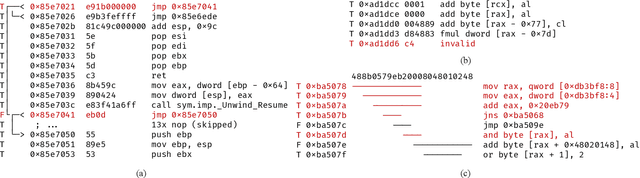
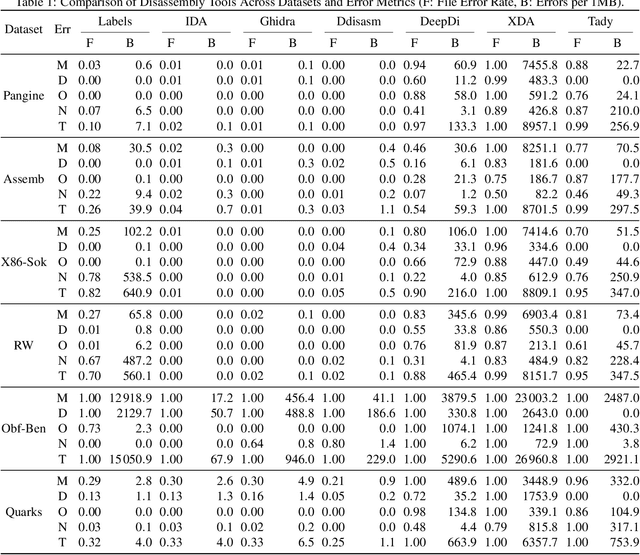
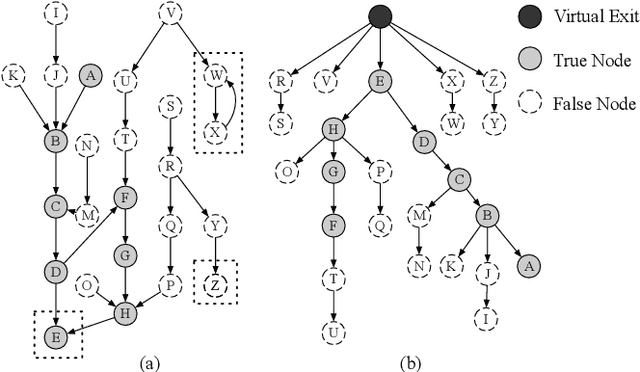
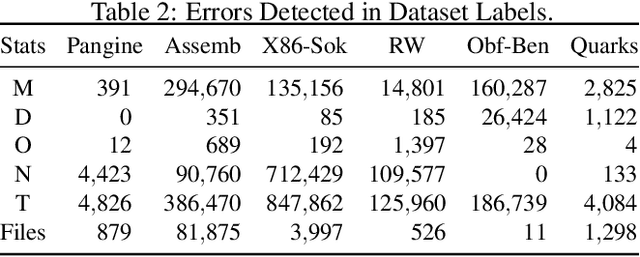
Disassembly is a crucial yet challenging step in binary analysis. While emerging neural disassemblers show promise for efficiency and accuracy, they frequently generate outputs violating fundamental structural constraints, which significantly compromise their practical usability. To address this critical problem, we regularize the disassembly solution space by formalizing and applying key structural constraints based on post-dominance relations. This approach systematically detects widespread errors in existing neural disassemblers' outputs. These errors often originate from models' limited context modeling and instruction-level decoding that neglect global structural integrity. We introduce Tady, a novel neural disassembler featuring an improved model architecture and a dedicated post-processing algorithm, specifically engineered to address these deficiencies. Comprehensive evaluations on diverse binaries demonstrate that Tady effectively eliminates structural constraint violations and functions with high efficiency, while maintaining instruction-level accuracy.
Why Do Class-Dependent Evaluation Effects Occur with Time Series Feature Attributions? A Synthetic Data Investigation
Jun 13, 2025Evaluating feature attribution methods represents a critical challenge in explainable AI (XAI), as researchers typically rely on perturbation-based metrics when ground truth is unavailable. However, recent work demonstrates that these evaluation metrics can show different performance across predicted classes within the same dataset. These "class-dependent evaluation effects" raise questions about whether perturbation analysis reliably measures attribution quality, with direct implications for XAI method development and the trustworthiness of evaluation techniques. We investigate under which conditions these class-dependent effects arise by conducting controlled experiments with synthetic time series data where ground truth feature locations are known. We systematically vary feature types and class contrasts across binary classification tasks, then compare perturbation-based degradation scores with ground truth-based precision-recall metrics using multiple attribution methods. Our experiments demonstrate that class-dependent effects emerge with both evaluation approaches even in simple scenarios with temporally localized features, triggered by basic variations in feature amplitude or temporal extent between classes. Most critically, we find that perturbation-based and ground truth metrics frequently yield contradictory assessments of attribution quality across classes, with weak correlations between evaluation approaches. These findings suggest that researchers should interpret perturbation-based metrics with care, as they may not always align with whether attributions correctly identify discriminating features. These findings reveal opportunities to reconsider what attribution evaluation actually measures and to develop more comprehensive evaluation frameworks that capture multiple dimensions of attribution quality.