 Add to Chrome
 Add to Firefox
 Add to Edge
Revisiting the Independence Assumption in LEO Satellite-to-Ground Optical Links: A State-Coupled Joint Fading Model
May 11, 2026
Performance analysis of low Earth orbit (LEO) satellite-to-ground optical links relies on composite fading models that typically evaluate scintillation and angular loss under the assumption of statistical independence. While ensuring analytical tractability, this assumption decouples fading mechanisms driven by the same atmospheric turbulence and fails to capture the distinct effects of free atmosphere (FA) and boundary layer (BL) perturbations. To model this coupling while preserving tractability, this paper develops a state-coupled joint fading model. In the proposed framework, aperture-averaged scintillation and effective angular loss are jointly characterized by a discrete slow atmospheric state, parameterized by separate FA and BL scaling factors. By replacing unconditional independence with state-conditioned independence, the model enables a closed-form derivation of the outage probability, preserving the computational simplicity of the independent baseline. Numerical results show that the independent baseline can misestimate outage under non-nominal layered turbulence states. This outage prediction bias varies with elevation because the relative roles of scintillation and angular loss change with the link geometry, resulting in different residual angular correction requirements for a given outage target.

Tady: A Neural Disassembler without Structural Constraint Violations
Jun 16, 2025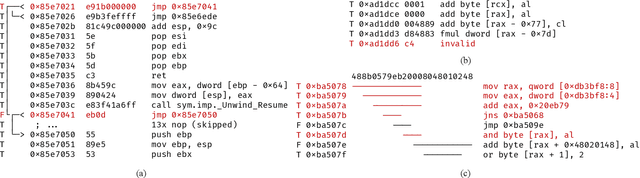
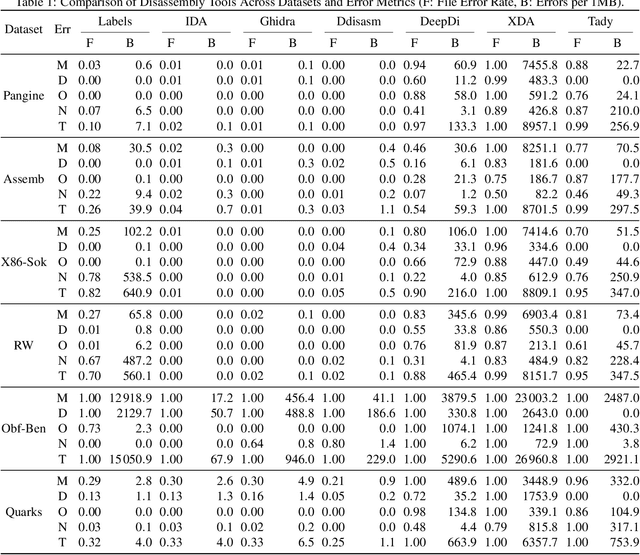
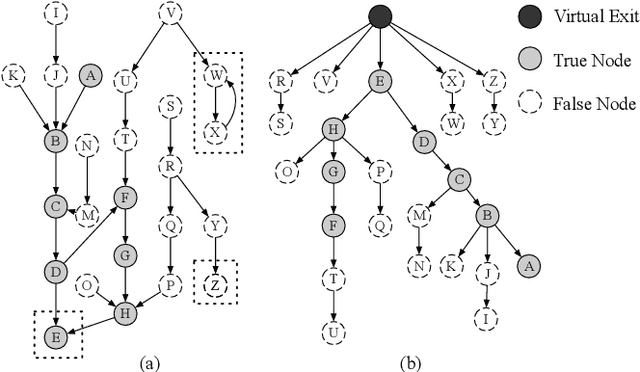
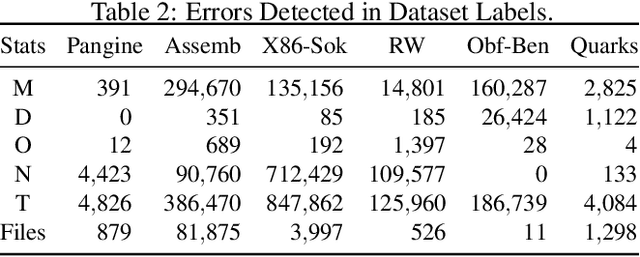
Disassembly is a crucial yet challenging step in binary analysis. While emerging neural disassemblers show promise for efficiency and accuracy, they frequently generate outputs violating fundamental structural constraints, which significantly compromise their practical usability. To address this critical problem, we regularize the disassembly solution space by formalizing and applying key structural constraints based on post-dominance relations. This approach systematically detects widespread errors in existing neural disassemblers' outputs. These errors often originate from models' limited context modeling and instruction-level decoding that neglect global structural integrity. We introduce Tady, a novel neural disassembler featuring an improved model architecture and a dedicated post-processing algorithm, specifically engineered to address these deficiencies. Comprehensive evaluations on diverse binaries demonstrate that Tady effectively eliminates structural constraint violations and functions with high efficiency, while maintaining instruction-level accuracy.