 Add to Chrome
 Add to Firefox
 Add to Edge
Learning Emotion from Motion: Kinetic Multi-Stream Skeleton Modeling with Metadata-Conditioned Weak Label Distributions
Jul 19, 2026
Skeleton-based emotion recognition from body motion remains challenging because emotional expressions are often characterized by subtle dynamic and relational motion cues, and hard labels may not fully capture ambiguity among related emotion categories. For the DIEM-A task in the MMAC ACII 2026 Challenge, we propose a multi-branch skeleton-based emotion recognition framework that combines a 6D rotation-based branch, a part-aware kinetic multi-stream branch, and a metadata-conditioned weak label distribution learning (LDL) branch. The branches are trained independently and fused by a probability-level ensemble at inference time. In 10-fold leave-performer-out cross-validation, the proposed framework improves Accuracy from 0.271 to 0.366 and Macro-F1 from 0.252 to 0.353 over the rotation-based baseline. Explainability ablations show that velocity and bone streams, as well as arm and leg regions, provide important cues for recognizing emotional body motion.

VT-3DAD: Cross-Category 3D Anomaly Detection via Visual-Text Normal Space Alignment
Jun 03, 2026Few-shot cross-category 3D anomaly detection aims to determine whether an unknown point cloud belongs to a target normal category using only a few normal references. Existing training-based methods usually require category-wise optimization, while recent training-free methods based on multi-view CLIP visual features mainly rely on visual similarity and may be confused by geometrically similar categories. In this paper, we propose VT-3DAD, a training-free framework for cross-category 3D anomaly detection via Visual-Text Normal Space Alignment. Given few-shot normal references and a test point cloud, VT-3DAD first generates realistic multi-view depth maps and extracts view-wise features using a frozen CLIP visual encoder. The visual branch measures reference-test deviation in the multi-view feature space. In parallel, depth-aware and 3D-aware prompts are encoded by the frozen CLIP text encoder to construct textual normal anchors, which provide semantic normality constraints for the target category. The final anomaly score is obtained by fusing visual deviation from normal references and semantic deviation from the textual normal space. Experiments on the ShapeNetPart dataset demonstrate that VT-3DAD achieves state-of-the-art performance. In particular, VT-3DAD improves the one-shot average AUC-ROC from 92.49% to 94.80% compared with the visual-only baseline, while also reducing the average standard deviation from 5.64 to 3.41.
DMP-3DAD: Cross-Category 3D Anomaly Detection via Realistic Depth Map Projection with Few Normal Samples
Feb 11, 2026Cross-category anomaly detection for 3D point clouds aims to determine whether an unseen object belongs to a target category using only a few normal examples. Most existing methods rely on category-specific training, which limits their flexibility in few-shot scenarios. In this paper, we propose DMP-3DAD, a training-free framework for cross-category 3D anomaly detection based on multi-view realistic depth map projection. Specifically, by converting point clouds into a fixed set of realistic depth images, our method leverages a frozen CLIP visual encoder to extract multi-view representations and performs anomaly detection via weighted feature similarity, which does not require any fine-tuning or category-dependent adaptation. Extensive experiments on the ShapeNetPart dataset demonstrate that DMP-3DAD achieves state-of-the-art performance under few-shot setting. The results show that the proposed approach provides a simple yet effective solution for practical cross-category 3D anomaly detection.
3D Human-Human Interaction Anomaly Detection
Dec 15, 2025Human-centric anomaly detection (AD) has been primarily studied to specify anomalous behaviors in a single person. However, as humans by nature tend to act in a collaborative manner, behavioral anomalies can also arise from human-human interactions. Detecting such anomalies using existing single-person AD models is prone to low accuracy, as these approaches are typically not designed to capture the complex and asymmetric dynamics of interactions. In this paper, we introduce a novel task, Human-Human Interaction Anomaly Detection (H2IAD), which aims to identify anomalous interactive behaviors within collaborative 3D human actions. To address H2IAD, we then propose Interaction Anomaly Detection Network (IADNet), which is formalized with a Temporal Attention Sharing Module (TASM). Specifically, in designing TASM, we share the encoded motion embeddings across both people such that collaborative motion correlations can be effectively synchronized. Moreover, we notice that in addition to temporal dynamics, human interactions are also characterized by spatial configurations between two people. We thus introduce a Distance-Based Relational Encoding Module (DREM) to better reflect social cues in H2IAD. The normalizing flow is eventually employed for anomaly scoring. Extensive experiments on human-human motion benchmarks demonstrate that IADNet outperforms existing Human-centric AD baselines in H2IAD.
Few-shot Human Action Anomaly Detection via a Unified Contrastive Learning Framework
Aug 25, 2025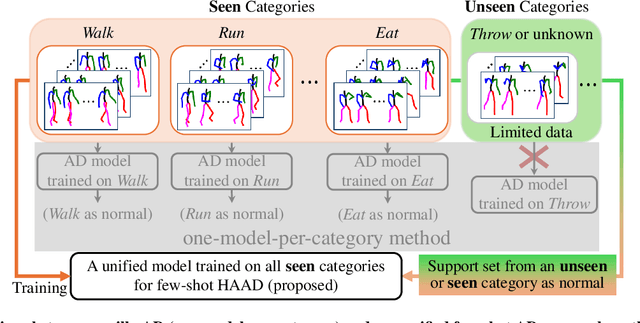
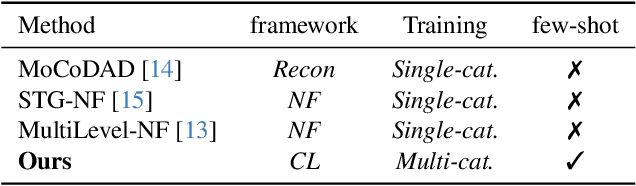
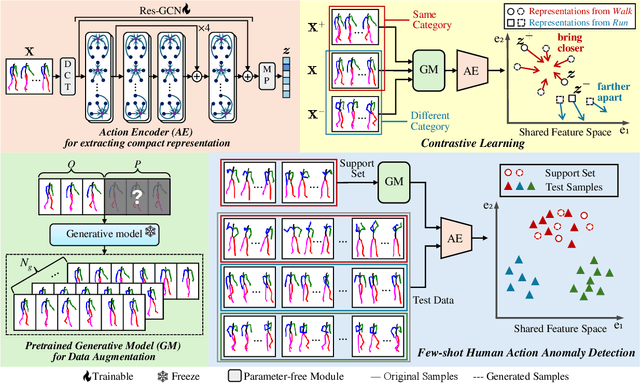
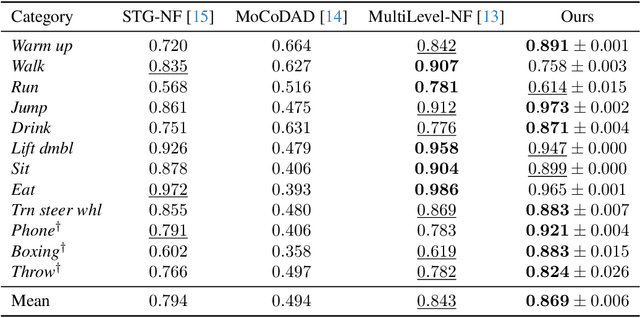
Human Action Anomaly Detection (HAAD) aims to identify anomalous actions given only normal action data during training. Existing methods typically follow a one-model-per-category paradigm, requiring separate training for each action category and a large number of normal samples. These constraints hinder scalability and limit applicability in real-world scenarios, where data is often scarce or novel categories frequently appear. To address these limitations, we propose a unified framework for HAAD that is compatible with few-shot scenarios. Our method constructs a category-agnostic representation space via contrastive learning, enabling AD by comparing test samples with a given small set of normal examples (referred to as the support set). To improve inter-category generalization and intra-category robustness, we introduce a generative motion augmentation strategy harnessing a diffusion-based foundation model for creating diverse and realistic training samples. Notably, to the best of our knowledge, our work is the first to introduce such a strategy specifically tailored to enhance contrastive learning for action AD. Extensive experiments on the HumanAct12 dataset demonstrate the state-of-the-art effectiveness of our approach under both seen and unseen category settings, regarding training efficiency and model scalability for few-shot HAAD.
3DKeyAD: High-Resolution 3D Point Cloud Anomaly Detection via Keypoint-Guided Point Clustering
Jul 17, 2025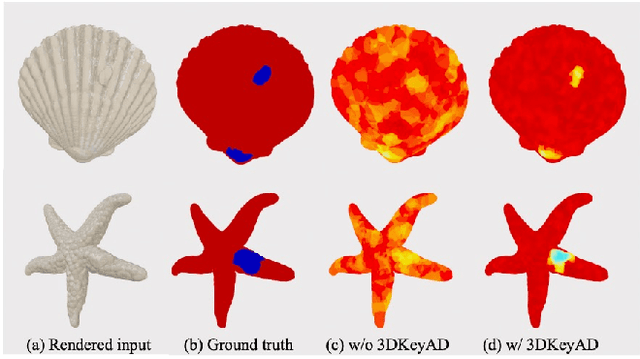
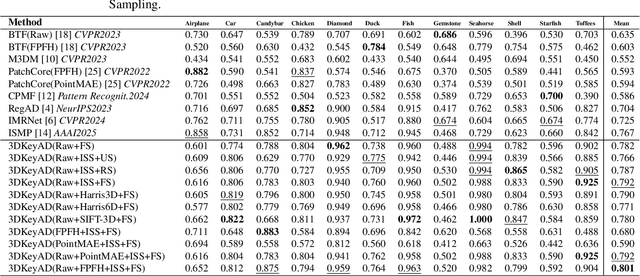
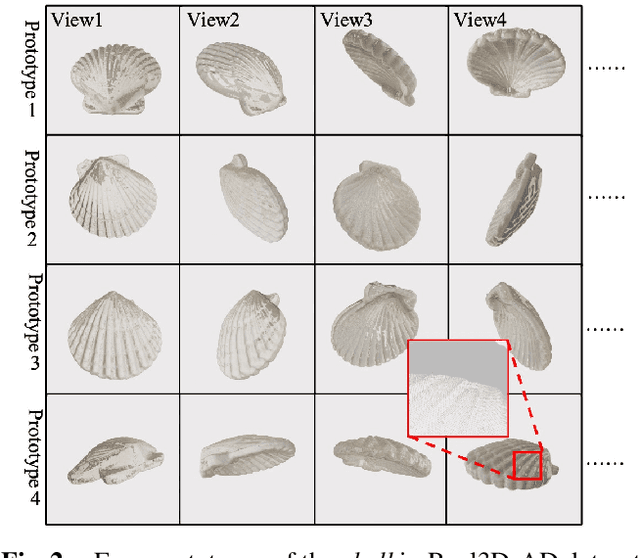
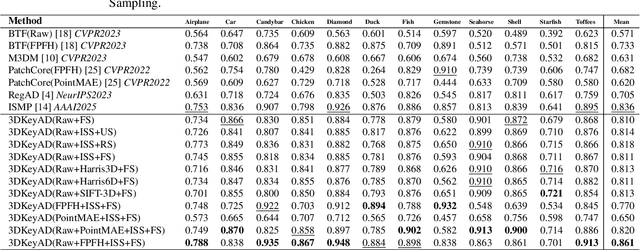
High-resolution 3D point clouds are highly effective for detecting subtle structural anomalies in industrial inspection. However, their dense and irregular nature imposes significant challenges, including high computational cost, sensitivity to spatial misalignment, and difficulty in capturing localized structural differences. This paper introduces a registration-based anomaly detection framework that combines multi-prototype alignment with cluster-wise discrepancy analysis to enable precise 3D anomaly localization. Specifically, each test sample is first registered to multiple normal prototypes to enable direct structural comparison. To evaluate anomalies at a local level, clustering is performed over the point cloud, and similarity is computed between features from the test sample and the prototypes within each cluster. Rather than selecting cluster centroids randomly, a keypoint-guided strategy is employed, where geometrically informative points are chosen as centroids. This ensures that clusters are centered on feature-rich regions, enabling more meaningful and stable distance-based comparisons. Extensive experiments on the Real3D-AD benchmark demonstrate that the proposed method achieves state-of-the-art performance in both object-level and point-level anomaly detection, even using only raw features.