 Add to Chrome
 Add to Firefox
 Add to Edge
Rep2wav: Noise Robust text-to-speech Using self-supervised representations
Sep 04, 2023


Benefiting from the development of deep learning, text-to-speech (TTS) techniques using clean speech have achieved significant performance improvements. The data collected from real scenes often contains noise and generally needs to be denoised by speech enhancement models. Noise-robust TTS models are often trained using the enhanced speech, which thus suffer from speech distortion and background noise that affect the quality of the synthesized speech. Meanwhile, it was shown that self-supervised pre-trained models exhibit excellent noise robustness on many speech tasks, implying that the learned representation has a better tolerance for noise perturbations. In this work, we therefore explore pre-trained models to improve the noise robustness of TTS models. Based on HiFi-GAN, we first propose a representation-to-waveform vocoder, which aims to learn to map the representation of pre-trained models to the waveform. We then propose a text-to-representation FastSpeech2 model, which aims to learn to map text to pre-trained model representations. Experimental results on the LJSpeech and LibriTTS datasets show that our method outperforms those using speech enhancement methods in both subjective and objective metrics. Audio samples are available at: https://zqs01.github.io/rep2wav.

Ultra Dual-Path Compression For Joint Echo Cancellation And Noise Suppression
Aug 21, 2023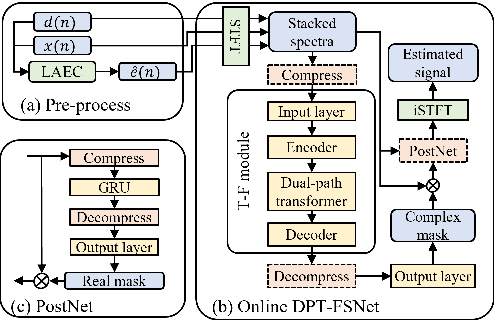
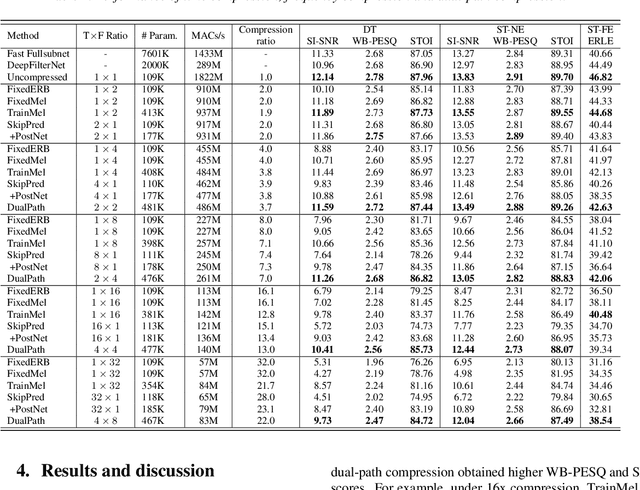
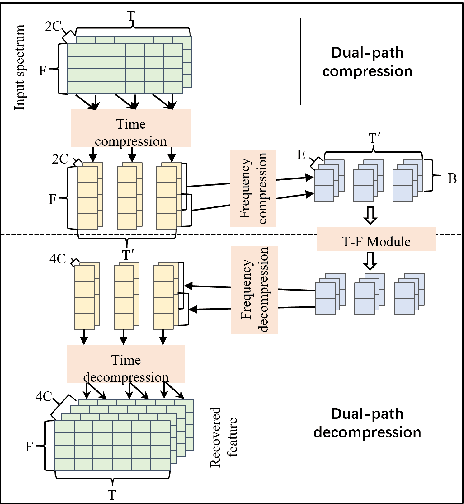
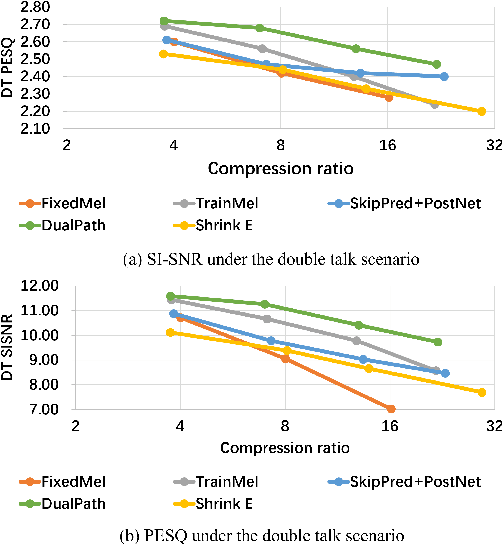
Echo cancellation and noise reduction are essential for full-duplex communication, yet most existing neural networks have high computational costs and are inflexible in tuning model complexity. In this paper, we introduce time-frequency dual-path compression to achieve a wide range of compression ratios on computational cost. Specifically, for frequency compression, trainable filters are used to replace manually designed filters for dimension reduction. For time compression, only using frame skipped prediction causes large performance degradation, which can be alleviated by a post-processing network with full sequence modeling. We have found that under fixed compression ratios, dual-path compression combining both the time and frequency methods will give further performance improvement, covering compression ratios from 4x to 32x with little model size change. Moreover, the proposed models show competitive performance compared with fast FullSubNet and DeepFilterNet. A demo page can be found at hangtingchen.github.io/ultra_dual_path_compression.github.io/.
Bayes Risk Transducer: Transducer with Controllable Alignment Prediction
Aug 19, 2023Automatic speech recognition (ASR) based on transducers is widely used. In training, a transducer maximizes the summed posteriors of all paths. The path with the highest posterior is commonly defined as the predicted alignment between the speech and the transcription. While the vanilla transducer does not have a prior preference for any of the valid paths, this work intends to enforce the preferred paths and achieve controllable alignment prediction. Specifically, this work proposes Bayes Risk Transducer (BRT), which uses a Bayes risk function to set lower risk values to the preferred paths so that the predicted alignment is more likely to satisfy specific desired properties. We further demonstrate that these predicted alignments with intentionally designed properties can provide practical advantages over the vanilla transducer. Experimentally, the proposed BRT saves inference cost by up to 46% for non-streaming ASR and reduces overall system latency by 41% for streaming ASR.
Animate-A-Story: Storytelling with Retrieval-Augmented Video Generation
Jul 13, 2023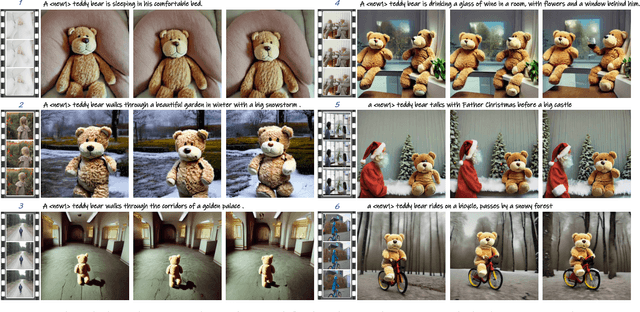
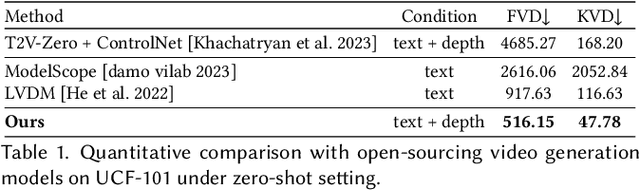
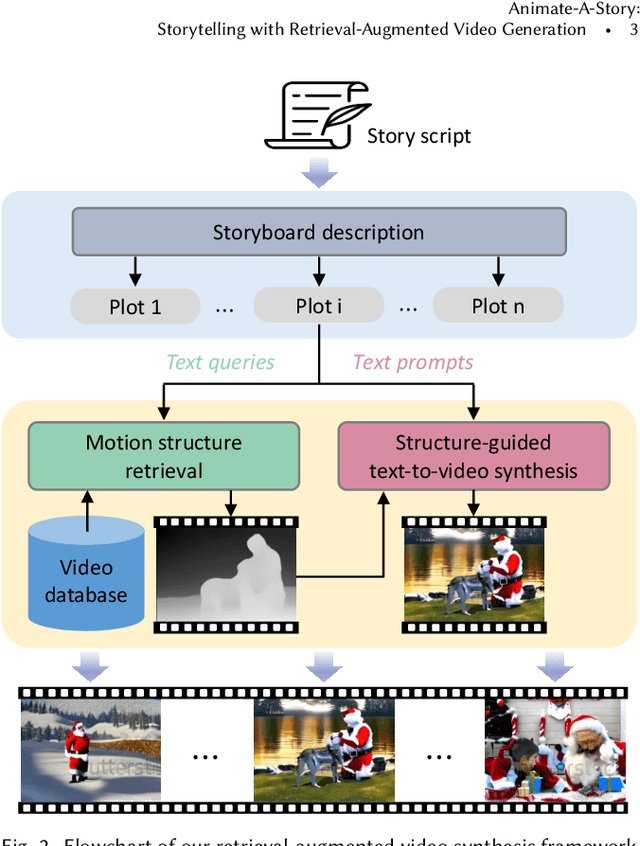
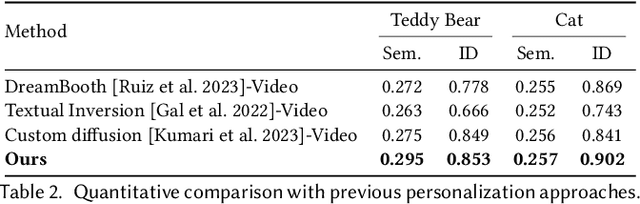
Generating videos for visual storytelling can be a tedious and complex process that typically requires either live-action filming or graphics animation rendering. To bypass these challenges, our key idea is to utilize the abundance of existing video clips and synthesize a coherent storytelling video by customizing their appearances. We achieve this by developing a framework comprised of two functional modules: (i) Motion Structure Retrieval, which provides video candidates with desired scene or motion context described by query texts, and (ii) Structure-Guided Text-to-Video Synthesis, which generates plot-aligned videos under the guidance of motion structure and text prompts. For the first module, we leverage an off-the-shelf video retrieval system and extract video depths as motion structure. For the second module, we propose a controllable video generation model that offers flexible controls over structure and characters. The videos are synthesized by following the structural guidance and appearance instruction. To ensure visual consistency across clips, we propose an effective concept personalization approach, which allows the specification of the desired character identities through text prompts. Extensive experiments demonstrate that our approach exhibits significant advantages over various existing baselines.
Make-A-Voice: Unified Voice Synthesis With Discrete Representation
May 30, 2023Various applications of voice synthesis have been developed independently despite the fact that they generate "voice" as output in common. In addition, the majority of voice synthesis models currently rely on annotated audio data, but it is crucial to scale them to self-supervised datasets in order to effectively capture the wide range of acoustic variations present in human voice, including speaker identity, emotion, and prosody. In this work, we propose Make-A-Voice, a unified framework for synthesizing and manipulating voice signals from discrete representations. Make-A-Voice leverages a "coarse-to-fine" approach to model the human voice, which involves three stages: 1) semantic stage: model high-level transformation between linguistic content and self-supervised semantic tokens, 2) acoustic stage: introduce varying control signals as acoustic conditions for semantic-to-acoustic modeling, and 3) generation stage: synthesize high-fidelity waveforms from acoustic tokens. Make-A-Voice offers notable benefits as a unified voice synthesis framework: 1) Data scalability: the major backbone (i.e., acoustic and generation stage) does not require any annotations, and thus the training data could be scaled up. 2) Controllability and conditioning flexibility: we investigate different conditioning mechanisms and effectively handle three voice synthesis applications, including text-to-speech (TTS), voice conversion (VC), and singing voice synthesis (SVS) by re-synthesizing the discrete voice representations with prompt guidance. Experimental results demonstrate that Make-A-Voice exhibits superior audio quality and style similarity compared with competitive baseline models. Audio samples are available at https://Make-A-Voice.github.io
Diverse and Expressive Speech Prosody Prediction with Denoising Diffusion Probabilistic Model
May 26, 2023Expressive human speech generally abounds with rich and flexible speech prosody variations. The speech prosody predictors in existing expressive speech synthesis methods mostly produce deterministic predictions, which are learned by directly minimizing the norm of prosody prediction error. Its unimodal nature leads to a mismatch with ground truth distribution and harms the model's ability in making diverse predictions. Thus, we propose a novel prosody predictor based on the denoising diffusion probabilistic model to take advantage of its high-quality generative modeling and training stability. Experiment results confirm that the proposed prosody predictor outperforms the deterministic baseline on both the expressiveness and diversity of prediction results with even fewer network parameters.
Eeg2vec: Self-Supervised Electroencephalographic Representation Learning
May 23, 2023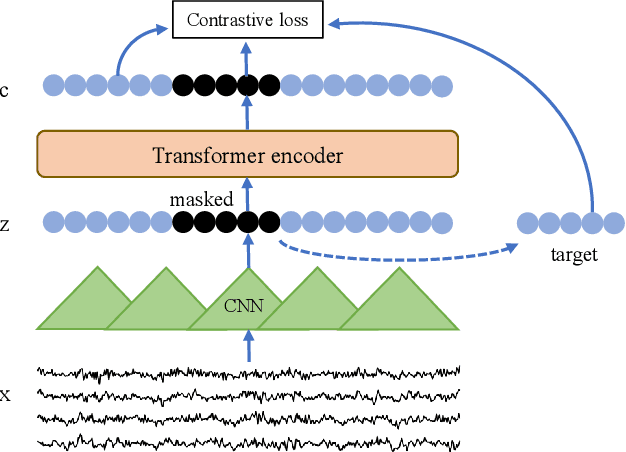
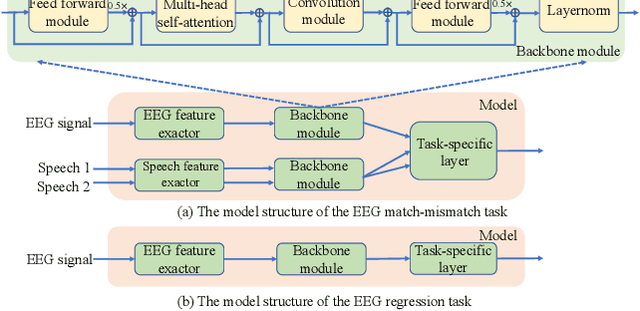
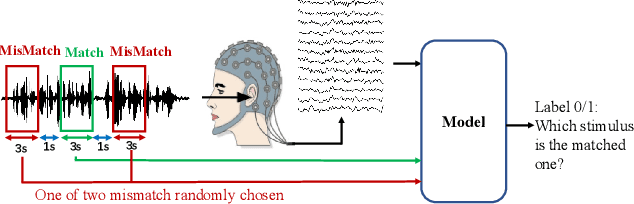
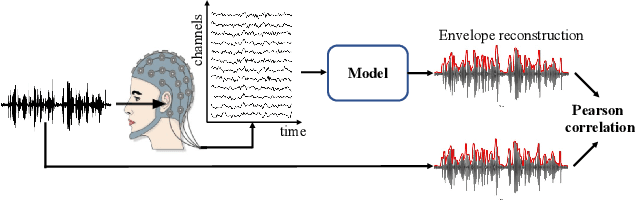
Recently, many efforts have been made to explore how the brain processes speech using electroencephalographic (EEG) signals, where deep learning-based approaches were shown to be applicable in this field. In order to decode speech signals from EEG signals, linear networks, convolutional neural networks (CNN) and long short-term memory networks are often used in a supervised manner. Recording EEG-speech labeled data is rather time-consuming and laborious, while unlabeled EEG data is abundantly available. Whether self-supervised methods are helpful to learn EEG representation to boost the performance of EEG auditory-related tasks has not been well explored. In this work, we first propose a self-supervised model based on contrastive loss and reconstruction loss to learn EEG representations, and then use the obtained pre-trained model as a feature extractor for downstream tasks. Second, for two considered downstream tasks, we use CNNs and Transformer networks to learn local features and global features, respectively. Finally, the EEG data from other channels are mixed into the chosen EEG data for augmentation. The effectiveness of our method is verified on the EEG match-mismatch and EEG regression tasks of the ICASSP2023 Auditory EEG Challenge.
HiFi-Codec: Group-residual Vector quantization for High Fidelity Audio Codec
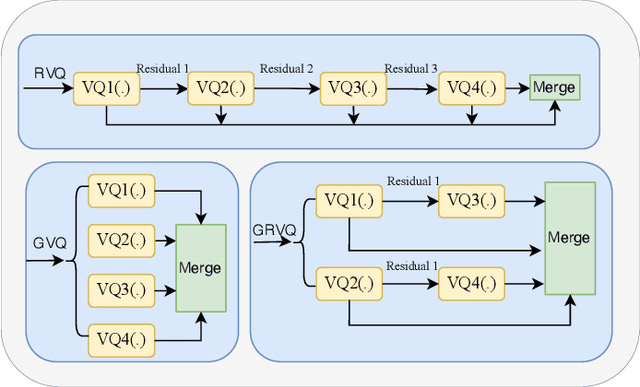
May 07, 2023Audio codec models are widely used in audio communication as a crucial technique for compressing audio into discrete representations. Nowadays, audio codec models are increasingly utilized in generation fields as intermediate representations. For instance, AudioLM is an audio generation model that uses the discrete representation of SoundStream as a training target, while VALL-E employs the Encodec model as an intermediate feature to aid TTS tasks. Despite their usefulness, two challenges persist: (1) training these audio codec models can be difficult due to the lack of publicly available training processes and the need for large-scale data and GPUs; (2) achieving good reconstruction performance requires many codebooks, which increases the burden on generation models. In this study, we propose a group-residual vector quantization (GRVQ) technique and use it to develop a novel \textbf{Hi}gh \textbf{Fi}delity Audio Codec model, HiFi-Codec, which only requires 4 codebooks. We train all the models using publicly available TTS data such as LibriTTS, VCTK, AISHELL, and more, with a total duration of over 1000 hours, using 8 GPUs. Our experimental results show that HiFi-Codec outperforms Encodec in terms of reconstruction performance despite requiring only 4 codebooks. To facilitate research in audio codec and generation, we introduce AcademiCodec, the first open-source audio codec toolkit that offers training codes and pre-trained models for Encodec, SoundStream, and HiFi-Codec. Code and pre-trained model can be found on: \href{https://github.com/yangdongchao/AcademiCodec}{https://github.com/yangdongchao/AcademiCodec}
InstructTTS: Modelling Expressive TTS in Discrete Latent Space with Natural Language Style Prompt
Jan 31, 2023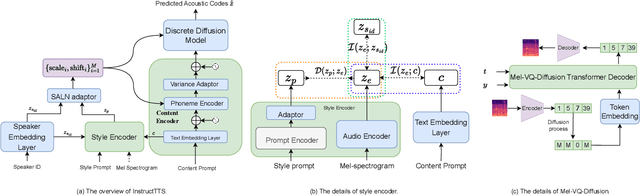
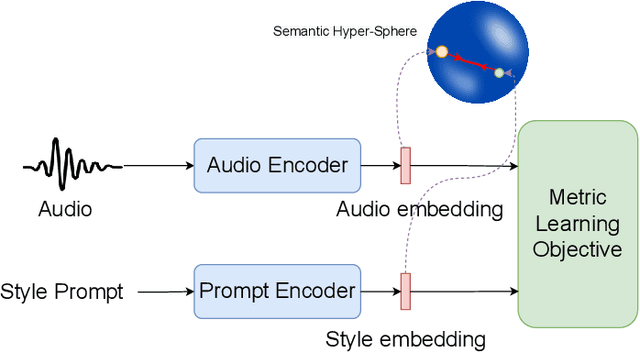
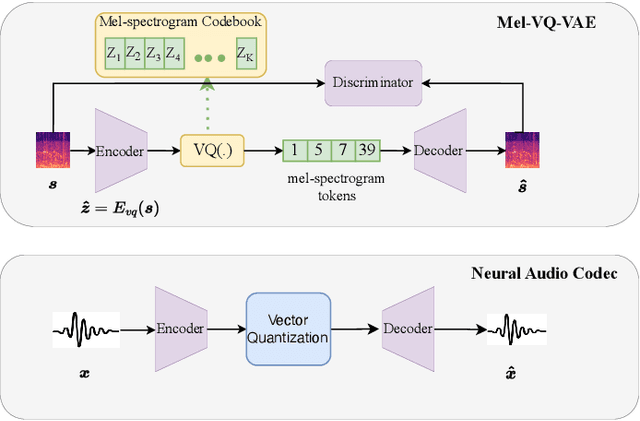
Expressive text-to-speech (TTS) aims to synthesize different speaking style speech according to human's demands. Nowadays, there are two common ways to control speaking styles: (1) Pre-defining a group of speaking style and using categorical index to denote different speaking style. However, there are limitations in the diversity of expressiveness, as these models can only generate the pre-defined styles. (2) Using reference speech as style input, which results in a problem that the extracted style information is not intuitive or interpretable. In this study, we attempt to use natural language as style prompt to control the styles in the synthetic speech, \textit{e.g.}, ``Sigh tone in full of sad mood with some helpless feeling". Considering that there is no existing TTS corpus which is proper to benchmark this novel task, we first construct a speech corpus, whose speech samples are annotated with not only content transcriptions but also style descriptions in natural language. Then we propose an expressive TTS model, named as InstructTTS, which is novel in the sense of following aspects: (1) We fully take the advantage of self-supervised learning and cross-modal metric learning, and propose a novel three-stage training procedure to obtain a robust sentence embedding model, which can effectively capture semantic information from the style prompts and control the speaking style in the generated speech. (2) We propose to model acoustic features in discrete latent space and train a novel discrete diffusion probabilistic model to generate vector-quantized (VQ) acoustic tokens rather than the commonly-used mel spectrogram. (3) We jointly apply mutual information (MI) estimation and minimization during acoustic model training to minimize style-speaker and style-content MI, avoiding possible content and speaker information leakage from the style prompt.
High Fidelity Speech Enhancement with Band-split RNN
Dec 01, 2022This report presents the development of our speech enhancement system, which includes the use of a recently proposed music separation model, the band-split recurrent neural network (BSRNN), and a MetricGAN-based training objective to improve non-differentiable quality metrics such as perceptual evaluation of speech quality (PESQ) score. Experiment conducted on Interspeech 2021 DNS challenge shows that our BSRNN system outperforms various top-ranking benchmark systems in previous deep noise suppression (DNS) challenges and achieves state-of-the-art (SOTA) result on the DNS-2020 non-blind test set in both offline and online scenarios.