 Add to Chrome
 Add to Firefox
 Add to Edge
CRL-VLA: Continual Vision-Language-Action Learning
Feb 03, 2026
Lifelong learning is critical for embodied agents in open-world environments, where reinforcement learning fine-tuning has emerged as an important paradigm to enable Vision-Language-Action (VLA) models to master dexterous manipulation through environmental interaction. Thus, Continual Reinforcement Learning (CRL) is a promising pathway for deploying VLA models in lifelong robotic scenarios, yet balancing stability (retaining old skills) and plasticity (learning new ones) remains a formidable challenge for existing methods. We introduce CRL-VLA, a framework for continual post-training of VLA models with rigorous theoretical bounds. We derive a unified performance bound linking the stability-plasticity trade-off to goal-conditioned advantage magnitude, scaled by policy divergence. CRL-VLA resolves this dilemma via asymmetric regulation: constraining advantage magnitudes on prior tasks while enabling controlled growth on new tasks. This is realized through a simple but effective dual-critic architecture with novel Goal-Conditioned Value Formulation (GCVF), where a frozen critic anchors semantic consistency and a trainable estimator drives adaptation. Experiments on the LIBERO benchmark demonstrate that CRL-VLA effectively harmonizes these conflicting objectives, outperforming baselines in both anti-forgetting and forward adaptation.

Omni-Judge: Can Omni-LLMs Serve as Human-Aligned Judges for Text-Conditioned Audio-Video Generation?
Feb 02, 2026State-of-the-art text-to-video generation models such as Sora 2 and Veo 3 can now produce high-fidelity videos with synchronized audio directly from a textual prompt, marking a new milestone in multi-modal generation. However, evaluating such tri-modal outputs remains an unsolved challenge. Human evaluation is reliable but costly and difficult to scale, while traditional automatic metrics, such as FVD, CLAP, and ViCLIP, focus on isolated modality pairs, struggle with complex prompts, and provide limited interpretability. Omni-modal large language models (omni-LLMs) present a promising alternative: they naturally process audio, video, and text, support rich reasoning, and offer interpretable chain-of-thought feedback. Driven by this, we introduce Omni-Judge, a study assessing whether omni-LLMs can serve as human-aligned judges for text-conditioned audio-video generation. Across nine perceptual and alignment metrics, Omni-Judge achieves correlation comparable to traditional metrics and excels on semantically demanding tasks such as audio-text alignment, video-text alignment, and audio-video-text coherence. It underperforms on high-FPS perceptual metrics, including video quality and audio-video synchronization, due to limited temporal resolution. Omni-Judge provides interpretable explanations that expose semantic or physical inconsistencies, enabling practical downstream uses such as feedback-based refinement. Our findings highlight both the potential and current limitations of omni-LLMs as unified evaluators for multi-modal generation.
Why Your Deep Research Agent Fails? On Hallucination Evaluation in Full Research Trajectory
Jan 30, 2026Diagnosing the failure mechanisms of Deep Research Agents (DRAs) remains a critical challenge. Existing benchmarks predominantly rely on end-to-end evaluation, obscuring critical intermediate hallucinations, such as flawed planning, that accumulate throughout the research trajectory. To bridge this gap, we propose a shift from outcome-based to process-aware evaluation by auditing the full research trajectory. We introduce the PIES Taxonomy to categorize hallucinations along functional components (Planning vs. Summarization) and error properties (Explicit vs. Implicit). We instantiate this taxonomy into a fine-grained evaluation framework that decomposes the trajectory to rigorously quantify these hallucinations. Leveraging this framework to isolate 100 distinctively hallucination-prone tasks including adversarial scenarios, we curate DeepHalluBench. Experiments on six state-of-theart DRAs reveal that no system achieves robust reliability. Furthermore, our diagnostic analysis traces the etiology of these failures to systemic deficits, specifically hallucination propagation and cognitive biases, providing foundational insights to guide future architectural optimization. Data and code are available at https://github.com/yuhao-zhan/DeepHalluBench.
Decoupled Split Learning via Auxiliary Loss
Jan 27, 2026Split learning is a distributed training paradigm where a neural network is partitioned between clients and a server, which allows data to remain at the client while only intermediate activations are shared. Traditional split learning relies on end-to-end backpropagation across the client-server split point. This incurs a large communication overhead (i.e., forward activations and backward gradients need to be exchanged every iteration) and significant memory use (for storing activations and gradients). In this paper, we develop a beyond-backpropagation training method for split learning. In this approach, the client and server train their model partitions semi-independently, using local loss signals instead of propagated gradients. In particular, the client's network is augmented with a small auxiliary classifier at the split point to provide a local error signal, while the server trains on the client's transmitted activations using the true loss function. This decoupling removes the need to send backward gradients, which cuts communication costs roughly in half and also reduces memory overhead (as each side only stores local activations for its own backward pass). We evaluate our approach on CIFAR-10 and CIFAR-100. Our experiments show two key results. First, the proposed approach achieves performance on par with standard split learning that uses backpropagation. Second, it significantly reduces communication (of transmitting activations/gradient) by 50% and peak memory usage by up to 58%.
HOSL: Hybrid-Order Split Learning for Memory-Constrained Edge Training
Jan 16, 2026Split learning (SL) enables collaborative training of large language models (LLMs) between resource-constrained edge devices and compute-rich servers by partitioning model computation across the network boundary. However, existing SL systems predominantly rely on first-order (FO) optimization, which requires clients to store intermediate quantities such as activations for backpropagation. This results in substantial memory overhead, largely negating benefits of model partitioning. In contrast, zeroth-order (ZO) optimization eliminates backpropagation and significantly reduces memory usage, but often suffers from slow convergence and degraded performance. In this work, we propose HOSL, a novel Hybrid-Order Split Learning framework that addresses this fundamental trade-off between memory efficiency and optimization effectiveness by strategically integrating ZO optimization on the client side with FO optimization on the server side. By employing memory-efficient ZO gradient estimation at the client, HOSL eliminates backpropagation and activation storage, reducing client memory consumption. Meanwhile, server-side FO optimization ensures fast convergence and competitive performance. Theoretically, we show that HOSL achieves a $\mathcal{O}(\sqrt{d_c/TQ})$ rate, which depends on client-side model dimension $d_c$ rather than the full model dimension $d$, demonstrating that convergence improves as more computation is offloaded to the server. Extensive experiments on OPT models (125M and 1.3B parameters) across 6 tasks demonstrate that HOSL reduces client GPU memory by up to 3.7$\times$ compared to the FO method while achieving accuracy within 0.20%-4.23% of this baseline. Furthermore, HOSL outperforms the ZO baseline by up to 15.55%, validating the effectiveness of our hybrid strategy for memory-efficient training on edge devices.
Advancing Adaptive Multi-Stage Video Anomaly Reasoning: A Benchmark Dataset and Method
Jan 15, 2026Recent progress in reasoning capabilities of Multimodal Large Language Models(MLLMs) has highlighted their potential for performing complex video understanding tasks. However, in the domain of Video Anomaly Detection and Understanding (VAD&U), existing MLLM-based methods are largely limited to anomaly localization or post-hoc description, lacking explicit reasoning processes, risk awareness, and decision-oriented interpretation. To address this gap, we define a new task termed Video Anomaly Reasoning (VAR), which elevates video anomaly analysis from descriptive understanding to structured, multi-stage reasoning. VAR explicitly requires models to perform progressive reasoning over anomalous events before answering anomaly-related questions, encompassing visual perception, causal interpretation, and risk-aware decision making. To support this task, we present a new dataset with 8,641 videos, where each video is annotated with diverse question types corresponding to different reasoning depths, totaling more than 50,000 samples, making it one of the largest datasets for video anomaly. The annotations are based on a structured Perception-Cognition-Action Chain-of-Thought (PerCoAct-CoT), which formalizes domain-specific reasoning priors for video anomaly understanding. This design enables systematic evaluation of multi-stage and adaptive anomaly reasoning. In addition, we propose Anomaly-Aware Group Relative Policy Optimization to further enhance reasoning reliability under weak supervision. Building upon the proposed task and dataset, we develop an end-to-end MLLM-based VAR model termed Vad-R1-Plus, which supports adaptive hierarchical reasoning and risk-aware decision making. Extensive experiments demonstrate that the proposed benchmark and method effectively advance the reasoning capabilities of MLLMs on VAR tasks, outperforming both open-source and proprietary baselines.
Semantic visually-guided acoustic highlighting with large vision-language models
Jan 12, 2026Balancing dialogue, music, and sound effects with accompanying video is crucial for immersive storytelling, yet current audio mixing workflows remain largely manual and labor-intensive. While recent advancements have introduced the visually guided acoustic highlighting task, which implicitly rebalances audio sources using multimodal guidance, it remains unclear which visual aspects are most effective as conditioning signals.We address this gap through a systematic study of whether deep video understanding improves audio remixing. Using textual descriptions as a proxy for visual analysis, we prompt large vision-language models to extract six types of visual-semantic aspects, including object and character appearance, emotion, camera focus, tone, scene background, and inferred sound-related cues. Through extensive experiments, camera focus, tone, and scene background consistently yield the largest improvements in perceptual mix quality over state-of-the-art baselines. Our findings (i) identify which visual-semantic cues most strongly support coherent and visually aligned audio remixing, and (ii) outline a practical path toward automating cinema-grade sound design using lightweight guidance derived from large vision-language models.
Needle in the Web: A Benchmark for Retrieving Targeted Web Pages in the Wild
Dec 18, 2025Large Language Models (LLMs) have evolved from simple chatbots into sophisticated agents capable of automating complex real-world tasks, where browsing and reasoning over live web content is key to assessing retrieval and cognitive skills. Existing benchmarks like BrowseComp and xBench-DeepSearch emphasize complex reasoning searches requiring multi-hop synthesis but neglect Fuzzy Exploratory Search, namely queries that are vague and multifaceted, where users seek the most relevant webpage rather than a single factual answer. To address this gap, we introduce Needle in the Web, a novel benchmark specifically designed to evaluate modern search agents and LLM-based systems on their ability to retrieve and reason over real-world web content in response to ambiguous, exploratory queries under varying levels of difficulty. Needle in the Web comprises 663 questions spanning seven distinct domains. To ensure high query quality and answer uniqueness, we employ a flexible methodology that reliably generates queries of controllable difficulty based on factual claims of web contents. We benchmark three leading LLMs and three agent-based search systems on Needle in the Web, finding that most models struggle: many achieve below 35% accuracy, and none consistently excel across domains or difficulty levels. These findings reveal that Needle in the Web presents a significant challenge for current search systems and highlights the open problem of effective fuzzy retrieval under semantic ambiguity.
DeepCode: Open Agentic Coding
Dec 08, 2025Recent advances in large language models (LLMs) have given rise to powerful coding agents, making it possible for code assistants to evolve into code engineers. However, existing methods still face significant challenges in achieving high-fidelity document-to-codebase synthesis--such as scientific papers to code--primarily due to a fundamental conflict between information overload and the context bottlenecks of LLMs. In this work, we introduce DeepCode, a fully autonomous framework that fundamentally addresses this challenge through principled information-flow management. By treating repository synthesis as a channel optimization problem, DeepCode seamlessly orchestrates four information operations to maximize task-relevant signals under finite context budgets: source compression via blueprint distillation, structured indexing using stateful code memory, conditional knowledge injection via retrieval-augmented generation, and closed-loop error correction. Extensive evaluations on the PaperBench benchmark demonstrate that DeepCode achieves state-of-the-art performance, decisively outperforming leading commercial agents such as Cursor and Claude Code, and crucially, surpassing PhD-level human experts from top institutes on key reproduction metrics. By systematically transforming paper specifications into production-grade implementations comparable to human expert quality, this work establishes new foundations for autonomous scientific reproduction that can accelerate research evaluation and discovery.
When to Think and When to Look: Uncertainty-Guided Lookback
Nov 19, 2025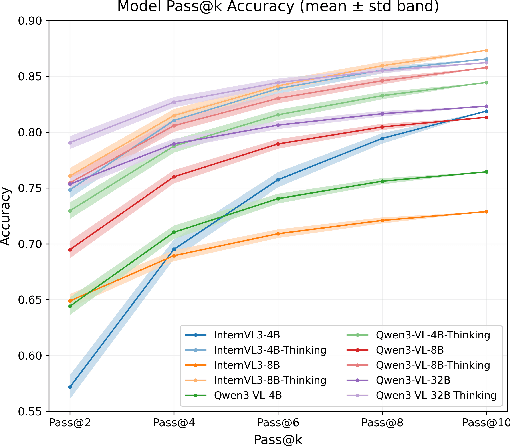

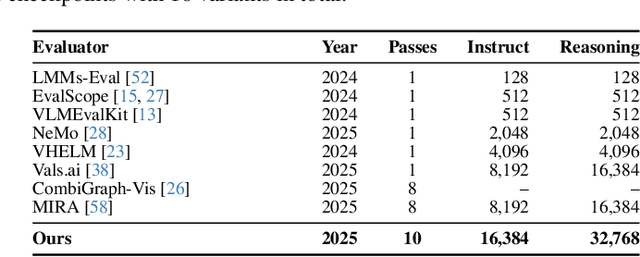
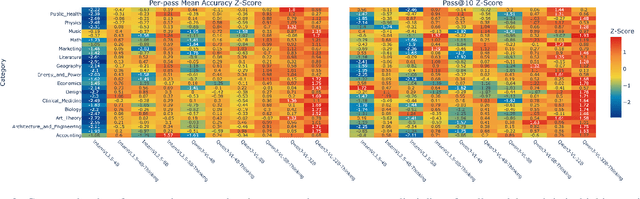
Test-time thinking (that is, generating explicit intermediate reasoning chains) is known to boost performance in large language models and has recently shown strong gains for large vision language models (LVLMs). However, despite these promising results, there is still no systematic analysis of how thinking actually affects visual reasoning. We provide the first such analysis with a large scale, controlled comparison of thinking for LVLMs, evaluating ten variants from the InternVL3.5 and Qwen3-VL families on MMMU-val under generous token budgets and multi pass decoding. We show that more thinking is not always better; long chains often yield long wrong trajectories that ignore the image and underperform the same models run in standard instruct mode. A deeper analysis reveals that certain short lookback phrases, which explicitly refer back to the image, are strongly enriched in successful trajectories and correlate with better visual grounding. Building on this insight, we propose uncertainty guided lookback, a training free decoding strategy that combines an uncertainty signal with adaptive lookback prompts and breadth search. Our method improves overall MMMU performance, delivers the largest gains in categories where standard thinking is weak, and outperforms several strong decoding baselines, setting a new state of the art under fixed model families and token budgets. We further show that this decoding strategy generalizes, yielding consistent improvements on five additional benchmarks, including two broad multimodal suites and math focused visual reasoning datasets.