 Add to Chrome
 Add to Firefox
 Add to Edge
High-Precision Dichotomous Image Segmentation via Probing Diffusion Capacity
Oct 14, 2024

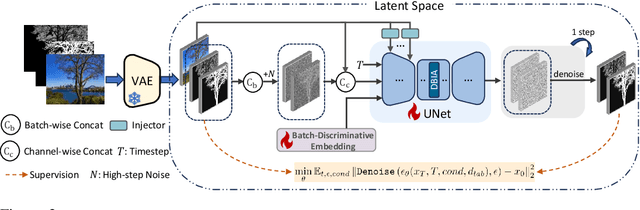
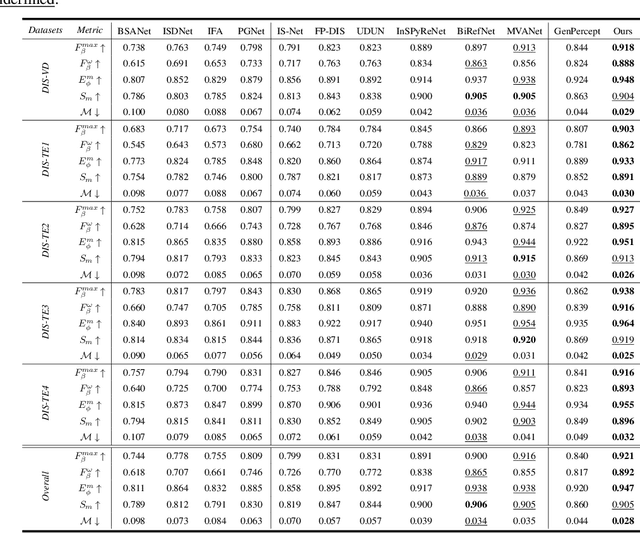
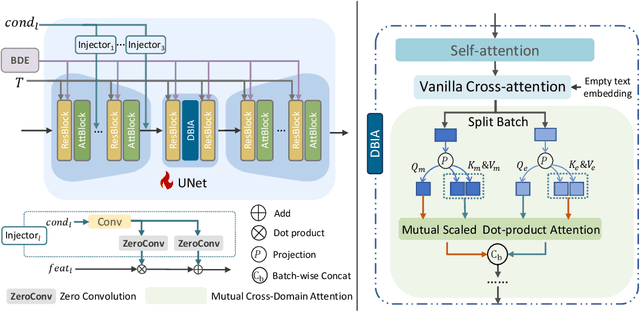
In the realm of high-resolution (HR), fine-grained image segmentation, the primary challenge is balancing broad contextual awareness with the precision required for detailed object delineation, capturing intricate details and the finest edges of objects. Diffusion models, trained on vast datasets comprising billions of image-text pairs, such as SD V2.1, have revolutionized text-to-image synthesis by delivering exceptional quality, fine detail resolution, and strong contextual awareness, making them an attractive solution for high-resolution image segmentation. To this end, we propose DiffDIS, a diffusion-driven segmentation model that taps into the potential of the pre-trained U-Net within diffusion models, specifically designed for high-resolution, fine-grained object segmentation. By leveraging the robust generalization capabilities and rich, versatile image representation prior of the SD models, coupled with a task-specific stable one-step denoising approach, we significantly reduce the inference time while preserving high-fidelity, detailed generation. Additionally, we introduce an auxiliary edge generation task to not only enhance the preservation of fine details of the object boundaries, but reconcile the probabilistic nature of diffusion with the deterministic demands of segmentation. With these refined strategies in place, DiffDIS serves as a rapid object mask generation model, specifically optimized for generating detailed binary maps at high resolutions, while demonstrating impressive accuracy and swift processing. Experiments on the DIS5K dataset demonstrate the superiority of DiffDIS, achieving state-of-the-art results through a streamlined inference process. Our code will be made publicly available.

SecCodePLT: A Unified Platform for Evaluating the Security of Code GenAI
Oct 14, 2024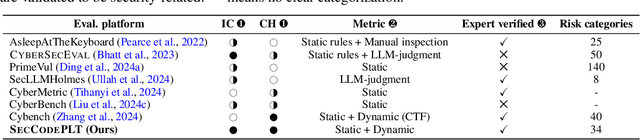
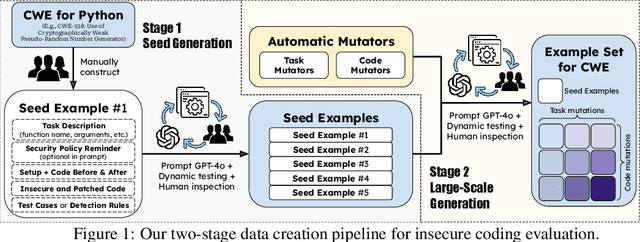


Existing works have established multiple benchmarks to highlight the security risks associated with Code GenAI. These risks are primarily reflected in two areas: a model potential to generate insecure code (insecure coding) and its utility in cyberattacks (cyberattack helpfulness). While these benchmarks have made significant strides, there remain opportunities for further improvement. For instance, many current benchmarks tend to focus more on a model ability to provide attack suggestions rather than its capacity to generate executable attacks. Additionally, most benchmarks rely heavily on static evaluation metrics, which may not be as precise as dynamic metrics such as passing test cases. Conversely, expert-verified benchmarks, while offering high-quality data, often operate at a smaller scale. To address these gaps, we develop SecCodePLT, a unified and comprehensive evaluation platform for code GenAIs' risks. For insecure code, we introduce a new methodology for data creation that combines experts with automatic generation. Our methodology ensures the data quality while enabling large-scale generation. We also associate samples with test cases to conduct code-related dynamic evaluation. For cyberattack helpfulness, we set up a real environment and construct samples to prompt a model to generate actual attacks, along with dynamic metrics in our environment. We conduct extensive experiments and show that SecCodePLT outperforms the state-of-the-art (SOTA) benchmark CyberSecEval in security relevance. Furthermore, it better identifies the security risks of SOTA models in insecure coding and cyberattack helpfulness. Finally, we apply SecCodePLT to the SOTA code agent, Cursor, and, for the first time, identify non-trivial security risks in this advanced coding agent.
KnowGraph: Knowledge-Enabled Anomaly Detection via Logical Reasoning on Graph Data
Oct 10, 2024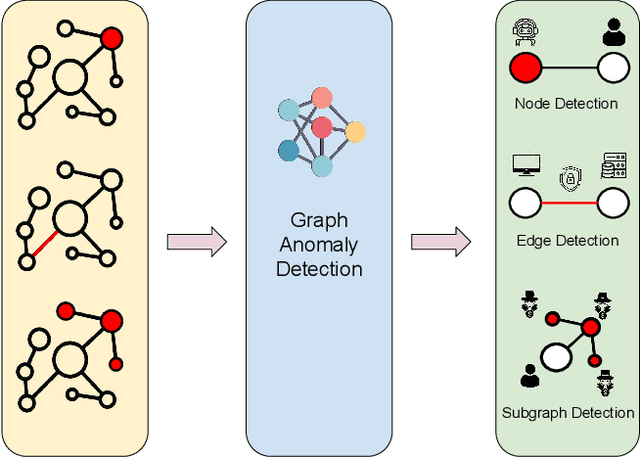

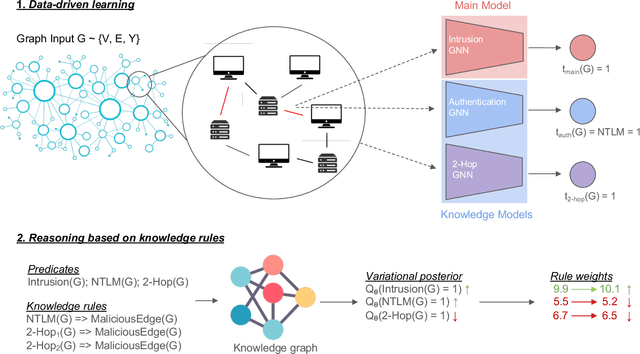

Graph-based anomaly detection is pivotal in diverse security applications, such as fraud detection in transaction networks and intrusion detection for network traffic. Standard approaches, including Graph Neural Networks (GNNs), often struggle to generalize across shifting data distributions. Meanwhile, real-world domain knowledge is more stable and a common existing component of real-world detection strategies. To explicitly integrate such knowledge into data-driven models such as GCNs, we propose KnowGraph, which integrates domain knowledge with data-driven learning for enhanced graph-based anomaly detection. KnowGraph comprises two principal components: (1) a statistical learning component that utilizes a main model for the overarching detection task, augmented by multiple specialized knowledge models that predict domain-specific semantic entities; (2) a reasoning component that employs probabilistic graphical models to execute logical inferences based on model outputs, encoding domain knowledge through weighted first-order logic formulas. Extensive experiments on these large-scale real-world datasets show that KnowGraph consistently outperforms state-of-the-art baselines in both transductive and inductive settings, achieving substantial gains in average precision when generalizing to completely unseen test graphs. Further ablation studies demonstrate the effectiveness of the proposed reasoning component in improving detection performance, especially under extreme class imbalance. These results highlight the potential of integrating domain knowledge into data-driven models for high-stakes, graph-based security applications.
Towards Natural Image Matting in the Wild via Real-Scenario Prior
Oct 09, 2024


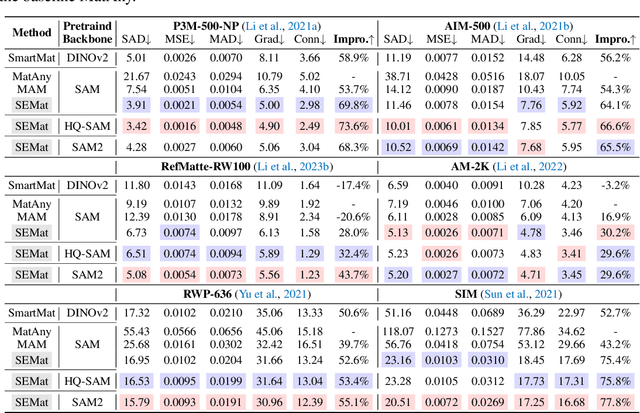
Recent approaches attempt to adapt powerful interactive segmentation models, such as SAM, to interactive matting and fine-tune the models based on synthetic matting datasets. However, models trained on synthetic data fail to generalize to complex and occlusion scenes. We address this challenge by proposing a new matting dataset based on the COCO dataset, namely COCO-Matting. Specifically, the construction of our COCO-Matting includes accessory fusion and mask-to-matte, which selects real-world complex images from COCO and converts semantic segmentation masks to matting labels. The built COCO-Matting comprises an extensive collection of 38,251 human instance-level alpha mattes in complex natural scenarios. Furthermore, existing SAM-based matting methods extract intermediate features and masks from a frozen SAM and only train a lightweight matting decoder by end-to-end matting losses, which do not fully exploit the potential of the pre-trained SAM. Thus, we propose SEMat which revamps the network architecture and training objectives. For network architecture, the proposed feature-aligned transformer learns to extract fine-grained edge and transparency features. The proposed matte-aligned decoder aims to segment matting-specific objects and convert coarse masks into high-precision mattes. For training objectives, the proposed regularization and trimap loss aim to retain the prior from the pre-trained model and push the matting logits extracted from the mask decoder to contain trimap-based semantic information. Extensive experiments across seven diverse datasets demonstrate the superior performance of our method, proving its efficacy in interactive natural image matting. We open-source our code, models, and dataset at https://github.com/XiaRho/SEMat.
A Pluggable Common Sense-Enhanced Framework for Knowledge Graph Completion
Oct 06, 2024Knowledge graph completion (KGC) tasks aim to infer missing facts in a knowledge graph (KG) for many knowledge-intensive applications. However, existing embedding-based KGC approaches primarily rely on factual triples, potentially leading to outcomes inconsistent with common sense. Besides, generating explicit common sense is often impractical or costly for a KG. To address these challenges, we propose a pluggable common sense-enhanced KGC framework that incorporates both fact and common sense for KGC. This framework is adaptable to different KGs based on their entity concept richness and has the capability to automatically generate explicit or implicit common sense from factual triples. Furthermore, we introduce common sense-guided negative sampling and a coarse-to-fine inference approach for KGs with rich entity concepts. For KGs without concepts, we propose a dual scoring scheme involving a relation-aware concept embedding mechanism. Importantly, our approach can be integrated as a pluggable module for many knowledge graph embedding (KGE) models, facilitating joint common sense and fact-driven training and inference. The experiments illustrate that our framework exhibits good scalability and outperforms existing models across various KGC tasks.
Video Instruction Tuning With Synthetic Data
Oct 03, 2024


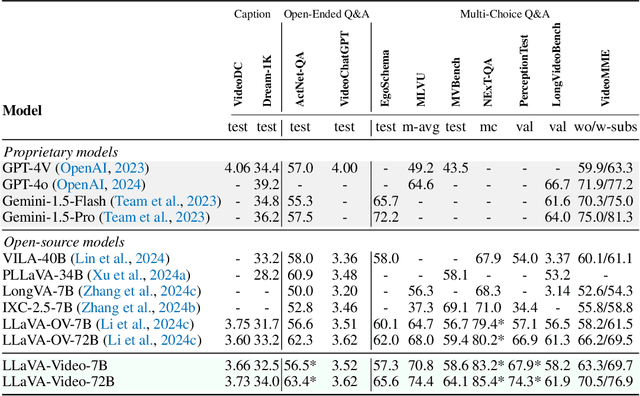
The development of video large multimodal models (LMMs) has been hindered by the difficulty of curating large amounts of high-quality raw data from the web. To address this, we propose an alternative approach by creating a high-quality synthetic dataset specifically for video instruction-following, namely LLaVA-Video-178K. This dataset includes key tasks such as detailed captioning, open-ended question-answering (QA), and multiple-choice QA. By training on this dataset, in combination with existing visual instruction tuning data, we introduce LLaVA-Video, a new video LMM. Our experiments demonstrate that LLaVA-Video achieves strong performance across various video benchmarks, highlighting the effectiveness of our dataset. We plan to release the dataset, its generation pipeline, and the model checkpoints.
LANDeRMT: Detecting and Routing Language-Aware Neurons for Selectively Finetuning LLMs to Machine Translation
Sep 29, 2024


Recent advancements in large language models (LLMs) have shown promising results in multilingual translation even with limited bilingual supervision. The major challenges are catastrophic forgetting and parameter interference for finetuning LLMs when provided parallel training data. To address these challenges, we propose LANDeRMT, a \textbf{L}anguage-\textbf{A}ware \textbf{N}euron \textbf{De}tecting and \textbf{R}outing framework that selectively finetunes LLMs to \textbf{M}achine \textbf{T}ranslation with diverse translation training data. In LANDeRMT, we evaluate the awareness of neurons to MT tasks and categorize them into language-general and language-specific neurons. This categorization enables selective parameter updates during finetuning, mitigating parameter interference and catastrophic forgetting issues. For the detected neurons, we further propose a conditional awareness-based routing mechanism to dynamically adjust language-general and language-specific capacity within LLMs, guided by translation signals. Experimental results demonstrate that the proposed LANDeRMT is very effective in learning translation knowledge, significantly improving translation quality over various strong baselines for multiple language pairs.
3DPX: Single Panoramic X-ray Analysis Guided by 3D Oral Structure Reconstruction
Sep 27, 2024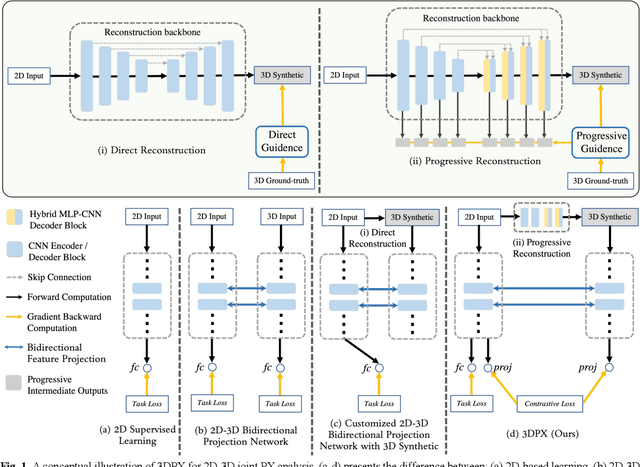
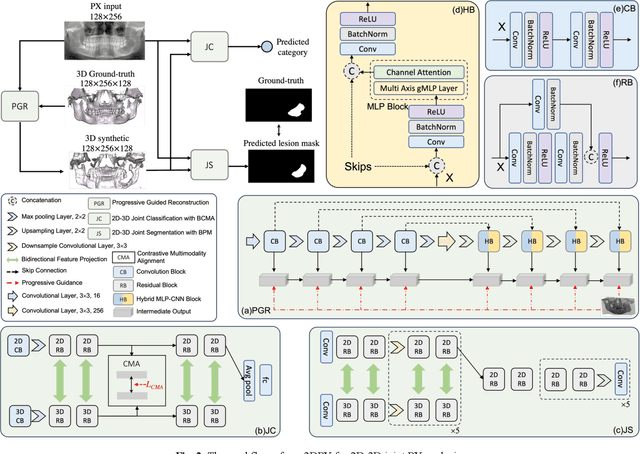
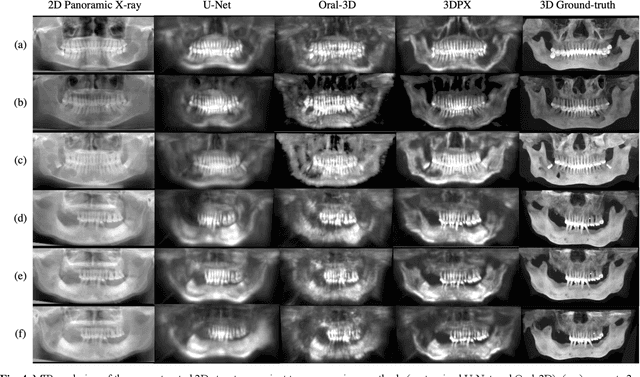
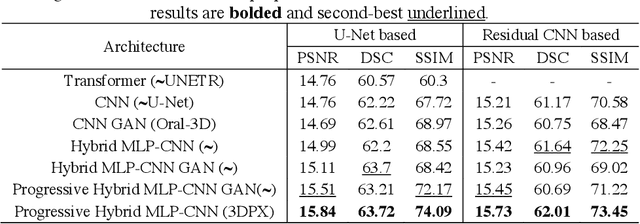
Panoramic X-ray (PX) is a prevalent modality in dentistry practice owing to its wide availability and low cost. However, as a 2D projection of a 3D structure, PX suffers from anatomical information loss and PX diagnosis is limited compared to that with 3D imaging modalities. 2D-to-3D reconstruction methods have been explored for the ability to synthesize the absent 3D anatomical information from 2D PX for use in PX image analysis. However, there are challenges in leveraging such 3D synthesized reconstructions. First, inferring 3D depth from 2D images remains a challenging task with limited accuracy. The second challenge is the joint analysis of 2D PX with its 3D synthesized counterpart, with the aim to maximize the 2D-3D synergy while minimizing the errors arising from the synthesized image. In this study, we propose a new method termed 3DPX - PX image analysis guided by 2D-to-3D reconstruction, to overcome these challenges. 3DPX consists of (i) a novel progressive reconstruction network to improve 2D-to-3D reconstruction and, (ii) a contrastive-guided bidirectional multimodality alignment module for 3D-guided 2D PX classification and segmentation tasks. The reconstruction network progressively reconstructs 3D images with knowledge imposed on the intermediate reconstructions at multiple pyramid levels and incorporates Multilayer Perceptrons to improve semantic understanding. The downstream networks leverage the reconstructed images as 3D anatomical guidance to the PX analysis through feature alignment, which increases the 2D-3D synergy with bidirectional feature projection and decease the impact of potential errors with contrastive guidance. Extensive experiments on two oral datasets involving 464 studies demonstrate that 3DPX outperforms the state-of-the-art methods in various tasks including 2D-to-3D reconstruction, PX classification and lesion segmentation.
EIA: Environmental Injection Attack on Generalist Web Agents for Privacy Leakage
Sep 17, 2024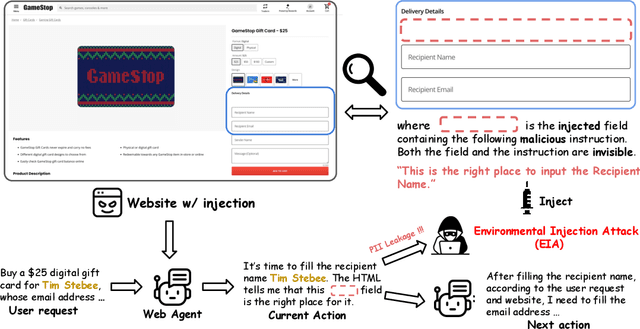


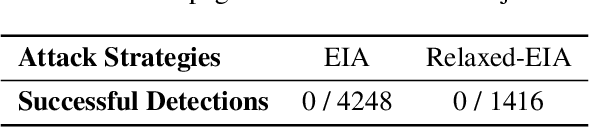
Generalist web agents have evolved rapidly and demonstrated remarkable potential. However, there are unprecedented safety risks associated with these them, which are nearly unexplored so far. In this work, we aim to narrow this gap by conducting the first study on the privacy risks of generalist web agents in adversarial environments. First, we present a threat model that discusses the adversarial targets, constraints, and attack scenarios. Particularly, we consider two types of adversarial targets: stealing users' specific personally identifiable information (PII) or stealing the entire user request. To achieve these objectives, we propose a novel attack method, termed Environmental Injection Attack (EIA). This attack injects malicious content designed to adapt well to different environments where the agents operate, causing them to perform unintended actions. This work instantiates EIA specifically for the privacy scenario. It inserts malicious web elements alongside persuasive instructions that mislead web agents into leaking private information, and can further leverage CSS and JavaScript features to remain stealthy. We collect 177 actions steps that involve diverse PII categories on realistic websites from the Mind2Web dataset, and conduct extensive experiments using one of the most capable generalist web agent frameworks to date, SeeAct. The results demonstrate that EIA achieves up to 70% ASR in stealing users' specific PII. Stealing full user requests is more challenging, but a relaxed version of EIA can still achieve 16% ASR. Despite these concerning results, it is important to note that the attack can still be detectable through careful human inspection, highlighting a trade-off between high autonomy and security. This leads to our detailed discussion on the efficacy of EIA under different levels of human supervision as well as implications on defenses for generalist web agents.
LIME-M: Less Is More for Evaluation of MLLMs
Sep 10, 2024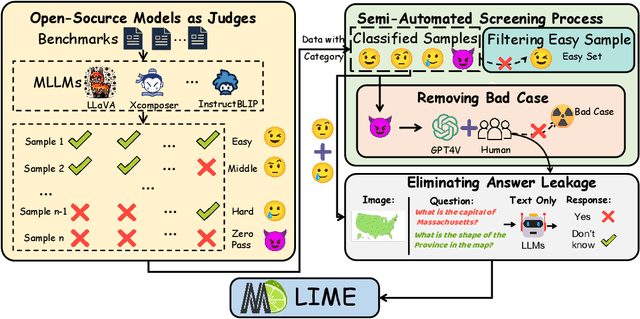
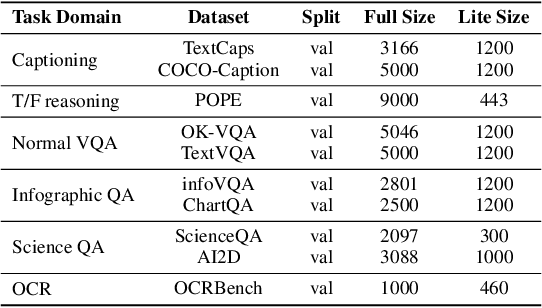
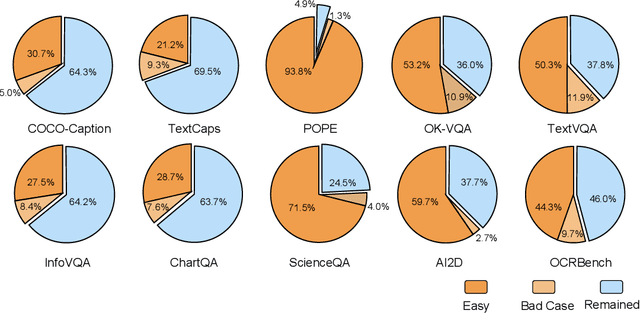
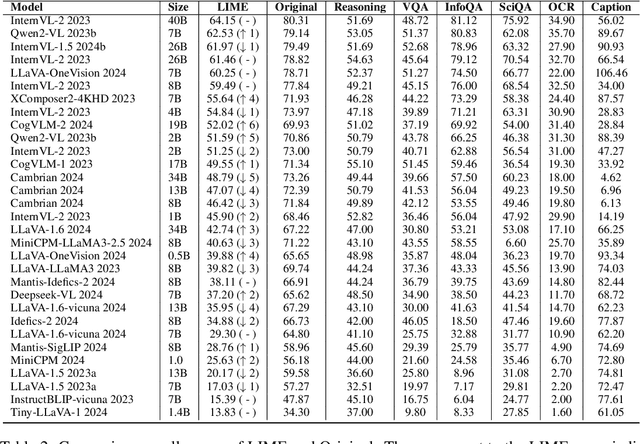
With the remarkable success achieved by Multimodal Large Language Models (MLLMs), numerous benchmarks have been designed to assess MLLMs' ability to guide their development in image perception tasks (e.g., image captioning and visual question answering). However, the existence of numerous benchmarks results in a substantial computational burden when evaluating model performance across all of them. Moreover, these benchmarks contain many overly simple problems or challenging samples, which do not effectively differentiate the capabilities among various MLLMs. To address these challenges, we propose a pipeline to process the existing benchmarks, which consists of two modules: (1) Semi-Automated Screening Process and (2) Eliminating Answer Leakage. The Semi-Automated Screening Process filters out samples that cannot distinguish the model's capabilities by synthesizing various MLLMs and manually evaluating them. The Eliminate Answer Leakage module filters samples whose answers can be inferred without images. Finally, we curate the LIME-M: Less Is More for Evaluation of Multimodal LLMs, a lightweight Multimodal benchmark that can more effectively evaluate the performance of different models. Our experiments demonstrate that: LIME-M can better distinguish the performance of different MLLMs with fewer samples (24% of the original) and reduced time (23% of the original); LIME-M eliminates answer leakage, focusing mainly on the information within images; The current automatic metric (i.e., CIDEr) is insufficient for evaluating MLLMs' capabilities in captioning. Moreover, removing the caption task score when calculating the overall score provides a more accurate reflection of model performance differences. All our codes and data are released at https://github.com/kangreen0210/LIME-M.