 Add to Chrome
 Add to Firefox
 Add to Edge
SARA: Unlocking Multilingual Knowledge in Mixture-of-Experts via Semantically Anchored Routing Alignment
Jun 24, 2026
Sparse Mixture-of-Experts (MoE) architectures have emerged as an increasingly influential paradigm as they offer a strategic balance between parameter scalability and computational efficiency. However, low-resource languages, which suffer from a scarcity of high-quality training data, often have their tokens routed to different experts than those predominantly activated by high-resource inputs, which limits cross-lingual expert sharing. This cross-lingual routing divergence consequently hinders their efficacy in multilingual contexts. To address this issue, we propose SARA (Semantically Anchored Routing Alignment), a framework designed to transfer specialized capabilities from high-resource languages as anchors to low-resource languages. SARA explicitly aligns the routing distribution of multilingual inputs with high-resource semantic anchors using a symmetric Jensen-Shannon (JS) divergence constraint. Unlike traditional distillation methods that operate on output logits, SARA directly aligns the internal routing distributions of MoE layers, encouraging mechanistic consistency in expert selection across languages. We conduct experiments on 2 LLMs across 5 low-resource languages and 3 benchmarks. Experiment results demonstrate that SARA outperforms standard instruction tuning, e.g., +0.8% on Qwen3-30B-A3B and +1.2% on Phi-3.5-MoE-instruct on Global-MMLU. Further analyses show that SARA effectively addresses performance bottlenecks in low-resource languages, providing a scalable pathway to enhance multilingual capabilities in sparse architectures.

TENP: Trapezoidal Expert Neuron Pruning For Mixture-of-Experts
Jun 03, 2026Mixture-of-Experts large language models (LLMs) scale efficiently through sparse activation, yet their deployment is fundamentally constrained by the large static parameter footprint of experts. Existing compression approaches either remove entire experts, disrupting routing topology and harming performance, or rely on unstructured weight pruning with limited practical efficiency. To address the limitations, we propose TENP, a structured Trapezoidal ExpertNeuron Pruning framework. Using a few samples, we identify and retain important experts, while applying expert neuron pruning (ENP) to less important experts, reserving model parameters in a trapezoidal pattern from shallow to deep layers. When evaluating expert importance, we jointly consider both the magnitude of the expert output and its ability to change the direction of the input vector. For ENP, we measure each neuron's projected contribution to the expert output to identify and retain important neurons. We conduct extensive experiments on the Qwen and DeepSeek models. Under a routing expert sparsity of 40% and an average of 63.76% activated expert parameters, the DeepSeek model suffers only a 1-point drop in accuracy compared to the full-parameter model. Moreover, it outperforms the full-parameter model by 10% on code generation tasks.
VaaWIT: Visual-Aware Adaptation of Large Language Models for Multilingual Web Image Translation
May 23, 2026Translating text embedded in Web images is crucial for improving content accessibility and cross-lingual information retrieval, particularly within social media and e-commerce domains. Although Large Vision-Language Models (LVLMs) have advanced multimodal understanding, applying them to Web image translation remains challenging due to the visual representation gap: standard encoders often prioritize high-level semantics over the fine-grained visual details required for recognizing diverse character morphologies. To address this challenge, we propose VaaWIT, an end-to-end framework that adapts Large Language Models for multilingual Web image translation. The framework introduces two key technical contributions: (1) a Dual-Stream Attention Module (DSAM), which facilitates bidirectional interaction between multilingual semantic features and detailed visual representations, thereby synthesizing unified features robust to textual variations; and (2) a Visual-Aware Adapter (VAA), a parameter-efficient fine-tuning strategy that dynamically injects these fused visual cues into the frozen LLM backbone. This design enables the model to align the visual context with linguistic reasoning effectively while minimizing computational costs. Extensive experiments on eight tasks on three public benchmarks demonstrate that VaaWIT significantly outperforms state-of-the-art (SOTA) open-source baselines and achieves competitive performance against proprietary models. These results validate the efficacy of integrating fine-grained visual perception into LLMs for complex Web content analysis.
Mix-MoE: Improving Multilingual Machine Translation of Large Language Models through Mixed MoEs
May 23, 2026Large Language Models (LLMs) have shown great promise in multilingual machine translation (MT), even with limited bilingual supervision. However, fine-tuning LLMs with parallel corpora presents major challenges, namely parameter interference. To address these issues, we propose Mix-MoE, a mixed Mixture-of-Experts framework designed to train LLMs for multilingual MT. Our framework operates in two distinct stages: (1) post-pretraining with MoE on monolingual corpora, and (2) post-pretraining with MoE on parallel corpora. Crucially, we divide the MoE layers into two specialized groups: Language Model Experts (LM Experts) and Machine Translation Experts (MT Experts). LM Experts are designed to capture and retain the monolingual knowledge learned by the pre-trained LLM. MT Experts, on the other hand, are specifically trained to acquire and store bilingual translation knowledge. Furthermore, to facilitate effective interaction between these specialized experts and leverage potential underlying structural patterns in text, we introduce a routing mechanism enhanced by Fourier Transform features derived from model representations. The experimental results demonstrate that Mix-MoE excels in multilingual MT, significantly outperforming existing baselines and showing notable progress in mitigating parameter interference.
FuxiMT: Sparsifying Large Language Models for Chinese-Centric Multilingual Machine Translation
May 20, 2025In this paper, we present FuxiMT, a novel Chinese-centric multilingual machine translation model powered by a sparsified large language model (LLM). We adopt a two-stage strategy to train FuxiMT. We first pre-train the model on a massive Chinese corpus and then conduct multilingual fine-tuning on a large parallel dataset encompassing 65 languages. FuxiMT incorporates Mixture-of-Experts (MoEs) and employs a curriculum learning strategy for robust performance across various resource levels. Experimental results demonstrate that FuxiMT significantly outperforms strong baselines, including state-of-the-art LLMs and machine translation models, particularly under low-resource scenarios. Furthermore, FuxiMT exhibits remarkable zero-shot translation capabilities for unseen language pairs, indicating its potential to bridge communication gaps where parallel data are scarce or unavailable.
MIT-10M: A Large Scale Parallel Corpus of Multilingual Image Translation
Dec 10, 2024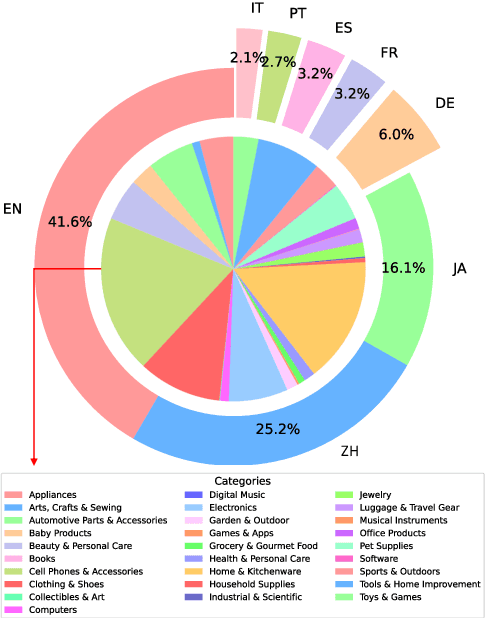
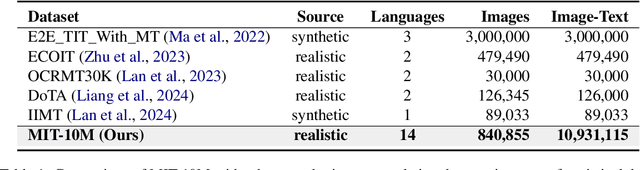
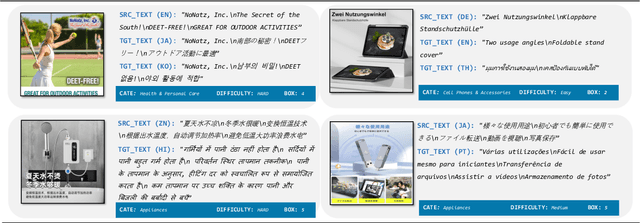

Image Translation (IT) holds immense potential across diverse domains, enabling the translation of textual content within images into various languages. However, existing datasets often suffer from limitations in scale, diversity, and quality, hindering the development and evaluation of IT models. To address this issue, we introduce MIT-10M, a large-scale parallel corpus of multilingual image translation with over 10M image-text pairs derived from real-world data, which has undergone extensive data cleaning and multilingual translation validation. It contains 840K images in three sizes, 28 categories, tasks with three levels of difficulty and 14 languages image-text pairs, which is a considerable improvement on existing datasets. We conduct extensive experiments to evaluate and train models on MIT-10M. The experimental results clearly indicate that our dataset has higher adaptability when it comes to evaluating the performance of the models in tackling challenging and complex image translation tasks in the real world. Moreover, the performance of the model fine-tuned with MIT-10M has tripled compared to the baseline model, further confirming its superiority.
Multilingual Large Language Models: A Systematic Survey
Nov 19, 2024This paper provides a comprehensive survey of the latest research on multilingual large language models (MLLMs). MLLMs not only are able to understand and generate language across linguistic boundaries, but also represent an important advancement in artificial intelligence. We first discuss the architecture and pre-training objectives of MLLMs, highlighting the key components and methodologies that contribute to their multilingual capabilities. We then discuss the construction of multilingual pre-training and alignment datasets, underscoring the importance of data quality and diversity in enhancing MLLM performance. An important focus of this survey is on the evaluation of MLLMs. We present a detailed taxonomy and roadmap covering the assessment of MLLMs' cross-lingual knowledge, reasoning, alignment with human values, safety, interpretability and specialized applications. Specifically, we extensively discuss multilingual evaluation benchmarks and datasets, and explore the use of LLMs themselves as multilingual evaluators. To enhance MLLMs from black to white boxes, we also address the interpretability of multilingual capabilities, cross-lingual transfer and language bias within these models. Finally, we provide a comprehensive review of real-world applications of MLLMs across diverse domains, including biology, medicine, computer science, mathematics and law. We showcase how these models have driven innovation and improvements in these specialized fields while also highlighting the challenges and opportunities in deploying MLLMs within diverse language communities and application scenarios. We listed the paper related in this survey and publicly available at https://github.com/tjunlp-lab/Awesome-Multilingual-LLMs-Papers.
LANDeRMT: Detecting and Routing Language-Aware Neurons for Selectively Finetuning LLMs to Machine Translation
Sep 29, 2024


Recent advancements in large language models (LLMs) have shown promising results in multilingual translation even with limited bilingual supervision. The major challenges are catastrophic forgetting and parameter interference for finetuning LLMs when provided parallel training data. To address these challenges, we propose LANDeRMT, a \textbf{L}anguage-\textbf{A}ware \textbf{N}euron \textbf{De}tecting and \textbf{R}outing framework that selectively finetunes LLMs to \textbf{M}achine \textbf{T}ranslation with diverse translation training data. In LANDeRMT, we evaluate the awareness of neurons to MT tasks and categorize them into language-general and language-specific neurons. This categorization enables selective parameter updates during finetuning, mitigating parameter interference and catastrophic forgetting issues. For the detected neurons, we further propose a conditional awareness-based routing mechanism to dynamically adjust language-general and language-specific capacity within LLMs, guided by translation signals. Experimental results demonstrate that the proposed LANDeRMT is very effective in learning translation knowledge, significantly improving translation quality over various strong baselines for multiple language pairs.
FuxiTranyu: A Multilingual Large Language Model Trained with Balanced Data
Aug 13, 2024

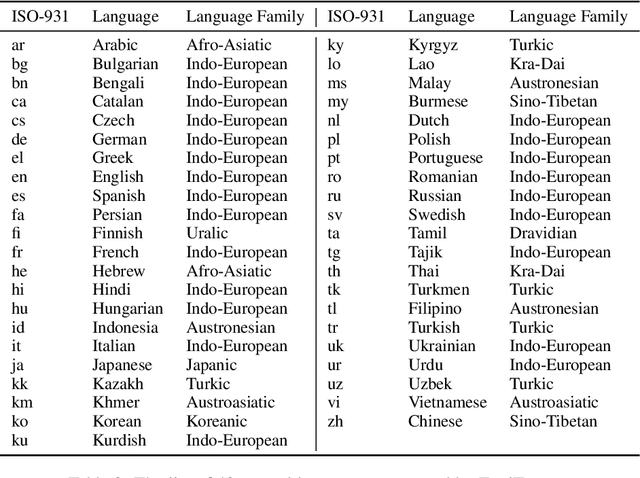

Large language models (LLMs) have demonstrated prowess in a wide range of tasks. However, many LLMs exhibit significant performance discrepancies between high- and low-resource languages. To mitigate this challenge, we present FuxiTranyu, an open-source multilingual LLM, which is designed to satisfy the need of the research community for balanced and high-performing multilingual capabilities. FuxiTranyu-8B, the base model with 8 billion parameters, is trained from scratch on a meticulously balanced multilingual data repository that contains 600 billion tokens covering 43 natural languages and 16 programming languages. In addition to the base model, we also develop two instruction-tuned models: FuxiTranyu-8B-SFT that is fine-tuned on a diverse multilingual instruction dataset, and FuxiTranyu-8B-DPO that is further refined with DPO on a preference dataset for enhanced alignment ability. Extensive experiments on a wide range of multilingual benchmarks demonstrate the competitive performance of FuxiTranyu against existing multilingual LLMs, e.g., BLOOM-7B, PolyLM-13B, Llama-2-Chat-7B and Mistral-7B-Instruct. Interpretability analyses at both the neuron and representation level suggest that FuxiTranyu is able to learn consistent multilingual representations across different languages. To promote further research into multilingual LLMs and their working mechanisms, we release both the base and instruction-tuned FuxiTranyu models together with 58 pretraining checkpoints at HuggingFace and Github.
Efficiently Exploring Large Language Models for Document-Level Machine Translation with In-context Learning
Jun 11, 2024Large language models (LLMs) exhibit outstanding performance in machine translation via in-context learning. In contrast to sentence-level translation, document-level translation (DOCMT) by LLMs based on in-context learning faces two major challenges: firstly, document translations generated by LLMs are often incoherent; secondly, the length of demonstration for in-context learning is usually limited. To address these issues, we propose a Context-Aware Prompting method (CAP), which enables LLMs to generate more accurate, cohesive, and coherent translations via in-context learning. CAP takes into account multi-level attention, selects the most relevant sentences to the current one as context, and then generates a summary from these collected sentences. Subsequently, sentences most similar to the summary are retrieved from the datastore as demonstrations, which effectively guide LLMs in generating cohesive and coherent translations. We conduct extensive experiments across various DOCMT tasks, and the results demonstrate the effectiveness of our approach, particularly in zero pronoun translation (ZPT) and literary translation tasks.