 Add to Chrome
 Add to Firefox
 Add to Edge
YAYI 2: Multilingual Open-Source Large Language Models
Dec 22, 2023
As the latest advancements in natural language processing, large language models (LLMs) have achieved human-level language understanding and generation abilities in many real-world tasks, and even have been regarded as a potential path to the artificial general intelligence. To better facilitate research on LLMs, many open-source LLMs, such as Llama 2 and Falcon, have recently been proposed and gained comparable performances to proprietary models. However, these models are primarily designed for English scenarios and exhibit poor performances in Chinese contexts. In this technical report, we propose YAYI 2, including both base and chat models, with 30 billion parameters. YAYI 2 is pre-trained from scratch on a multilingual corpus which contains 2.65 trillion tokens filtered by our pre-training data processing pipeline. The base model is aligned with human values through supervised fine-tuning with millions of instructions and reinforcement learning from human feedback. Extensive experiments on multiple benchmarks, such as MMLU and CMMLU, consistently demonstrate that the proposed YAYI 2 outperforms other similar sized open-source models.

ALT: Towards Fine-grained Alignment between Language and CTR Models for Click-Through Rate Prediction
Oct 30, 2023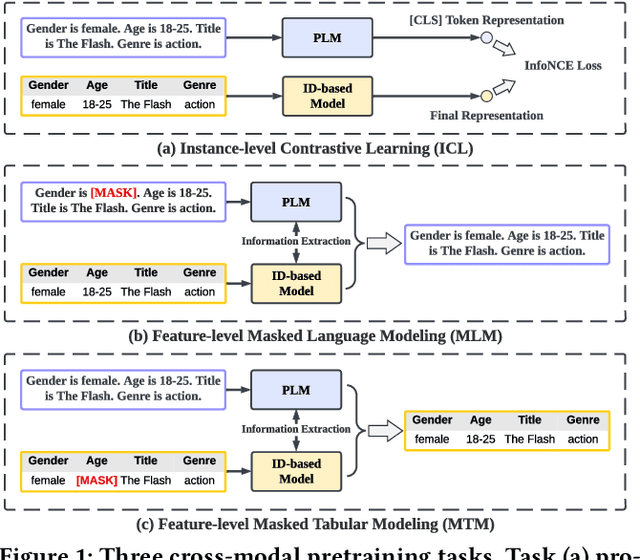
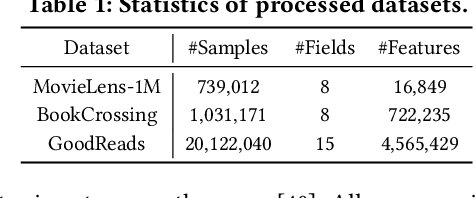
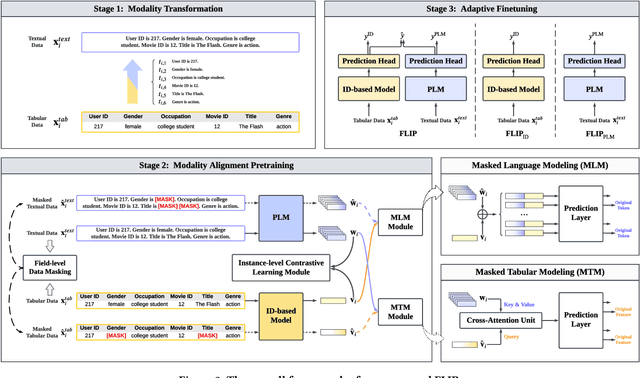
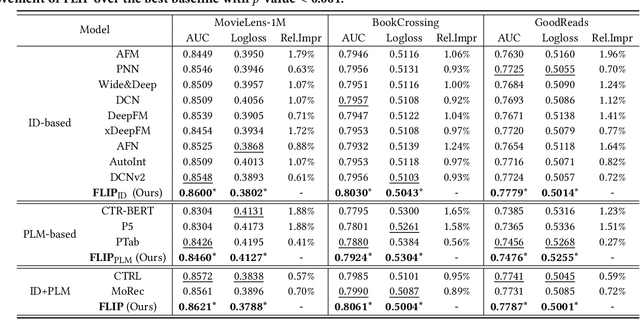
Click-through rate (CTR) prediction plays as a core function module in various personalized online services. According to the data modality and input format, the models for CTR prediction can be mainly classified into two categories. The first one is the traditional CTR models that take as inputs the one-hot encoded ID features of tabular modality, which aims to capture the collaborative signals via feature interaction modeling. The second category takes as inputs the sentences of textual modality obtained by hard prompt templates, where pretrained language models (PLMs) are adopted to extract the semantic knowledge. These two lines of research generally focus on different characteristics of the same input data (i.e., textual and tabular modalities), forming a distinct complementary relationship with each other. Therefore, in this paper, we propose to conduct fine-grained feature-level Alignment between Language and CTR models (ALT) for CTR prediction. Apart from the common CLIP-like instance-level contrastive learning, we further design a novel joint reconstruction pretraining task for both masked language and tabular modeling. Specifically, the masked data of one modality (i.e., tokens or features) has to be recovered with the help of the other modality, which establishes the feature-level interaction and alignment via sufficient mutual information extraction between dual modalities. Moreover, we propose three different finetuning strategies with the option to train the aligned language and CTR models separately or jointly for downstream CTR prediction tasks, thus accommodating the varying efficacy and efficiency requirements for industrial applications. Extensive experiments on three real-world datasets demonstrate that ALT outperforms SOTA baselines, and is highly compatible for various language and CTR models.
Hierarchical Vector Quantized Transformer for Multi-class Unsupervised Anomaly Detection
Oct 22, 2023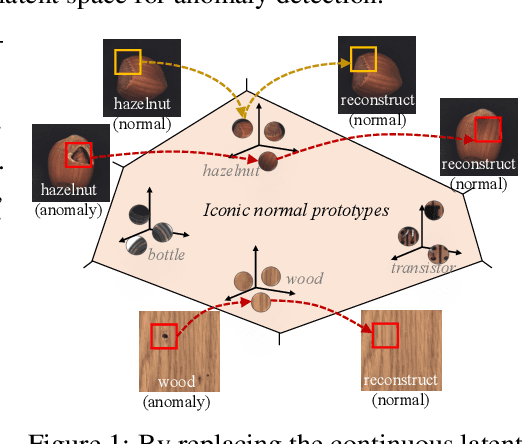
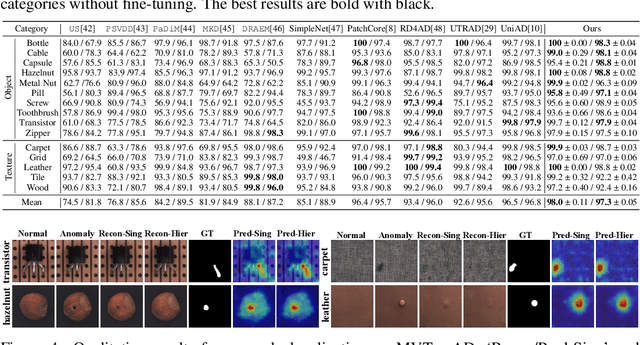
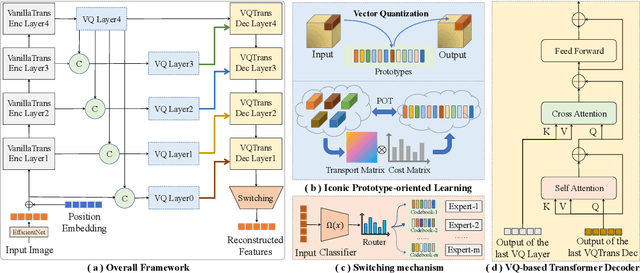
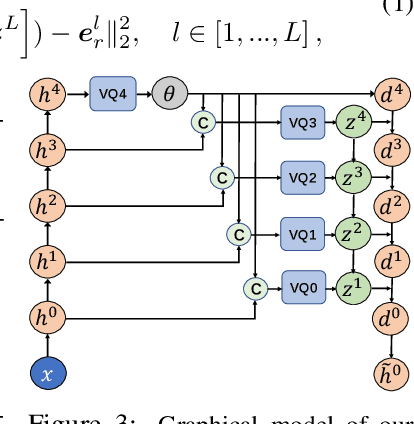
Unsupervised image Anomaly Detection (UAD) aims to learn robust and discriminative representations of normal samples. While separate solutions per class endow expensive computation and limited generalizability, this paper focuses on building a unified framework for multiple classes. Under such a challenging setting, popular reconstruction-based networks with continuous latent representation assumption always suffer from the "identical shortcut" issue, where both normal and abnormal samples can be well recovered and difficult to distinguish. To address this pivotal issue, we propose a hierarchical vector quantized prototype-oriented Transformer under a probabilistic framework. First, instead of learning the continuous representations, we preserve the typical normal patterns as discrete iconic prototypes, and confirm the importance of Vector Quantization in preventing the model from falling into the shortcut. The vector quantized iconic prototype is integrated into the Transformer for reconstruction, such that the abnormal data point is flipped to a normal data point.Second, we investigate an exquisite hierarchical framework to relieve the codebook collapse issue and replenish frail normal patterns. Third, a prototype-oriented optimal transport method is proposed to better regulate the prototypes and hierarchically evaluate the abnormal score. By evaluating on MVTec-AD and VisA datasets, our model surpasses the state-of-the-art alternatives and possesses good interpretability. The code is available at https://github.com/RuiyingLu/HVQ-Trans.
ClickPrompt: CTR Models are Strong Prompt Generators for Adapting Language Models to CTR Prediction
Oct 17, 2023


Click-through rate (CTR) prediction has become increasingly indispensable for various Internet applications. Traditional CTR models convert the multi-field categorical data into ID features via one-hot encoding, and extract the collaborative signals among features. Such a paradigm suffers from the problem of semantic information loss. Another line of research explores the potential of pretrained language models (PLMs) for CTR prediction by converting input data into textual sentences through hard prompt templates. Although semantic signals are preserved, they generally fail to capture the collaborative information (e.g., feature interactions, pure ID features), not to mention the unacceptable inference overhead brought by the huge model size. In this paper, we aim to model both the semantic knowledge and collaborative knowledge for accurate CTR estimation, and meanwhile address the inference inefficiency issue. To benefit from both worlds and close their gaps, we propose a novel model-agnostic framework (i.e., ClickPrompt), where we incorporate CTR models to generate interaction-aware soft prompts for PLMs. We design a prompt-augmented masked language modeling (PA-MLM) pretraining task, where PLM has to recover the masked tokens based on the language context, as well as the soft prompts generated by CTR model. The collaborative and semantic knowledge from ID and textual features would be explicitly aligned and interacted via the prompt interface. Then, we can either tune the CTR model with PLM for superior performance, or solely tune the CTR model without PLM for inference efficiency. Experiments on four real-world datasets validate the effectiveness of ClickPrompt compared with existing baselines.
Tuning Multi-mode Token-level Prompt Alignment across Modalities
Sep 25, 2023
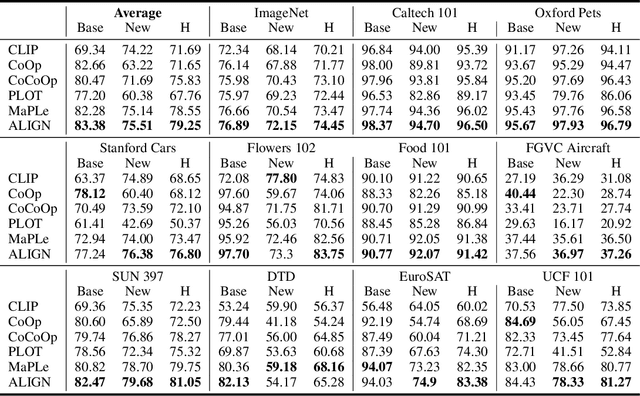
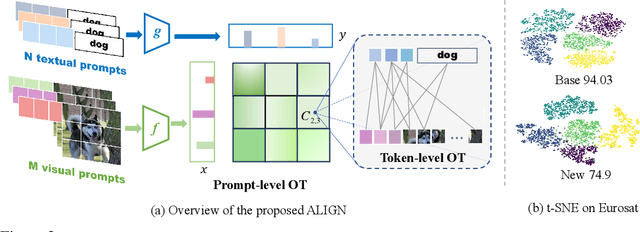
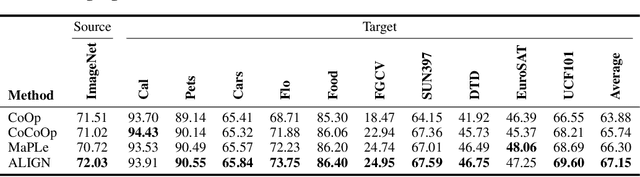
Prompt tuning pre-trained vision-language models have demonstrated significant potential in improving open-world visual concept understanding. However, prior works only primarily focus on single-mode (only one prompt for each modality) and holistic level (image or sentence) semantic alignment, which fails to capture the sample diversity, leading to sub-optimal prompt discovery. To address the limitation, we propose a multi-mode token-level tuning framework that leverages the optimal transportation to learn and align a set of prompt tokens across modalities. Specifically, we rely on two essential factors: 1) multi-mode prompts discovery, which guarantees diverse semantic representations, and 2) token-level alignment, which helps explore fine-grained similarity. Thus, the similarity can be calculated as a hierarchical transportation problem between the modality-specific sets. Extensive experiments on popular image recognition benchmarks show the superior generalization and few-shot abilities of our approach. The qualitative analysis demonstrates that the learned prompt tokens have the ability to capture diverse visual concepts.
HAMUR: Hyper Adapter for Multi-Domain Recommendation
Sep 12, 2023Multi-Domain Recommendation (MDR) has gained significant attention in recent years, which leverages data from multiple domains to enhance their performance concurrently.However, current MDR models are confronted with two limitations. Firstly, the majority of these models adopt an approach that explicitly shares parameters between domains, leading to mutual interference among them. Secondly, due to the distribution differences among domains, the utilization of static parameters in existing methods limits their flexibility to adapt to diverse domains. To address these challenges, we propose a novel model Hyper Adapter for Multi-Domain Recommendation (HAMUR). Specifically, HAMUR consists of two components: (1). Domain-specific adapter, designed as a pluggable module that can be seamlessly integrated into various existing multi-domain backbone models, and (2). Domain-shared hyper-network, which implicitly captures shared information among domains and dynamically generates the parameters for the adapter. We conduct extensive experiments on two public datasets using various backbone networks. The experimental results validate the effectiveness and scalability of the proposed model.
Scenario-Aware Hierarchical Dynamic Network for Multi-Scenario Recommendation
Sep 05, 2023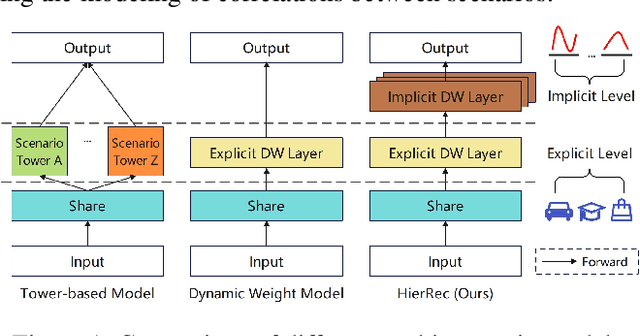
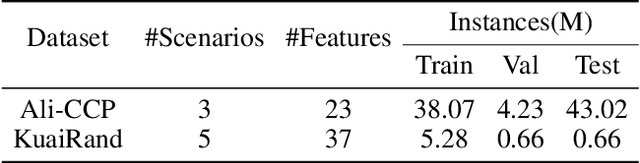
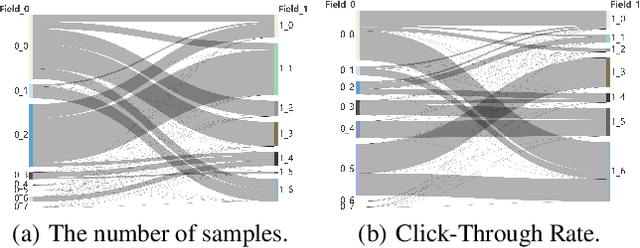
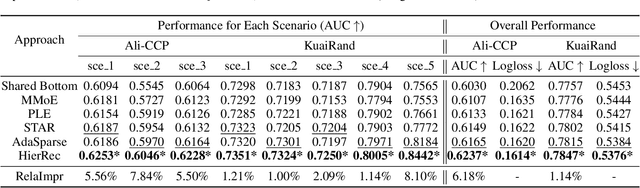
Click-Through Rate (CTR) prediction is a fundamental technique in recommendation and advertising systems. Recent studies have shown that implementing multi-scenario recommendations contributes to strengthening information sharing and improving overall performance. However, existing multi-scenario models only consider coarse-grained explicit scenario modeling that depends on pre-defined scenario identification from manual prior rules, which is biased and sub-optimal. To address these limitations, we propose a Scenario-Aware Hierarchical Dynamic Network for Multi-Scenario Recommendations (HierRec), which perceives implicit patterns adaptively and conducts explicit and implicit scenario modeling jointly. In particular, HierRec designs a basic scenario-oriented module based on the dynamic weight to capture scenario-specific information. Then the hierarchical explicit and implicit scenario-aware modules are proposed to model hybrid-grained scenario information. The multi-head implicit modeling design contributes to perceiving distinctive patterns from different perspectives. Our experiments on two public datasets and real-world industrial applications on a mainstream online advertising platform demonstrate that our HierRec outperforms existing models significantly.
ReLLa: Retrieval-enhanced Large Language Models for Lifelong Sequential Behavior Comprehension in Recommendation
Aug 22, 2023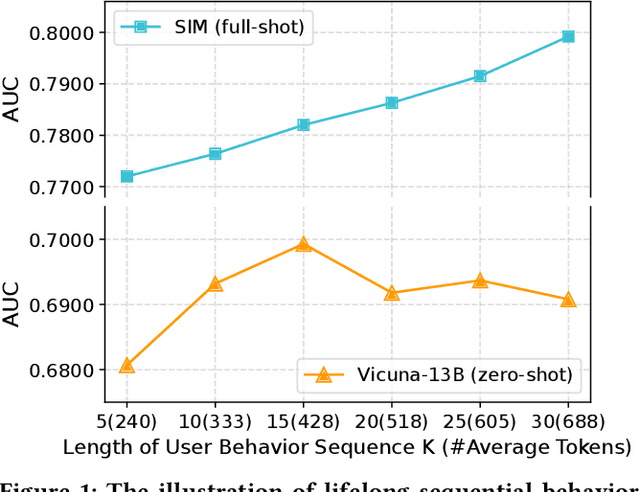
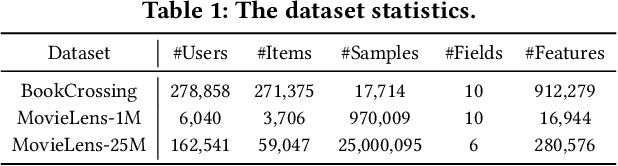
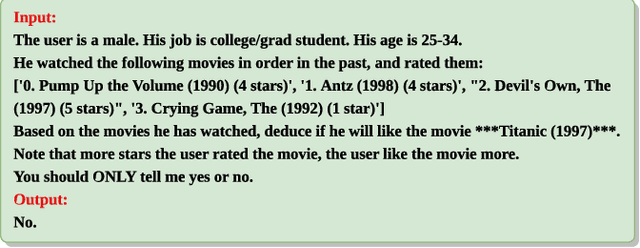
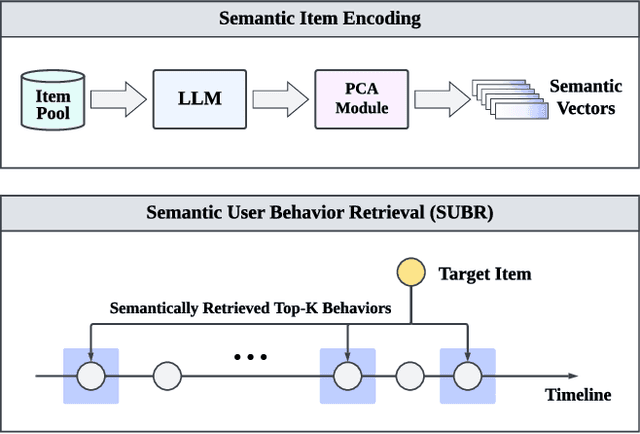
With large language models (LLMs) achieving remarkable breakthroughs in natural language processing (NLP) domains, LLM-enhanced recommender systems have received much attention and have been actively explored currently. In this paper, we focus on adapting and empowering a pure large language model for zero-shot and few-shot recommendation tasks. First and foremost, we identify and formulate the lifelong sequential behavior incomprehension problem for LLMs in recommendation domains, i.e., LLMs fail to extract useful information from a textual context of long user behavior sequence, even if the length of context is far from reaching the context limitation of LLMs. To address such an issue and improve the recommendation performance of LLMs, we propose a novel framework, namely Retrieval-enhanced Large Language models (ReLLa) for recommendation tasks in both zero-shot and few-shot settings. For zero-shot recommendation, we perform semantic user behavior retrieval (SUBR) to improve the data quality of testing samples, which greatly reduces the difficulty for LLMs to extract the essential knowledge from user behavior sequences. As for few-shot recommendation, we further design retrieval-enhanced instruction tuning (ReiT) by adopting SUBR as a data augmentation technique for training samples. Specifically, we develop a mixed training dataset consisting of both the original data samples and their retrieval-enhanced counterparts. We conduct extensive experiments on a real-world public dataset (i.e., MovieLens-1M) to demonstrate the superiority of ReLLa compared with existing baseline models, as well as its capability for lifelong sequential behavior comprehension.
A hybrid Decoder-DeepONet operator regression framework for unaligned observation data
Aug 18, 2023Deep neural operators (DNOs) have been utilized to approximate nonlinear mappings between function spaces. However, DNOs face the challenge of increased dimensionality and computational cost associated with unaligned observation data. In this study, we propose a hybrid Decoder-DeepONet operator regression framework to handle unaligned data effectively. Additionally, we introduce a Multi-Decoder-DeepONet, which utilizes an average field of training data as input augmentation. The consistencies of the frameworks with the operator approximation theory are provided, on the basis of the universal approximation theorem. Two numerical experiments, Darcy problem and flow-field around an airfoil, are conducted to validate the efficiency and accuracy of the proposed methods. Results illustrate the advantages of Decoder-DeepONet and Multi-Decoder-DeepONet in handling unaligned observation data and showcase their potentials in improving prediction accuracy.
AutoAssign+: Automatic Shared Embedding Assignment in Streaming Recommendation
Aug 14, 2023In the domain of streaming recommender systems, conventional methods for addressing new user IDs or item IDs typically involve assigning initial ID embeddings randomly. However, this practice results in two practical challenges: (i) Items or users with limited interactive data may yield suboptimal prediction performance. (ii) Embedding new IDs or low-frequency IDs necessitates consistently expanding the embedding table, leading to unnecessary memory consumption. In light of these concerns, we introduce a reinforcement learning-driven framework, namely AutoAssign+, that facilitates Automatic Shared Embedding Assignment Plus. To be specific, AutoAssign+ utilizes an Identity Agent as an actor network, which plays a dual role: (i) Representing low-frequency IDs field-wise with a small set of shared embeddings to enhance the embedding initialization, and (ii) Dynamically determining which ID features should be retained or eliminated in the embedding table. The policy of the agent is optimized with the guidance of a critic network. To evaluate the effectiveness of our approach, we perform extensive experiments on three commonly used benchmark datasets. Our experiment results demonstrate that AutoAssign+ is capable of significantly enhancing recommendation performance by mitigating the cold-start problem. Furthermore, our framework yields a reduction in memory usage of approximately 20-30%, verifying its practical effectiveness and efficiency for streaming recommender systems.