 Add to Chrome
 Add to Firefox
 Add to Edge
FELT: Generating Tactile Signals from Vision for Visuo-Tactile Manipulation
Jul 22, 2026
The sense of touch is central to manipulation, especially when vision is occluded or ambiguous. Although combining vision and touch improves manipulation, learning robust visuo-tactile policies requires substantial tactile data. Such data remains scarcer than visual data, because tactile sensors are fragile, specialized, and hard to standardize. To address this, we present Feature-Extracted Latent Tactile (FELT), a learning-based framework that synthesizes per-finger pressure tactile images from RGB observations, reducing the need for tactile-equipped data collection. FELT uses a large frozen visual encoder and a lightweight query decoder to predict tactile signals in a single feed-forward pass. To respect the physical topology of dual-finger tactile sensors, FELT decodes the left and right tactile sensor panels through separate branches, capturing the asymmetric contact patterns during interactions such as wiping, insertion, and in-hand rotation. At inference time, FELT only requires RGB data, allowing us to augment existing vision-only data with tactile observations, either as generated tactile images or as latent tactile features. Experiments on four contact-rich manipulation tasks demonstrate that both generated tactile images and latent tactile features improve policy success over vision-only baselines, with latent feature requiring no real tactile sensor during policy training or deployment. Supplementary material is available on our anonymous website: https://felt-tactile.github.io/.

VTAP Gripper: Synergizing Fingertip Sensing and a Visuo-Tactile Active Palm for Dexterous In-Hand Manipulation
Jul 16, 2026This paper presents a tactile-reactive gripper that integrates a Visuo-Tactile Active Palm (VTAP) and compliant, reconfigurable fingers equipped with tactile array sensors. The design exploits structured finger-palm synergy and multi-modal perception to achieve both robust grasping and fine manipulation. The actuated bi-modal palm seamlessly combines long-range visual localization with contact-rich tactile feedback, substantially extending the system's manipulation capability. To bridge the embodiment gap between human hand motion and the heterogeneous three-finger structure, we further propose a staged, gesture-conditioned retargeting framework for dexterous teleoperation. Extensive experiments validate the system across a range of challenging tasks: reactive grasping of YCB and fragile objects, in-hand syringe reorientation and plunger actuation, singulation of clustered objects down to 3 mm in diameter, and vision-tactile peg-in-hole insertion. Results demonstrate that high manipulation performance can be achieved through coordinated finger-palm interaction and multi-modal sensing, without resorting to high degrees of freedom anthropomorphic designs. The VTAP gripper and its retargeting framework offer a practical reference architecture for dexterous gripper design, manipulation, and contact-rich data collection in support of learning-based approaches. Project webpage: https://yuhochau.github.io/vtap/.
Deform360: A Massive Multi-view Visuotactile Dataset for Deformable World Models
Jul 06, 2026Predicting object dynamics (i.e., world modeling) is a fundamental challenge for robotic manipulation, and modeling deformable objects presents a particularly difficult case due to their high-dimensional state spaces and complex material properties. While current world models approach this through two distinct paradigms: learning the dynamics over the 2D pixel space or more explicit 3D geometric space. A systematic understanding of their relative strengths and limitations remains elusive due to the lack of diverse, large-scale real-world data. To address this, we present Deform360, a large-scale visuotactile dataset featuring 198 daily-life objects, 1,980 interaction sequences, and over 215 hours of observations from 41 surround-view cameras and bimanual tactile grippers to capture both global motion and contact-induced local deformations. Leveraging a novel markerless visuotactile 3D tracking pipeline to extract dense geometry and motion, we systematically evaluate current state-of-the-art world models, comparing 2D video models against 3D particle models. Finally, we provide a preliminary demonstration indicating the real-world applicability of our dataset by performing robot planning tasks on deformable objects. Our analysis reveals key insights into the trade-offs between structural priors and scalability, providing a solid benchmark for future research in generalizable deformable object-centric world modeling. Project website: https://deform360.lhy.xyz
Efficient and Reliable Teleoperation through Real-to-Sim-to-Real Shared Autonomy
Mar 17, 2026Fine-grained, contact-rich teleoperation remains slow, error-prone, and unreliable in real-world manipulation tasks, even for experienced operators. Shared autonomy offers a promising way to improve performance by combining human intent with automated assistance, but learning effective assistance in simulation requires a faithful model of human behavior, which is difficult to obtain in practice. We propose a real-to-sim-to-real shared autonomy framework that augments human teleoperation with learned corrective behaviors, using a simple yet effective k-nearest-neighbor (kNN) human surrogate to model operator actions in simulation. The surrogate is fit from less than five minutes of real-world teleoperation data and enables stable training of a residual copilot policy with model-free reinforcement learning. The resulting copilot is deployed to assist human operators in real-world fine-grained manipulation tasks. Through simulation experiments and a user study with sixteen participants on industry-relevant tasks, including nut threading, gear meshing, and peg insertion, we show that our system improves task success for novice operators and execution efficiency for experienced operators compared to direct teleoperation and shared-autonomy baselines that rely on expert priors or behavioral-cloning pilots. In addition, copilot-assisted teleoperation produces higher-quality demonstrations for downstream imitation learning.
Learning Force-Regulated Manipulation with a Low-Cost Tactile-Force-Controlled Gripper
Feb 10, 2026Successfully manipulating many everyday objects, such as potato chips, requires precise force regulation. Failure to modulate force can lead to task failure or irreversible damage to the objects. Humans can precisely achieve this by adapting force from tactile feedback, even within a short period of physical contact. We aim to give robots this capability. However, commercial grippers exhibit high cost or high minimum force, making them unsuitable for studying force-controlled policy learning with everyday force-sensitive objects. We introduce TF-Gripper, a low-cost (~$150) force-controlled parallel-jaw gripper that integrates tactile sensing as feedback. It has an effective force range of 0.45-45N and is compatible with different robot arms. Additionally, we designed a teleoperation device paired with TF-Gripper to record human-applied grasping forces. While standard low-frequency policies can be trained on this data, they struggle with the reactive, contact-dependent nature of force regulation. To overcome this, we propose RETAF (REactive Tactile Adaptation of Force), a framework that decouples grasping force control from arm pose prediction. RETAF regulates force at high frequency using wrist images and tactile feedback, while a base policy predicts end-effector pose and gripper open/close action. We evaluate TF-Gripper and RETAF across five real-world tasks requiring precise force regulation. Results show that compared to position control, direct force control significantly improves grasp stability and task performance. We further show that tactile feedback is essential for force regulation, and that RETAF consistently outperforms baselines and can be integrated with various base policies. We hope this work opens a path for scaling the learning of force-controlled policies in robotic manipulation. Project page: https://force-gripper.github.io .
3D-ViTac: Learning Fine-Grained Manipulation with Visuo-Tactile Sensing
Oct 31, 2024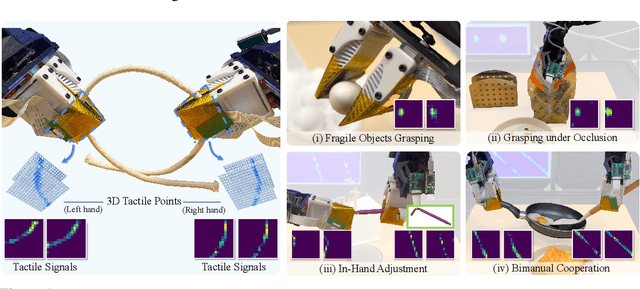
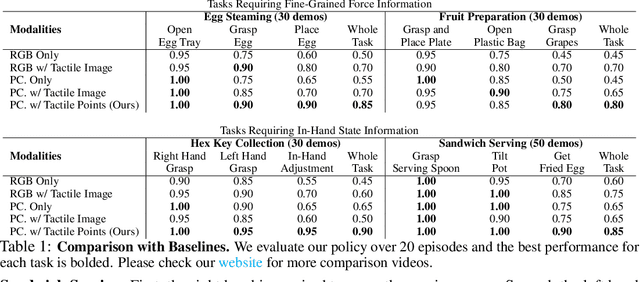
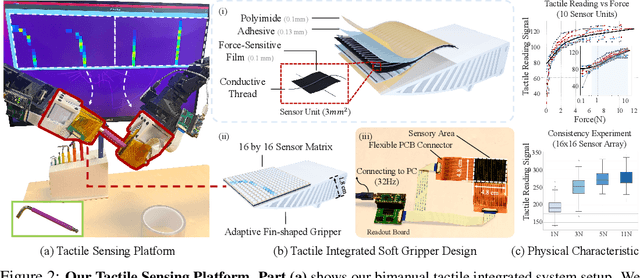
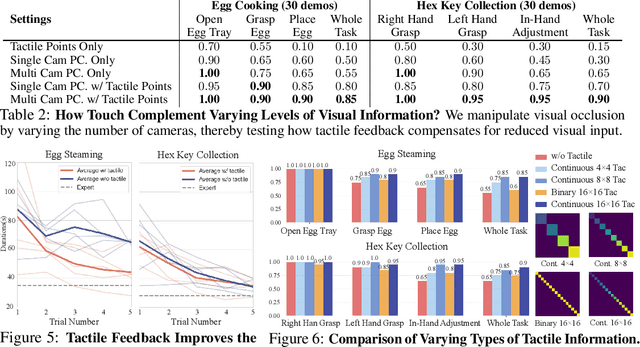
Tactile and visual perception are both crucial for humans to perform fine-grained interactions with their environment. Developing similar multi-modal sensing capabilities for robots can significantly enhance and expand their manipulation skills. This paper introduces \textbf{3D-ViTac}, a multi-modal sensing and learning system designed for dexterous bimanual manipulation. Our system features tactile sensors equipped with dense sensing units, each covering an area of 3$mm^2$. These sensors are low-cost and flexible, providing detailed and extensive coverage of physical contacts, effectively complementing visual information. To integrate tactile and visual data, we fuse them into a unified 3D representation space that preserves their 3D structures and spatial relationships. The multi-modal representation can then be coupled with diffusion policies for imitation learning. Through concrete hardware experiments, we demonstrate that even low-cost robots can perform precise manipulations and significantly outperform vision-only policies, particularly in safe interactions with fragile items and executing long-horizon tasks involving in-hand manipulation. Our project page is available at \url{https://binghao-huang.github.io/3D-ViTac/}.
GenDP: 3D Semantic Fields for Category-Level Generalizable Diffusion Policy
Oct 23, 2024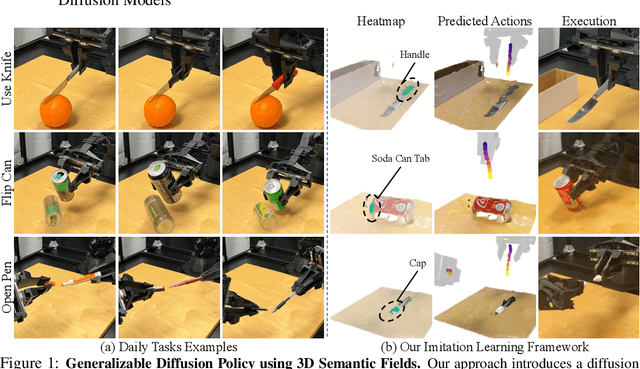
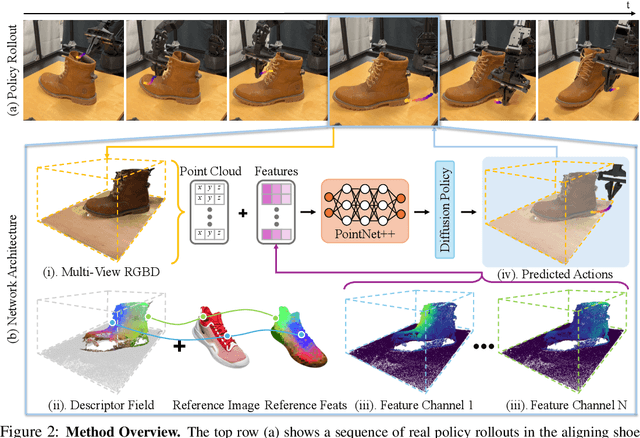
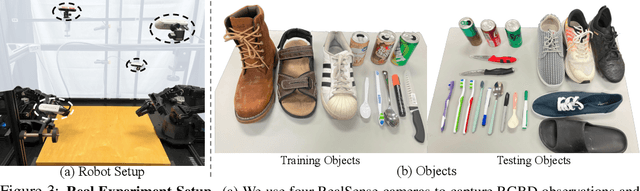
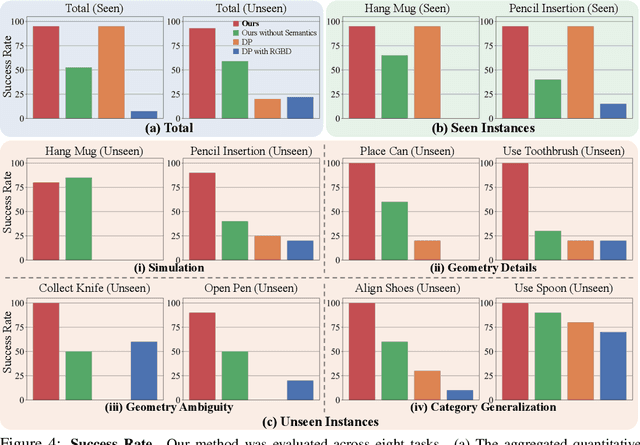
Diffusion-based policies have shown remarkable capability in executing complex robotic manipulation tasks but lack explicit characterization of geometry and semantics, which often limits their ability to generalize to unseen objects and layouts. To enhance the generalization capabilities of Diffusion Policy, we introduce a novel framework that incorporates explicit spatial and semantic information via 3D semantic fields. We generate 3D descriptor fields from multi-view RGBD observations with large foundational vision models, then compare these descriptor fields against reference descriptors to obtain semantic fields. The proposed method explicitly considers geometry and semantics, enabling strong generalization capabilities in tasks requiring category-level generalization, resolving geometric ambiguities, and attention to subtle geometric details. We evaluate our method across eight tasks involving articulated objects and instances with varying shapes and textures from multiple object categories. Our method demonstrates its effectiveness by increasing Diffusion Policy's average success rate on unseen instances from 20% to 93%. Additionally, we provide a detailed analysis and visualization to interpret the sources of performance gain and explain how our method can generalize to novel instances.
Sim2Real Manipulation on Unknown Objects with Tactile-based Reinforcement Learning
Mar 18, 2024Using tactile sensors for manipulation remains one of the most challenging problems in robotics. At the heart of these challenges is generalization: How can we train a tactile-based policy that can manipulate unseen and diverse objects? In this paper, we propose to perform Reinforcement Learning with only visual tactile sensing inputs on diverse objects in a physical simulator. By training with diverse objects in simulation, it enables the policy to generalize to unseen objects. However, leveraging simulation introduces the Sim2Real transfer problem. To mitigate this problem, we study different tactile representations and evaluate how each affects real-robot manipulation results after transfer. We conduct our experiments on diverse real-world objects and show significant improvements over baselines for the pivoting task. Our project page is available at https://tactilerl.github.io/.
RoboEXP: Action-Conditioned Scene Graph via Interactive Exploration for Robotic Manipulation
Feb 23, 2024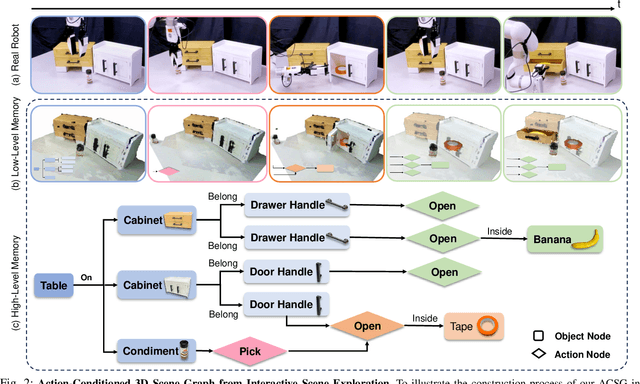
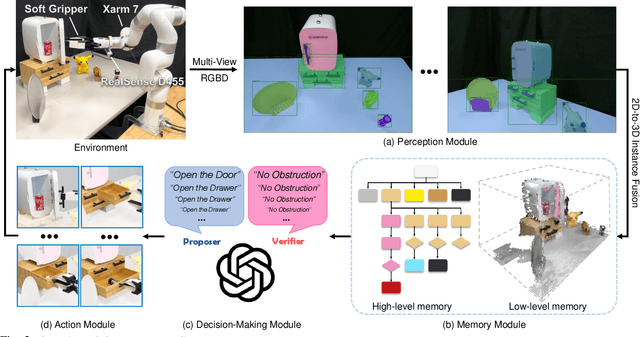
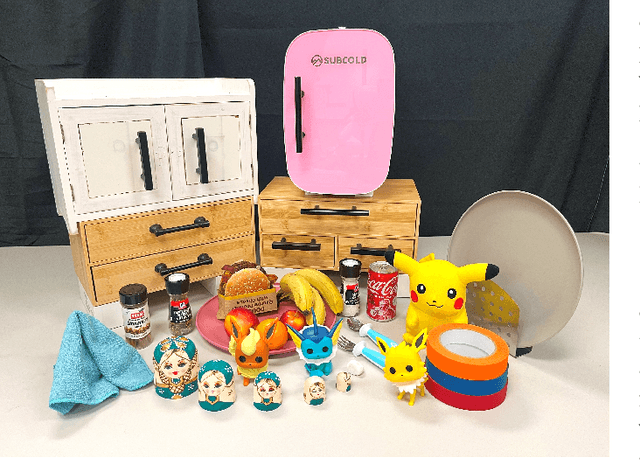
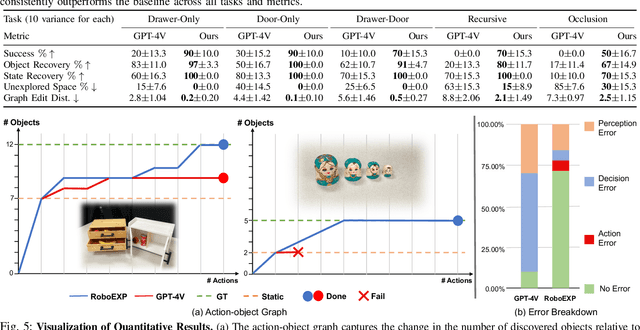
Robots need to explore their surroundings to adapt to and tackle tasks in unknown environments. Prior work has proposed building scene graphs of the environment but typically assumes that the environment is static, omitting regions that require active interactions. This severely limits their ability to handle more complex tasks in household and office environments: before setting up a table, robots must explore drawers and cabinets to locate all utensils and condiments. In this work, we introduce the novel task of interactive scene exploration, wherein robots autonomously explore environments and produce an action-conditioned scene graph (ACSG) that captures the structure of the underlying environment. The ACSG accounts for both low-level information, such as geometry and semantics, and high-level information, such as the action-conditioned relationships between different entities in the scene. To this end, we present the Robotic Exploration (RoboEXP) system, which incorporates the Large Multimodal Model (LMM) and an explicit memory design to enhance our system's capabilities. The robot reasons about what and how to explore an object, accumulating new information through the interaction process and incrementally constructing the ACSG. We apply our system across various real-world settings in a zero-shot manner, demonstrating its effectiveness in exploring and modeling environments it has never seen before. Leveraging the constructed ACSG, we illustrate the effectiveness and efficiency of our RoboEXP system in facilitating a wide range of real-world manipulation tasks involving rigid, articulated objects, nested objects like Matryoshka dolls, and deformable objects like cloth.
Robot Synesthesia: In-Hand Manipulation with Visuotactile Sensing
Dec 04, 2023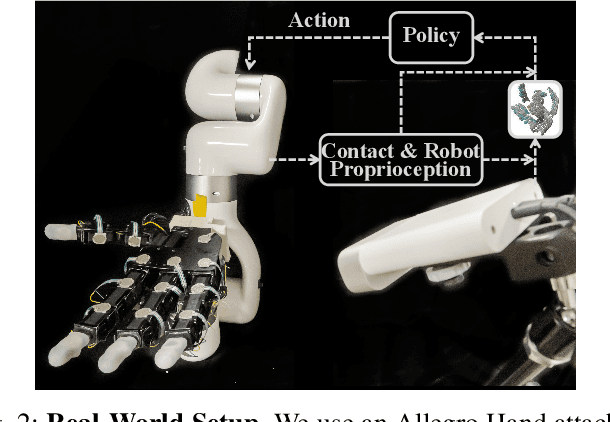
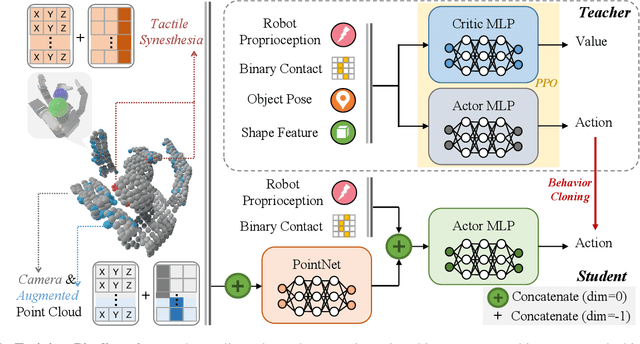
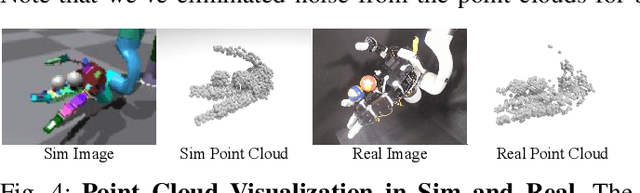
Executing contact-rich manipulation tasks necessitates the fusion of tactile and visual feedback. However, the distinct nature of these modalities poses significant challenges. In this paper, we introduce a system that leverages visual and tactile sensory inputs to enable dexterous in-hand manipulation. Specifically, we propose Robot Synesthesia, a novel point cloud-based tactile representation inspired by human tactile-visual synesthesia. This approach allows for the simultaneous and seamless integration of both sensory inputs, offering richer spatial information and facilitating better reasoning about robot actions. The method, trained in a simulated environment and then deployed to a real robot, is applicable to various in-hand object rotation tasks. Comprehensive ablations are performed on how the integration of vision and touch can improve reinforcement learning and Sim2Real performance. Our project page is available at https://yingyuan0414.github.io/visuotactile/ .