 Add to Chrome
 Add to Firefox
 Add to Edge
Pixel2Catch: Multi-Agent Sim-to-Real Transfer for Agile Manipulation with a Single RGB Camera
Feb 26, 2026
To catch a thrown object, a robot must be able to perceive the object's motion and generate control actions in a timely manner. Rather than explicitly estimating the object's 3D position, this work focuses on a novel approach that recognizes object motion using pixel-level visual information extracted from a single RGB image. Such visual cues capture changes in the object's position and scale, allowing the policy to reason about the object's motion. Furthermore, to achieve stable learning in a high-DoF system composed of a robot arm equipped with a multi-fingered hand, we design a heterogeneous multi-agent reinforcement learning framework that defines the arm and hand as independent agents with distinct roles. Each agent is trained cooperatively using role-specific observations and rewards, and the learned policies are successfully transferred from simulation to the real world.

DexTouch: Learning to Seek and Manipulate Objects with Tactile Dexterity
Jan 23, 2024The sense of touch is an essential ability for skillfully performing a variety of tasks, providing the capacity to search and manipulate objects without relying on visual information. Extensive research has been conducted over time to apply these human tactile abilities to robots. In this paper, we introduce a multi-finger robot system designed to search for and manipulate objects using the sense of touch without relying on visual information. Randomly located target objects are searched using tactile sensors, and the objects are manipulated for tasks that mimic daily-life. The objective of the study is to endow robots with human-like tactile capabilities. To achieve this, binary tactile sensors are implemented on one side of the robot hand to minimize the Sim2Real gap. Training the policy through reinforcement learning in simulation and transferring the trained policy to the real environment, we demonstrate that object search and manipulation using tactile sensors is possible even in an environment without vision information. In addition, an ablation study was conducted to analyze the effect of tactile information on manipulative tasks. Our project page is available at https://lee-kangwon.github.io/dextouch/
Robot Synesthesia: In-Hand Manipulation with Visuotactile Sensing
Dec 04, 2023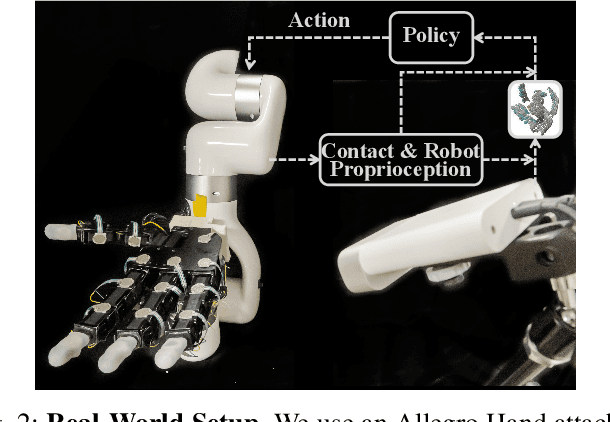
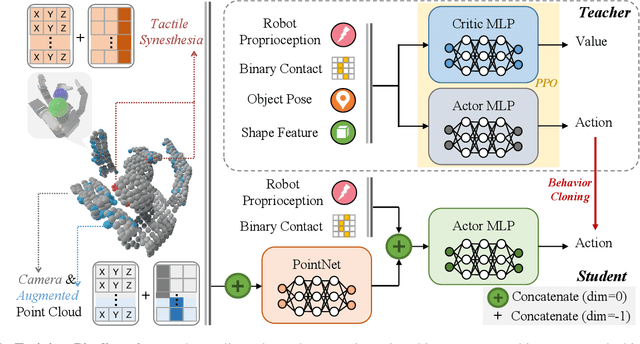
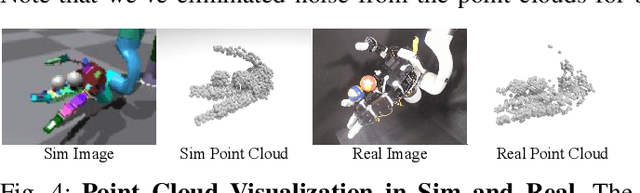
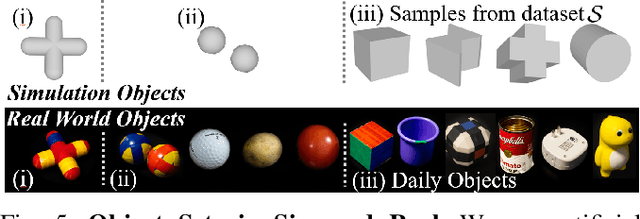
Executing contact-rich manipulation tasks necessitates the fusion of tactile and visual feedback. However, the distinct nature of these modalities poses significant challenges. In this paper, we introduce a system that leverages visual and tactile sensory inputs to enable dexterous in-hand manipulation. Specifically, we propose Robot Synesthesia, a novel point cloud-based tactile representation inspired by human tactile-visual synesthesia. This approach allows for the simultaneous and seamless integration of both sensory inputs, offering richer spatial information and facilitating better reasoning about robot actions. The method, trained in a simulated environment and then deployed to a real robot, is applicable to various in-hand object rotation tasks. Comprehensive ablations are performed on how the integration of vision and touch can improve reinforcement learning and Sim2Real performance. Our project page is available at https://yingyuan0414.github.io/visuotactile/ .