 Add to Chrome
 Add to Firefox
 Add to Edge
See Selectively, Act Adaptively: Dual-Level Structural Decomposition for Bimanual Robot Manipulation
Jun 11, 2026
In bimanual robotic manipulation, task-relevant visual information varies with the task stage and context, while the interaction of the two arms shifts between independent and coordinated modes, making policy learning challenging. However, existing monolithic Vision-Language-Action (VLA) policies process diverse visual inputs and interaction patterns through a single shared representation and action generation pathway, often failing to separately account for visual relevance and bimanual interaction structure. To address this issue, we propose a bimanual manipulation VLA framework based on Dual-Level Structural Decomposition. The View-Selective Visual Router dynamically adjusts wrist-view contributions to emphasize relevant visual cues, while the Interaction-Aware Action Mixture-of-Experts (MoE) decomposes action generation into coordinated and arm-wise pathways to adapt to varying bimanual interaction modes. We evaluate the proposed method on six simulated bimanual manipulation tasks in RoboTwin 2.0 and three long-horizon real-world tasks. Our model improves the overall average success rate over a monolithic baseline by 27.7% in simulation and 43.3% in real-world evaluation, while consistently outperforming single-module variants across both settings. These results demonstrate that jointly considering selective visual processing and explicit decomposition of bimanual interaction structures provides an effective inductive bias for robust bimanual manipulation.

ThermoAct:Thermal-Aware Vision-Language-Action Models for Robotic Perception and Decision-Making
Mar 26, 2026In recent human-robot collaboration environments, there is a growing focus on integrating diverse sensor data beyond visual information to enable safer and more intelligent task execution. Although thermal data can be crucial for enhancing robot safety and operational efficiency, its integration has been relatively overlooked in prior research. This paper proposes a novel Vision-Language-Action (VLA) framework that incorporates thermal information for robot task execution. The proposed system leverages a Vision-Language Model (VLM) as a high-level planner to interpret complex natural language commands and decompose them into simpler sub-tasks. This approach facilitates efficient data collection and robust reasoning for complex operations. Unlike conventional methods that rely solely on visual data, our approach integrates thermal information, enabling the robot to perceive physical properties and proactively ensure environmental safety. Experimental results from real-world task scenarios validate the feasibility of our proposed framework, suggesting its potential to enhance task success rates and safety compared to existing vision-based systems.
Pixel2Catch: Multi-Agent Sim-to-Real Transfer for Agile Manipulation with a Single RGB Camera
Feb 26, 2026To catch a thrown object, a robot must be able to perceive the object's motion and generate control actions in a timely manner. Rather than explicitly estimating the object's 3D position, this work focuses on a novel approach that recognizes object motion using pixel-level visual information extracted from a single RGB image. Such visual cues capture changes in the object's position and scale, allowing the policy to reason about the object's motion. Furthermore, to achieve stable learning in a high-DoF system composed of a robot arm equipped with a multi-fingered hand, we design a heterogeneous multi-agent reinforcement learning framework that defines the arm and hand as independent agents with distinct roles. Each agent is trained cooperatively using role-specific observations and rewards, and the learned policies are successfully transferred from simulation to the real world.
Selective Perception for Robot: Task-Aware Attention in Multimodal VLA
Feb 17, 2026In robotics, Vision-Language-Action (VLA) models that integrate diverse multimodal signals from multi-view inputs have emerged as an effective approach. However, most prior work adopts static fusion that processes all visual inputs uniformly, which incurs unnecessary computational overhead and allows task-irrelevant background information to act as noise. Inspired by the principles of human active perception, we propose a dynamic information fusion framework designed to maximize the efficiency and robustness of VLA models. Our approach introduces a lightweight adaptive routing architecture that analyzes the current text prompt and observations from a wrist-mounted camera in real-time to predict the task-relevance of multiple camera views. By conditionally attenuating computations for views with low informational utility and selectively providing only essential visual features to the policy network, Our framework achieves computation efficiency proportional to task relevance. Furthermore, to efficiently secure large-scale annotation data for router training, we established an automated labeling pipeline utilizing Vision-Language Models (VLMs) to minimize data collection and annotation costs. Experimental results in real-world robotic manipulation scenarios demonstrate that the proposed approach achieves significant improvements in both inference efficiency and control performance compared to existing VLA models, validating the effectiveness and practicality of dynamic information fusion in resource-constrained, real-time robot control environments.
DexTouch: Learning to Seek and Manipulate Objects with Tactile Dexterity
Jan 23, 2024The sense of touch is an essential ability for skillfully performing a variety of tasks, providing the capacity to search and manipulate objects without relying on visual information. Extensive research has been conducted over time to apply these human tactile abilities to robots. In this paper, we introduce a multi-finger robot system designed to search for and manipulate objects using the sense of touch without relying on visual information. Randomly located target objects are searched using tactile sensors, and the objects are manipulated for tasks that mimic daily-life. The objective of the study is to endow robots with human-like tactile capabilities. To achieve this, binary tactile sensors are implemented on one side of the robot hand to minimize the Sim2Real gap. Training the policy through reinforcement learning in simulation and transferring the trained policy to the real environment, we demonstrate that object search and manipulation using tactile sensors is possible even in an environment without vision information. In addition, an ablation study was conducted to analyze the effect of tactile information on manipulative tasks. Our project page is available at https://lee-kangwon.github.io/dextouch/
Robot Synesthesia: In-Hand Manipulation with Visuotactile Sensing
Dec 04, 2023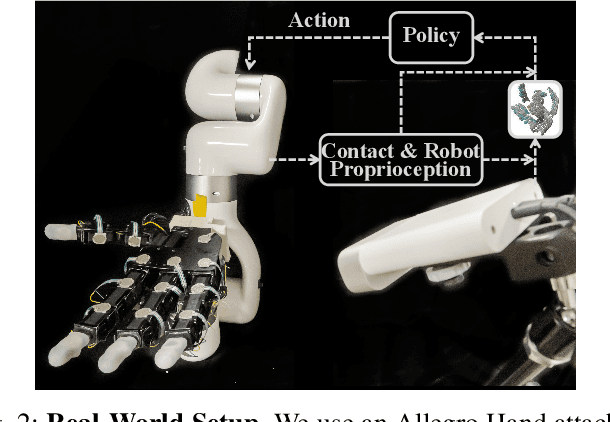
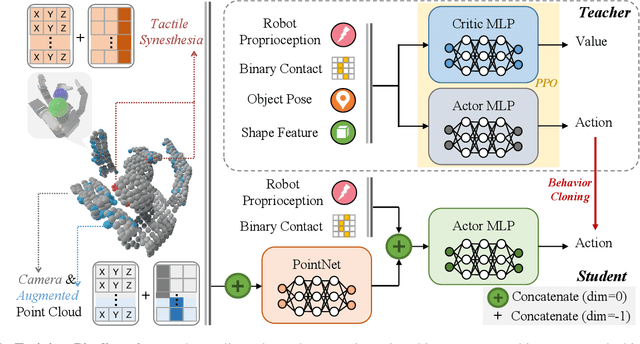
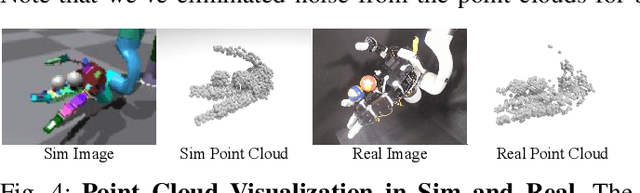
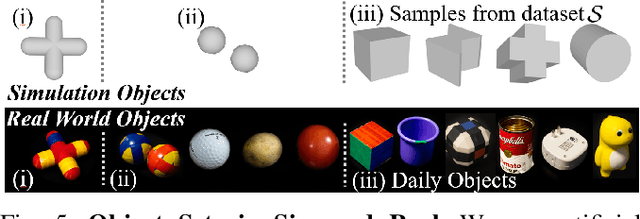
Executing contact-rich manipulation tasks necessitates the fusion of tactile and visual feedback. However, the distinct nature of these modalities poses significant challenges. In this paper, we introduce a system that leverages visual and tactile sensory inputs to enable dexterous in-hand manipulation. Specifically, we propose Robot Synesthesia, a novel point cloud-based tactile representation inspired by human tactile-visual synesthesia. This approach allows for the simultaneous and seamless integration of both sensory inputs, offering richer spatial information and facilitating better reasoning about robot actions. The method, trained in a simulated environment and then deployed to a real robot, is applicable to various in-hand object rotation tasks. Comprehensive ablations are performed on how the integration of vision and touch can improve reinforcement learning and Sim2Real performance. Our project page is available at https://yingyuan0414.github.io/visuotactile/ .