 Add to Chrome
 Add to Firefox
 Add to Edge
Trajectory-Level Redirection Attacks on Vision-Language-Action Models
Jun 11, 2026
Vision-language-action (VLA) policies bring natural language into closed-loop robot control, enabling robots to execute manipulation tasks directly from text instructions. The same interface gives text a recurring role in control because the prompt is reused at every replanning step, and each prompt-conditioned action changes the future observations on which the policy acts. Existing VLA attacks study adversarial prompts that elicit targeted low-level actions or make such actions persist across changing images. We identify a stronger trajectory-level failure mode: a prompt that still $\textit{appears}$ to specify the intended task but redirects the final physical outcome. We mathematically formalize this setting as $\textit{command-preserving trajectory redirection}$, a prompt-only threat model in which the attacker chooses one prompt before the episode, all policy and environment components remain fixed, and the prompt must stay close to the benign instruction while omitting target words and correction language. To find such prompts, we introduce an on-policy prompt search method that uses rollouts to discover perturbations whose closed-loop behavior tracks a target task while satisfying the command-preserving constraints. Experiments in simulation and on hardware show that near-benign prompt perturbations can redirect VLA rollouts to attacker-specified targets. These results expose a trajectory-level vulnerability in VLA instruction grounding: text that appears to preserve the intended command can still give an adversary control over the robot's final physical outcome. Project website: https://vla-redirection-attack.github.io/

Beyond Individual Personas: Aligning Synthetic Dialogue to Population-Level Behavior Distributions
Jun 05, 2026Synthetic dialogue corpora are increasingly used as proxies for target dialogue data, yet persona-grounded generators optimize individual conversations rather than corpus composition, yielding locally plausible dialogues with distorted population-level behavior mixes. We introduce GroupPersona, a framework that aligns synthetic dialogue corpora to the behavior distribution of a reference corpus. GroupPersona turns population statistics into generation controls: it separates each dialogue's core behavioral signature from predictable side effects, and uses the resulting behavioral groups to condition user agents on the interaction patterns that define the reference population. We evaluate GroupPersona on four corpora crossing two dialogue sources, assistant-style and Reddit-derived, with two construction variants: structure-preserving and variation-enhanced. GroupPersona lowers Jensen-Shannon divergence between synthetic and reference distributions over 12 behavior attributes from 0.234 to 0.177 relative to the strongest average baseline, a 24.4% reduction, and is best or tied-best on all four corpora while preserving structural alignment. It also achieves the closest calibration to reference-conversation quality scores, reducing mean absolute deviation from the reference-conversation profile to 0.63 versus 0.91 for the next-best baseline.
Interactive World Simulator for Robot Policy Training and Evaluation
Mar 09, 2026Action-conditioned video prediction models (often referred to as world models) have shown strong potential for robotics applications, but existing approaches are often slow and struggle to capture physically consistent interactions over long horizons, limiting their usefulness for scalable robot policy training and evaluation. We present Interactive World Simulator, a framework for building interactive world models from a moderate-sized robot interaction dataset. Our approach leverages consistency models for both image decoding and latent-space dynamics prediction, enabling fast and stable simulation of physical interactions. In our experiments, the learned world models produce interaction-consistent pixel-level predictions and support stable long-horizon interactions for more than 10 minutes at 15 FPS on a single RTX 4090 GPU. Our framework enables scalable demonstration collection solely within the world models to train state-of-the-art imitation policies. Through extensive real-world evaluation across diverse tasks involving rigid objects, deformable objects, object piles, and their interactions, we find that policies trained on world-model-generated data perform comparably to those trained on the same amount of real-world data. Additionally, we evaluate policies both within the world models and in the real world across diverse tasks, and observe a strong correlation between simulated and real-world performance. Together, these results establish the Interactive World Simulator as a stable and physically consistent surrogate for scalable robotic data generation and faithful, reproducible policy evaluation.
ATOD: An Evaluation Framework and Benchmark for Agentic Task-Oriented Dialogue System
Jan 17, 2026Recent advances in task-oriented dialogue (TOD) systems, driven by large language models (LLMs) with extensive API and tool integration, have enabled conversational agents to coordinate interleaved goals, maintain long-horizon context, and act proactively through asynchronous execution. These capabilities extend beyond traditional TOD systems, yet existing benchmarks lack systematic support for evaluating such agentic behaviors. To address this gap, we introduce ATOD, a benchmark and synthetic dialogue generation pipeline that produces richly annotated conversations requiring long-term reasoning. ATOD captures key characteristics of advanced TOD, including multi-goal coordination, dependency management, memory, adaptability, and proactivity. Building on ATOD, we propose ATOD-Eval, a holistic evaluation framework that translates these dimensions into fine-grained metrics and supports reproducible offline and online evaluation. We further present a strong agentic memory-based evaluator for benchmarking on ATOD. Experiments show that ATOD-Eval enables comprehensive assessment across task completion, agentic capability, and response quality, and that the proposed evaluator offers a better accuracy-efficiency tradeoff compared to existing memory- and LLM-based approaches under this evaluation setting.
A Real-to-Sim-to-Real Approach to Robotic Manipulation with VLM-Generated Iterative Keypoint Rewards
Feb 12, 2025Task specification for robotic manipulation in open-world environments is challenging, requiring flexible and adaptive objectives that align with human intentions and can evolve through iterative feedback. We introduce Iterative Keypoint Reward (IKER), a visually grounded, Python-based reward function that serves as a dynamic task specification. Our framework leverages VLMs to generate and refine these reward functions for multi-step manipulation tasks. Given RGB-D observations and free-form language instructions, we sample keypoints in the scene and generate a reward function conditioned on these keypoints. IKER operates on the spatial relationships between keypoints, leveraging commonsense priors about the desired behaviors, and enabling precise SE(3) control. We reconstruct real-world scenes in simulation and use the generated rewards to train reinforcement learning (RL) policies, which are then deployed into the real world-forming a real-to-sim-to-real loop. Our approach demonstrates notable capabilities across diverse scenarios, including both prehensile and non-prehensile tasks, showcasing multi-step task execution, spontaneous error recovery, and on-the-fly strategy adjustments. The results highlight IKER's effectiveness in enabling robots to perform multi-step tasks in dynamic environments through iterative reward shaping.
RoboEXP: Action-Conditioned Scene Graph via Interactive Exploration for Robotic Manipulation
Feb 23, 2024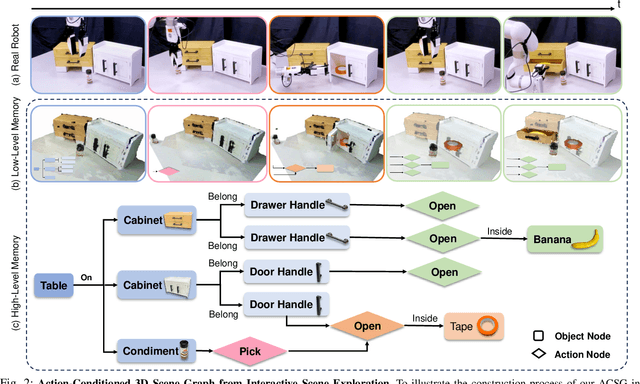
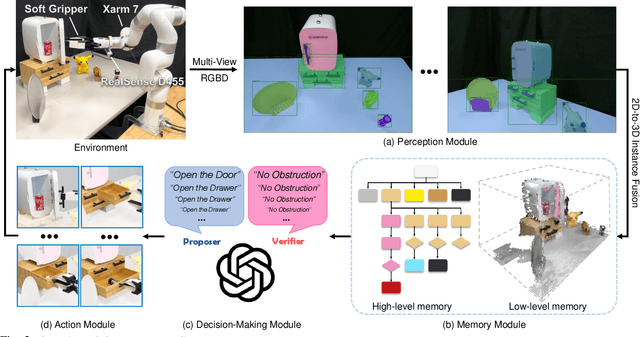
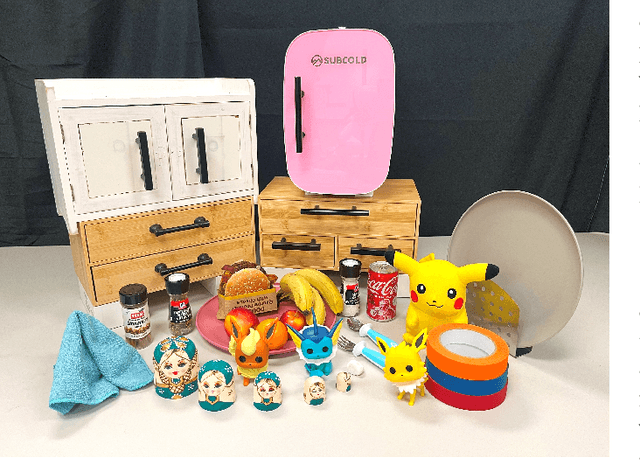
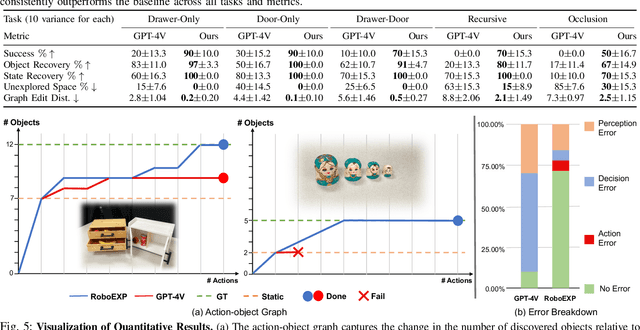
Robots need to explore their surroundings to adapt to and tackle tasks in unknown environments. Prior work has proposed building scene graphs of the environment but typically assumes that the environment is static, omitting regions that require active interactions. This severely limits their ability to handle more complex tasks in household and office environments: before setting up a table, robots must explore drawers and cabinets to locate all utensils and condiments. In this work, we introduce the novel task of interactive scene exploration, wherein robots autonomously explore environments and produce an action-conditioned scene graph (ACSG) that captures the structure of the underlying environment. The ACSG accounts for both low-level information, such as geometry and semantics, and high-level information, such as the action-conditioned relationships between different entities in the scene. To this end, we present the Robotic Exploration (RoboEXP) system, which incorporates the Large Multimodal Model (LMM) and an explicit memory design to enhance our system's capabilities. The robot reasons about what and how to explore an object, accumulating new information through the interaction process and incrementally constructing the ACSG. We apply our system across various real-world settings in a zero-shot manner, demonstrating its effectiveness in exploring and modeling environments it has never seen before. Leveraging the constructed ACSG, we illustrate the effectiveness and efficiency of our RoboEXP system in facilitating a wide range of real-world manipulation tasks involving rigid, articulated objects, nested objects like Matryoshka dolls, and deformable objects like cloth.