 Add to Chrome
 Add to Firefox
 Add to Edge
Robust Deepfake Detection, NTIRE 2026 Challenge: Report
Apr 27, 2026
Robustness is a long-overlooked problem in deepfake detection. However, detection performance is nearly worthless in the real world if it suffers under exposure to even slight image degradation. In addition to weaker degradations that can accidentally occur in the image processing pipeline, there is another risk of malicious deepfakes that specifically introduce degradations, purposefully exploiting the detector's weaknesses in that regard. Here, we present an overview of the NTIRE 2026 Robust Deepfake Detection Challenge, which specifically addresses that problem. Participants were tasked with building a detector that would later be tested on an unknown test-set, which included both common and uncommon degradations of various strengths. With a total number of 337 participants and 57 submissions to the final leaderboard, the first edition of the challenge was well received. To ensure the reliability of the results, participants were given only 24h to complete the test run with no labels provided, limiting the possibility of training on the test data. Furthermore, the top solutions were scored on a private test-set to detect any such overfitting. This report presents the competition setting, dataset preparation, as well as details and performance of methods. Top methods rely on large foundation models, ensembles, and degradation training to combine generality and robustness.

Low Light Image Enhancement Challenge at NTIRE 2026
Apr 19, 2026This paper presents a comprehensive review of the NTIRE 2026 Low Light Image Enhancement Challenge, highlighting the proposed solutions and final results. The objective of this challenge is to identify effective networks capable of producing clearer and visually compelling images in diverse and challenging conditions by learning representative visual cues with the purpose of restoring information loss due to low-contrast and noisy images. A total of 195 participants registered for the first track and 153 for the second track of the competition, and 22 teams ultimately submitted valid entries. This paper thoroughly evaluates the state-of-the-art advances in (joint denoising and) low-light image enhancement, showcasing the significant progress in the field, while leveraging samples of our novel dataset.
The Fourth Challenge on Image Super-Resolution ($\times$4) at NTIRE 2026: Benchmark Results and Method Overview
Apr 16, 2026This paper presents the NTIRE 2026 image super-resolution ($\times$4) challenge, one of the associated competitions of the NTIRE 2026 Workshop at CVPR 2026. The challenge aims to reconstruct high-resolution (HR) images from low-resolution (LR) inputs generated through bicubic downsampling with a $\times$4 scaling factor. The objective is to develop effective super-resolution solutions and analyze recent advances in the field. To reflect the evolving objectives of image super-resolution, the challenge includes two tracks: (1) a restoration track, which emphasizes pixel-wise fidelity and ranks submissions based on PSNR; and (2) a perceptual track, which focuses on visual realism and evaluates results using a perceptual score. A total of 194 participants registered for the challenge, with 31 teams submitting valid entries. This report summarizes the challenge design, datasets, evaluation protocol, main results, and methods of participating teams. The challenge provides a unified benchmark and offers insights into current progress and future directions in image super-resolution.
NTIRE 2026 Challenge on Robust AI-Generated Image Detection in the Wild
Apr 13, 2026This paper presents an overview of the NTIRE 2026 Challenge on Robust AI-Generated Image Detection in the Wild, held in conjunction with the NTIRE workshop at CVPR 2026. The goal of this challenge was to develop detection models capable of distinguishing real images from generated ones in realistic scenarios: the images are often transformed (cropped, resized, compressed, blurred) for practical usage, and therefore, the detection models should be robust to such transformations. The challenge is based on a novel dataset consisting of 108,750 real and 185,750 AI-generated images from 42 generators comprising a large variety of open-source and closed-source models of various architectures, augmented with 36 image transformations. Methods were evaluated using ROC AUC on the full test set, including both transformed and untransformed images. A total of 511 participants registered, with 20 teams submitting valid final solutions. This report provides a comprehensive overview of the challenge, describes the proposed solutions, and can be used as a valuable reference for researchers and practitioners in increasing the robustness of the detection models to real-world transformations.
ThinkGeo: Evaluating Tool-Augmented Agents for Remote Sensing Tasks
May 29, 2025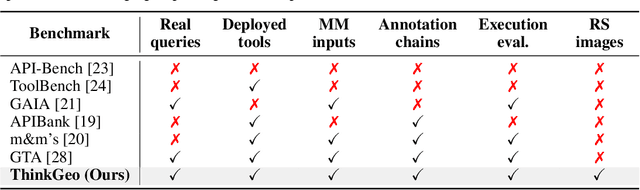
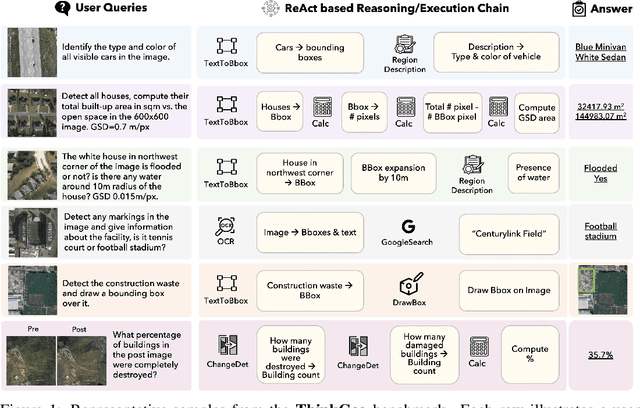
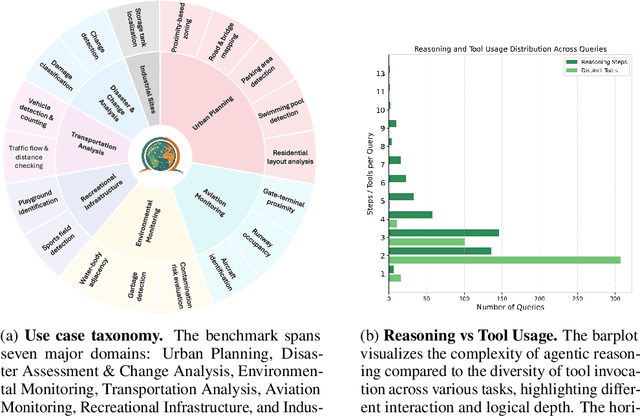
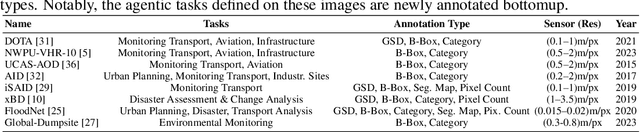
Recent progress in large language models (LLMs) has enabled tool-augmented agents capable of solving complex real-world tasks through step-by-step reasoning. However, existing evaluations often focus on general-purpose or multimodal scenarios, leaving a gap in domain-specific benchmarks that assess tool-use capabilities in complex remote sensing use cases. We present ThinkGeo, an agentic benchmark designed to evaluate LLM-driven agents on remote sensing tasks via structured tool use and multi-step planning. Inspired by tool-interaction paradigms, ThinkGeo includes human-curated queries spanning a wide range of real-world applications such as urban planning, disaster assessment and change analysis, environmental monitoring, transportation analysis, aviation monitoring, recreational infrastructure, and industrial site analysis. Each query is grounded in satellite or aerial imagery and requires agents to reason through a diverse toolset. We implement a ReAct-style interaction loop and evaluate both open and closed-source LLMs (e.g., GPT-4o, Qwen2.5) on 436 structured agentic tasks. The benchmark reports both step-wise execution metrics and final answer correctness. Our analysis reveals notable disparities in tool accuracy and planning consistency across models. ThinkGeo provides the first extensive testbed for evaluating how tool-enabled LLMs handle spatial reasoning in remote sensing. Our code and dataset are publicly available
NTIRE 2025 Challenge on Image Super-Resolution ($\times$4): Methods and Results
Apr 20, 2025This paper presents the NTIRE 2025 image super-resolution ($\times$4) challenge, one of the associated competitions of the 10th NTIRE Workshop at CVPR 2025. The challenge aims to recover high-resolution (HR) images from low-resolution (LR) counterparts generated through bicubic downsampling with a $\times$4 scaling factor. The objective is to develop effective network designs or solutions that achieve state-of-the-art SR performance. To reflect the dual objectives of image SR research, the challenge includes two sub-tracks: (1) a restoration track, emphasizes pixel-wise accuracy and ranks submissions based on PSNR; (2) a perceptual track, focuses on visual realism and ranks results by a perceptual score. A total of 286 participants registered for the competition, with 25 teams submitting valid entries. This report summarizes the challenge design, datasets, evaluation protocol, the main results, and methods of each team. The challenge serves as a benchmark to advance the state of the art and foster progress in image SR.
The Tenth NTIRE 2025 Image Denoising Challenge Report
Apr 16, 2025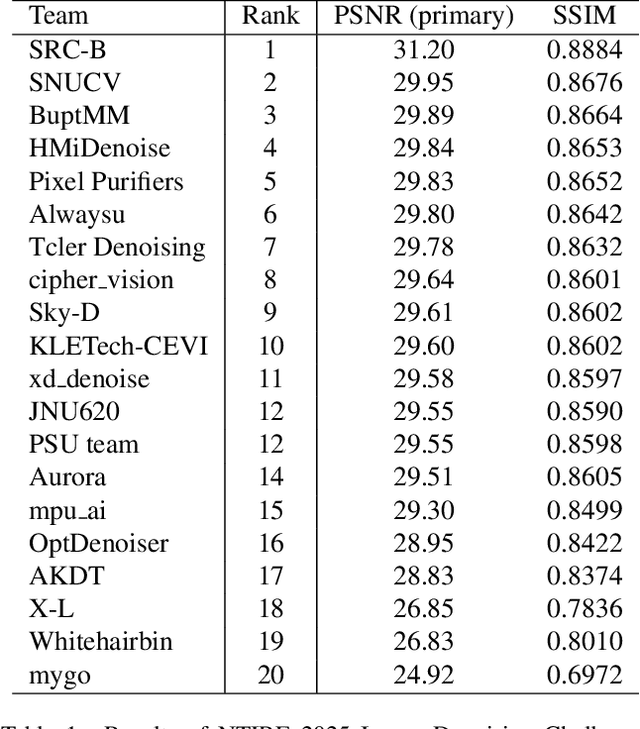
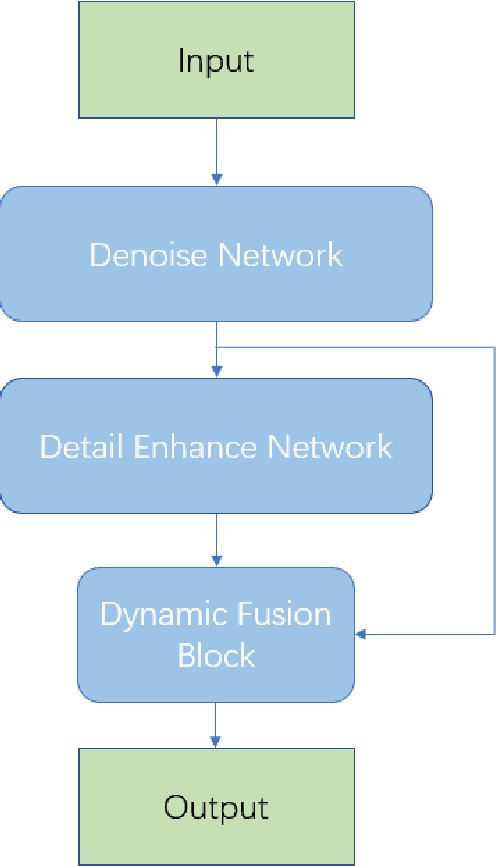
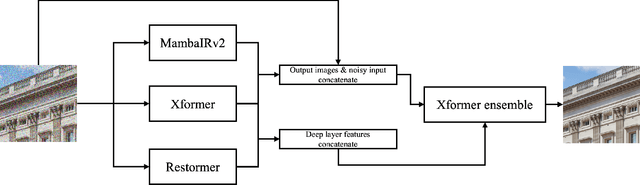
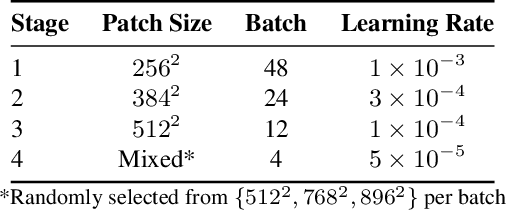
This paper presents an overview of the NTIRE 2025 Image Denoising Challenge ({\sigma} = 50), highlighting the proposed methodologies and corresponding results. The primary objective is to develop a network architecture capable of achieving high-quality denoising performance, quantitatively evaluated using PSNR, without constraints on computational complexity or model size. The task assumes independent additive white Gaussian noise (AWGN) with a fixed noise level of 50. A total of 290 participants registered for the challenge, with 20 teams successfully submitting valid results, providing insights into the current state-of-the-art in image denoising.
The Tenth NTIRE 2025 Efficient Super-Resolution Challenge Report
Apr 14, 2025This paper presents a comprehensive review of the NTIRE 2025 Challenge on Single-Image Efficient Super-Resolution (ESR). The challenge aimed to advance the development of deep models that optimize key computational metrics, i.e., runtime, parameters, and FLOPs, while achieving a PSNR of at least 26.90 dB on the $\operatorname{DIV2K\_LSDIR\_valid}$ dataset and 26.99 dB on the $\operatorname{DIV2K\_LSDIR\_test}$ dataset. A robust participation saw \textbf{244} registered entrants, with \textbf{43} teams submitting valid entries. This report meticulously analyzes these methods and results, emphasizing groundbreaking advancements in state-of-the-art single-image ESR techniques. The analysis highlights innovative approaches and establishes benchmarks for future research in the field.
EarthDial: Turning Multi-sensory Earth Observations to Interactive Dialogues
Dec 19, 2024
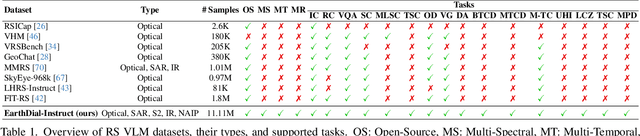


Automated analysis of vast Earth observation data via interactive Vision-Language Models (VLMs) can unlock new opportunities for environmental monitoring, disaster response, and resource management. Existing generic VLMs do not perform well on Remote Sensing data, while the recent Geo-spatial VLMs remain restricted to a fixed resolution and few sensor modalities. In this paper, we introduce EarthDial, a conversational assistant specifically designed for Earth Observation (EO) data, transforming complex, multi-sensory Earth observations into interactive, natural language dialogues. EarthDial supports multi-spectral, multi-temporal, and multi-resolution imagery, enabling a wide range of remote sensing tasks, including classification, detection, captioning, question answering, visual reasoning, and visual grounding. To achieve this, we introduce an extensive instruction tuning dataset comprising over 11.11M instruction pairs covering RGB, Synthetic Aperture Radar (SAR), and multispectral modalities such as Near-Infrared (NIR) and infrared. Furthermore, EarthDial handles bi-temporal and multi-temporal sequence analysis for applications like change detection. Our extensive experimental results on 37 downstream applications demonstrate that EarthDial outperforms existing generic and domain-specific models, achieving better generalization across various EO tasks.
Dynamic Pre-training: Towards Efficient and Scalable All-in-One Image Restoration
Apr 02, 2024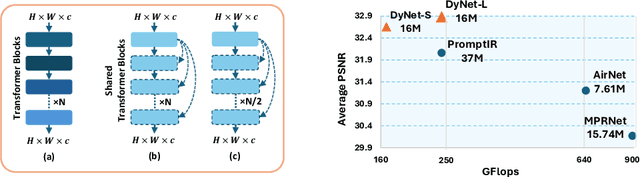


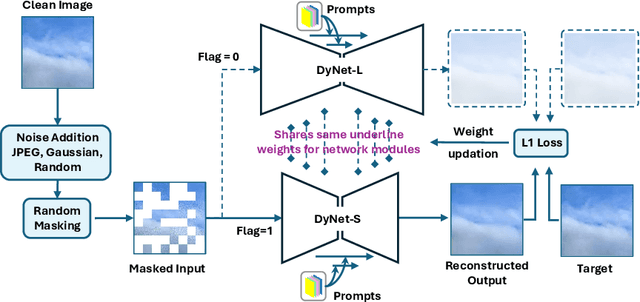
All-in-one image restoration tackles different types of degradations with a unified model instead of having task-specific, non-generic models for each degradation. The requirement to tackle multiple degradations using the same model can lead to high-complexity designs with fixed configuration that lack the adaptability to more efficient alternatives. We propose DyNet, a dynamic family of networks designed in an encoder-decoder style for all-in-one image restoration tasks. Our DyNet can seamlessly switch between its bulkier and lightweight variants, thereby offering flexibility for efficient model deployment with a single round of training. This seamless switching is enabled by our weights-sharing mechanism, forming the core of our architecture and facilitating the reuse of initialized module weights. Further, to establish robust weights initialization, we introduce a dynamic pre-training strategy that trains variants of the proposed DyNet concurrently, thereby achieving a 50% reduction in GPU hours. To tackle the unavailability of large-scale dataset required in pre-training, we curate a high-quality, high-resolution image dataset named Million-IRD having 2M image samples. We validate our DyNet for image denoising, deraining, and dehazing in all-in-one setting, achieving state-of-the-art results with 31.34% reduction in GFlops and a 56.75% reduction in parameters compared to baseline models. The source codes and trained models are available at https://github.com/akshaydudhane16/DyNet.