 Add to Chrome
 Add to Firefox
 Add to Edge
CoVR-R:Reason-Aware Composed Video Retrieval
Mar 20, 2026
Composed Video Retrieval (CoVR) aims to find a target video given a reference video and a textual modification. Prior work assumes the modification text fully specifies the visual changes, overlooking after-effects and implicit consequences (e.g., motion, state transitions, viewpoint or duration cues) that emerge from the edit. We argue that successful CoVR requires reasoning about these after-effects. We introduce a reasoning-first, zero-shot approach that leverages large multimodal models to (i) infer causal and temporal consequences implied by the edit, and (ii) align the resulting reasoned queries to candidate videos without task-specific finetuning. To evaluate reasoning in CoVR, we also propose CoVR-Reason, a benchmark that pairs each (reference, edit, target) triplet with structured internal reasoning traces and challenging distractors that require predicting after-effects rather than keyword matching. Experiments show that our zero-shot method outperforms strong retrieval baselines on recall at K and particularly excels on implicit-effect subsets. Our automatic and human analysis confirm higher step consistency and effect factuality in our retrieved results. Our findings show that incorporating reasoning into general-purpose multimodal models enables effective CoVR by explicitly accounting for causal and temporal after-effects. This reduces dependence on task-specific supervision, improves generalization to challenging implicit-effect cases, and enhances interpretability of retrieval outcomes. These results point toward a scalable and principled framework for explainable video search. The model, code, and benchmark are available at https://github.com/mbzuai-oryx/CoVR-R.

Mobile-O: Unified Multimodal Understanding and Generation on Mobile Device
Feb 24, 2026Unified multimodal models can both understand and generate visual content within a single architecture. Existing models, however, remain data-hungry and too heavy for deployment on edge devices. We present Mobile-O, a compact vision-language-diffusion model that brings unified multimodal intelligence to a mobile device. Its core module, the Mobile Conditioning Projector (MCP), fuses vision-language features with a diffusion generator using depthwise-separable convolutions and layerwise alignment. This design enables efficient cross-modal conditioning with minimal computational cost. Trained on only a few million samples and post-trained in a novel quadruplet format (generation prompt, image, question, answer), Mobile-O jointly enhances both visual understanding and generation capabilities. Despite its efficiency, Mobile-O attains competitive or superior performance compared to other unified models, achieving 74% on GenEval and outperforming Show-O and JanusFlow by 5% and 11%, while running 6x and 11x faster, respectively. For visual understanding, Mobile-O surpasses them by 15.3% and 5.1% averaged across seven benchmarks. Running in only ~3s per 512x512 image on an iPhone, Mobile-O establishes the first practical framework for real-time unified multimodal understanding and generation on edge devices. We hope Mobile-O will ease future research in real-time unified multimodal intelligence running entirely on-device with no cloud dependency. Our code, models, datasets, and mobile application are publicly available at https://amshaker.github.io/Mobile-O/
DuwatBench: Bridging Language and Visual Heritage through an Arabic Calligraphy Benchmark for Multimodal Understanding
Jan 27, 2026Arabic calligraphy represents one of the richest visual traditions of the Arabic language, blending linguistic meaning with artistic form. Although multimodal models have advanced across languages, their ability to process Arabic script, especially in artistic and stylized calligraphic forms, remains largely unexplored. To address this gap, we present DuwatBench, a benchmark of 1,272 curated samples containing about 1,475 unique words across six classical and modern calligraphic styles, each paired with sentence-level detection annotations. The dataset reflects real-world challenges in Arabic writing, such as complex stroke patterns, dense ligatures, and stylistic variations that often challenge standard text recognition systems. Using DuwatBench, we evaluated 13 leading Arabic and multilingual multimodal models and showed that while they perform well on clean text, they struggle with calligraphic variation, artistic distortions, and precise visual-text alignment. By publicly releasing DuwatBench and its annotations, we aim to advance culturally grounded multimodal research, foster fair inclusion of the Arabic language and visual heritage in AI systems, and support continued progress in this area. Our dataset (https://huggingface.co/datasets/MBZUAI/DuwatBench) and evaluation suit (https://github.com/mbzuai-oryx/DuwatBench) are publicly available.
Thinking Beyond Labels: Vocabulary-Free Fine-Grained Recognition using Reasoning-Augmented LMMs
Dec 21, 2025Vocabulary-free fine-grained image recognition aims to distinguish visually similar categories within a meta-class without a fixed, human-defined label set. Existing solutions for this problem are limited by either the usage of a large and rigid list of vocabularies or by the dependency on complex pipelines with fragile heuristics where errors propagate across stages. Meanwhile, the ability of recent large multi-modal models (LMMs) equipped with explicit or implicit reasoning to comprehend visual-language data, decompose problems, retrieve latent knowledge, and self-correct suggests a more principled and effective alternative. Building on these capabilities, we propose FiNDR (Fine-grained Name Discovery via Reasoning), the first reasoning-augmented LMM-based framework for vocabulary-free fine-grained recognition. The system operates in three automated steps: (i) a reasoning-enabled LMM generates descriptive candidate labels for each image; (ii) a vision-language model filters and ranks these candidates to form a coherent class set; and (iii) the verified names instantiate a lightweight multi-modal classifier used at inference time. Extensive experiments on popular fine-grained classification benchmarks demonstrate state-of-the-art performance under the vocabulary-free setting, with a significant relative margin of up to 18.8% over previous approaches. Remarkably, the proposed method surpasses zero-shot baselines that exploit pre-defined ground-truth names, challenging the assumption that human-curated vocabularies define an upper bound. Additionally, we show that carefully curated prompts enable open-source LMMs to match proprietary counterparts. These findings establish reasoning-augmented LMMs as an effective foundation for scalable, fully automated, open-world fine-grained visual recognition. The source code is available on github.com/demidovd98/FiNDR.
How Good are Foundation Models in Step-by-Step Embodied Reasoning?
Sep 18, 2025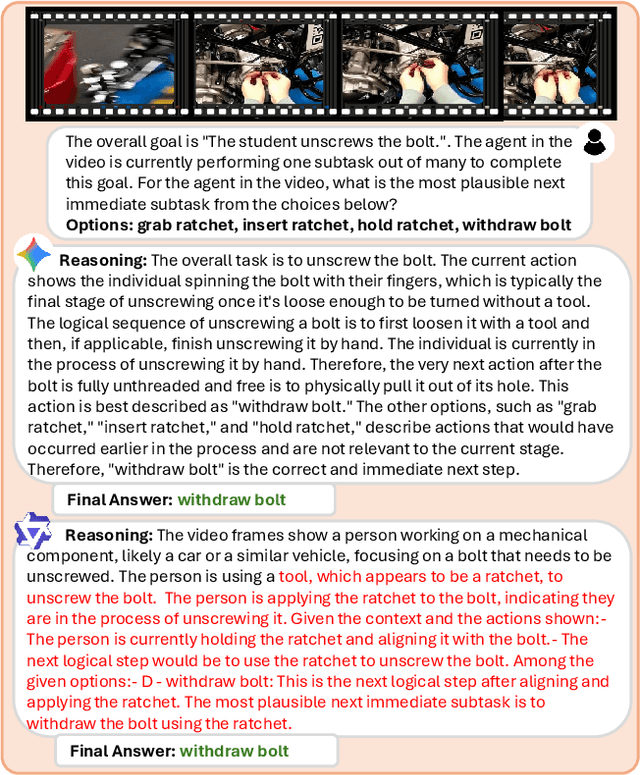
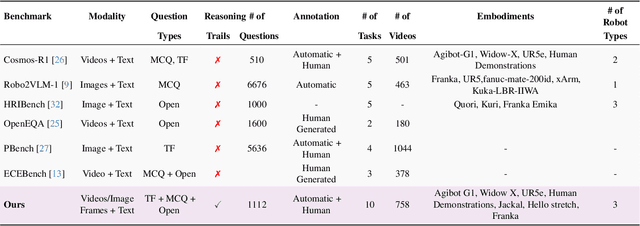
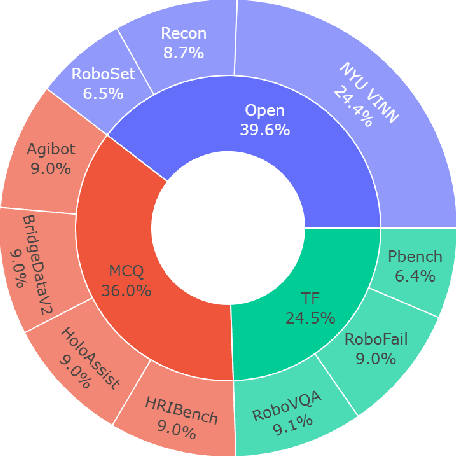
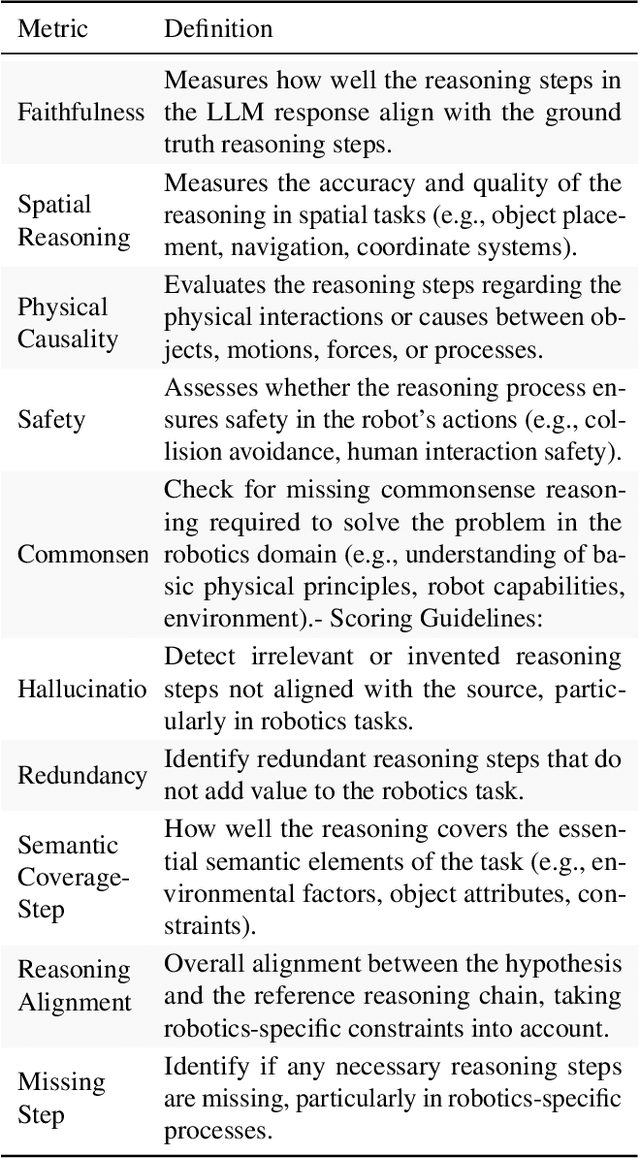
Embodied agents operating in the physical world must make decisions that are not only effective but also safe, spatially coherent, and grounded in context. While recent advances in large multimodal models (LMMs) have shown promising capabilities in visual understanding and language generation, their ability to perform structured reasoning for real-world embodied tasks remains underexplored. In this work, we aim to understand how well foundation models can perform step-by-step reasoning in embodied environments. To this end, we propose the Foundation Model Embodied Reasoning (FoMER) benchmark, designed to evaluate the reasoning capabilities of LMMs in complex embodied decision-making scenarios. Our benchmark spans a diverse set of tasks that require agents to interpret multimodal observations, reason about physical constraints and safety, and generate valid next actions in natural language. We present (i) a large-scale, curated suite of embodied reasoning tasks, (ii) a novel evaluation framework that disentangles perceptual grounding from action reasoning, and (iii) empirical analysis of several leading LMMs under this setting. Our benchmark includes over 1.1k samples with detailed step-by-step reasoning across 10 tasks and 8 embodiments, covering three different robot types. Our results highlight both the potential and current limitations of LMMs in embodied reasoning, pointing towards key challenges and opportunities for future research in robot intelligence. Our data and code will be made publicly available.
Beyond Simple Edits: Composed Video Retrieval with Dense Modifications
Aug 19, 2025Composed video retrieval is a challenging task that strives to retrieve a target video based on a query video and a textual description detailing specific modifications. Standard retrieval frameworks typically struggle to handle the complexity of fine-grained compositional queries and variations in temporal understanding limiting their retrieval ability in the fine-grained setting. To address this issue, we introduce a novel dataset that captures both fine-grained and composed actions across diverse video segments, enabling more detailed compositional changes in retrieved video content. The proposed dataset, named Dense-WebVid-CoVR, consists of 1.6 million samples with dense modification text that is around seven times more than its existing counterpart. We further develop a new model that integrates visual and textual information through Cross-Attention (CA) fusion using grounded text encoder, enabling precise alignment between dense query modifications and target videos. The proposed model achieves state-of-the-art results surpassing existing methods on all metrics. Notably, it achieves 71.3\% Recall@1 in visual+text setting and outperforms the state-of-the-art by 3.4\%, highlighting its efficacy in terms of leveraging detailed video descriptions and dense modification texts. Our proposed dataset, code, and model are available at :https://github.com/OmkarThawakar/BSE-CoVR
Fann or Flop: A Multigenre, Multiera Benchmark for Arabic Poetry Understanding in LLMs
May 26, 2025
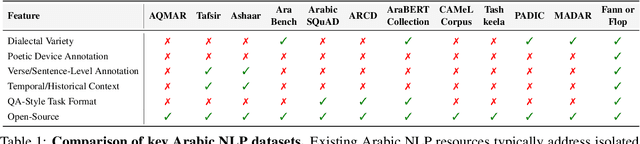
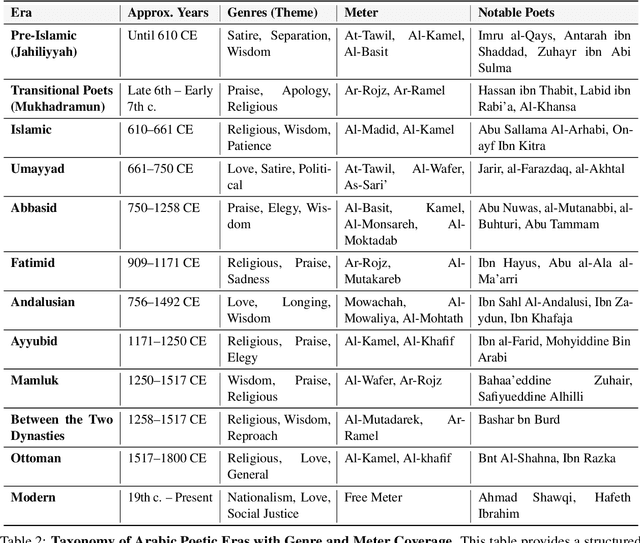
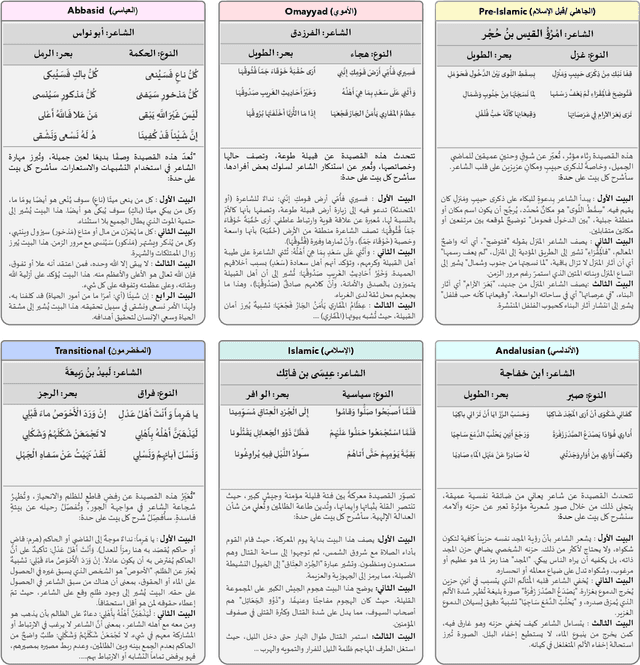
Arabic poetry is one of the richest and most culturally rooted forms of expression in the Arabic language, known for its layered meanings, stylistic diversity, and deep historical continuity. Although large language models (LLMs) have demonstrated strong performance across languages and tasks, their ability to understand Arabic poetry remains largely unexplored. In this work, we introduce \emph{Fann or Flop}, the first benchmark designed to assess the comprehension of Arabic poetry by LLMs in 12 historical eras, covering 14 core poetic genres and a variety of metrical forms, from classical structures to contemporary free verse. The benchmark comprises a curated corpus of poems with explanations that assess semantic understanding, metaphor interpretation, prosodic awareness, and cultural context. We argue that poetic comprehension offers a strong indicator for testing how good the LLM understands classical Arabic through Arabic poetry. Unlike surface-level tasks, this domain demands deeper interpretive reasoning and cultural sensitivity. Our evaluation of state-of-the-art LLMs shows that most models struggle with poetic understanding despite strong results on standard Arabic benchmarks. We release "Fann or Flop" along with the evaluation suite as an open-source resource to enable rigorous evaluation and advancement for Arabic language models. Code is available at: https://github.com/mbzuai-oryx/FannOrFlop.
ARB: A Comprehensive Arabic Multimodal Reasoning Benchmark
May 22, 2025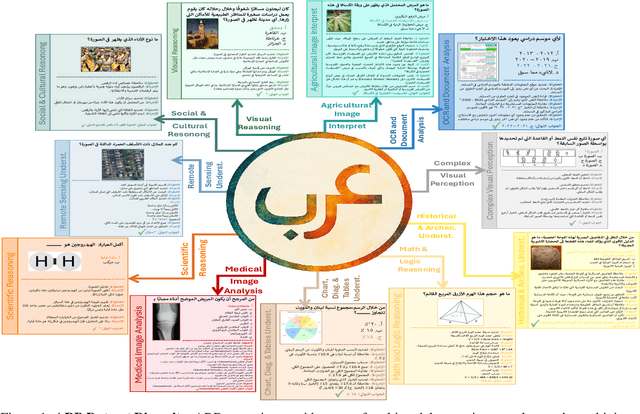
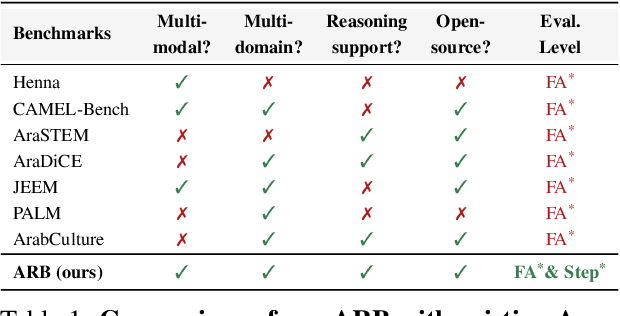
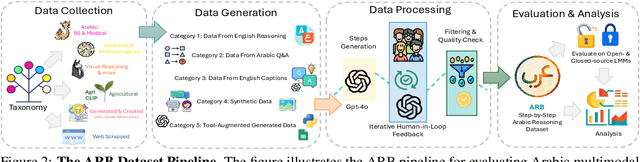
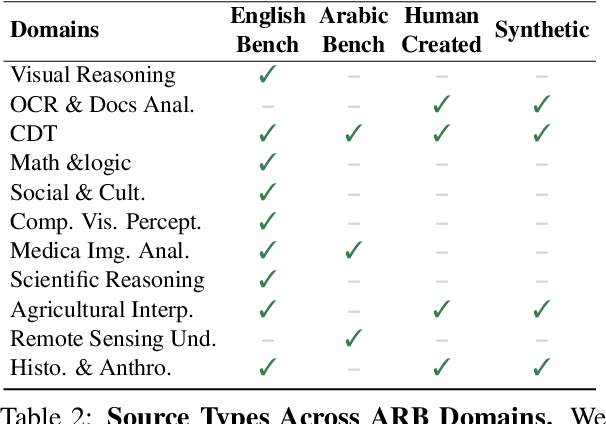
As Large Multimodal Models (LMMs) become more capable, there is growing interest in evaluating their reasoning processes alongside their final outputs. However, most benchmarks remain focused on English, overlooking languages with rich linguistic and cultural contexts, such as Arabic. To address this gap, we introduce the Comprehensive Arabic Multimodal Reasoning Benchmark (ARB), the first benchmark designed to evaluate step-by-step reasoning in Arabic across both textual and visual modalities. ARB spans 11 diverse domains, including visual reasoning, document understanding, OCR, scientific analysis, and cultural interpretation. It comprises 1,356 multimodal samples paired with 5,119 human-curated reasoning steps and corresponding actions. We evaluated 12 state-of-the-art open- and closed-source LMMs and found persistent challenges in coherence, faithfulness, and cultural grounding. ARB offers a structured framework for diagnosing multimodal reasoning in underrepresented languages and marks a critical step toward inclusive, transparent, and culturally aware AI systems. We release the benchmark, rubric, and evaluation suit to support future research and reproducibility. Code available at: https://github.com/mbzuai-oryx/ARB
DriveLMM-o1: A Step-by-Step Reasoning Dataset and Large Multimodal Model for Driving Scenario Understanding
Mar 13, 2025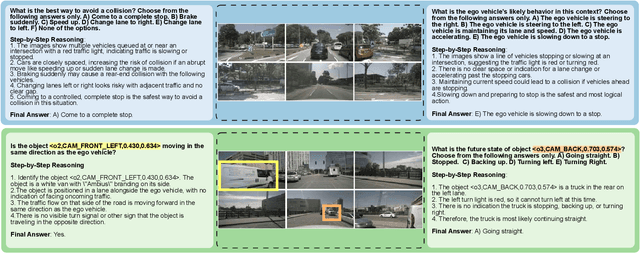
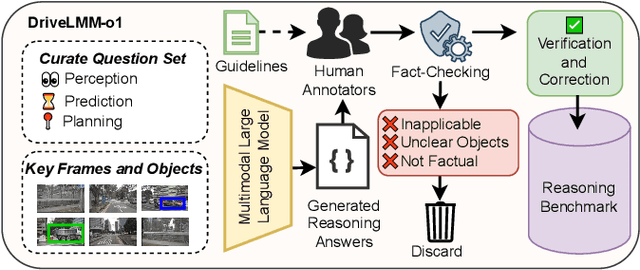
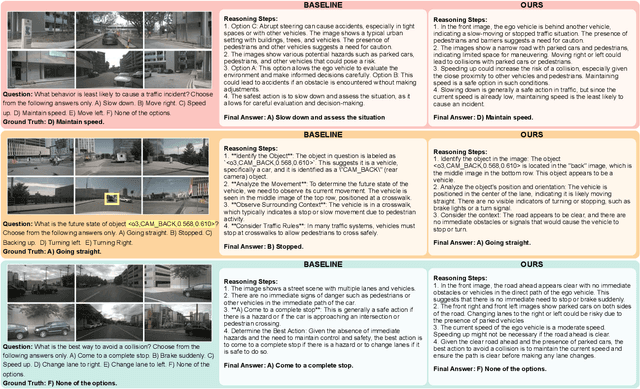
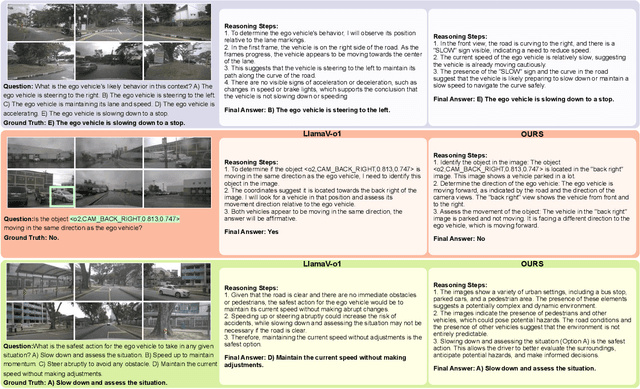
While large multimodal models (LMMs) have demonstrated strong performance across various Visual Question Answering (VQA) tasks, certain challenges require complex multi-step reasoning to reach accurate answers. One particularly challenging task is autonomous driving, which demands thorough cognitive processing before decisions can be made. In this domain, a sequential and interpretive understanding of visual cues is essential for effective perception, prediction, and planning. Nevertheless, common VQA benchmarks often focus on the accuracy of the final answer while overlooking the reasoning process that enables the generation of accurate responses. Moreover, existing methods lack a comprehensive framework for evaluating step-by-step reasoning in realistic driving scenarios. To address this gap, we propose DriveLMM-o1, a new dataset and benchmark specifically designed to advance step-wise visual reasoning for autonomous driving. Our benchmark features over 18k VQA examples in the training set and more than 4k in the test set, covering diverse questions on perception, prediction, and planning, each enriched with step-by-step reasoning to ensure logical inference in autonomous driving scenarios. We further introduce a large multimodal model that is fine-tuned on our reasoning dataset, demonstrating robust performance in complex driving scenarios. In addition, we benchmark various open-source and closed-source methods on our proposed dataset, systematically comparing their reasoning capabilities for autonomous driving tasks. Our model achieves a +7.49% gain in final answer accuracy, along with a 3.62% improvement in reasoning score over the previous best open-source model. Our framework, dataset, and model are available at https://github.com/ayesha-ishaq/DriveLMM-o1.
LLM Post-Training: A Deep Dive into Reasoning Large Language Models
Feb 28, 2025Large Language Models (LLMs) have transformed the natural language processing landscape and brought to life diverse applications. Pretraining on vast web-scale data has laid the foundation for these models, yet the research community is now increasingly shifting focus toward post-training techniques to achieve further breakthroughs. While pretraining provides a broad linguistic foundation, post-training methods enable LLMs to refine their knowledge, improve reasoning, enhance factual accuracy, and align more effectively with user intents and ethical considerations. Fine-tuning, reinforcement learning, and test-time scaling have emerged as critical strategies for optimizing LLMs performance, ensuring robustness, and improving adaptability across various real-world tasks. This survey provides a systematic exploration of post-training methodologies, analyzing their role in refining LLMs beyond pretraining, addressing key challenges such as catastrophic forgetting, reward hacking, and inference-time trade-offs. We highlight emerging directions in model alignment, scalable adaptation, and inference-time reasoning, and outline future research directions. We also provide a public repository to continually track developments in this fast-evolving field: https://github.com/mbzuai-oryx/Awesome-LLM-Post-training.