 Add to Chrome
 Add to Firefox
 Add to Edge
Wmt Benchmark
Papers and Code
MO-GRPO: Mitigating Reward Hacking of Group Relative Policy Optimization on Multi-Objective Problems
Sep 26, 2025
Group Relative Policy Optimization (GRPO) has been shown to be an effective algorithm when an accurate reward model is available. However, such a highly reliable reward model is not available in many real-world tasks. In this paper, we particularly focus on multi-objective settings, in which we identify that GRPO is vulnerable to reward hacking, optimizing only one of the objectives at the cost of the others. To address this issue, we propose MO-GRPO, an extension of GRPO with a simple normalization method to reweight the reward functions automatically according to the variances of their values. We first show analytically that MO-GRPO ensures that all reward functions contribute evenly to the loss function while preserving the order of preferences, eliminating the need for manual tuning of the reward functions' scales. Then, we evaluate MO-GRPO experimentally in four domains: (i) the multi-armed bandits problem, (ii) simulated control task (Mo-Gymnasium), (iii) machine translation tasks on the WMT benchmark (En-Ja, En-Zh), and (iv) instruction following task. MO-GRPO achieves stable learning by evenly distributing correlations among the components of rewards, outperforming GRPO, showing MO-GRPO to be a promising algorithm for multi-objective reinforcement learning problems.

Align-then-Slide: A complete evaluation framework for Ultra-Long Document-Level Machine Translation
Sep 04, 2025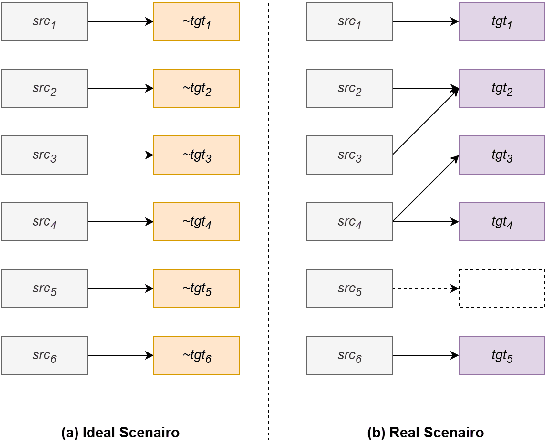
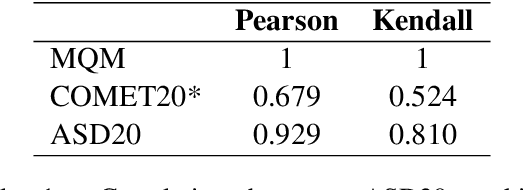
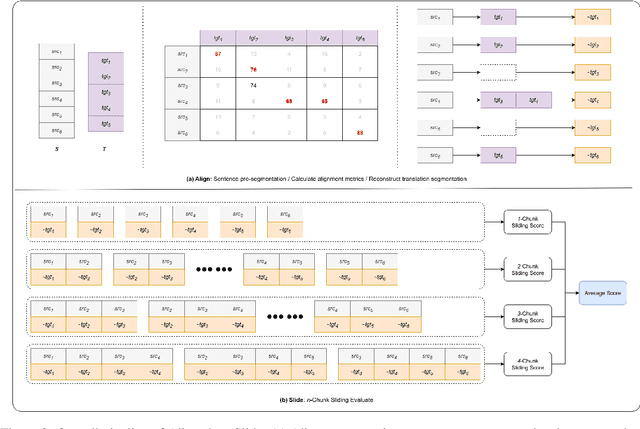
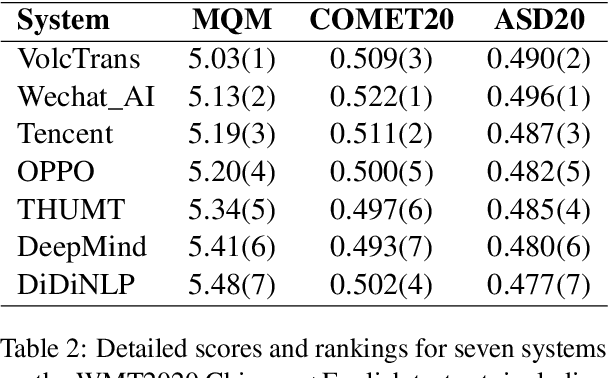
Large language models (LLMs) have ushered in a new era for document-level machine translation (\textit{doc}-mt), yet their whole-document outputs challenge existing evaluation methods that assume sentence-by-sentence alignment. We introduce \textit{\textbf{Align-then-Slide}}, a complete evaluation framework for ultra-long doc-mt. In the Align stage, we automatically infer sentence-level source-target correspondences and rebuild the target to match the source sentence number, resolving omissions and many-to-one/one-to-many mappings. In the n-Chunk Sliding Evaluate stage, we calculate averaged metric scores under 1-, 2-, 3- and 4-chunk for multi-granularity assessment. Experiments on the WMT benchmark show a Pearson correlation of 0.929 between our method with expert MQM rankings. On a newly curated real-world test set, our method again aligns closely with human judgments. Furthermore, preference data produced by Align-then-Slide enables effective CPO training and its direct use as a reward model for GRPO, both yielding translations preferred over a vanilla SFT baseline. The results validate our framework as an accurate, robust, and actionable evaluation tool for doc-mt systems.
ConsistencyChecker: Tree-based Evaluation of LLM Generalization Capabilities
Jun 14, 2025Evaluating consistency in large language models (LLMs) is crucial for ensuring reliability, particularly in complex, multi-step interactions between humans and LLMs. Traditional self-consistency methods often miss subtle semantic changes in natural language and functional shifts in code or equations, which can accumulate over multiple transformations. To address this, we propose ConsistencyChecker, a tree-based evaluation framework designed to measure consistency through sequences of reversible transformations, including machine translation tasks and AI-assisted programming tasks. In our framework, nodes represent distinct text states, while edges correspond to pairs of inverse operations. Dynamic and LLM-generated benchmarks ensure a fair assessment of the model's generalization ability and eliminate benchmark leakage. Consistency is quantified based on similarity across different depths of the transformation tree. Experiments on eight models from various families and sizes show that ConsistencyChecker can distinguish the performance of different models. Notably, our consistency scores-computed entirely without using WMT paired data-correlate strongly (r > 0.7) with WMT 2024 auto-ranking, demonstrating the validity of our benchmark-free approach. Our implementation is available at: https://github.com/ulab-uiuc/consistencychecker.
Design of intelligent proofreading system for English translation based on CNN and BERT
Jun 05, 2025Since automatic translations can contain errors that require substantial human post-editing, machine translation proofreading is essential for improving quality. This paper proposes a novel hybrid approach for robust proofreading that combines convolutional neural networks (CNN) with Bidirectional Encoder Representations from Transformers (BERT). In order to extract semantic information from phrases and expressions, CNN uses a variety of convolution kernel filters to capture local n-gram patterns. In the meanwhile, BERT creates context-rich representations of whole sequences by utilizing stacked bidirectional transformer encoders. Using BERT's attention processes, the integrated error detection component relates tokens to spot translation irregularities including word order problems and omissions. The correction module then uses parallel English-German alignment and GRU decoder models in conjunction with translation memory to propose logical modifications that maintain original meaning. A unified end-to-end training process optimized for post-editing performance is applied to the whole pipeline. The multi-domain collection of WMT and the conversational dialogues of Open-Subtitles are two of the English-German parallel corpora used to train the model. Multiple loss functions supervise detection and correction capabilities. Experiments attain a 90% accuracy, 89.37% F1, and 16.24% MSE, exceeding recent proofreading techniques by over 10% overall. Comparative benchmarking demonstrates state-of-the-art performance in identifying and coherently rectifying mistranslations and omissions.
MT-R1-Zero: Advancing LLM-based Machine Translation via R1-Zero-like Reinforcement Learning
Apr 14, 2025Large-scale reinforcement learning (RL) methods have proven highly effective in enhancing the reasoning abilities of large language models (LLMs), particularly for tasks with verifiable solutions such as mathematics and coding. However, applying this idea to machine translation (MT), where outputs are flexibly formatted and difficult to automatically evaluate with explicit rules, remains underexplored. In this work, we introduce MT-R1-Zero, the first open-source adaptation of the R1-Zero RL framework for MT without supervised fine-tuning or cold-start. We propose a rule-metric mixed reward mechanism to guide LLMs towards improved translation quality via emergent reasoning. On the WMT 24 English-Chinese benchmark, our MT-R1-Zero-3B-Mix achieves competitive performance, surpassing TowerInstruct-7B-v0.2 by an average of 1.26 points. Meanwhile, our MT-R1-Zero-7B-Mix attains a high average score of 62.25 across all metrics, placing it on par with advanced proprietary models such as GPT-4o and Claude-3.5-Sonnet, while the MT-R1-Zero-7B-Sem variant achieves state-of-the-art scores on semantic metrics. Moreover, our work exhibits strong generalization capabilities on out-of-distribution MT tasks, robustly supporting multilingual and low-resource settings. Extensive analysis of model behavior across different initializations and reward metrics offers pioneering insight into the critical role of reward design, LLM adaptability, training dynamics, and emergent reasoning patterns within the R1-Zero paradigm for MT. Our code is available at https://github.com/fzp0424/MT-R1-Zero.
Entropy-UID: A Method for Optimizing Information Density
Feb 20, 2025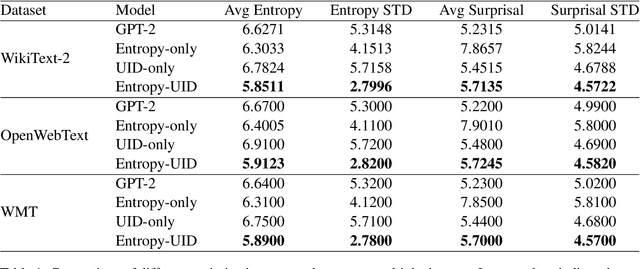
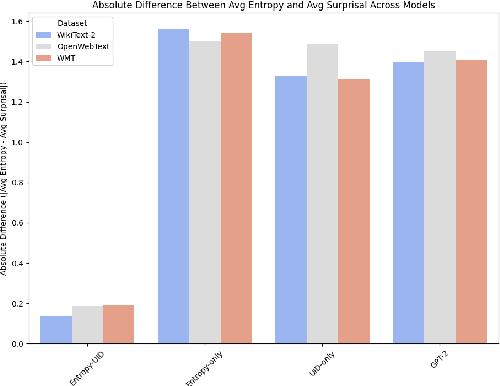
Balanced and efficient information flow is essential for optimizing language generation models. In this work, we propose Entropy-UID, a new token selection method that balances entropy and Uniform Information Density (UID) principles for enhanced efficiency of text generation. Our approach adaptively adjusts token selection by jointly minimizing entropy and surprisal, promoting more even information distribution across generated sequences. Theoretical validation demonstrates that Entropy-UID optimally reduces information spikes while maintaining fluency and coherence. The method has been evulated using information-theoretic metrics on multiple benchmark datasets, including WikiText-2, OpenWebText, and WMT. Experimental results show that Entropy-UID achieves lower surprisal and entropy variance compared to standard GPT-2 and alternative heuristics, leading to more balanced and human-like text generation. Our findings point towards the potential of leveraging information-theoretic constraints to refine token selection strategies in autoregressive language models.
PMMT: Preference Alignment in Multilingual Machine Translation via LLM Distillation
Oct 15, 2024Translation is important for cross-language communication, and many efforts have been made to improve its accuracy. However, less investment is conducted in aligning translations with human preferences, such as translation tones or styles. In this paper, a new method is proposed to effectively generate large-scale multilingual parallel corpora with specific translation preferences using Large Language Models (LLMs). Meanwhile, an automatic pipeline is designed to distill human preferences into smaller Machine Translation (MT) models for efficiently and economically supporting large-scale calls in online services. Experiments indicate that the proposed method takes the lead in translation tasks with aligned human preferences by a large margin. Meanwhile, on popular public benchmarks like WMT and Flores, on which our models were not trained, the proposed method also shows a competitive performance compared to SOTA works.
Multi-Agent Sampling: Scaling Inference Compute for Data Synthesis with Tree Search-Based Agentic Collaboration
Dec 22, 2024Scaling laws for inference compute in multi-agent systems remain under-explored compared to single-agent scenarios. This work aims to bridge this gap by investigating the problem of data synthesis through multi-agent sampling, where synthetic responses are generated by sampling from multiple distinct language models. Effective model coordination is crucial for successful multi-agent collaboration. Unlike previous approaches that rely on fixed workflows, we treat model coordination as a multi-step decision-making process, optimizing generation structures dynamically for each input question. We introduce Tree Search-based Orchestrated Agents~(TOA), where the workflow evolves iteratively during the sequential sampling process. To achieve this, we leverage Monte Carlo Tree Search (MCTS), integrating a reward model to provide real-time feedback and accelerate exploration. Our experiments on alignment, machine translation, and mathematical reasoning demonstrate that multi-agent sampling significantly outperforms single-agent sampling as inference compute scales. TOA is the most compute-efficient approach, achieving SOTA performance on WMT and a 71.8\% LC win rate on AlpacaEval. Moreover, fine-tuning with our synthesized alignment data surpasses strong preference learning methods on challenging benchmarks such as Arena-Hard and AlpacaEval.
Predictor-Corrector Enhanced Transformers with Exponential Moving Average Coefficient Learning
Nov 05, 2024Residual networks, as discrete approximations of Ordinary Differential Equations (ODEs), have inspired significant advancements in neural network design, including multistep methods, high-order methods, and multi-particle dynamical systems. The precision of the solution to ODEs significantly affects parameter optimization, thereby impacting model performance. In this work, we present a series of advanced explorations of Transformer architecture design to minimize the error compared to the true ``solution.'' First, we introduce a predictor-corrector learning framework to minimize truncation errors, which consists of a high-order predictor and a multistep corrector. Second, we propose an exponential moving average-based coefficient learning method to strengthen our higher-order predictor. Extensive experiments on large-scale machine translation, abstractive summarization, language modeling, and natural language understanding benchmarks demonstrate the superiority of our approach. On the WMT'14 English-German and English-French tasks, our model achieved BLEU scores of 30.95 and 44.27, respectively. Furthermore, on the OPUS multilingual machine translation task, our model surpasses a robust 3.8B DeepNet by an average of 2.9 SacreBLEU, using only 1/3 parameters. Notably, it also beats LLama models by 5.7 accuracy points on the LM Harness Evaluation.
Revisiting the Markov Property for Machine Translation
Feb 03, 2024
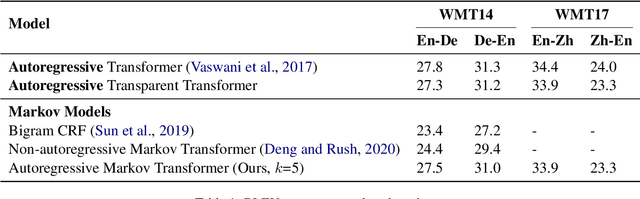
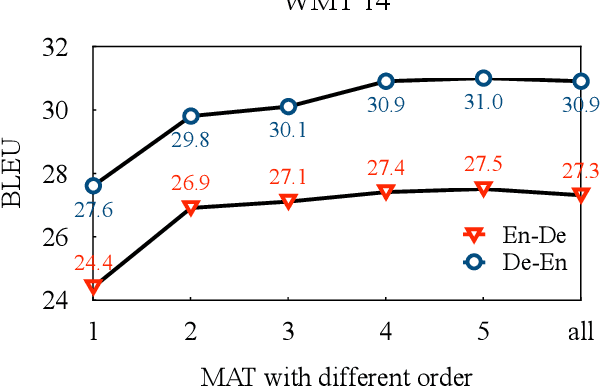
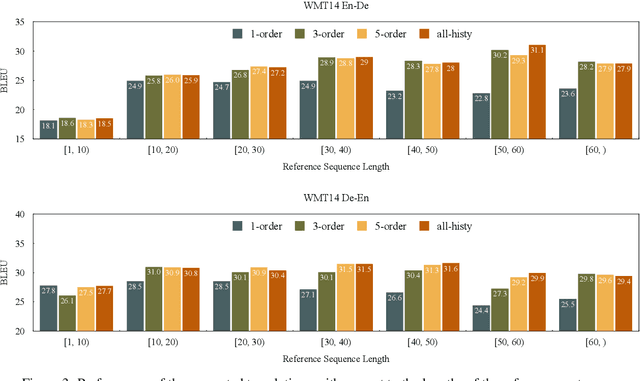
In this paper, we re-examine the Markov property in the context of neural machine translation. We design a Markov Autoregressive Transformer~(MAT) and undertake a comprehensive assessment of its performance across four WMT benchmarks. Our findings indicate that MAT with an order larger than 4 can generate translations with quality on par with that of conventional autoregressive transformers. In addition, counter-intuitively, we also find that the advantages of utilizing a higher-order MAT do not specifically contribute to the translation of longer sentences.