 Add to Chrome
 Add to Firefox
 Add to Edge
Orienteering Problem with Uncertain Time-Varying Rewards: Framework and Benchmark for Everyday Service Robotics
Aug 19, 2026
We present the orienteering problem with uncertain time-varying rewards (OP-UTVR), a novel variant of the orienteering problem (OP). While most existing OP formulations assume rewards to be known in advance, practical applications involve uncertain and time-varying rewards, as with shifting customer demand for delivery agents. OP-UTVR relaxes this assumption by allowing agents to estimate reward dynamics from observations and forecast future rewards. This enables informed routing decisions despite stochastic reward changes and inevitable prediction errors. We address this problem using three planners that differ in planning horizon and online adaptivity, and derive theoretical bounds on their performance under reward stochasticity. We further introduce a mobile service robot benchmark for OP-UTVR, where a robot navigates among pedestrians in indoor environments. Experiments reveal trade-offs between planning horizon and adaptivity, and demonstrate the effectiveness of long-horizon planning with online adaptation.

JOR-Bench: Japanese Operations Research Benchmarks for Large Language Models
Jul 18, 2026We present JOR-Bench, a collection of five Japanese-language benchmarks for evaluating the ability of large language models (LLMs) to formulate and solve operations research (OR) problems. Each benchmark is a Japanese translation of an existing English benchmark: IndustryOR, MAMO Complex LP, NL4OPT, OptiBench, and OptMATH, covering 1,319 problems spanning linear programming, mixed-integer programming, non-linear programming, and combinatorial optimization. JOR-Bench is a solver-independent benchmark that can be used with any solver or programming language, and consists of pairs of Japanese problem statements and expected numerical answers. We evaluate seven LLMs, including multilingual general-purpose models and Japanese-specialized models, on both the original English and the new Japanese versions, and compare performance across languages. For the main evaluation, we standardize execution with the Python interface to OR-Tools to make model outputs comparable and reproducible with open-source software. Our results show that OR formulation ability is largely language-neutral for strong multilingual models; the overall average accuracy difference between English and Japanese is only $-0.3$ pp. Yet error analysis reveals subtle cross-lingual differences, including a pragmatic disambiguation failure in some domains that causes models to output decision-variable values instead of the objective value when the prompt is in Japanese.
Cost of Reasoning in non-English Languages: A Case Study on Japanese
Jul 11, 2026Reasoning Language Models (RLMs) achieve their strongest performance when they reason in English, the language for which reasoning-oriented training data is most abundant. However, reasoning trace is a clue for model interpretability and safety, and useful in practice for both the model users and for model developers. Thus, it is desirable to be able to develop a model that reasons in a language of the user's choice, while still maintaining strong reasoning performance. To this end, we study the feasibility of training a model that reasons in Japanese. We develop a Japanese-reasoning variant of Qwen-3-Swallow-8B, which is a Japanese LLM continually pretrained from Qwen-3-8B, with GRPO and evaluate it across coding, math, and science benchmarks. The study shows that reasoning-language control is feasible by training a Japanese continually pretrained model with GRPO. However, its performance is at best on par with strong English-reasoning baselines on several benchmarks. We also evaluate the trained model on Japanese cultural benchmarks and observe that the model's performance is worse than the baseline models, suggesting that the reasoning in Japanese does not immediately improve performance on culturally relevant tasks for free.
CAT-Translate: Building Compact Open-Source Models for Japanese-English Translation
Jun 19, 2026Nowadays, large multilingual translation models demonstrate impressive translation capabilities in the machine translation benchmarks. This raises a practical question to the developers: is it worth developing translation models specialized for a particular language pair if you only need to support that language pair? To give an anecdotal answer to this question, we develop a family of small language models (0.8B, 1.4B, 3.3B, and 7B parameters) specialized for Japanese-English bidirectional translation. We employ a two-stage supervised fine-tuning approach followed by Multi-Objective GRPO (Ichihara et al. 2025) to train models on synthetically generated parallel corpora. We evaluate our models on WMT and real-world translation benchmarks across business, legal, medical, financial, and patent domains. While multilingual models achieve strong performance on WMT benchmarks, our compact models outperform them on real-world benchmarks, suggesting the practical utility of developing specialized translation models even in the era of large multilingual models.
Consensus Group Relative Policy Optimization for Text Generation
Feb 03, 2026Many strong decoding methods for text generation follow a sample-and-rerank paradigm: they draw multiple candidates, score each under a utility (reward) function using consensus across samples, and return the best one. Although effective, these methods incur high computational costs during inference due to repeated sampling and scoring. Prior attempts to amortize inference-time computation typically rely on gold references, teacher labels, or curated preference data, increasing dataset construction effort and the demand for high-fidelity reward models. We propose Consensus Group Relative Policy Optimization (C-GRPO), which distills Minimum Bayes Risk (MBR) decoding into training by formulating the consensus utility as a group-relative objective within GRPO. C-GRPO requires only a utility function and policy samples, without gold references or explicit preference labels. Under ideal conditions, we show that the objective function of C-GRPO is directionally aligned with the gradient of the expected-utility objective underlying MBR decoding, leading to a convergence guarantee. Experiments on machine translation (WMT 2024) and text summarization (XSum) demonstrate that C-GRPO successfully achieves performance comparable to MBR decoding without the associated inference-time overhead, while outperforming reference-free baseline methods.
MO-GRPO: Mitigating Reward Hacking of Group Relative Policy Optimization on Multi-Objective Problems
Sep 26, 2025Group Relative Policy Optimization (GRPO) has been shown to be an effective algorithm when an accurate reward model is available. However, such a highly reliable reward model is not available in many real-world tasks. In this paper, we particularly focus on multi-objective settings, in which we identify that GRPO is vulnerable to reward hacking, optimizing only one of the objectives at the cost of the others. To address this issue, we propose MO-GRPO, an extension of GRPO with a simple normalization method to reweight the reward functions automatically according to the variances of their values. We first show analytically that MO-GRPO ensures that all reward functions contribute evenly to the loss function while preserving the order of preferences, eliminating the need for manual tuning of the reward functions' scales. Then, we evaluate MO-GRPO experimentally in four domains: (i) the multi-armed bandits problem, (ii) simulated control task (Mo-Gymnasium), (iii) machine translation tasks on the WMT benchmark (En-Ja, En-Zh), and (iv) instruction following task. MO-GRPO achieves stable learning by evenly distributing correlations among the components of rewards, outperforming GRPO, showing MO-GRPO to be a promising algorithm for multi-objective reinforcement learning problems.
Document-Level Text Generation with Minimum Bayes Risk Decoding using Optimal Transport
May 29, 2025Document-level text generation tasks are known to be more difficult than sentence-level text generation tasks as they require the understanding of longer context to generate high-quality texts. In this paper, we investigate the adaption of Minimum Bayes Risk (MBR) decoding for document-level text generation tasks. MBR decoding makes use of a utility function to estimate the output with the highest expected utility from a set of candidate outputs. Although MBR decoding is shown to be effective in a wide range of sentence-level text generation tasks, its performance on document-level text generation tasks is limited as many of the utility functions are designed for evaluating the utility of sentences. To this end, we propose MBR-OT, a variant of MBR decoding using Wasserstein distance to compute the utility of a document using a sentence-level utility function. The experimental result shows that the performance of MBR-OT outperforms that of the standard MBR in document-level machine translation, text simplification, and dense image captioning tasks. Our code is available at https://github.com/jinnaiyuu/mbr-optimal-transport
Theoretical Guarantees for Minimum Bayes Risk Decoding
Feb 18, 2025Minimum Bayes Risk (MBR) decoding optimizes output selection by maximizing the expected utility value of an underlying human distribution. While prior work has shown the effectiveness of MBR decoding through empirical evaluation, few studies have analytically investigated why the method is effective. As a result of our analysis, we show that, given the size $n$ of the reference hypothesis set used in computation, MBR decoding approaches the optimal solution with high probability at a rate of $O\left(n^{-\frac{1}{2}}\right)$, under certain assumptions, even though the language space $Y$ is significantly larger $Y\gg n$. This result helps to theoretically explain the strong performance observed in several prior empirical studies on MBR decoding. In addition, we provide the performance gap for maximum-a-posteriori (MAP) decoding and compare it to MBR decoding. The result of this paper indicates that MBR decoding tends to converge to the optimal solution faster than MAP decoding in several cases.
Evaluation of Best-of-N Sampling Strategies for Language Model Alignment
Feb 18, 2025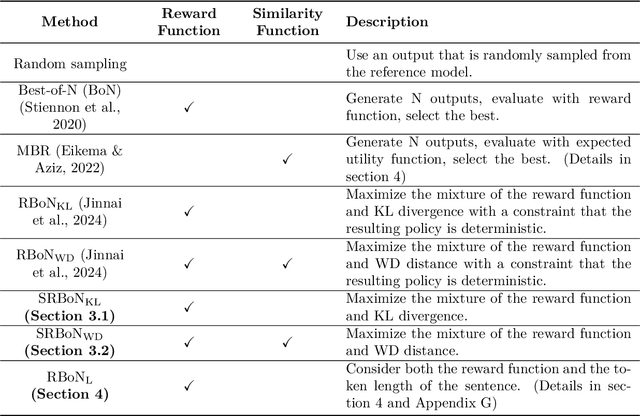
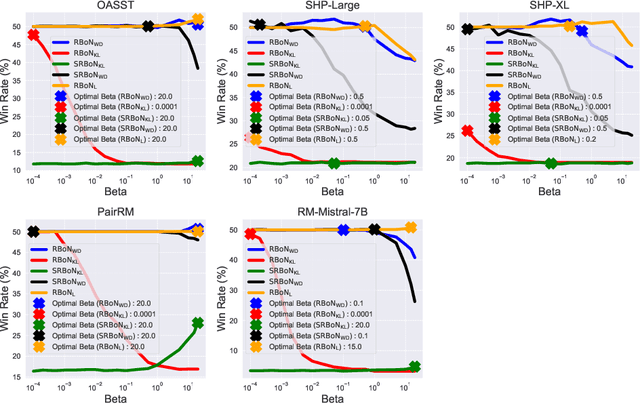
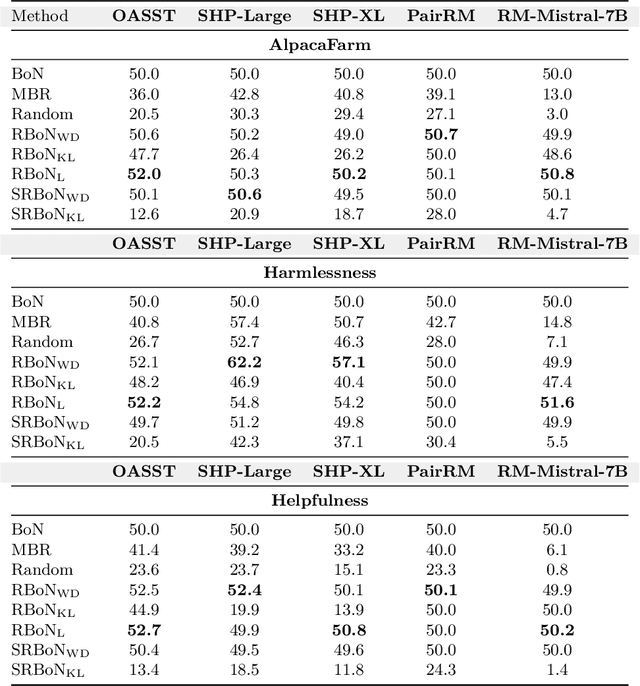
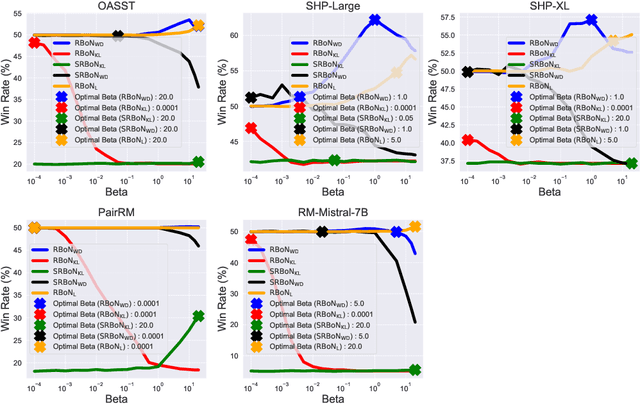
Best-of-N (BoN) sampling with a reward model has been shown to be an effective strategy for aligning Large Language Models (LLMs) with human preferences at the time of decoding. BoN sampling is susceptible to a problem known as reward hacking. Since the reward model is an imperfect proxy for the true objective, an excessive focus on optimizing its value can lead to a compromise of its performance on the true objective. Previous work proposes Regularized BoN sampling (RBoN), a BoN sampling with regularization to the objective, and shows that it outperforms BoN sampling so that it mitigates reward hacking and empirically (Jinnai et al., 2024). However, Jinnai et al. (2024) introduce RBoN based on a heuristic and they lack the analysis of why such regularization strategy improves the performance of BoN sampling. The aim of this study is to analyze the effect of BoN sampling on regularization strategies. Using the regularization strategies corresponds to robust optimization, which maximizes the worst case over a set of possible perturbations in the proxy reward. Although the theoretical guarantees are not directly applicable to RBoN, RBoN corresponds to a practical implementation. This paper proposes an extension of the RBoN framework, called Stochastic RBoN sampling (SRBoN), which is a theoretically guaranteed approach to worst-case RBoN in proxy reward. We then perform an empirical evaluation using the AlpacaFarm and Anthropic's hh-rlhf datasets to evaluate which factors of the regularization strategies contribute to the improvement of the true proxy reward. In addition, we also propose another simple RBoN method, the Sentence Length Regularized BoN, which has a better performance in the experiment as compared to the previous methods.
Does Cross-Cultural Alignment Change the Commonsense Morality of Language Models?
Jun 24, 2024Alignment of the language model with human preferences is a common approach to making a language model useful to end users. However, most alignment work is done in English, and human preference datasets are dominated by English, reflecting only the preferences of English-speaking annotators. Nevertheless, it is common practice to use the English preference data, either directly or by translating it into the target language, when aligning a multilingual language model. The question is whether such an alignment strategy marginalizes the preference of non-English speaking users. To this end, we investigate the effect of aligning Japanese language models with (mostly) English resources. In particular, we focus on evaluating whether the commonsense morality of the resulting fine-tuned models is aligned with Japanese culture using the JCommonsenseMorality (JCM) and ETHICS datasets. The experimental results show that the fine-tuned model outperforms the SFT model. However, it does not demonstrate the same level of improvement as a model fine-tuned using the JCM, suggesting that while some aspects of commonsense morality are transferable, others may not be.