 Add to Chrome
 Add to Firefox
 Add to Edge
Shape Representation Of 3d Point Clouds
Papers and Code
Learning Part-Aware Dense 3D Feature Field for Generalizable Articulated Object Manipulation
Feb 15, 2026
Articulated object manipulation is essential for various real-world robotic tasks, yet generalizing across diverse objects remains a major challenge. A key to generalization lies in understanding functional parts (e.g., door handles and knobs), which indicate where and how to manipulate across diverse object categories and shapes. Previous works attempted to achieve generalization by introducing foundation features, while these features are mostly 2D-based and do not specifically consider functional parts. When lifting these 2D features to geometry-profound 3D space, challenges arise, such as long runtimes, multi-view inconsistencies, and low spatial resolution with insufficient geometric information. To address these issues, we propose Part-Aware 3D Feature Field (PA3FF), a novel dense 3D feature with part awareness for generalizable articulated object manipulation. PA3FF is trained by 3D part proposals from a large-scale labeled dataset, via a contrastive learning formulation. Given point clouds as input, PA3FF predicts a continuous 3D feature field in a feedforward manner, where the distance between point features reflects the proximity of functional parts: points with similar features are more likely to belong to the same part. Building on this feature, we introduce the Part-Aware Diffusion Policy (PADP), an imitation learning framework aimed at enhancing sample efficiency and generalization for robotic manipulation. We evaluate PADP on several simulated and real-world tasks, demonstrating that PA3FF consistently outperforms a range of 2D and 3D representations in manipulation scenarios, including CLIP, DINOv2, and Grounded-SAM. Beyond imitation learning, PA3FF enables diverse downstream methods, including correspondence learning and segmentation tasks, making it a versatile foundation for robotic manipulation. Project page: https://pa3ff.github.io

RI-Mamba: Rotation-Invariant Mamba for Robust Text-to-Shape Retrieval
Feb 12, 20263D assets have rapidly expanded in quantity and diversity due to the growing popularity of virtual reality and gaming. As a result, text-to-shape retrieval has become essential in facilitating intuitive search within large repositories. However, existing methods require canonical poses and support few object categories, limiting their real-world applicability where objects can belong to diverse classes and appear in random orientations. To address this challenge, we propose RI-Mamba, the first rotation-invariant state-space model for point clouds. RI-Mamba defines global and local reference frames to disentangle pose from geometry and uses Hilbert sorting to construct token sequences with meaningful geometric structure while maintaining rotation invariance. We further introduce a novel strategy to compute orientational embeddings and reintegrate them via feature-wise linear modulation, effectively recovering spatial context and enhancing model expressiveness. Our strategy is inherently compatible with state-space models and operates in linear time. To scale up retrieval, we adopt cross-modal contrastive learning with automated triplet generation, allowing training on diverse datasets without manual annotation. Extensive experiments demonstrate RI-Mamba's superior representational capacity and robustness, achieving state-of-the-art performance on the OmniObject3D benchmark across more than 200 object categories under arbitrary orientations. Our code will be made available at https://github.com/ndkhanh360/RI-Mamba.git.
Molecular Representations in Implicit Functional Space via Hyper-Networks
Jan 29, 2026Molecular representations fundamentally shape how machine learning systems reason about molecular structure and physical properties. Most existing approaches adopt a discrete pipeline: molecules are encoded as sequences, graphs, or point clouds, mapped to fixed-dimensional embeddings, and then used for task-specific prediction. This paradigm treats molecules as discrete objects, despite their intrinsically continuous and field-like physical nature. We argue that molecular learning can instead be formulated as learning in function space. Specifically, we model each molecule as a continuous function over three-dimensional (3D) space and treat this molecular field as the primary object of representation. From this perspective, conventional molecular representations arise as particular sampling schemes of an underlying continuous object. We instantiate this formulation with MolField, a hyper-network-based framework that learns distributions over molecular fields. To ensure physical consistency, these functions are defined over canonicalized coordinates, yielding invariance to global SE(3) transformations. To enable learning directly over functions, we introduce a structured weight tokenization and train a sequence-based hyper-network to model a shared prior over molecular fields. We evaluate MolField on molecular dynamics and property prediction. Our results show that treating molecules as continuous functions fundamentally changes how molecular representations generalize across tasks and yields downstream behavior that is stable to how molecules are discretized or queried.
Proc3D: Procedural 3D Generation and Parametric Editing of 3D Shapes with Large Language Models
Jan 18, 2026Generating 3D models has traditionally been a complex task requiring specialized expertise. While recent advances in generative AI have sought to automate this process, existing methods produce non-editable representation, such as meshes or point clouds, limiting their adaptability for iterative design. In this paper, we introduce Proc3D, a system designed to generate editable 3D models while enabling real-time modifications. At its core, Proc3D introduces procedural compact graph (PCG), a graph representation of 3D models, that encodes the algorithmic rules and structures necessary for generating the model. This representation exposes key parameters, allowing intuitive manual adjustments via sliders and checkboxes, as well as real-time, automated modifications through natural language prompts using Large Language Models (LLMs). We demonstrate Proc3D's capabilities using two generative approaches: GPT-4o with in-context learning (ICL) and a fine-tuned LLAMA-3 model. Experimental results show that Proc3D outperforms existing methods in editing efficiency, achieving more than 400x speedup over conventional approaches that require full regeneration for each modification. Additionally, Proc3D improves ULIP scores by 28%, a metric that evaluates the alignment between generated 3D models and text prompts. By enabling text-aligned 3D model generation along with precise, real-time parametric edits, Proc3D facilitates highly accurate text-based image editing applications.
Joint Semantic and Rendering Enhancements in 3D Gaussian Modeling with Anisotropic Local Encoding
Jan 05, 2026Recent works propose extending 3DGS with semantic feature vectors for simultaneous semantic segmentation and image rendering. However, these methods often treat the semantic and rendering branches separately, relying solely on 2D supervision while ignoring the 3D Gaussian geometry. Moreover, current adaptive strategies adapt the Gaussian set depending solely on rendering gradients, which can be insufficient in subtle or textureless regions. In this work, we propose a joint enhancement framework for 3D semantic Gaussian modeling that synergizes both semantic and rendering branches. Firstly, unlike conventional point cloud shape encoding, we introduce an anisotropic 3D Gaussian Chebyshev descriptor using the Laplace-Beltrami operator to capture fine-grained 3D shape details, thereby distinguishing objects with similar appearances and reducing reliance on potentially noisy 2D guidance. In addition, without relying solely on rendering gradient, we adaptively adjust Gaussian allocation and spherical harmonics with local semantic and shape signals, enhancing rendering efficiency through selective resource allocation. Finally, we employ a cross-scene knowledge transfer module to continuously update learned shape patterns, enabling faster convergence and robust representations without relearning shape information from scratch for each new scene. Experiments on multiple datasets demonstrate improvements in segmentation accuracy and rendering quality while maintaining high rendering frame rates.
Enhanced 3D Shape Analysis via Information Geometry
Dec 18, 2025Three-dimensional point clouds provide highly accurate digital representations of objects, essential for applications in computer graphics, photogrammetry, computer vision, and robotics. However, comparing point clouds faces significant challenges due to their unstructured nature and the complex geometry of the surfaces they represent. Traditional geometric metrics such as Hausdorff and Chamfer distances often fail to capture global statistical structure and exhibit sensitivity to outliers, while existing Kullback-Leibler (KL) divergence approximations for Gaussian Mixture Models can produce unbounded or numerically unstable values. This paper introduces an information geometric framework for 3D point cloud shape analysis by representing point clouds as Gaussian Mixture Models (GMMs) on a statistical manifold. We prove that the space of GMMs forms a statistical manifold and propose the Modified Symmetric Kullback-Leibler (MSKL) divergence with theoretically guaranteed upper and lower bounds, ensuring numerical stability for all GMM comparisons. Through comprehensive experiments on human pose discrimination (MPI-FAUST dataset) and animal shape comparison (G-PCD dataset), we demonstrate that MSKL provides stable and monotonically varying values that directly reflect geometric variation, outperforming traditional distances and existing KL approximations.
Repurposing 2D Diffusion Models for 3D Shape Completion
Dec 16, 2025We present a framework that adapts 2D diffusion models for 3D shape completion from incomplete point clouds. While text-to-image diffusion models have achieved remarkable success with abundant 2D data, 3D diffusion models lag due to the scarcity of high-quality 3D datasets and a persistent modality gap between 3D inputs and 2D latent spaces. To overcome these limitations, we introduce the Shape Atlas, a compact 2D representation of 3D geometry that (1) enables full utilization of the generative power of pretrained 2D diffusion models, and (2) aligns the modalities between the conditional input and output spaces, allowing more effective conditioning. This unified 2D formulation facilitates learning from limited 3D data and produces high-quality, detail-preserving shape completions. We validate the effectiveness of our results on the PCN and ShapeNet-55 datasets. Additionally, we show the downstream application of creating artist-created meshes from our completed point clouds, further demonstrating the practicality of our method.
LoG3D: Ultra-High-Resolution 3D Shape Modeling via Local-to-Global Partitioning
Nov 18, 2025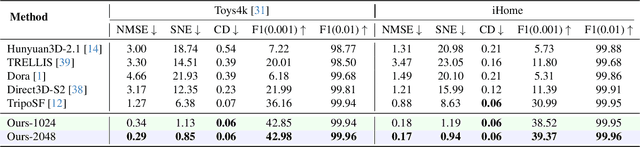
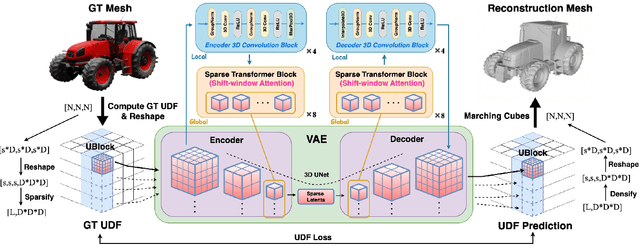
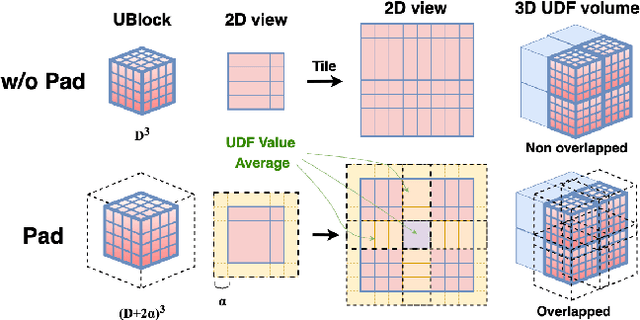
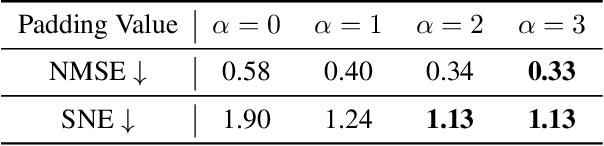
Generating high-fidelity 3D contents remains a fundamental challenge due to the complexity of representing arbitrary topologies-such as open surfaces and intricate internal structures-while preserving geometric details. Prevailing methods based on signed distance fields (SDFs) are hampered by costly watertight preprocessing and struggle with non-manifold geometries, while point-cloud representations often suffer from sampling artifacts and surface discontinuities. To overcome these limitations, we propose a novel 3D variational autoencoder (VAE) framework built upon unsigned distance fields (UDFs)-a more robust and computationally efficient representation that naturally handles complex and incomplete shapes. Our core innovation is a local-to-global (LoG) architecture that processes the UDF by partitioning it into uniform subvolumes, termed UBlocks. This architecture couples 3D convolutions for capturing local detail with sparse transformers for enforcing global coherence. A Pad-Average strategy further ensures smooth transitions at subvolume boundaries during reconstruction. This modular design enables seamless scaling to ultra-high resolutions up to $2048^3$-a regime previously unattainable for 3D VAEs. Experiments demonstrate state-of-the-art performance in both reconstruction accuracy and generative quality, yielding superior surface smoothness and geometric flexibility.
FUSE: A Flow-based Mapping Between Shapes
Nov 17, 2025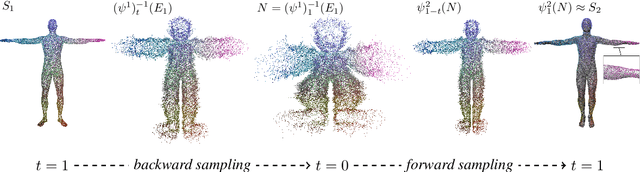
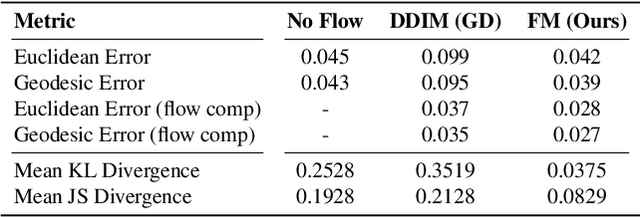
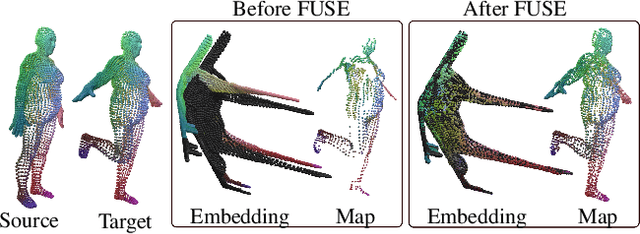
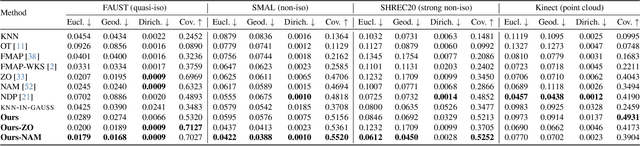
We introduce a novel neural representation for maps between 3D shapes based on flow-matching models, which is computationally efficient and supports cross-representation shape matching without large-scale training or data-driven procedures. 3D shapes are represented as the probability distribution induced by a continuous and invertible flow mapping from a fixed anchor distribution. Given a source and a target shape, the composition of the inverse flow (source to anchor) with the forward flow (anchor to target), we continuously map points between the two surfaces. By encoding the shapes with a pointwise task-tailored embedding, this construction provides an invertible and modality-agnostic representation of maps between shapes across point clouds, meshes, signed distance fields (SDFs), and volumetric data. The resulting representation consistently achieves high coverage and accuracy across diverse benchmarks and challenging settings in shape matching. Beyond shape matching, our framework shows promising results in other tasks, including UV mapping and registration of raw point cloud scans of human bodies.
Voronoi-Assisted Diffusion for Computing Unsigned Distance Fields from Unoriented Points
Oct 14, 2025Unsigned Distance Fields (UDFs) provide a flexible representation for 3D shapes with arbitrary topology, including open and closed surfaces, orientable and non-orientable geometries, and non-manifold structures. While recent neural approaches have shown promise in learning UDFs, they often suffer from numerical instability, high computational cost, and limited controllability. We present a lightweight, network-free method, Voronoi-Assisted Diffusion (VAD), for computing UDFs directly from unoriented point clouds. Our approach begins by assigning bi-directional normals to input points, guided by two Voronoi-based geometric criteria encoded in an energy function for optimal alignment. The aligned normals are then diffused to form an approximate UDF gradient field, which is subsequently integrated to recover the final UDF. Experiments demonstrate that VAD robustly handles watertight and open surfaces, as well as complex non-manifold and non-orientable geometries, while remaining computationally efficient and stable.