 Add to Chrome
 Add to Firefox
 Add to Edge
How Noisy Poses Break Inverse Dynamics: Analysis and Mitigation for Video-Based Joint Torque Estimation
May 23, 2026
Recent advances in monocular 3D human pose estimation enable accurate body tracking from video. However, translating these kinematic estimates into physical quantities, such as joint torques, remains challenging due to noise amplification through inverse dynamics. In this work, we provide a systematic analysis of how pose estimation noise propagates through the inverse dynamics pipeline. We present three key findings: (1) pose noise is amplified by approximately 1,000x when computing joint torques via numerical differentiation, (2) proximal joints (spine, hips) are up to 10x more sensitive to noise than distal joints (wrists, hands), and (3) low-pass filtering before differentiation substantially reduces this amplification. To enable this analysis, we develop SMPL-Dynamics, a fully differentiable inverse dynamics module for the SMPL body model that requires no external physics simulators. Our module supports end-to-end gradient computation, and we demonstrate this through differentiable pose refinement, which reduces torque error by 93% with negligible change in pose.

Rethinking Graph Convolution for 2D-to-3D Hand Pose Lifting
May 13, 2026Graph convolutional networks (GCNs) are widely used for 3D hand pose estimation, where the hand skeleton is encoded as a fixed adjacency graph. We revisit whether this is the most effective way to incorporate hand topology in 2D-to-3D lifting. In this paper, we perform controlled, parameter-matched ablations on the FPHA benchmark and show that standard multi-head self-attention consistently outperforms GCN baselines. Even when the GCN is strengthened with multi-hop adjacency and matched parameter count, self-attention reduces MPJPE from 12.36 mm to 10.09 mm. A skeleton-constrained graph attention network recovers most of this gap, indicating that input-dependent aggregation is a major source of improvement, while fully connected attention yields additional gains. We further show that hand topology is most effective when introduced as a soft structural prior through graph-distance positional encoding, rather than as a hard adjacency constraint. These results suggest that, for hand pose lifting, adaptive spatial attention is a more effective inductive bias than fixed graph convolution.
Delaunay Canopy: Building Wireframe Reconstruction from Airborne LiDAR Point Clouds via Delaunay Graph
Apr 02, 2026Reconstructing building wireframe from airborne LiDAR point clouds yields a compact, topology-centric representation that enables structural understanding beyond dense meshes. Yet a key limitation persists: conventional methods have failed to achieve accurate wireframe reconstruction in regions afflicted by significant noise, sparsity, or internal corners. This failure stems from the inability to establish an adaptive search space to effectively leverage the rich 3D geometry of large, sparse building point clouds. In this work, we address this challenge with Delaunay Canopy, which utilizes the Delaunay graph as a geometric prior to define a geometrically adaptive search space. Central to our approach is Delaunay Graph Scoring, which not only reconstructs the underlying geometric manifold but also yields region-wise curvature signatures to robustly guide the reconstruction. Built on this foundation, our corner and wire selection modules leverage the Delaunay-induced prior to focus on highly probable elements, thereby shaping the search space and enabling accurate prediction even in previously intractable regions. Extensive experiments on the Building3D Tallinn city and entry-level datasets demonstrate state-of-the-art wireframe reconstruction, delivering accurate predictions across diverse and complex building geometries.
GenFusion: Feed-forward Human Performance Capture via Progressive Canonical Space Updates
Mar 30, 2026We present a feed-forward human performance capture method that renders novel views of a performer from a monocular RGB stream. A key challenge in this setting is the lack of sufficient observations, especially for unseen regions. Assuming the subject moves continuously over time, we take advantage of the fact that more body parts become observable by maintaining a canonical space that is progressively updated with each incoming frame. This canonical space accumulates appearance information over time and serves as a context bank when direct observations are missing in the current live frame. To effectively utilize this context while respecting the deformation of the live state, we formulate the rendering process as probabilistic regression. This resolves conflicts between past and current observations, producing sharper reconstructions than deterministic regression approaches. Furthermore, it enables plausible synthesis even in regions with no prior observations. Experiments on in-domain (4D-Dress) and out-of-distribution (MVHumanNet) datasets demonstrate the effectiveness of our approach.
Repurposing 2D Diffusion Models for 3D Shape Completion
Dec 16, 2025We present a framework that adapts 2D diffusion models for 3D shape completion from incomplete point clouds. While text-to-image diffusion models have achieved remarkable success with abundant 2D data, 3D diffusion models lag due to the scarcity of high-quality 3D datasets and a persistent modality gap between 3D inputs and 2D latent spaces. To overcome these limitations, we introduce the Shape Atlas, a compact 2D representation of 3D geometry that (1) enables full utilization of the generative power of pretrained 2D diffusion models, and (2) aligns the modalities between the conditional input and output spaces, allowing more effective conditioning. This unified 2D formulation facilitates learning from limited 3D data and produces high-quality, detail-preserving shape completions. We validate the effectiveness of our results on the PCN and ShapeNet-55 datasets. Additionally, we show the downstream application of creating artist-created meshes from our completed point clouds, further demonstrating the practicality of our method.
Artist-Created Mesh Generation from Raw Observation
Sep 15, 2025We present an end-to-end framework for generating artist-style meshes from noisy or incomplete point clouds, such as those captured by real-world sensors like LiDAR or mobile RGB-D cameras. Artist-created meshes are crucial for commercial graphics pipelines due to their compatibility with animation and texturing tools and their efficiency in rendering. However, existing approaches often assume clean, complete inputs or rely on complex multi-stage pipelines, limiting their applicability in real-world scenarios. To address this, we propose an end-to-end method that refines the input point cloud and directly produces high-quality, artist-style meshes. At the core of our approach is a novel reformulation of 3D point cloud refinement as a 2D inpainting task, enabling the use of powerful generative models. Preliminary results on the ShapeNet dataset demonstrate the promise of our framework in producing clean, complete meshes.
GAS: Generative Avatar Synthesis from a Single Image
Feb 10, 2025We introduce a generalizable and unified framework to synthesize view-consistent and temporally coherent avatars from a single image, addressing the challenging problem of single-image avatar generation. While recent methods employ diffusion models conditioned on human templates like depth or normal maps, they often struggle to preserve appearance information due to the discrepancy between sparse driving signals and the actual human subject, resulting in multi-view and temporal inconsistencies. Our approach bridges this gap by combining the reconstruction power of regression-based 3D human reconstruction with the generative capabilities of a diffusion model. The dense driving signal from the initial reconstructed human provides comprehensive conditioning, ensuring high-quality synthesis faithful to the reference appearance and structure. Additionally, we propose a unified framework that enables the generalization learned from novel pose synthesis on in-the-wild videos to naturally transfer to novel view synthesis. Our video-based diffusion model enhances disentangled synthesis with high-quality view-consistent renderings for novel views and realistic non-rigid deformations in novel pose animation. Results demonstrate the superior generalization ability of our method across in-domain and out-of-domain in-the-wild datasets. Project page: https://humansensinglab.github.io/GAS/
Generalizable Human Gaussians for Sparse View Synthesis
Jul 17, 2024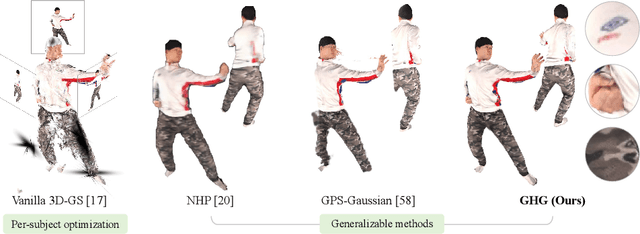

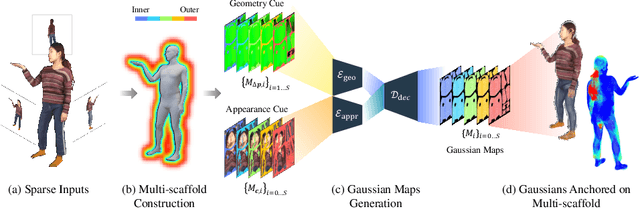
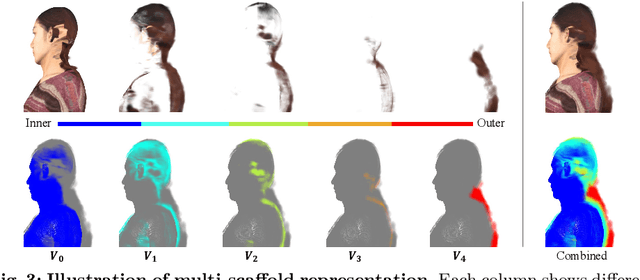
Recent progress in neural rendering has brought forth pioneering methods, such as NeRF and Gaussian Splatting, which revolutionize view rendering across various domains like AR/VR, gaming, and content creation. While these methods excel at interpolating {\em within the training data}, the challenge of generalizing to new scenes and objects from very sparse views persists. Specifically, modeling 3D humans from sparse views presents formidable hurdles due to the inherent complexity of human geometry, resulting in inaccurate reconstructions of geometry and textures. To tackle this challenge, this paper leverages recent advancements in Gaussian Splatting and introduces a new method to learn generalizable human Gaussians that allows photorealistic and accurate view-rendering of a new human subject from a limited set of sparse views in a feed-forward manner. A pivotal innovation of our approach involves reformulating the learning of 3D Gaussian parameters into a regression process defined on the 2D UV space of a human template, which allows leveraging the strong geometry prior and the advantages of 2D convolutions. In addition, a multi-scaffold is proposed to effectively represent the offset details. Our method outperforms recent methods on both within-dataset generalization as well as cross-dataset generalization settings.
DELIFFAS: Deformable Light Fields for Fast Avatar Synthesis
Oct 17, 2023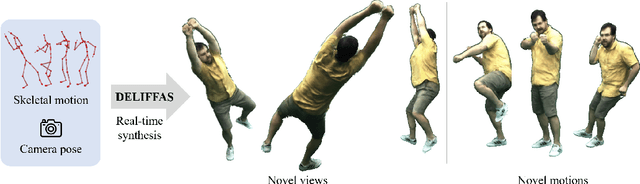
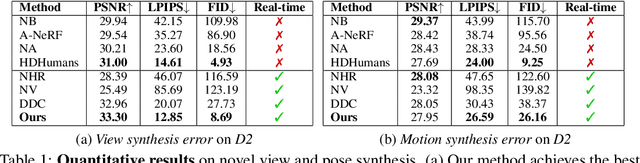
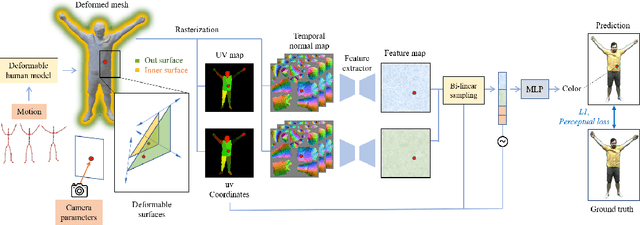
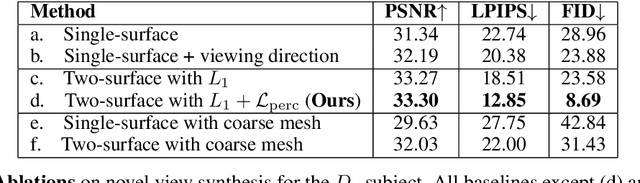
Generating controllable and photorealistic digital human avatars is a long-standing and important problem in Vision and Graphics. Recent methods have shown great progress in terms of either photorealism or inference speed while the combination of the two desired properties still remains unsolved. To this end, we propose a novel method, called DELIFFAS, which parameterizes the appearance of the human as a surface light field that is attached to a controllable and deforming human mesh model. At the core, we represent the light field around the human with a deformable two-surface parameterization, which enables fast and accurate inference of the human appearance. This allows perceptual supervision on the full image compared to previous approaches that could only supervise individual pixels or small patches due to their slow runtime. Our carefully designed human representation and supervision strategy leads to state-of-the-art synthesis results and inference time. The video results and code are available at https://vcai.mpi-inf.mpg.de/projects/DELIFFAS.
Neural Image-based Avatars: Generalizable Radiance Fields for Human Avatar Modeling
Apr 10, 2023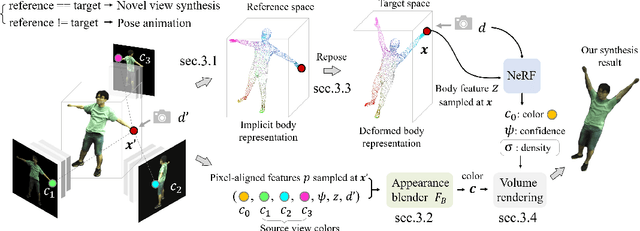
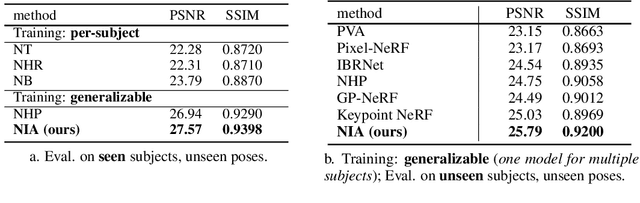
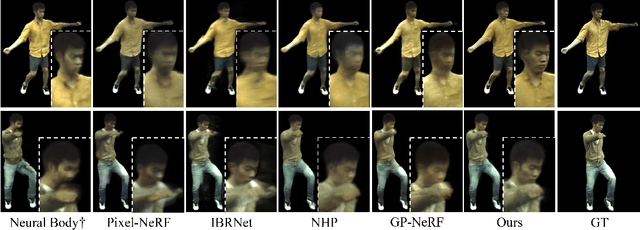

We present a method that enables synthesizing novel views and novel poses of arbitrary human performers from sparse multi-view images. A key ingredient of our method is a hybrid appearance blending module that combines the advantages of the implicit body NeRF representation and image-based rendering. Existing generalizable human NeRF methods that are conditioned on the body model have shown robustness against the geometric variation of arbitrary human performers. Yet they often exhibit blurry results when generalized onto unseen identities. Meanwhile, image-based rendering shows high-quality results when sufficient observations are available, whereas it suffers artifacts in sparse-view settings. We propose Neural Image-based Avatars (NIA) that exploits the best of those two methods: to maintain robustness under new articulations and self-occlusions while directly leveraging the available (sparse) source view colors to preserve appearance details of new subject identities. Our hybrid design outperforms recent methods on both in-domain identity generalization as well as challenging cross-dataset generalization settings. Also, in terms of the pose generalization, our method outperforms even the per-subject optimized animatable NeRF methods. The video results are available at https://youngjoongunc.github.io/nia