 Add to Chrome
 Add to Firefox
 Add to Edge
Metric--Phase Fields: Decoupling Distance and Sign for Thin-Structure Reconstruction from Unoriented Point Clouds
May 25, 2026
Neural Signed Distance Functions (SDFs) excel at reconstructing watertight manifolds but fail on thin structures and open boundaries due to strict inside--outside constraints. Conversely, Unsigned Distance Fields (UDFs) accommodate general geometries but suffer from gradient singularities at the zero-level set, hindering optimization and extraction. We introduce Metric--Phase Fields (MPFs), a decoupled implicit representation that separates metric proximity from topological phase. Given an unoriented point cloud, MPFs learn (i) an unsigned metric field $r$ and (ii) a smooth phase field $θ$, for which we derive a bounded phase indicator $P=\tanh(βθ)$ that provides soft inside--outside cues where they are meaningful. We couple the two fields via a gated-metric formulation with a residual phase injection to obtain a signed implicit function with stable near-surface gradients. The phase coefficient $β$ is learnable, allowing MPFs to adaptively control the sharpness of the phase transition and the degree of saturation of the soft sign indicator. Experiments on both synthetic and scanned thin-shell and thin-plate shapes demonstrate that MPFs preserve thin and layered structures more faithfully than recent SDF-based methods, while also enabling more robust training and more reliable surface extraction than UDF-based approaches. Check out \href{https://github.com/JIAYI-Scarlett/ICML2026-MPF}{MPFs-GitHub} for source code and test models.

Voronoi-Assisted Diffusion for Computing Unsigned Distance Fields from Unoriented Points
Oct 14, 2025Unsigned Distance Fields (UDFs) provide a flexible representation for 3D shapes with arbitrary topology, including open and closed surfaces, orientable and non-orientable geometries, and non-manifold structures. While recent neural approaches have shown promise in learning UDFs, they often suffer from numerical instability, high computational cost, and limited controllability. We present a lightweight, network-free method, Voronoi-Assisted Diffusion (VAD), for computing UDFs directly from unoriented point clouds. Our approach begins by assigning bi-directional normals to input points, guided by two Voronoi-based geometric criteria encoded in an energy function for optimal alignment. The aligned normals are then diffused to form an approximate UDF gradient field, which is subsequently integrated to recover the final UDF. Experiments demonstrate that VAD robustly handles watertight and open surfaces, as well as complex non-manifold and non-orientable geometries, while remaining computationally efficient and stable.
Quasi-Medial Distance Field (Q-MDF): A Robust Method for Approximating and Discretizing Neural Medial Axis
Oct 23, 2024The medial axis, a lower-dimensional shape descriptor, plays an important role in the field of digital geometry processing. Despite its importance, robust computation of the medial axis transform from diverse inputs, especially point clouds with defects, remains a significant challenge. In this paper, we tackle the challenge by proposing a new implicit method that diverges from mainstream explicit medial axis computation techniques. Our key technical insight is the difference between the signed distance field (SDF) and the medial field (MF) of a solid shape is the unsigned distance field (UDF) of the shape's medial axis. This allows for formulating medial axis computation as an implicit reconstruction problem. Utilizing a modified double covering method, we extract the medial axis as the zero level-set of the UDF. Extensive experiments show that our method has enhanced accuracy and robustness in learning compact medial axis transform from thorny meshes and point clouds compared to existing methods.
Topological Feature Search Method for Multichannel EEG: Application in ADHD classification
Apr 10, 2024
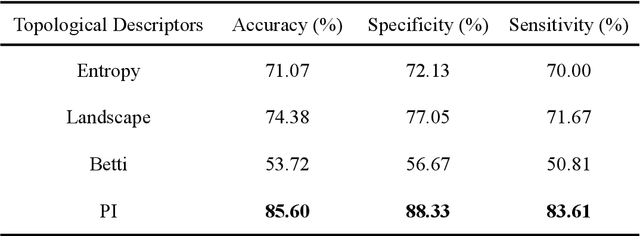
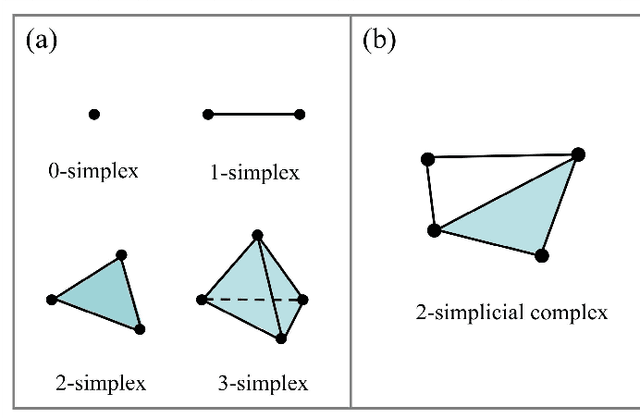
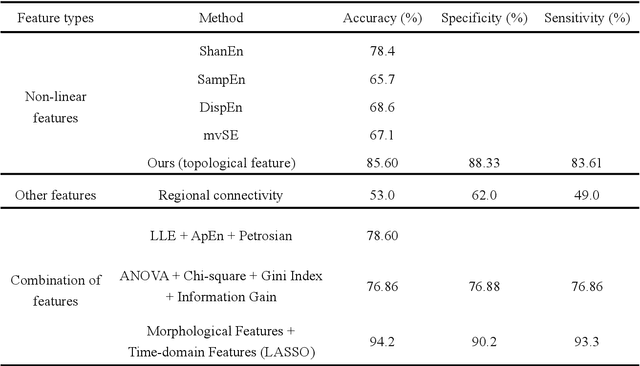
In recent years, the preliminary diagnosis of Attention Deficit Hyperactivity Disorder (ADHD) using electroencephalography (EEG) has garnered attention from researchers. EEG, known for its expediency and efficiency, plays a pivotal role in the diagnosis and treatment of ADHD. However, the non-stationarity of EEG signals and inter-subject variability pose challenges to the diagnostic and classification processes. Topological Data Analysis (TDA) offers a novel perspective for ADHD classification, diverging from traditional time-frequency domain features. Yet, conventional TDA models are restricted to single-channel time series and are susceptible to noise, leading to the loss of topological features in persistence diagrams.This paper presents an enhanced TDA approach applicable to multi-channel EEG in ADHD. Initially, optimal input parameters for multi-channel EEG are determined. Subsequently, each channel's EEG undergoes phase space reconstruction (PSR) followed by the utilization of k-Power Distance to Measure (k-PDTM) for approximating ideal point clouds. Then, multi-dimensional time series are re-embedded, and TDA is applied to obtain topological feature information. Gaussian function-based Multivariate Kernel Density Estimation (MKDE) is employed in the merger persistence diagram to filter out desired topological feature mappings. Finally, persistence image (PI) method is utilized to extract topological features, and the influence of various weighting functions on the results is discussed.The effectiveness of our method is evaluated using the IEEE ADHD dataset. Results demonstrate that the accuracy, sensitivity, and specificity reach 85.60%, 83.61%, and 88.33%, respectively. Compared to traditional TDA methods, our method was effectively improved and outperforms typical nonlinear descriptors. These findings indicate that our method exhibits higher precision and robustness.