 Add to Chrome
 Add to Firefox
 Add to Edge
BrepGaussian: CAD reconstruction from Multi-View Images with Gaussian Splatting
Feb 24, 2026
The boundary representation (B-rep) models a 3D solid as its explicit boundaries: trimmed corners, edges, and faces. Recovering B-rep representation from unstructured data is a challenging and valuable task of computer vision and graphics. Recent advances in deep learning have greatly improved the recovery of 3D shape geometry, but still depend on dense and clean point clouds and struggle to generalize to novel shapes. We propose B-rep Gaussian Splatting (BrepGaussian), a novel framework that learns 3D parametric representations from 2D images. We employ a Gaussian Splatting renderer with learnable features, followed by a specific fitting strategy. To disentangle geometry reconstruction and feature learning, we introduce a two-stage learning framework that first captures geometry and edges and then refines patch features to achieve clean geometry and coherent instance representations. Extensive experiments demonstrate the superior performance of our approach to state-of-the-art methods. We will release our code and datasets upon acceptance.

LoG3D: Ultra-High-Resolution 3D Shape Modeling via Local-to-Global Partitioning
Nov 18, 2025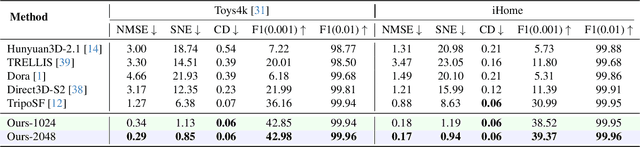
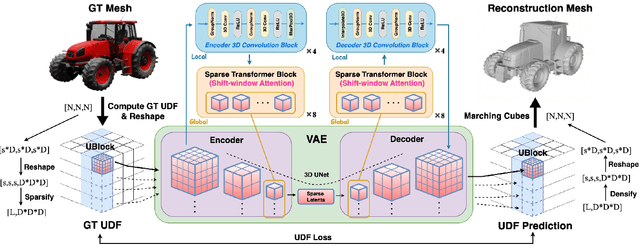
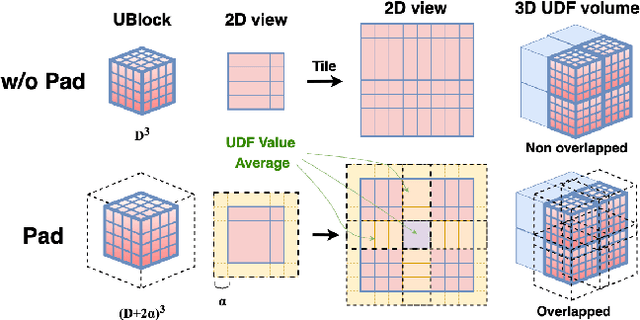
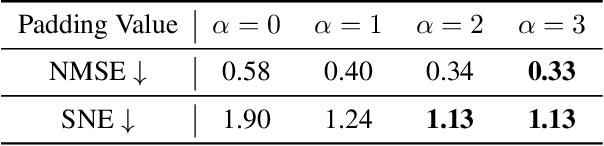
Generating high-fidelity 3D contents remains a fundamental challenge due to the complexity of representing arbitrary topologies-such as open surfaces and intricate internal structures-while preserving geometric details. Prevailing methods based on signed distance fields (SDFs) are hampered by costly watertight preprocessing and struggle with non-manifold geometries, while point-cloud representations often suffer from sampling artifacts and surface discontinuities. To overcome these limitations, we propose a novel 3D variational autoencoder (VAE) framework built upon unsigned distance fields (UDFs)-a more robust and computationally efficient representation that naturally handles complex and incomplete shapes. Our core innovation is a local-to-global (LoG) architecture that processes the UDF by partitioning it into uniform subvolumes, termed UBlocks. This architecture couples 3D convolutions for capturing local detail with sparse transformers for enforcing global coherence. A Pad-Average strategy further ensures smooth transitions at subvolume boundaries during reconstruction. This modular design enables seamless scaling to ultra-high resolutions up to $2048^3$-a regime previously unattainable for 3D VAEs. Experiments demonstrate state-of-the-art performance in both reconstruction accuracy and generative quality, yielding superior surface smoothness and geometric flexibility.