 Add to Chrome
 Add to Firefox
 Add to Edge
RiskFlow: Fast and Faithful Safety-Critical Traffic Scenario Generation
Jun 04, 2026
Safety-critical traffic scenario generation is essential for evaluating autonomous driving systems under rare but high-risk interactions. Existing diffusion-based methods offer strong controllability in closed-loop generation, but their iterative denoising process is computationally expensive and may accumulate sampling and guidance errors over long rollouts, causing unrealistic motion artifacts such as jitter, abnormal acceleration, and off-road behavior. To address these issues, we propose RiskFlow, a closed-loop safety-critical multi-agent traffic generation framework that formulates future trajectory generation as transport in the action space. Instead of relying on iterative denoising, RiskFlow learns an average velocity field over a finite interval to transform Gaussian action sequences into future acceleration and yaw-rate commands with a single forward pass, using a JVP-based objective for efficient and stable training. At test time, RiskFlow applies output-space guidance to the generated actions, steering selected critical agents toward risky interactions while regularizing off-road behavior, and reconstructs physically feasible trajectories through vehicle dynamics. Experiments on nuScenes with tbsim closed-loop evaluation show that RiskFlow achieves a strong adversariality-realism trade-off across multi-agent and long-horizon settings. Compared with representative baselines, RiskFlow consistently improves realism while maintaining competitive safety-critical generation capability, and substantially reduces inference time for evaluation.

Prune-Quantize-Distill: An Ordered Pipeline for Efficient Neural Network Compression
Apr 05, 2026Modern deployment often requires trading accuracy for efficiency under tight CPU and memory constraints, yet common compression proxies such as parameter count or FLOPs do not reliably predict wall-clock inference time. In particular, unstructured sparsity can reduce model storage while failing to accelerate (and sometimes slightly slowing down) standard CPU execution due to irregular memory access and sparse kernel overhead. Motivated by this gap between compression and acceleration, we study a practical, ordered pipeline that targets measured latency by combining three widely used techniques: unstructured pruning, INT8 quantization-aware training (QAT), and knowledge distillation (KD). Empirically, INT8 QAT provides the dominant runtime benefit, while pruning mainly acts as a capacity-reduction pre-conditioner that improves the robustness of subsequent low-precision optimization; KD, applied last, recovers accuracy within the already constrained sparse INT8 regime without changing the deployment form. We evaluate on CIFAR-10/100 using three backbones (ResNet-18, WRN-28-10, and VGG-16-BN). Across all settings, the ordered pipeline achieves a stronger accuracy-size-latency frontier than any single technique alone, reaching 0.99-1.42 ms CPU latency with competitive accuracy and compact checkpoints. Controlled ordering ablations with a fixed 20/40/40 epoch allocation further confirm that stage order is consequential, with the proposed ordering generally performing best among the tested permutations. Overall, our results provide a simple guideline for edge deployment: evaluate compression choices in the joint accuracy-size-latency space using measured runtime, rather than proxy metrics alone.
Cognitive Agency Surrender: Defending Epistemic Sovereignty via Scaffolded AI Friction
Mar 23, 2026The proliferation of Generative Artificial Intelligence has transformed benign cognitive offloading into a systemic risk of cognitive agency surrender. Driven by the commercial dogma of "zero-friction" design, highly fluent AI interfaces actively exploit human cognitive miserliness, prematurely satisfying the need for cognitive closure and inducing severe automation bias. To empirically quantify this epistemic erosion, we deployed a zero-shot semantic classification pipeline ($τ=0.7$) on 1,223 high-confidence AI-HCI papers from 2023 to early 2026. Our analysis reveals an escalating "agentic takeover": a brief 2025 surge in research defending human epistemic sovereignty (19.1%) was abruptly suppressed in early 2026 (13.1%) by an explosive shift toward optimizing autonomous machine agents (19.6%), while frictionless usability maintained a structural hegemony (67.3%). To dismantle this trap, we theorize "Scaffolded Cognitive Friction," repurposing Multi-Agent Systems (MAS) as explicit cognitive forcing functions (e.g., computational Devil's Advocates) to inject germane epistemic tension and disrupt heuristic execution. Furthermore, we outline a multimodal computational phenotyping agenda -- integrating gaze transition entropy, task-evoked pupillometry, fNIRS, and Hierarchical Drift Diffusion Modeling (HDDM) -- to mathematically decouple decision outcomes from cognitive effort. Ultimately, intentionally designed friction is not merely a psychological intervention, but a foundational technical prerequisite for enforcing global AI governance and preserving societal cognitive resilience.
SkyReels-V4: Multi-modal Video-Audio Generation, Inpainting and Editing model
Feb 26, 2026SkyReels V4 is a unified multi modal video foundation model for joint video audio generation, inpainting, and editing. The model adopts a dual stream Multimodal Diffusion Transformer (MMDiT) architecture, where one branch synthesizes video and the other generates temporally aligned audio, while sharing a powerful text encoder based on the Multimodal Large Language Models (MMLM). SkyReels V4 accepts rich multi modal instructions, including text, images, video clips, masks, and audio references. By combining the MMLMs multi modal instruction following capability with in context learning in the video branch MMDiT, the model can inject fine grained visual guidance under complex conditioning, while the audio branch MMDiT simultaneously leverages audio references to guide sound generation. On the video side, we adopt a channel concatenation formulation that unifies a wide range of inpainting style tasks, such as image to video, video extension, and video editing under a single interface, and naturally extends to vision referenced inpainting and editing via multi modal prompts. SkyReels V4 supports up to 1080p resolution, 32 FPS, and 15 second duration, enabling high fidelity, multi shot, cinema level video generation with synchronized audio. To make such high resolution, long-duration generation computationally feasible, we introduce an efficiency strategy: Joint generation of low resolution full sequences and high-resolution keyframes, followed by dedicated super-resolution and frame interpolation models. To our knowledge, SkyReels V4 is the first video foundation model that simultaneously supports multi-modal input, joint video audio generation, and a unified treatment of generation, inpainting, and editing, while maintaining strong efficiency and quality at cinematic resolutions and durations.
From Pixels to Policies: Reinforcing Spatial Reasoning in Language Models for Content-Aware Layout Design
Feb 14, 2026We introduce LaySPA, a reinforcement learning framework that equips large language models (LLMs) with explicit and interpretable spatial reasoning for content-aware graphic layout design. LaySPA addresses two key challenges: LLMs' limited spatial reasoning and the lack of opacity in design decision making. Instead of operating at the pixel level, we reformulate layout design as a policy learning problem over a structured textual spatial environment that explicitly encodes canvas geometry, element attributes, and inter-element relationships. LaySPA produces dual-level outputs comprising interpretable reasoning traces and structured layout specifications, enabling transparent and controllable design decision making. Layout design policy is optimized via a multi-objective spatial critique that decomposes layout quality into geometric validity, relational coherence, and aesthetic consistency, and is trained using relative group optimization to stabilize learning in open-ended design spaces. Experiments demonstrate that LaySPA improves structural validity and visual quality, outperforming larger proprietary LLMs and achieving performance comparable to specialized SOTA layout generators while requiring fewer annotated samples and reduced latency.
Improved Approximate Regret for Decentralized Online Continuous Submodular Maximization via Reductions
Feb 10, 2026To expand the applicability of decentralized online learning, previous studies have proposed several algorithms for decentralized online continuous submodular maximization (D-OCSM) -- a non-convex/non-concave setting with continuous DR-submodular reward functions. However, there exist large gaps between their approximate regret bounds and the regret bounds achieved in the convex setting. Moreover, if focusing on projection-free algorithms, which can efficiently handle complex decision sets, they cannot even recover the approximate regret bounds achieved in the centralized setting. In this paper, we first demonstrate that for D-OCSM over general convex decision sets, these two issues can be addressed simultaneously. Furthermore, for D-OCSM over downward-closed decision sets, we show that the second issue can be addressed while significantly alleviating the first issue. Our key techniques are two reductions from D-OCSM to decentralized online convex optimization (D-OCO), which can exploit D-OCO algorithms to improve the approximate regret of D-OCSM in these two cases, respectively.
Proc3D: Procedural 3D Generation and Parametric Editing of 3D Shapes with Large Language Models
Jan 18, 2026Generating 3D models has traditionally been a complex task requiring specialized expertise. While recent advances in generative AI have sought to automate this process, existing methods produce non-editable representation, such as meshes or point clouds, limiting their adaptability for iterative design. In this paper, we introduce Proc3D, a system designed to generate editable 3D models while enabling real-time modifications. At its core, Proc3D introduces procedural compact graph (PCG), a graph representation of 3D models, that encodes the algorithmic rules and structures necessary for generating the model. This representation exposes key parameters, allowing intuitive manual adjustments via sliders and checkboxes, as well as real-time, automated modifications through natural language prompts using Large Language Models (LLMs). We demonstrate Proc3D's capabilities using two generative approaches: GPT-4o with in-context learning (ICL) and a fine-tuned LLAMA-3 model. Experimental results show that Proc3D outperforms existing methods in editing efficiency, achieving more than 400x speedup over conventional approaches that require full regeneration for each modification. Additionally, Proc3D improves ULIP scores by 28%, a metric that evaluates the alignment between generated 3D models and text prompts. By enabling text-aligned 3D model generation along with precise, real-time parametric edits, Proc3D facilitates highly accurate text-based image editing applications.
PRISM: Learning Design Knowledge from Data for Stylistic Design Improvement
Jan 16, 2026Graphic design often involves exploring different stylistic directions, which can be time-consuming for non-experts. We address this problem of stylistically improving designs based on natural language instructions. While VLMs have shown initial success in graphic design, their pretrained knowledge on styles is often too general and misaligned with specific domain data. For example, VLMs may associate minimalism with abstract designs, whereas designers emphasize shape and color choices. Our key insight is to leverage design data -- a collection of real-world designs that implicitly capture designer's principles -- to learn design knowledge and guide stylistic improvement. We propose PRISM (PRior-Informed Stylistic Modification) that constructs and applies a design knowledge base through three stages: (1) clustering high-variance designs to capture diversity within a style, (2) summarizing each cluster into actionable design knowledge, and (3) retrieving relevant knowledge during inference to enable style-aware improvement. Experiments on the Crello dataset show that PRISM achieves the highest average rank of 1.49 (closer to 1 is better) over baselines in style alignment. User studies further validate these results, showing that PRISM is consistently preferred by designers.
Shape My Moves: Text-Driven Shape-Aware Synthesis of Human Motions
Apr 04, 2025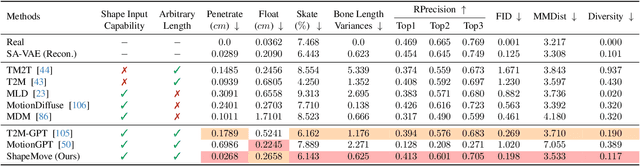
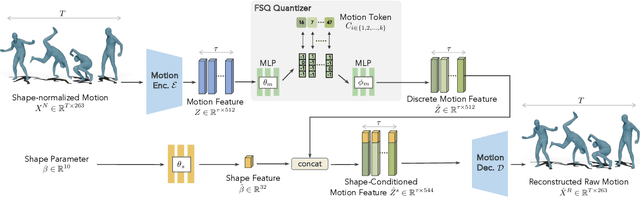
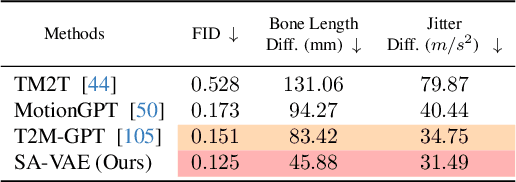
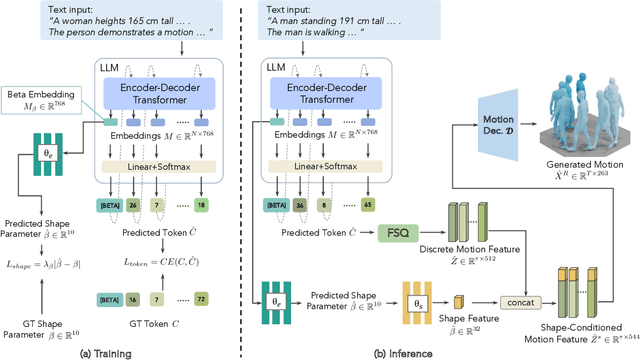
We explore how body shapes influence human motion synthesis, an aspect often overlooked in existing text-to-motion generation methods due to the ease of learning a homogenized, canonical body shape. However, this homogenization can distort the natural correlations between different body shapes and their motion dynamics. Our method addresses this gap by generating body-shape-aware human motions from natural language prompts. We utilize a finite scalar quantization-based variational autoencoder (FSQ-VAE) to quantize motion into discrete tokens and then leverage continuous body shape information to de-quantize these tokens back into continuous, detailed motion. Additionally, we harness the capabilities of a pretrained language model to predict both continuous shape parameters and motion tokens, facilitating the synthesis of text-aligned motions and decoding them into shape-aware motions. We evaluate our method quantitatively and qualitatively, and also conduct a comprehensive perceptual study to demonstrate its efficacy in generating shape-aware motions.
ScreenLLM: Stateful Screen Schema for Efficient Action Understanding and Prediction
Mar 26, 2025Graphical User Interface (GUI) agents are autonomous systems that interpret and generate actions, enabling intelligent user assistance and automation. Effective training of these agent presents unique challenges, such as sparsity in supervision signals, scalability for large datasets, and the need for nuanced user understanding. We propose stateful screen schema, an efficient representation of GUI interactions that captures key user actions and intentions over time. Building on this foundation, we introduce ScreenLLM, a set of multimodal large language models (MLLMs) tailored for advanced UI understanding and action prediction. Extensive experiments on both open-source and proprietary models show that ScreenLLM accurately models user behavior and predicts actions. Our work lays the foundation for scalable, robust, and intelligent GUI agents that enhance user interaction in diverse software environments.