 Add to Chrome
 Add to Firefox
 Add to Edge
Music Quality Assessment
Papers and Code
SoulX-Singer: Towards High-Quality Zero-Shot Singing Voice Synthesis
Feb 08, 2026
While recent years have witnessed rapid progress in speech synthesis, open-source singing voice synthesis (SVS) systems still face significant barriers to industrial deployment, particularly in terms of robustness and zero-shot generalization. In this report, we introduce SoulX-Singer, a high-quality open-source SVS system designed with practical deployment considerations in mind. SoulX-Singer supports controllable singing generation conditioned on either symbolic musical scores (MIDI) or melodic representations, enabling flexible and expressive control in real-world production workflows. Trained on more than 42,000 hours of vocal data, the system supports Mandarin Chinese, English, and Cantonese and consistently achieves state-of-the-art synthesis quality across languages under diverse musical conditions. Furthermore, to enable reliable evaluation of zero-shot SVS performance in practical scenarios, we construct SoulX-Singer-Eval, a dedicated benchmark with strict training-test disentanglement, facilitating systematic assessment in zero-shot settings.

When Noise Lowers The Loss: Rethinking Likelihood-Based Evaluation in Music Large Language Models
Feb 02, 2026The rise of music large language models (LLMs) demands robust methods of evaluating output quality, especially in distinguishing high-quality compositions from "garbage music". Curiously, we observe that the standard cross-entropy loss -- a core training metric -- often decrease when models encounter systematically corrupted music, undermining its validity as a standalone quality indicator. To investigate this paradox, we introduce noise injection experiment, where controlled noise signal of varying lengths are injected into musical contexts. We hypothesize that a model's loss reacting positively to these perturbations, specifically a sharp increase ("Peak" area) for short injection, can serve as a proxy for its ability to discern musical integrity. Experiments with MusicGen models in the audio waveform domain confirm that Music LLMs respond more strongly to local, texture-level disruptions than to global semantic corruption. Beyond exposing this bias, our results highlight a new principle: the shape of the loss curve -- rather than its absolute value -- encodes critical information about the quality of the generated content (i.e., model behavior). We envision this profile-based evaluation as a label-free, model-intrinsic framework for assessing musical quality -- opening the door to more principled training objectives and sharper benchmarks.
PhyAVBench: A Challenging Audio Physics-Sensitivity Benchmark for Physically Grounded Text-to-Audio-Video Generation
Dec 30, 2025Text-to-audio-video (T2AV) generation underpins a wide range of applications demanding realistic audio-visual content, including virtual reality, world modeling, gaming, and filmmaking. However, existing T2AV models remain incapable of generating physically plausible sounds, primarily due to their limited understanding of physical principles. To situate current research progress, we present PhyAVBench, a challenging audio physics-sensitivity benchmark designed to systematically evaluate the audio physics grounding capabilities of existing T2AV models. PhyAVBench comprises 1,000 groups of paired text prompts with controlled physical variables that implicitly induce sound variations, enabling a fine-grained assessment of models' sensitivity to changes in underlying acoustic conditions. We term this evaluation paradigm the Audio-Physics Sensitivity Test (APST). Unlike prior benchmarks that primarily focus on audio-video synchronization, PhyAVBench explicitly evaluates models' understanding of the physical mechanisms underlying sound generation, covering 6 major audio physics dimensions, 4 daily scenarios (music, sound effects, speech, and their mix), and 50 fine-grained test points, ranging from fundamental aspects such as sound diffraction to more complex phenomena, e.g., Helmholtz resonance. Each test point consists of multiple groups of paired prompts, where each prompt is grounded by at least 20 newly recorded or collected real-world videos, thereby minimizing the risk of data leakage during model pre-training. Both prompts and videos are iteratively refined through rigorous human-involved error correction and quality control to ensure high quality. We argue that only models with a genuine grasp of audio-related physical principles can generate physically consistent audio-visual content. We hope PhyAVBench will stimulate future progress in this critical yet largely unexplored domain.
Quality-Aware Framework for Video-Derived Respiratory Signals
Dec 16, 2025
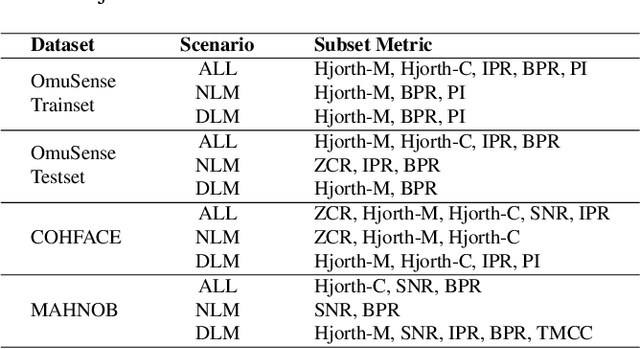
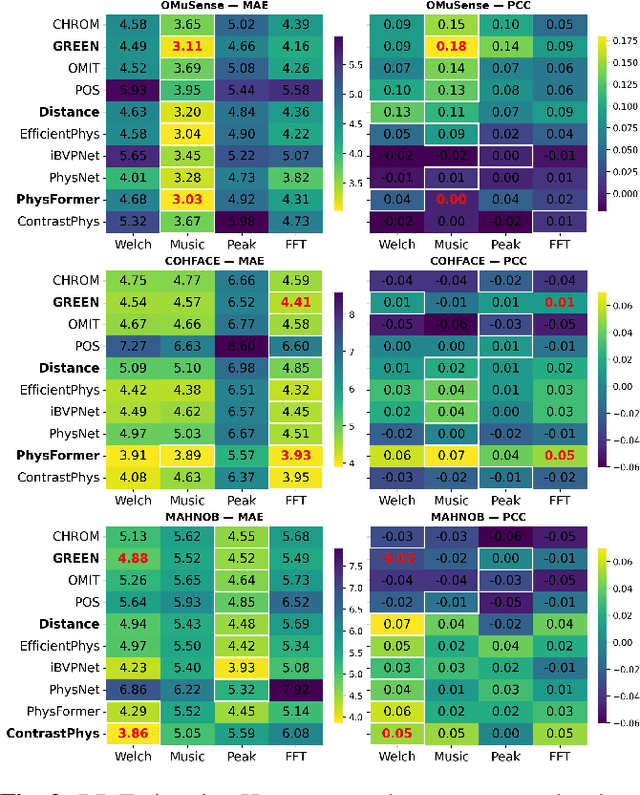
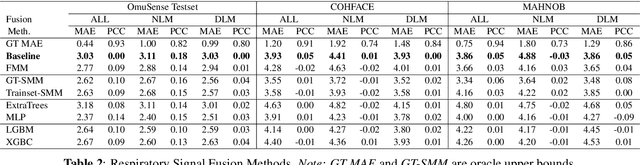
Video-based respiratory rate (RR) estimation is often unreliable due to inconsistent signal quality across extraction methods. We present a predictive, quality-aware framework that integrates heterogeneous signal sources with dynamic assessment of reliability. Ten signals are extracted from facial remote photoplethysmography (rPPG), upper-body motion, and deep learning pipelines, and analyzed using four spectral estimators: Welch's method, Multiple Signal Classification (MUSIC), Fast Fourier Transform (FFT), and peak detection. Segment-level quality indices are then used to train machine learning models that predict accuracy or select the most reliable signal. This enables adaptive signal fusion and quality-based segment filtering. Experiments on three public datasets (OMuSense-23, COHFACE, MAHNOB-HCI) show that the proposed framework achieves lower RR estimation errors than individual methods in most cases, with performance gains depending on dataset characteristics. These findings highlight the potential of quality-driven predictive modeling to deliver scalable and generalizable video-based respiratory monitoring solutions.
VABench: A Comprehensive Benchmark for Audio-Video Generation
Dec 10, 2025Recent advances in video generation have been remarkable, enabling models to produce visually compelling videos with synchronized audio. While existing video generation benchmarks provide comprehensive metrics for visual quality, they lack convincing evaluations for audio-video generation, especially for models aiming to generate synchronized audio-video outputs. To address this gap, we introduce VABench, a comprehensive and multi-dimensional benchmark framework designed to systematically evaluate the capabilities of synchronous audio-video generation. VABench encompasses three primary task types: text-to-audio-video (T2AV), image-to-audio-video (I2AV), and stereo audio-video generation. It further establishes two major evaluation modules covering 15 dimensions. These dimensions specifically assess pairwise similarities (text-video, text-audio, video-audio), audio-video synchronization, lip-speech consistency, and carefully curated audio and video question-answering (QA) pairs, among others. Furthermore, VABench covers seven major content categories: animals, human sounds, music, environmental sounds, synchronous physical sounds, complex scenes, and virtual worlds. We provide a systematic analysis and visualization of the evaluation results, aiming to establish a new standard for assessing video generation models with synchronous audio capabilities and to promote the comprehensive advancement of the field.
Aligning Generative Music AI with Human Preferences: Methods and Challenges
Nov 19, 2025Recent advances in generative AI for music have achieved remarkable fidelity and stylistic diversity, yet these systems often fail to align with nuanced human preferences due to the specific loss functions they use. This paper advocates for the systematic application of preference alignment techniques to music generation, addressing the fundamental gap between computational optimization and human musical appreciation. Drawing on recent breakthroughs including MusicRL's large-scale preference learning, multi-preference alignment frameworks like diffusion-based preference optimization in DiffRhythm+, and inference-time optimization techniques like Text2midi-InferAlign, we discuss how these techniques can address music's unique challenges: temporal coherence, harmonic consistency, and subjective quality assessment. We identify key research challenges including scalability to long-form compositions, reliability amongst others in preference modelling. Looking forward, we envision preference-aligned music generation enabling transformative applications in interactive composition tools and personalized music services. This work calls for sustained interdisciplinary research combining advances in machine learning, music-theory to create music AI systems that truly serve human creative and experiential needs.
MuCPT: Music-related Natural Language Model Continued Pretraining
Nov 18, 2025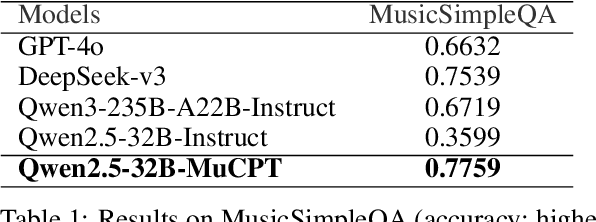
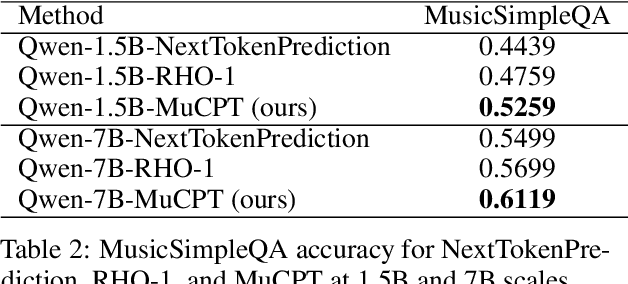
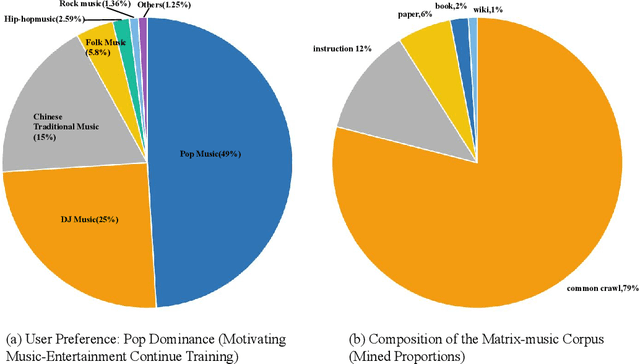
Large language models perform strongly on general tasks but remain constrained in specialized settings such as music, particularly in the music-entertainment domain, where corpus scale, purity, and the match between data and training objectives are critical. We address this by constructing a large, music-related natural language corpus (40B tokens) that combines open source and in-house data, and by implementing a domain-first data pipeline: a lightweight classifier filters and weights in-domain text, followed by multi-stage cleaning, de-duplication, and privacy-preserving masking. We further integrate multi-source music text with associated metadata to form a broader, better-structured foundation of domain knowledge. On the training side, we introduce reference-model (RM)-based token-level soft scoring for quality control: a unified loss-ratio criterion is used both for data selection and for dynamic down-weighting during optimization, reducing noise gradients and amplifying task-aligned signals, thereby enabling more effective music-domain continued pretraining and alignment. To assess factuality, we design the MusicSimpleQA benchmark, which adopts short, single-answer prompts with automated agreement scoring. Beyond the benchmark design, we conduct systematic comparisons along the axes of data composition. Overall, this work advances both the right corpus and the right objective, offering a scalable data-training framework and a reusable evaluation tool for building domain LLMs in the music field.
VoiceAssistant-Eval: Benchmarking AI Assistants across Listening, Speaking, and Viewing
Sep 26, 2025The growing capabilities of large language models and multimodal systems have spurred interest in voice-first AI assistants, yet existing benchmarks are inadequate for evaluating the full range of these systems' capabilities. We introduce VoiceAssistant-Eval, a comprehensive benchmark designed to assess AI assistants across listening, speaking, and viewing. VoiceAssistant-Eval comprises 10,497 curated examples spanning 13 task categories. These tasks include natural sounds, music, and spoken dialogue for listening; multi-turn dialogue, role-play imitation, and various scenarios for speaking; and highly heterogeneous images for viewing. To demonstrate its utility, we evaluate 21 open-source models and GPT-4o-Audio, measuring the quality of the response content and speech, as well as their consistency. The results reveal three key findings: (1) proprietary models do not universally outperform open-source models; (2) most models excel at speaking tasks but lag in audio understanding; and (3) well-designed smaller models can rival much larger ones. Notably, the mid-sized Step-Audio-2-mini (7B) achieves more than double the listening accuracy of LLaMA-Omni2-32B-Bilingual. However, challenges remain: multimodal (audio plus visual) input and role-play voice imitation tasks are difficult for current models, and significant gaps persist in robustness and safety alignment. VoiceAssistant-Eval identifies these gaps and establishes a rigorous framework for evaluating and guiding the development of next-generation AI assistants. Code and data will be released at https://mathllm.github.io/VoiceAssistantEval/ .
Improving Perceptual Audio Aesthetic Assessment via Triplet Loss and Self-Supervised Embeddings
Sep 03, 2025We present a system for automatic multi-axis perceptual quality prediction of generative audio, developed for Track 2 of the AudioMOS Challenge 2025. The task is to predict four Audio Aesthetic Scores--Production Quality, Production Complexity, Content Enjoyment, and Content Usefulness--for audio generated by text-to-speech (TTS), text-to-audio (TTA), and text-to-music (TTM) systems. A main challenge is the domain shift between natural training data and synthetic evaluation data. To address this, we combine BEATs, a pretrained transformer-based audio representation model, with a multi-branch long short-term memory (LSTM) predictor and use a triplet loss with buffer-based sampling to structure the embedding space by perceptual similarity. Our results show that this improves embedding discriminability and generalization, enabling domain-robust audio quality assessment without synthetic training data.
QAMRO: Quality-aware Adaptive Margin Ranking Optimization for Human-aligned Assessment of Audio Generation Systems
Aug 12, 2025Evaluating audio generation systems, including text-to-music (TTM), text-to-speech (TTS), and text-to-audio (TTA), remains challenging due to the subjective and multi-dimensional nature of human perception. Existing methods treat mean opinion score (MOS) prediction as a regression problem, but standard regression losses overlook the relativity of perceptual judgments. To address this limitation, we introduce QAMRO, a novel Quality-aware Adaptive Margin Ranking Optimization framework that seamlessly integrates regression objectives from different perspectives, aiming to highlight perceptual differences and prioritize accurate ratings. Our framework leverages pre-trained audio-text models such as CLAP and Audiobox-Aesthetics, and is trained exclusively on the official AudioMOS Challenge 2025 dataset. It demonstrates superior alignment with human evaluations across all dimensions, significantly outperforming robust baseline models.